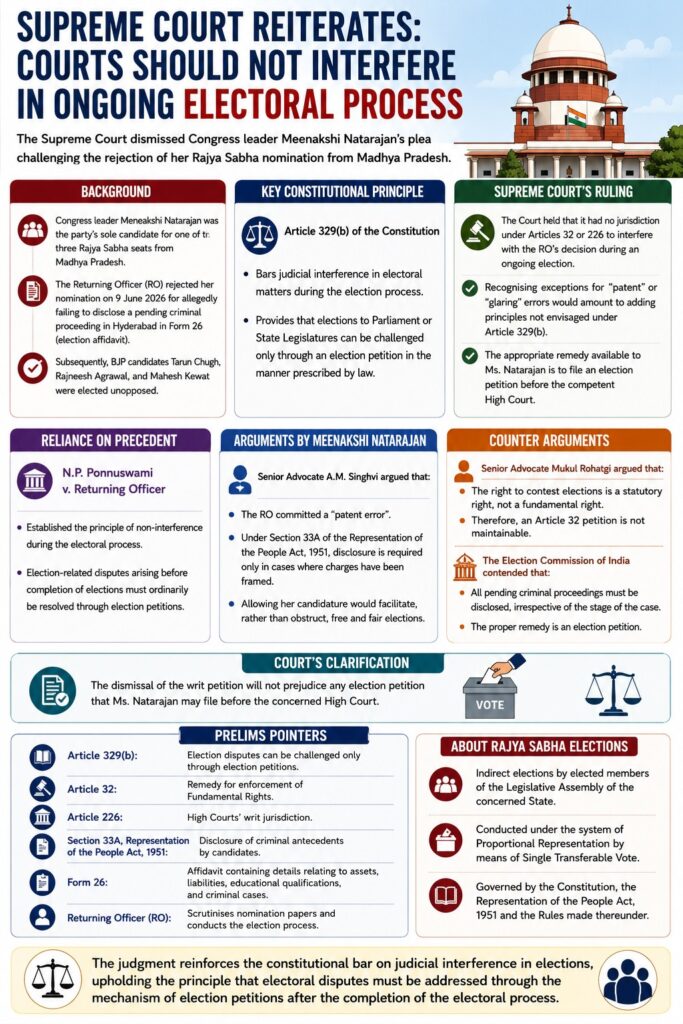
Why in the news?
The Supreme Court dismissed Congress leader Meenakshi Natarajan’s plea challenging the rejection of her Rajya Sabha nomination from Madhya Pradesh, reiterating that courts should not ordinarily interfere in an ongoing electoral process.
Background
- Congress leader Meenakshi Natarajan was the party’s sole candidate for one of the three Rajya Sabha seats from Madhya Pradesh.
- The Returning Officer (RO) rejected her nomination on 9 June 2026 for allegedly failing to disclose a pending criminal proceeding in Hyderabad in Form 26 (election affidavit).
- Subsequently, BJP candidates Tarun Chugh, Rajneesh Agrawal, and Mahesh Kewat were elected unopposed.
Key Constitutional Principle
- Article 329(b) of the Constitution: Bars judicial interference in electoral matters during the election process.
- Provides that elections to Parliament or State Legislatures can be challenged only through an election petition in the manner prescribed by law.
Supreme Court’s Ruling
- The Court held that it had no jurisdiction under Articles 32 or 226 to interfere with the RO’s decision during an ongoing election.
- Recognising exceptions for “patent” or “glaring” errors would amount to adding principles not envisaged under Article 329(b).
- The appropriate remedy available to Ms. Natarajan is to file an election petition before the competent High Court.
Reliance on Precedent
- N.P. Ponnuswami v. Returning Officer: Established the principle of non-interference during the electoral process.
- Election-related disputes arising before completion of elections must ordinarily be resolved through election petitions.
Arguments by Meenakshi Natarajan
- Senior Advocate A.M. Singhvi argued that: The RO committed a “patent error”.
- Under Section 33A of the Representation of the People Act, 1951, disclosure is required only in cases where charges have been framed.
- Allowing her candidature would facilitate, rather than obstruct, free and fair elections.
Counter Arguments
- Senior Advocate Mukul Rohatgi argued that:
- The right to contest elections is a statutory right, not a fundamental right.
- Therefore, an Article 32 petition is not maintainable.
- The Election Commission of India contended that:
- All pending criminal proceedings must be disclosed, irrespective of the stage of the case.
- The proper remedy is an election petition.
Court’s Clarification
- The dismissal of the writ petition will not prejudice any election petition that Ms. Natarajan may file before the concerned High Court.
Prelims Pointers
- Article 329(b): Election disputes can be challenged only through election petitions.
- Article 32: Remedy for enforcement of Fundamental Rights.
- Article 226: High Courts’ writ jurisdiction.
- Section 33A, Representation of the People Act, 1951: Disclosure of criminal antecedents by candidates.
- Form 26: Affidavit containing details relating to assets, liabilities, educational qualifications, and criminal cases.
- Returning Officer (RO): Scrutinises nomination papers and conducts the election process.
