Why in the news?
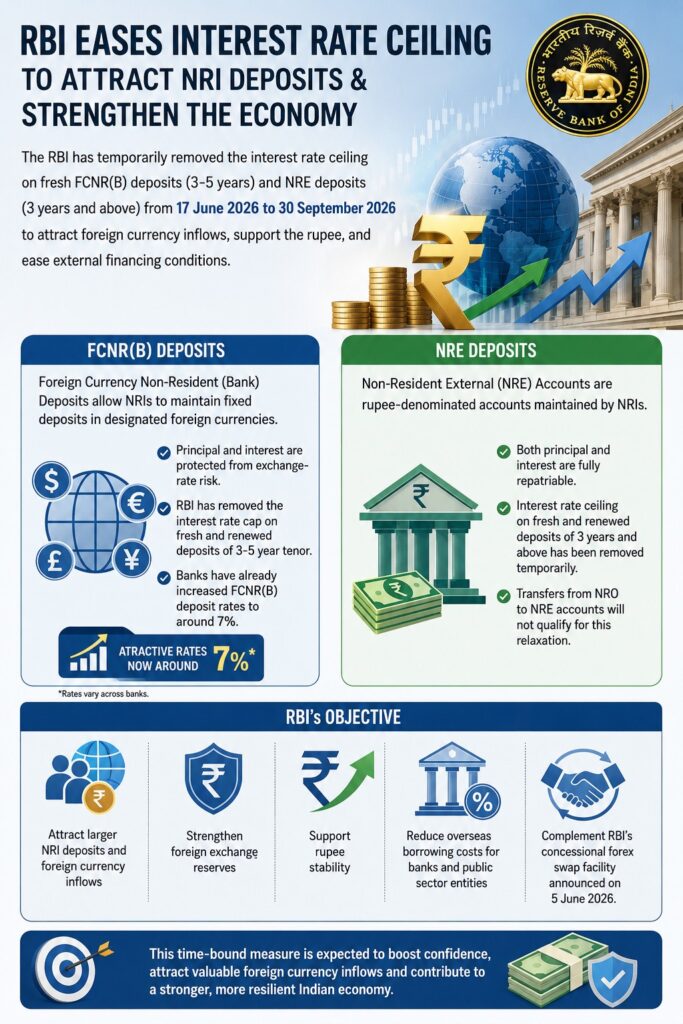
The RBI has temporarily removed the interest rate ceiling on fresh FCNR(B) deposits (3-5 years) and NRE deposits (3 years and above) from 17 June 2026 to 30 September 2026 to attract foreign currency inflows, support the rupee, and ease external financing conditions.
FCNR(B) Deposits
- Foreign Currency Non-Resident (Bank) Deposits allow NRIs to maintain fixed deposits in designated foreign currencies.
- Principal and interest are protected from exchange-rate risk.
- RBI has removed the interest rate cap on fresh and renewed deposits of 3-5 year tenor.
- Banks have already increased FCNR(B) deposit rates to around 7%.
NRE Deposits
- Non-Resident External (NRE) Accounts are rupee-denominated accounts maintained by NRIs.
- Both principal and interest are fully repatriable.
- Interest rate ceiling on fresh and renewed deposits of 3 years and above has been removed temporarily.
- Transfers from NRO to NRE accounts will not qualify for this relaxation.
RBI’s Objective
- Attract larger NRI deposits and foreign currency inflows.
- Strengthen foreign exchange reserves.
- Support rupee stability.
- Reduce overseas borrowing costs for banks and public sector entities.
- Complement RBI’s concessional forex swap facility announced on 5 June 2026.
Expected Impact
- Analysts estimate $30-50 billion of inflows by Q3 FY27.
- Similar FCNR(B) scheme in 2013 attracted nearly $25 billion.
- Increased foreign currency liquidity may ease external sector pressures.
[2021] Consider the following:
1. Foreign currency convertible bonds
2. Foreign institutional investment with certain conditions
3. Global depository receipts
4. Non-resident external deposits
Which of the above can be included in Foreign Direct Investments?
[A] 1, 2 and 3
[B] 3 only
[C] 2 and 4
[D] 1 and 4
