Why in the news?
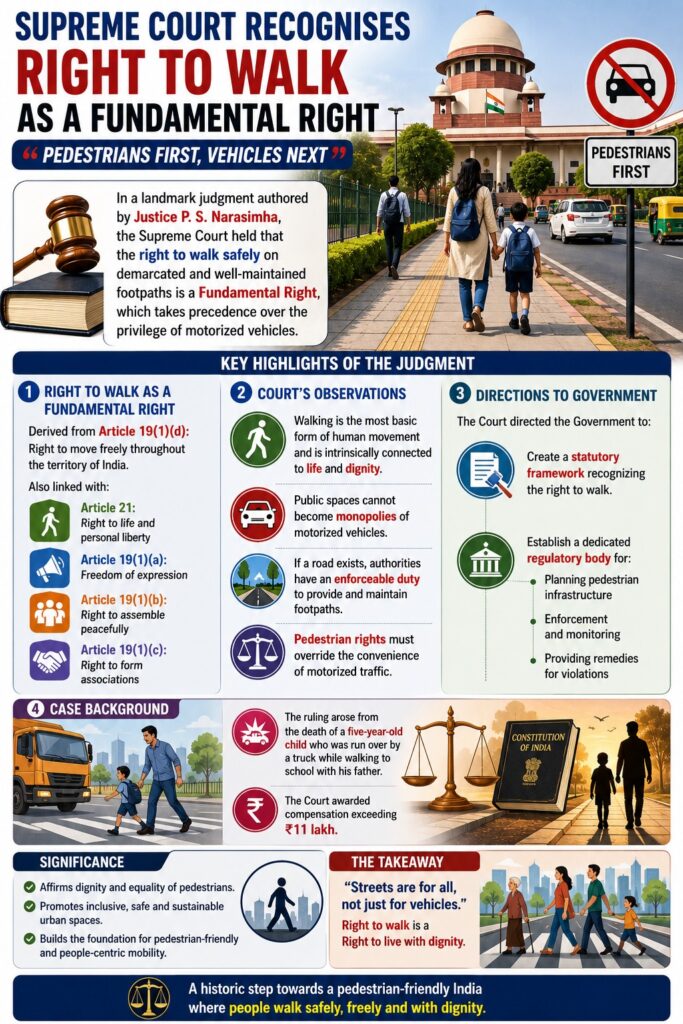
The Supreme Court, in a landmark judgment authored by Justice P. S. Narasimha, held that the right to walk safely on demarcated and well-maintained footpaths is a Fundamental Right, which takes precedence over the privilege of motorized vehicles.
Right to Walk as a Fundamental Right
- Derived from Article 19(1)(d): Right to move freely throughout the territory of India.
- Also linked with:
- Article 21: Right to life and personal liberty.
- Article 19(1)(a): Freedom of expression.
- Article 19(1)(b): Right to assemble peacefully.
- Article 19(1)(c): Right to form associations.
Court’s Observations
- Walking is the most basic form of human movement and is intrinsically connected to life and dignity.
- Public spaces cannot become monopolies of motorized vehicles.
- If a road exists, authorities have an enforceable duty to provide and maintain footpaths.
- Pedestrian rights must override the convenience of motorized traffic.
Directions to Government
- Create a statutory framework recognizing the right to walk.
- Establish a dedicated regulatory body for:
- Planning pedestrian infrastructure.
- Enforcement and monitoring.
- Providing remedies for violations.
- Judgment sent to Ministries of:
- Housing & Urban Affairs
- Rural Development
- Road Transport & Highways
Case Background
- The ruling arose from the death of a five-year-old child who was run over by a truck while walking to school with his father.
- The Court awarded compensation exceeding ₹11 lakh.
[2018] Right to Privacy is protected as an intrinsic part of Right to Life and Personal Liberty. Which of the following in the Constitution of India correctly and appropriately imply the above statement?
(a) Article 14 and the provisions under the 42nd Amendment to the Constitution.
(b) Article 17 and the Directive Principles of State Policy in Part IV.
(c) Article 21 and the freedoms guaranteed in Part III.
(d) Article 24 and the provisions under the 44th Amendment to the Constitution.
