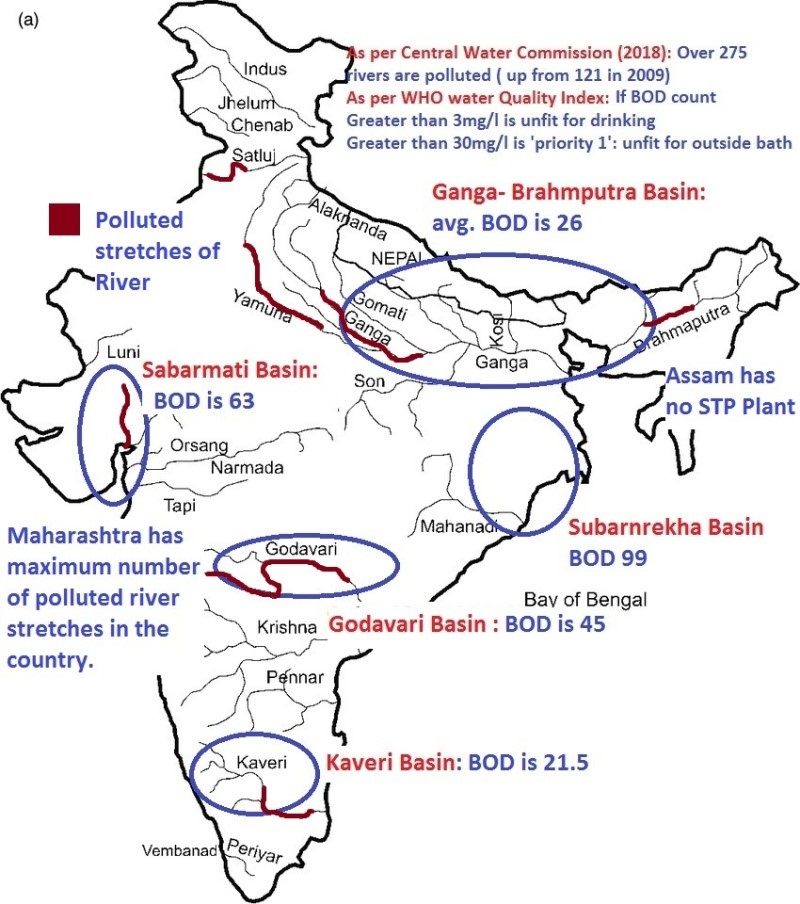
River water pollution as significant environmental issue
Pollution – Eg- 60% of untreated sewage water is released into rivers daily. (CPCB)
Impact on health – diarrhoea, cholera, typhoid and skin infections.
Faecal coliform in Ganga exceeds safe limits by up to 150 times
Marine Ecology – Eg- Eutrophication, algal blooms, and dead zones
Marine Biodiversity – Eg- Bioaccumulation in Fish
Water crisis – Eg- 600 million Indians experience water scarcity. (NITI Aayog)
Mitigation Measures
On-site Effluent Treatment plants for textile and tannery clusters to treat wastewater before discharge
Zero Liquid Discharge (ZLD) technologies. Eg- Mandatory in Tamil Nadu textile units.
Install real-time effluent monitoring sensors in industries for instant alerts to CPCB/SPCBs.
Cleaner Production Technologies – Eg- Green dyeing technologies in Surat textile units.
Polluter-Pays principles – Eg- NGT orders on Yamuna and Musi industries.
Industrial Zoning to restrict polluting industries near rivers. Eg- Ganga floodplain conservation zones.
Create riparian vegetative buffers to filter runoff. Eg- Ganga floodplain conservation zones.
Strengthen Monitoring & Surveillance – Use drones, GIS, river basin audits and citizen reporting tools.
Government Initiatives
Namami Gange Mission – Focus on industrial discharge reduction, and ZLD compliance. Eg- Closure of non-compliant Kanpur tanneries.
The National Water Quality Monitoring Programme of CPCB identifies critically polluted stretches
Environment (Protection) Act – Sets strict industry-specific limits for BOD, COD, heavy metals and toxins.
Water Pollution Act, 1974 – Establishes the CPCB for planning and regulating environmental matters
Yamuna Action Plan to clean the stretch of river Yamuna.
AMRUT & SBM (Urban) Convergence – Expands sewage treatment.
A technology driven and community driven approach is needed to ensure resilient, pollution-free rivers.