According to LS speaker Om Birla, Parliamentary Committees are the “backbone of parliamentary democracy. It is an essential mechanism of legislative oversight, promoting informed, bipartisan, and continuous accountability.
Structure of the Parliamentary Committee System
Standing Committees (Permanent in Nature)-
Department-related Standing Committees (DRSCs) – 24 in number; examine Bills, budgets, and policies of ministries.
Financial Committees – Public Accounts Committee (PAC), Estimates Committee, and Committee on Public Undertakings (COPU).
Housekeeping Committees – e.g., Business Advisory Committee, Committee on Subordinate Legislation, etc.
Ad hoc Committees (Temporary in Nature)- Constituted for specific purposes – e.g., Joint Parliamentary Committee (JPC) on the 2G Spectrum Scam (2011) and Waqf Amendment Bill.
Importance of Parliamentary Committees
Ensuring Fiscal Accountability – Committees like PAC scrutinize CAG reports, ensuring that public funds are used efficiently and lawfully.
Continuous Executive Oversight – They enable ongoing parliamentary supervision over expenditure, even when Parliament is not in session.
Strengthening Audit Mechanism – The PAC’s linkage with CAG institutionalizes the audit process, reinforcing transparency in governance.
Promoting Rational Budgeting – The Estimates Committee evaluates expenditure patterns and recommends economy and efficiency in public spending.
Enhancing PSU Accountability – The Committee on Public Undertakings (COPU) monitors performance and financial health of PSUs, promoting corporate discipline.
Institutional Continuity – These committees function annually, ensuring regular scrutiny beyond political cycles.
Evidence-Based Decision Making – Reports are based on expert testimony and data, improving quality of legislative oversight.
Non-Partisan Deliberation – Work in committees is largely bipartisan, reducing political confrontation seen in the House.
Public Transparency – Publication of reports increases citizen awareness and reinforces Parliament’s role as a watchdog of the executive.
Institutional Memory Building – The accumulated reports and recommendations create a repository of fiscal best practices for future governance.
Challenges-
Non-binding recommendations and lack of discussion on parliamentary reports
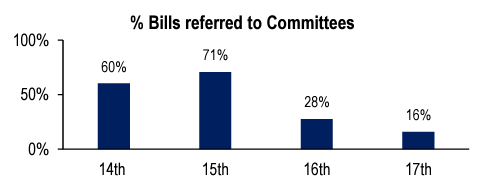
Fewer bills referred- In the 15th Lok Sabha -71%, 16th Lok Sabha -27% and in 17th Lok Sabha -16% of the bills introduced were referred to the committees.
Lack of specialised knowledge among members in financial and economic matters leads to superficial scrutiny.
Bulky CAG and budgetary reports result in inadequate time for detailed examination.
Post mortem analysis- This lowers the quality of oversight and recommendations.
Political influence often causes biased decision-making and undermines objectivity.
Lack of Public Awareness and Transparency- Committee proceedings are held behind closed doors.
Way Forward
Implement ARC & NCRWC suggestions for expert support units and public disclosure of reports.
Enhance capacity-building of MPs on financial management.
Make committee recommendations time-bound and mandatory for government response.
In the words of Woodrow Wilson, “Congress in session is Congress on public exhibition, while Congress in its committee rooms is Congress at work.”