India’s 110 million tribal population (8.6%) comprise over 705 distinct ethnic groups. However, they are legally and politically unified under the category of “Scheduled Tribes” (STs).
Diversities Among Tribal Communities in India
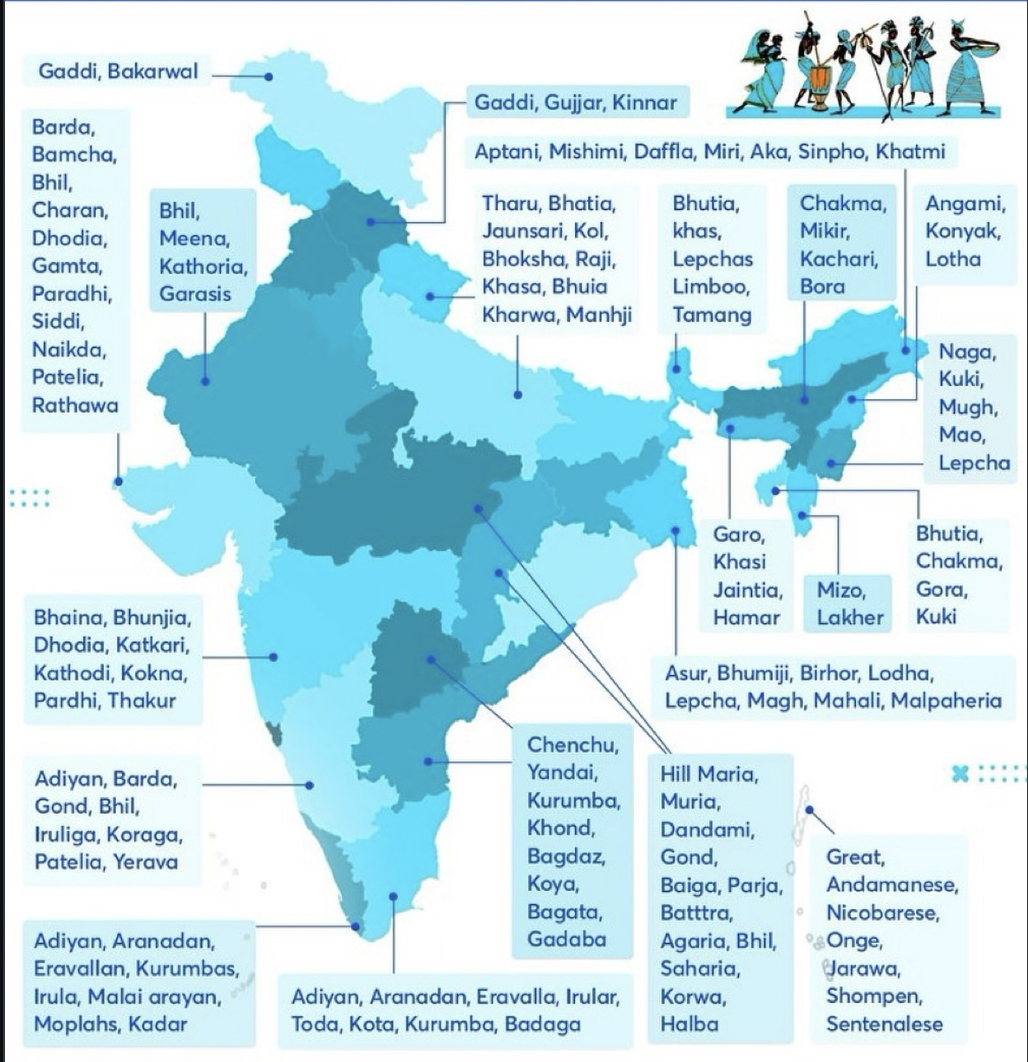
Ethnic and Racial – Negrito (Andamanese) and Proto-Australoid (Central Indian tribes) to Mongoloid (Northeast tribes).
Modes of Subsistence- Hunter-Gatherers (Sentinels), Pastoralists (Toda), Shifting Cultivators (Jhumias of Mizoram), Settled Agriculturists (Meenas of).
Geographical Dispersion- arid deserts of Rajasthan (Bhils), high Himalayas (Gaddis), tropical rainforests of the Andamans.
Social Organization- Matrilineal societies of Meghalaya (Khasis, Garos), Patrilineal systems of Central India.
Religious Beliefs- Sarnaism (nature worship), Christianity (Northeast), Buddhism (Ladakh), or Hinduism (Central India).
Demographic Scale- Gonds and Bhils number in millions, PVTGs like the Great Andamanese fewer than 50 members.
Educational Attainment- nearly 90% in Mizoram to less than 30% among PVTGs in Chhattisgarh.
Specific contexts where tribes can be considered as a single category
Political Representation and Voice – limited representation in “cabinet” as well as in administration. Eg- less than 5% SC/ST at secretary level
Constitutional and Legal Safeguards – Unified recognition as Scheduled Tribes for protective discrimination. Eg- Fifth and Sixth Schedule, reservations in education, employment, and legislatures.
Administrative Planning and Resource Allocation – Eg- Tribal Sub-Plan (TSP)
Historical Experience of Marginalisation – Shared legacy of colonial forest policies, land alienation, and erosion of autonomy.
Structural Economic Deprivation – Common patterns of poverty, livelihood insecurity, and dependence on primary resources.
Human Development Deficits – Similar disadvantages in nutrition, health, and education indicators at the aggregate level.
Vulnerability to Displacement and Development Projects – Disproportionate impact of mining, dams, and conservation projects on tribal regions.
Social Exclusion and Discrimination – Limited access to education, healthcare, markets, and political institutions across regions.
Ecological and Livelihood Linkages – Shared dependence on forests, land, and commons for survival. Eg- shifting cultivation
Implementing SC judgment on sub-categorization (Davinder Singh case) can help avoid over-homogenisation and one-size-fits for all approach