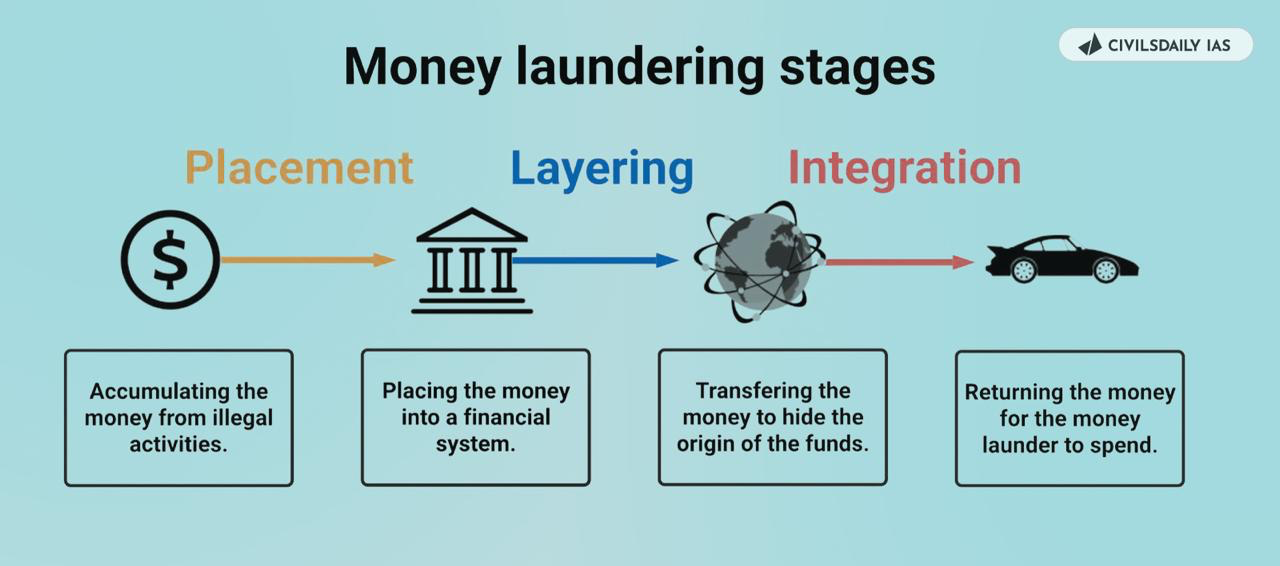
As per FATF, “Money laundering is the processing of criminal proceeds to disguise their illegal origin in order to legitimize the ill-gotten gains of crime.”
As per UNODC, money laundering costs around 2-5% of global GDP ($2 to $5.5 trillion)
Role of emerging technologies
Cryptocurrencies and Virtual Assets – Enable anonymous, borderless and rapid transfers. Eg- Laundering through Bitcoin and privacy coins.
Dark Web and Encrypted Platforms – Facilitate illegal marketplaces and untraceable transactions. Eg- “Hydra Market”
Fintech and Digital Payments – Micro-transactions and layering obscure audit trails. Eg- Use of mule accounts in UPI scams.
AI Tools – Creation of fake digital identities to open mule accounts.
Online Gambling and Gaming Platforms – Convert illicit funds into in-game assets and winnings. Eg- betting apps linked to Mahadev Book
NFT Markets – Buying and selling NFTs at inflated prices to legitimise funds.
DeFi Platforms – use mixers, decentralized exchanges (DEXs), and cross-chain bridges to obscure the origins of illicit funds. Eg- internationally sanctioned Tornado Cash
Impact of Globalisation on Money Laundering
Ease of Cross-Border Capital Mobility. Eg- Nirav Modi-PNB scam funds traced across Hong Kong, Dubai and the UK
Offshore Financial Centres and Tax Havens. Eg- Eg- Pandora Papers (2021) revealed shell companies in British Virgin Islands used to hide assets.
Complex Global Trade Networks – Trade-based laundering through invoice manipulation.
Multinational Corporate Structures launder money through Shell companies. Eg- Eg- Adani-Hindenburg case (2023)
Migration and Remittance Networks – Eg- Hawala networks in Gulf-Kerala corridor linked to gold smuggling and laundering.
Measures taken
At national Level
PMLA, 2002 and Amendments
Definition of “proceeds of crime” expanded to include assets held abroad.
Virtual digital assets (VDAs) like cryptocurrencies, online gaming and betting platforms brought under PMLA.
PMLA linked with National Financial Information Registry (RBI) to improve real-time data monitoring.
ED- Investigates offences under PMLA, including attachment and confiscation of properties. Eg- over 6000 cases filed
Financial Intelligence Unit – India (FIU-IND)- Receives and analyses suspicious transaction reports from banks and financial institutions.
Regulatory Measures by Financial Regulators (KYC norms)
RBI for banking
SEBI for capital markets
IRDAI for insurance
At international level
Vienna convention on money laundering 1988.
FATF – Intergovernmental body setting global AML standards. (India in “regular follow-up” category – highest rating by FATF)
Egmont Group – International network of FIUs for sharing of financial intelligence across borders.
Basel AML Index – Ranks countries on AML risk.
OECD Common Reporting Standard (CRS) – Information exchange among countries to detect offshore tax evasion and illicit financial flows.
India has signed DTAA with 85 countries to prevent illegal activities like tax evasion & money laundering.
These measures India’s commitment to zero tolerance for money laundering and terror funding.