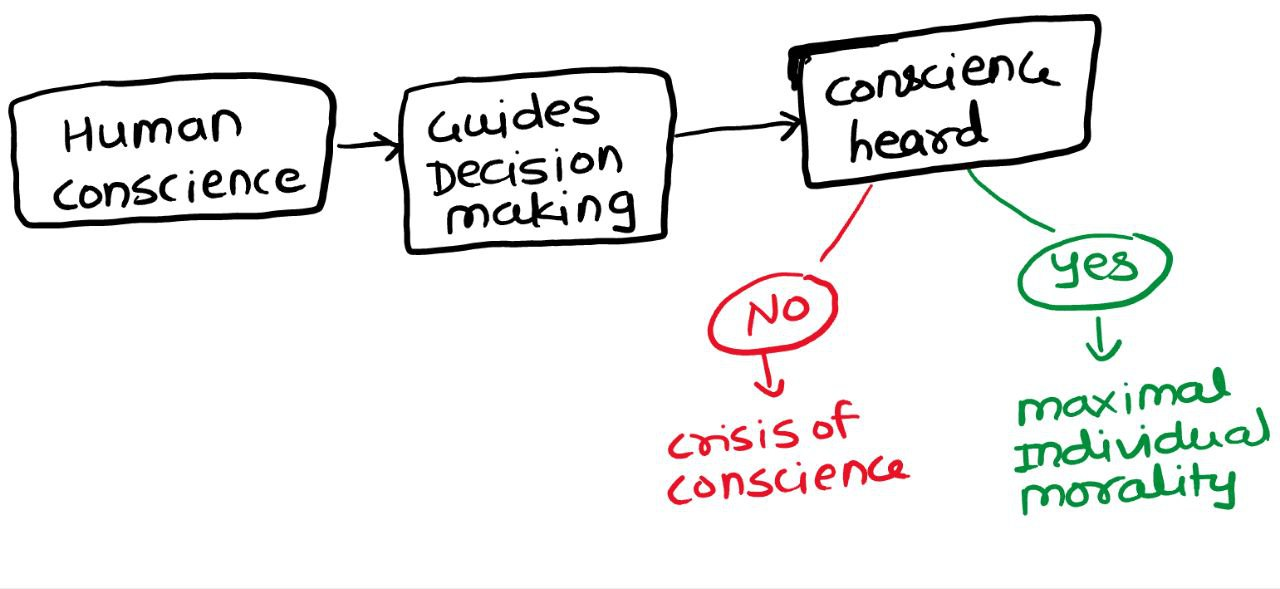
A crisis of conscience arises when a person faces a conflict between personal values, professional duties, social pressures and moral principles. EI can play decisive role in navigating this crisis.
Role of EI in overcoming crisis of conscience
Self-awareness helps identify moral discomfort early.
Self-regulation prevents panic, fear or anger from dictating action. (“Amygdala Hijack”) Eg- Sanjiv Chaturvedi (IFS) exposing corruption in AIIMS
EI provides Moral clarity through reflection – prevents impulsive action.
EI builds courage through emotional control and enables ethical action. Eg- Whistleblowers like Satyendra Dubey.
EI developes communication skills that enables respectful dissent. Eg- Mahatma Gandhi
EI helps in conflict management without hostility. Eg- Nelson Mandela balancing justice and reconciliation.
It builds resilience to endure consequences of ethical action. Eg- punitive transfers of Ashok Khemka
Empathy and perspective-taking helps avoid moral absolutism and promotes fairness. Eg- Justice V.R. Krishna Iyer institutionalising PIL
Inner peace through EI reduces cognitive dissonance after ethical choice. Eg- Satish Dhawan taking responsibility for failure
On the other hand, EI can also undermine ethical stand
EI can be used to justify unethical actions. Eg- bureaucrats blaming “political pressure” to justify complicity.
Rationalisation of wrongdoing – Managing guilt instead of correcting behaviour. Eg- “sanskritization of corruption”
Manipulation of others’ emotions. Eg- Cult leaders like Jim Jones emotionally controlled followers into mass suicide.
Conflict avoidance instead of necessary confrontation. Eg- Corporate HR heads ignoring harassment complaints to “avoid workplace disruption”.
Institutional conformity – EI helps individuals to adapt to unethical cultures. Eg- Eichmann committing atrocities under “orders” (banality of evil)
Emotional burnout due to constant emotional regulation
High empathy may lead to compromise on objectivity and firmness
Ethical relativism – Eg- Justifying censorship or surveillance as “necessary for public safety.”
Thus, EI is value-neutral and a “means” to an “end.” It needs a strong moral compass to develop virtuous character.