India has 18% of the world’s population but only 4% of the freshwater resources. As per NITI Aayog “Composite Water Management Index”, 60 Cr people are experiencing high to extreme water stress.
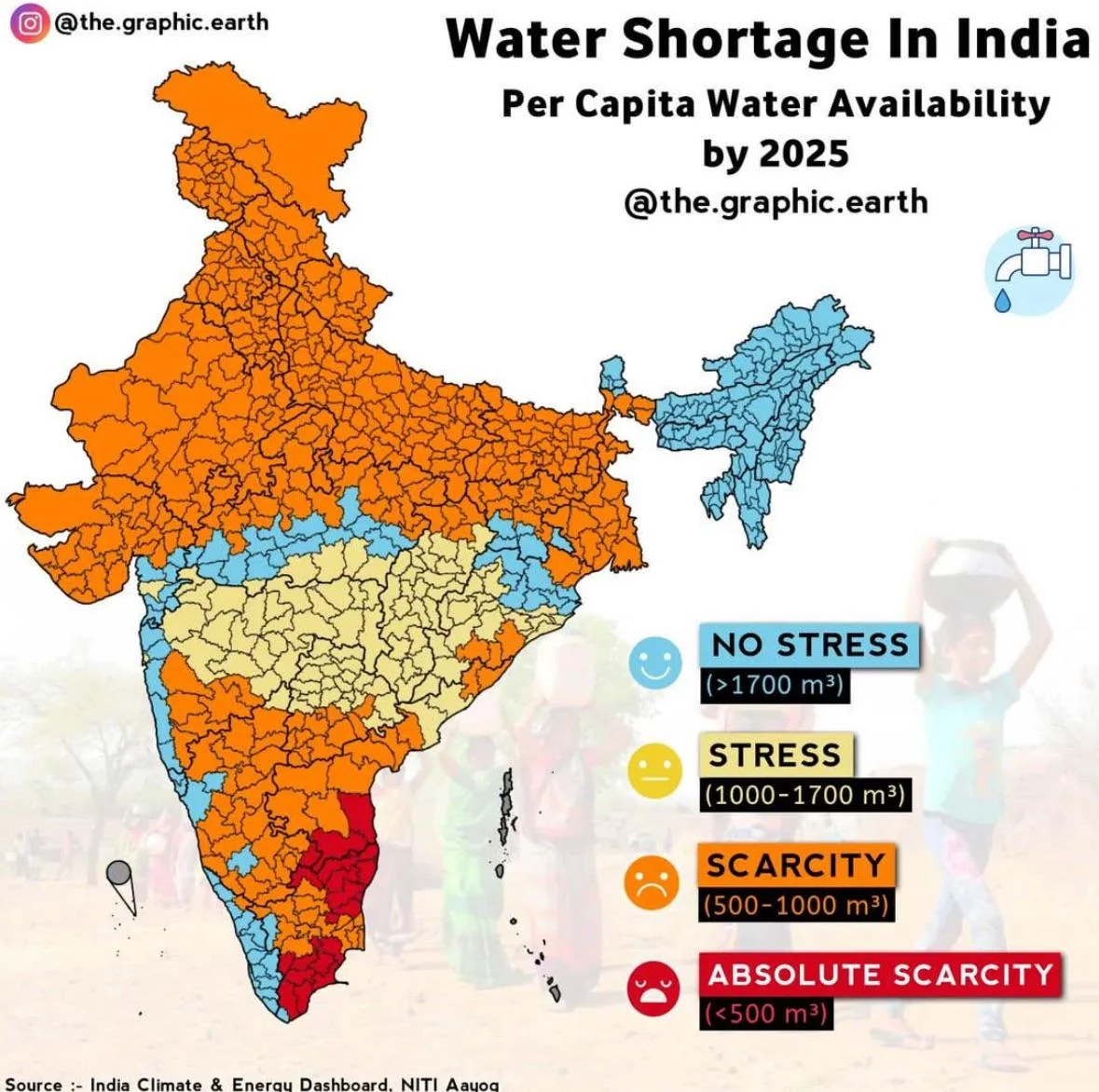
~85% of India’s freshwater is used in agriculture (FAO).
Groundwater depletion:
1,006 blocks are over-exploited or critical (CGWB, 2023).
Punjab and Haryana – ~1 metre annual groundwater decline.
Per capita water availability fell from 1,820 m³ (2001)1,486 m³ (2025).
“Day Zero” in cities like Chennai, Bengaluru, and Shimla
By 2030, water demand could outstrip supply by twofold. (NITI Aayog)
21 cities could exhaust groundwater by 2030. (NITI Aayog)
The World Resources Institute ranks India 13th among the 17 most water-stressed nations globally
2024 Annual Groundwater Quality Report – that 70% of India’s water sources are contaminated
World Bank projects that climate-induced water scarcity could reduce India’s GDP by up to 12% by 2050
Measures to improve water management
Enhancing Water Storage Infrastructure
Renovation Traditional Water Bodies – Example: Mission Kakatiya (Telangana) and Kudimaramath (Tamil Nadu).
Farm-Level Storage – Promote farm ponds, percolation tanks, check dams, and contour bunds through MGNREGA. Eg- jalyukta Shivar of Maharashtra
Rainwater Harvesting – Mandatory rooftop harvesting in water-stressed cities. Eg- Chennai Model
Interlinking of Rivers – Eg- Projects like Ken-Betwa Link can ease water shortages in Bundelkhand.
Use recharge wells to replenish aquifers through Atal Bhujal Yojana
Dam Modernisation to enhance water storage capacity
Improving Irrigation Efficiency
Micro-Irrigation Expansion through PMKSY-PDMC. Eg- Drip saves 30-50% water; sprinkler saves 25-35%.
Canal Modernisation- Improves efficiency from .
Precision Farming – Use of sensors, fertigation, controlled irrigation for sustainable agriculture and optimal water use.
Remote Sensing & GIS for Water Accounting – Monitor aquifers, rainfall-runoff, and canal leakages.
Increase Capital Investment in Irrigation Systems and Fast-track AIBP projects
Strengthening Community-Led Measures – Eg- Pani Panchayats in Odisha.
Demand-Side Management
Crop Diversification – Shift from water-intensive crops (paddy, sugarcane) to millets, pulses, oilseeds, horticulture. Example: Haryana’s Mera Pani Meri Virasat.
Water Budgeting at Village Level through Gram Sabhas. Eg- Pani Foundation villages in Maharashtra.
Water Pricing – Rational, volumetric pricing to reduce wastage.
Water Users Associations (WUAs) – Participatory Irrigation Management for equitable distribution and canal maintenance.
Incentivise Water Saving – Eg- Punjab’s Pani Bachao Paise Kamao for reducing groundwater usage.
Implementing Mihir Shah Committee recommendations of One Water Approach by merging CGWB and CWC into a National Water Commission (NWC) is essential to achieve a water-secure economy.