Integrated farming system refers to the integration of multiple components of agriculture in a single farm unit to enhance productivity, sustainability and resilience while optimising resource use.
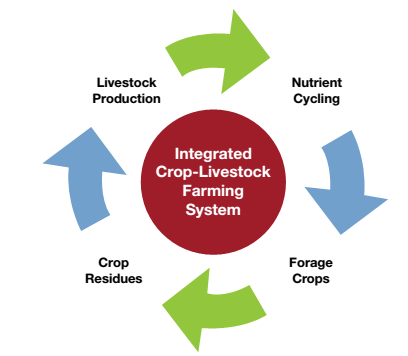
Resource Use Efficiency by recycling farm by-products into inputs.
Improved Soil Health through addition of organic matter. Eg- Vermi-composting + green manuring in rice-vegetable-livestock systems.
Water use efficiency – Eg- .
Reduction in Pests & Diseases due to practices like crop rotation, intercropping, and mixed cropping.
Higher Productivity per Unit Area compared to monocropping due to synergistic systems.
Income Security – Multiple income sources reduce climate and market vulnerability. Eg- crop loss can be offset by milk/poultry/fish income.
Doubling Farmers income – Eg- paddy cultivation + fish farming + poultry in Tamil Nadu saw income rise by over 100%. (ICAR study)
Employment Generation – Labour demand increases year-round due to diversified activities
Enhanced Biodiversity by offering homes for a variety of plant and animal species. Eg- Agroforestry
Challenges in IFS
Small and Marginal Land Holdings (86%) restricts integration of enterprises like ponds or livestock.
High Initial Investment requirement in biogas units, sheds and fish ponds require capital.
Limited Knowledge & Skills at village level – IFS demands multi-disciplinary expertise.
Lack of Market Linkages and assured procurement channels for surplus milk, fish, vegetables
Policy Gaps – Schemes operate in silos rather than landscape-based integrated planning.
Way Forward
Promote climate and region-wise IFS models (dryland, coastal, hill).
Financial Support – low-interest loans + integrated crop-livestock insurance.
Rural Agri-Logistics Nodes under Gati Shakti Framework to develop cold chains, aggregation centers
Extension Support through Krishi Sakhis, FPOs and Agri-Startups for training and backward-forward linkages.
Raising R&D Investment to 1% of GDP
Budget 2025-26 emphasised Agriculture as the ‘first engine’ for India’s development journey. IFS can be the backbone of this journey.