Why in News?
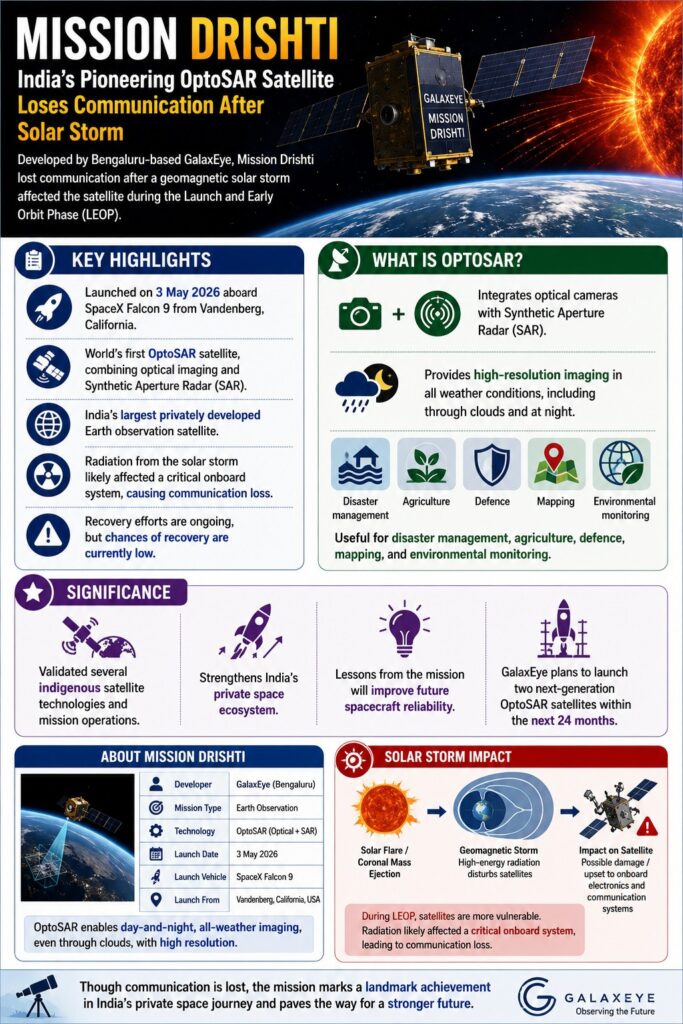
Mission Drishti, developed by Bengaluru based GalaxEye, lost communication after a geomagnetic solar storm affected the satellite during the Launch and Early Orbit Phase (LEOP).
Key Highlights
- Launched on 3 May 2026 aboard SpaceX Falcon 9 from Vandenberg, California.
- World’s first OptoSAR satellite, combining optical imaging and Synthetic Aperture Radar (SAR).
- India’s largest privately developed Earth observation satellite.
- Radiation from the solar storm likely affected a critical onboard system, causing communication loss.
- Recovery efforts are ongoing, but chances of recovery are currently low.
What is OptoSAR?
- Integrates optical cameras with Synthetic Aperture Radar (SAR).
- Provides high-resolution imaging in all weather conditions, including through clouds and at night.
- Useful for disaster management, agriculture, defence, mapping, and environmental monitoring.
Significance
- Validated several indigenous satellite technologies and mission operations.
- Strengthens India’s private space ecosystem.
- Lessons from the mission will improve future spacecraft reliability.
- GalaxEye plans to launch two next-generation OptoSAR satellites within the next 24 months.
[2022] If a major solar storm (solar flare) reaches the Earth, which of the following are the possible effects on the Earth?:
1. GPS and navigation systems could fail.
2. Tsunamis could occur at equatorial regions.
3. Power grids could be damaged.
4. Intense auroras could occur over much of the Earth.
5. Forest fires could take place over much of the planet.
6. Orbits of the satellites could be disturbed
7. Shortwave radio communication of the aircraft flying over polar regions could be interrupted.
Select the correct answer using the code given below;
[A] 1, 2, 4 and 5 only
[B] 2, 3, 5, 6 and 7 only
[C] 1, 3, 4, 6 and 7 only
[D] 1, 2, 3, 4, 5, 6 and