Why in the News?
India’s drug regulator, the Central Drugs Standard Control Organisation (CDSCO), has approved Qdenga, the country’s first dengue vaccine, after its licensing in over 40 countries and World Health Organisation (WHO) prequalification, arriving amid some of India’s worst dengue outbreaks.
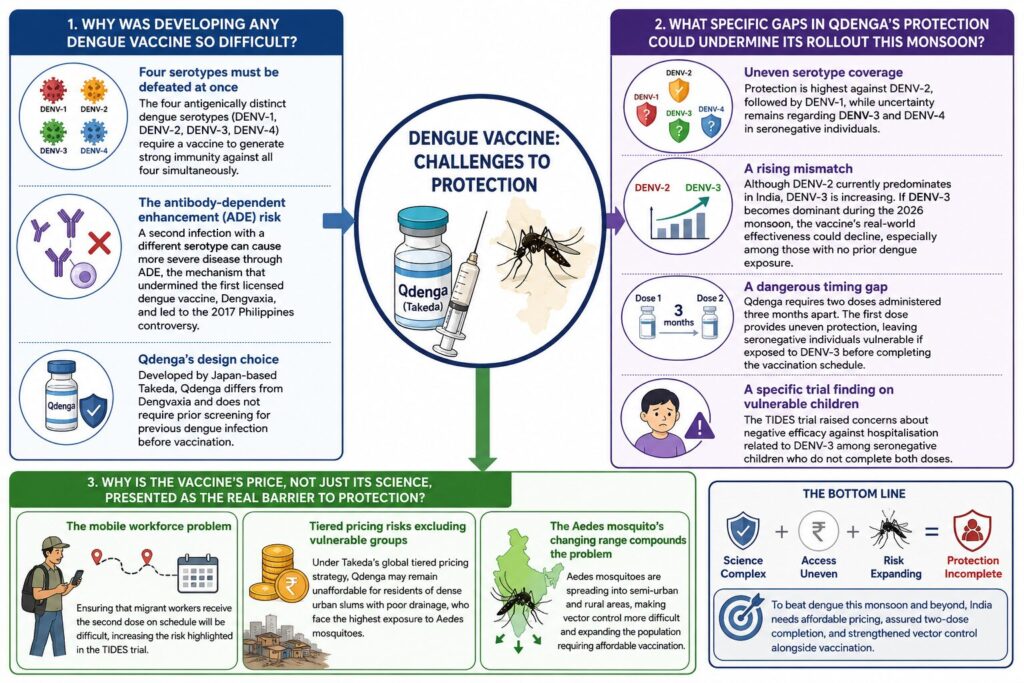
Why was developing any dengue vaccine so difficult in the first place?
- Four serotypes must be defeated at once: The four antigenically distinct dengue serotypes (DENV-1, DENV-2, DENV-3, DENV-4) require a vaccine to generate strong immunity against all four simultaneously.
- The antibody-dependent enhancement (ADE) risk: A second infection with a different serotype can cause more severe disease through antibody-dependent enhancement (ADE), the mechanism that undermined the first licensed dengue vaccine, Dengvaxia, and led to the 2017 Philippines controversy.
- Qdenga’s design choice: Developed by Japan-based Takeda, Qdenga differs from Dengvaxia and does not require prior screening for previous dengue infection before vaccination.
What specific gaps in Qdenga’s protection could undermine its rollout this monsoon?
- Uneven serotype coverage: Protection is highest against DENV-2, followed by DENV-1, while uncertainty remains regarding DENV-3 and DENV-4 in seronegative individuals.
- A rising mismatch: Although DENV-2 currently predominates in India, DENV-3 is increasing. If DENV-3 becomes dominant during the 2026 monsoon, the vaccine’s real-world effectiveness could decline, especially among those with no prior dengue exposure.
- A dangerous timing gap: Qdenga requires two doses administered three months apart. The first dose provides uneven protection, leaving seronegative individuals vulnerable if exposed to DENV-3 before completing the vaccination schedule.
- A specific trial finding on vulnerable children: The Tetravalent Immunization against Dengue Efficacy Study (TIDES) trial raised concerns about negative efficacy against hospitalisation related to DENV-3 among seronegative children who do not complete both doses.
Why is the vaccine’s price, not just its science, presented as the real barrier to protection?
- The mobile workforce problem: Ensuring that migrant workers receive the second dose on schedule will be difficult, increasing the risk highlighted in the TIDES trial.
- Tiered pricing risks excluding vulnerable groups: Under Takeda’s global tiered pricing strategy, Qdenga may remain unaffordable for residents of dense urban slums with poor drainage, who face the highest exposure to Aedes mosquitoes.
- The Aedes mosquito’s changing range compounds the problem: Aedes mosquitoes are spreading into semi-urban and rural areas, making vector control more difficult and expanding the population requiring affordable vaccination.
Conclusion
The approval of Qdenga is a significant milestone in India’s fight against dengue, but its public health impact depends on addressing serotype-specific protection gaps, ensuring completion of the two-dose schedule, and making the vaccine affordable for high-risk populations. The editorial argues that price negotiations are essential for the vaccine to achieve meaningful public health outcomes.
Back2Basics
About Dengue:
- Dengue (break-bone fever) is a viral infection that is spread from mosquitoes to people. It is more common in tropical and subtropical than in temperate climates.
- Transmission: The dengue virus is transmitted to humans through the bites of infected female mosquitoes, primarily the Aedes aegypti mosquito. Other species within the Aedes genus can also act as vectors, but their contribution is normally secondary to Aedes aegypti.
- Human-to-mosquito transmission: Mosquitoes can become infected by people who are viremic with DENV. This can be someone who has a symptomatic dengue infection, someone who is yet to have a symptomatic infection (those who are pre-symptomatic), and also someone who shows no signs of illness (those who are asymptomatic).
Dengue Serotype
- Four Types: The virus exists as four closely related strains: DENV-1, DENV-2, DENV-3, and DENV-4.
- Immunity: Catching one serotype gives you lifelong immunity to that specific type, but only short protection against the other three.
- Severe Risk: Getting infected a second time by a different serotype can raise your chance of getting severe dengue.
Important Keywords:
- Antibody-dependent enhancement (ADE): A phenomenon in which antibodies generated from a previous infection with one dengue serotype enhance, rather than prevent, severe disease during infection with a different serotype, making dengue vaccine development particularly challenging.
- WHO prequalification: A World Health Organization (WHO) assessment that certifies a vaccine meets international standards of quality, safety, and efficacy, enabling procurement by governments and international agencies.
PYQ Relevance
[UPSC 2022] What is the basic principle behind vaccine development? How do vaccines work? What approaches were adopted by the Indian vaccine manufacturers to produce COVID-19 vaccines?
Linkage: The PYQ examines the science behind vaccine development and immunization, a core GS-3 Science & Technology theme. The article applies these principles to dengue, highlighting challenges of multi-serotype vaccines, ADE, efficacy, and rollout.