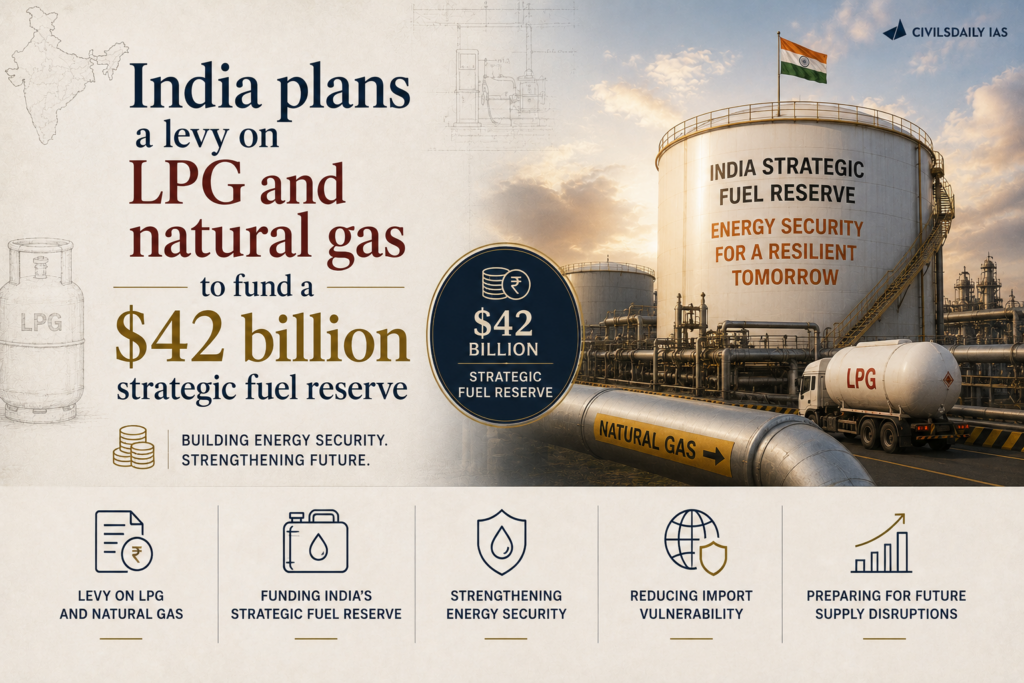
Why in the News
India proposed to fund an enlarged strategic fuel reserve through a small charge on cooking gas and natural gas. The move exposes the trade off between building energy insurance and raising the household fuel bill.
What is a Strategic Petroleum Reserve?
- Emergency stockpile: A strategic petroleum reserve is a government held store of fuel to cushion supply shocks and price spikes.
- Current cover: India’s existing reserves hold crude oil at underground sites managed by the Indian Strategic Petroleum Reserves Limited (ISPRL).
- New feature: For the first time the buffer would extend beyond crude to cover LNG and LPG.
How would the new reserve be funded?
- LPG charge: A levy of about Rs 1.29 per kg on cooking gas is proposed.
- Gas charge: A levy of about Rs 1.43 per standard cubic metre on natural gas is proposed.
- Annual pool: The charges would raise close to $1.5 billion a year.
- Cover target: The reserve would hold roughly two months of crude and LNG and six weeks of LPG.
Why does energy security drive this now?
- Import dependence: India imports about 90% of its crude and is the third largest oil importer.
- Chokepoint risk: Disruption at the Strait of Hormuz has already forced diversification of LNG sources.
- Price volatility: A larger buffer reduces exposure to sudden price surges.
Conclusion
The proposal marks a shift from a crude only buffer to a broader fuel insurance system, paid for by consumers. The next milestone is the formal notification of the levy and the reserve’s expansion plan.
Back2Basics
Cooking gas and Natural gas
Cooking gas (Liquefied Petroleum Gas or LPG) and natural gas (Piped Natural Gas or PNG) differ primarily in chemical composition, how they are stored, and how they are delivered to homes.
Key Differences in Composition and Properties
- Chemical Makeup: Cooking gas (LPG) is made of propane and butane (C₃H₈ and C₄H₁₀), while natural gas is primarily methane (CH₄).
- Energy Output: LPG has a higher calorific value, meaning it produces more heat per unit and cooks food faster than natural gas.
- Behavior in Leaks: LPG is heavier than air and settles near the floor during a leak, whereas natural gas is lighter than air and rises/disperses quickly upward.
PYQ Relevance
[UPSC 2025]“Energy security constitutes the dominant kingpin of India’s foreign policy, and is linked with India’s overarching influence in Middle Eastern countries.” How would you integrate energy security with India’s foreign policy trajectories in the coming years?
Linkage: The PYQ examines the role of energy security in shaping India’s foreign policy and strategic interests. The article highlights India’s plan to expand strategic fuel reserves to reduce import risks and strengthen long-term energy security.