Why in the News
A recent NITI Aayog Report flagged the closure of nearly 94,000 government schools across India over the past decade. Falling enrolment and a declining fertility rate underlie the closures and mergers. The debate weighs neighbourhood access against better resourced consolidated schools.
What is school consolidation?
- Definition: the merging of under enrolled schools into better equipped composite schools with qualified teachers and improved infrastructure.
- Aim: to raise educational quality rather than merely cut costs.
- Constitutional placement: education sits on the Concurrent List, so states drive closure and merger policy.
What is UDISE Plus?
- Full form: the Unified District Information System for Education Plus.
- Function: an education management information system that tracks schools, enrolment and teachers nationwide.
- It is the largest digital database of information related to school education in India.
- This portal, operated by the Union Ministry of Education, records the details of all recognized government and private schools in the country online.
What do the data reveal between 2014-15 and 2024-25?
- Schools: the total number of schools fell by about 45,000, driven entirely by a fall of 94,000 government schools while private unaided schools grew.
- Enrolment: overall enrolment fell by 2.26 crore to 24.69 crore.
- Sector shift: government enrolment fell while private enrolment rose from 8.42 crore to 9.59 crore.
- Teachers: teacher numbers rose from about 90 lakh to over one crore, improving teacher availability.
- Demography: the total fertility rate fell from more than 3 in the early 1990s to about 2.0, below the replacement level of 2.1.
Why does school size matter?
- Thin schools: thousands of schools run with a single teacher or a handful of students.
- Weak instruction: low size makes grade wise, subject specific teaching, laboratories and peer learning difficult.
- Teacher load: teachers handle multiple classes alongside administrative tasks.
- Hidden disparity: national averages mask overcrowded urban schools alongside near empty rural ones.
What are the challenges to school consolidation?
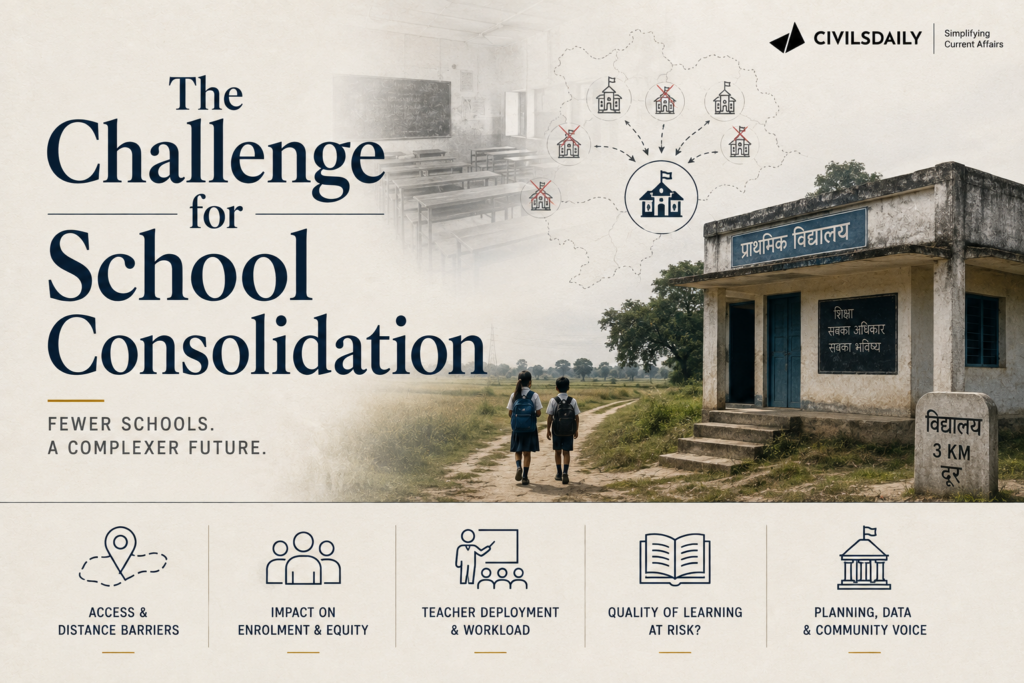
- Travel distance: longer distances disadvantage young children, girls and students in remote or tribal areas.
- Access risk: closures can strip neighbourhood access unless safe transport is guaranteed.
- Cost driven mergers: decisions taken on financial grounds alone can undercut quality goals.
- Equity gap: consolidation must balance quality, efficiency and equitable access, not just efficiency.
- Data need: decisions should be data driven rather than administrative, with uninterrupted access ensured wherever schools merge.
Conclusion
The school numbers reflect a transformation, not merely closures, driven by demographic change and shifting preferences. Consolidation can raise quality but only if it protects access for the most vulnerable children. Success should be measured by whether every child reaches a well resourced school, with safe transport where schools merge.
Back2Basics
International Examples & Case Studies
India (Project SATH-E & State Initiatives):
- Under NITI Aayog’s Project SATH-E, states like Madhya Pradesh, Jharkhand, and Odisha consolidated over 26,000 schools.
- Rajasthan horizontally merged co-located schools and built vertically integrated “Adarsh” (model) schools spanning grades 1-12. This reduced multi-grade teaching and doubled the presence of designated headmasters.
China (Rural School Consolidation Policy):
- Implemented to centralize resources in middle-income rural areas. While it successfully built larger, better-funded institutions, longitudinal studies indicate unintended consequences.
- For instance, longer commutes occasionally limited written minority language facility and worsened educational equity for marginalized groups.
The Nordic Countries & Western Europe: Ecosystem Integration
- Low demographic density in isolated rural pockets across Denmark, the Netherlands, and Norway.
- Unlike abrupt closures, Denmark and other Nordic nations leveraged regional clustering. Rather than completely standardizing environments, they implemented extensive public support networks, dedicated student transport, and digital infrastructure to ease student adjustments.
- Short-term disruption to student test scores was documented, particularly for students transferring from the smallest schools. However, these adverse effects weakened over time as institutional integration stabilized
PYQ Relevance
[UPSC 2022] The Right of Children to Free and Compulsory Education Act, 2009 remains inadequate in promoting incentive-based system for children’s education without generating awareness about the importance of schooling. Analyse.
Linkage: The PYQ examines whether school education reforms ensure universal and equitable access under the RTE Act. The article assesses whether school consolidation can improve quality without compromising access for vulnerable children.