Why in the News
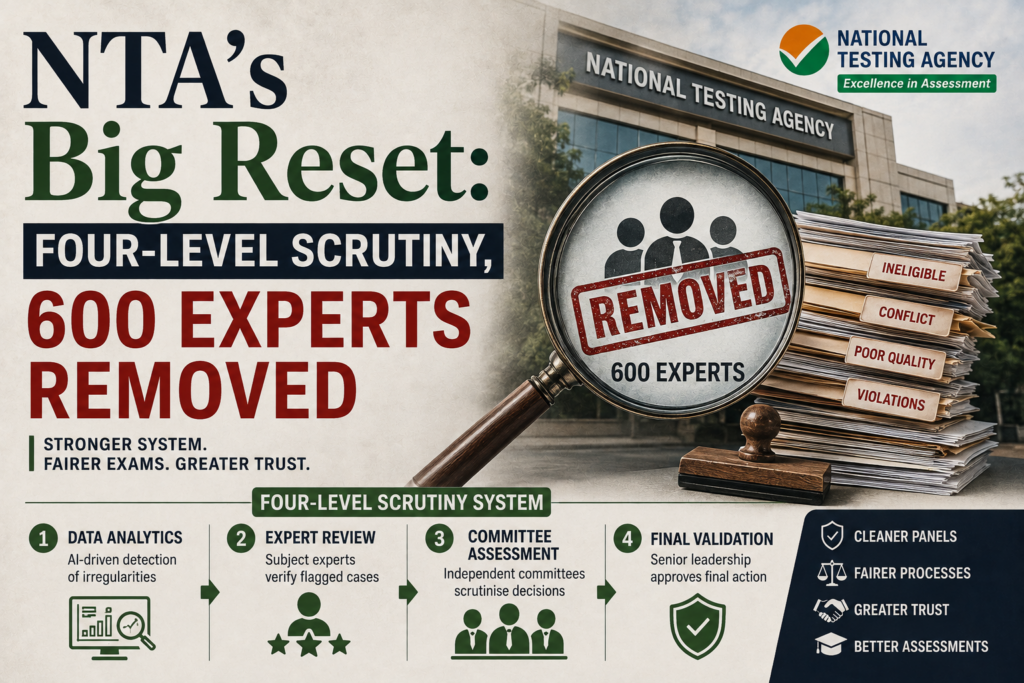
The NTA is overhauling its examination system after the NEET-UG paper leak and UGC-NET errors. Measures include removing 600 experts, introducing a four-tier paper-checking system, strengthening CISF security, and redesigning confidential operations.
What is NTA?
- Established: 2017 by the Ministry of Education as an autonomous testing agency.
- Purpose: Conduct transparent and standardised entrance and eligibility examinations.
- Major exams: NEET-UG, JEE Main, UGC-NET, CUET, CMAT and CSIR-UGC NET.
- Governance: Director General + Governing Body chaired by an eminent educationist.
Confidential Operations (CONOPS)
- Covers question setting, translation, moderation, printing, storage, transport and distribution.
- Reforms include secluded rooms, air-gapped systems and device deposit protocols.
- Air-Gapped System: A computer/network physically isolated from external networks, reducing the risk of remote data theft.
What is UGC-NET?
- Conducted by NTA to determine eligibility for Assistant Professor and Junior Research Fellowship (JRF).
- Conducted twice a year across multiple subjects.
Key Reforms
- 600 experts removed and new experts inducted.
- Four-tier question paper verification.
- New secured premises with CISF protection.
- Audit of examination processes.
- Complete redesign of confidential operations.
Major Challenges
- Long confidentiality chain: Multiple actors increase leak risks.
- Outsourced infrastructure: Dependence on private examination centres.
- Limited permanent staff: Heavy reliance on deputationists and contractual experts.
- Question quality: Factual, translation and typographical errors.
- Multilingual risks: Multiple language versions increase error points.
- Weak investigation: Lack of standardised investigation and forensic procedures.
- No independent appellate mechanism: Disputes often reach courts.
- Candidate burden: Cancellations impose significant time and financial costs.
