Why in the News
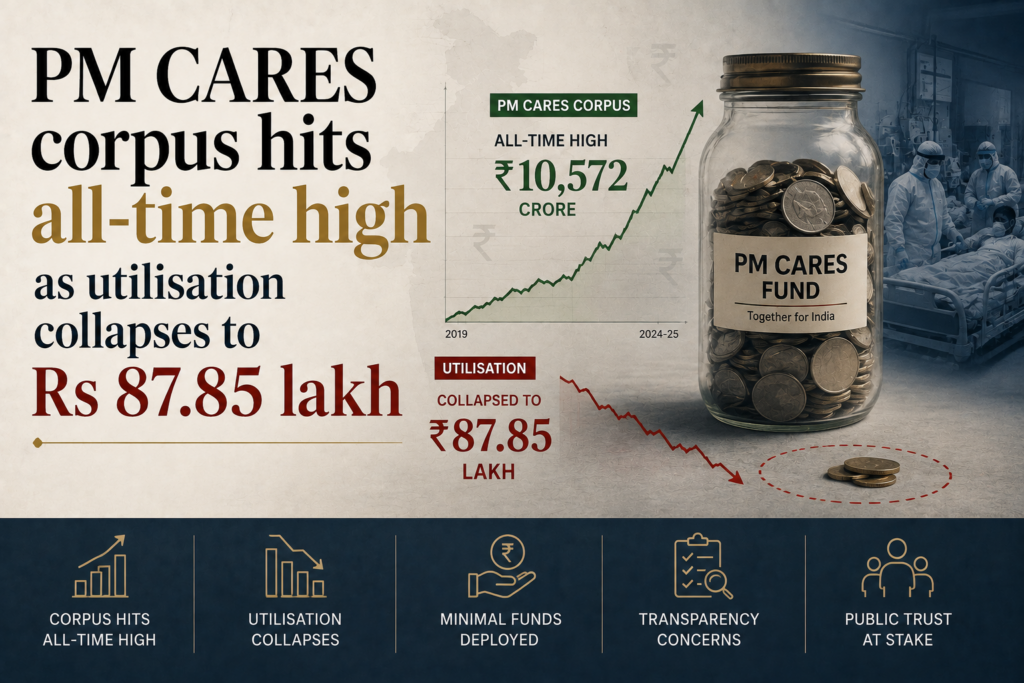
Audited statements of the PM CARES Fund for 2023-24 and 2024-25, both published only on 17 August 2026 after a two year delay, show the closing balance at an all time high of Rs 8,452.06 crore while spending fell to a five year low of Rs 87.85 lakh. A fund created to disburse relief in emergencies is now accumulating faster through interest than it is spending, which raises the question of what a relief fund is for when it does not disburse.
What is the PM CARES Fund?
- Full name: The Prime Minister’s Citizen Assistance and Relief in Emergency Situations Fund, created on 27 March 2020, days after the national lockdown was imposed.
- Legal form: A public charitable trust registered under the Registration Act, 1908, rather than a statutory or constitutional fund.
- Composition of the trust: The Prime Minister is the ex officio chairman, and the Defence Minister, Home Minister and Finance Minister are ex officio trustees.
- Sources of money: Voluntary domestic donations, foreign contributions, interest earned on bank balances and fixed deposits, and refunds returned by implementing agencies.
- Position on transparency: The Fund is not treated as a public authority under the Right to Information Act, 2005, and does not accept audit by the Comptroller and Auditor General of India, being audited instead by an independent chartered accountant.
What is a public charitable trust?
- What it is: A public charitable trust is a private legal arrangement in which trustees hold property for a charitable purpose benefiting an indeterminate section of the public, created by a trust deed and registered under the Registration Act, 1908.
- Consequence of the form: It is not created by statute and does not draw on the Consolidated Fund, so parliamentary appropriation control and constitutional audit do not attach to it automatically.
What is a refund from an implementing agency?
- What it is: A refund from an implementing agency is money previously released to an executing body for a sanctioned purpose and returned unspent or unutilised to the fund.
- Why it matters here: A refund inflates receipts without any relief being delivered, so a year with high refunds and low disbursement records activity that produced no outcome.
What do the 2024-25 audited statements show?
- Total contributions: Contributions fell to Rs 479.96 crore, comprising Rs 479.04 crore domestic and about Rs 92 lakh foreign, down about 30 percent over the previous year.
- Interest income: The Fund received Rs 475.14 crore as interest, of which Rs 469.37 crore came from fixed deposits and Rs 5.76 crore from regular accounts.
- Other receipts: About Rs 13.49 lakh was received as refund of tax deducted at source on fixed deposit interest, and Rs 324.65 crore came back as refund from implementing agencies.
- Total income: Total income grew to Rs 1,279.9 crore, up 41 percent over the previous year.
- Total spending: Total spending fell to Rs 87.85 lakh, comprising Rs 87.84 lakh on the PM CARES for Children Scheme and Rs 451 in bank and short message service charges.
- Utilisation ratio: The Fund spent 0.01 percent of its closing balance, and between March 2020 and 31 March 2025 it spent less than one fifth, or 18.1 percent, of its total income.
- Closing balance: The closing balance touched an all time high of Rs 8,452.06 crore, 17.83 percent above the previous year’s Rs 7,173.03 crore.
- Two year corpus growth: The corpus grew 25.8 percent between 2022-23 and 2024-25, from about Rs 6,722 crore to about Rs 8,453 crore.
Why has the corpus grown while spending collapsed?
- Interest now rivals donations: In 2024-25 interest income of Rs 475 crore was almost the same as donations of Rs 480 crore, so the Fund grows without any fresh public contribution.
- The instrument shift: The corpus was moved from savings bank accounts to fixed deposits in 2023-24, which is the immediate reason for the jump in interest earnings.
- Refunds outweigh disbursement: In 2024-25, Rs 324.65 crore came back from implementing agencies while only Rs 0.87 crore went out, so money returning exceeded money spent by a factor of over three hundred.
- Inflow consistently exceeds outflow: Since 2022-23 the money flowing in through donations and interest has far exceeded the money disbursed in every single year.
- Spending narrowed to one scheme: Almost the entire 2024-25 outgo went to the PM CARES for Children Scheme, so the Fund has effectively ceased to operate as a general emergency relief instrument.
Why does a record corpus in a relief fund raise a governance question rather than settle one?
- Both readings are defensible: A large unspent corpus can be read as prudent reserve building for a future emergency, or as money raised on an emergency appeal and then withheld from that emergency.
- The appeal was purpose specific: Donations were solicited during a public health emergency, so accumulation departs from the stated purpose on which consent to donate was given.
- Scale of the mismatch: Utilisation of 0.01 percent of an available Rs 8,452 crore cannot be explained by a shortage of relief needs during a period of recurring floods, cyclones and heat emergencies.
- Refunds without explanation: Neither the identity of the implementing agencies, nor the nature of the payments, nor the reasons for the Rs 324 crore of refunds has been disclosed, so it is not known whether refunds followed faulty procurement.
- The oversight gap widens with the corpus: The larger the accumulation, the weaker the case for keeping the Fund outside both the Right to Information Act and constitutional audit.
- No competing claim is resolved: A public charitable trust is legally entitled to build a corpus, and the objection is not to legality but to the absence of any published disbursement policy that would justify the accumulation.
What transparency questions remain unanswered?
- Sources of funds: No information is available on who the donors are, including donors of the foreign contributions the Fund has received.
- Identity of implementing agencies: The agencies that received and refunded money have not been named.
- Purpose of refunded allocations: The purpose for which the refunded money was originally allotted has not been disclosed, leaving open whether refunds followed faulty equipment supply.
- Missing audit annexures: The explanatory notes accompanying the audit report were not uploaded alongside the statements.
- Delay in publication: Statements for 2023-24 and 2024-25 were both released only on 17 August 2026, after a failure to upload annual disclosures since 2022-23, a lapse publicly flagged on 8 August 2026.
- Pattern of delay: The publication dates run 19 August 2020 for 2019-20, 8 February 2022 for 2020-21, 1 November 2022 for 2021-22, 28 December 2024 for 2022-23, and 17 August 2026 for the last two years together, computed from the Internet Archive and the Fund portal’s own metadata.
- Auditor change: The prolonged delay in releasing statements coincided with the Centre changing the Fund’s auditors.
- Statutory position: The Fund continues to refuse to submit itself to the Right to Information Act, 2005.
Challenges to the PM CARES Fund
- Contested public authority status: The Fund’s exclusion from the Right to Information Act, 2005 rests on it being a trust rather than a body owned or controlled by government, a characterisation litigated repeatedly, e.g. the Delhi High Court has heard a series of petitions since 2020 seeking a declaration that the Fund is a public authority.
- Absence of constitutional audit: Money raised in the name of the highest offices of the State is audited by a private chartered accountant rather than the Comptroller and Auditor General, e.g. the National Disaster Response Fund, its statutory counterpart, is audited by the CAG under the Disaster Management Act, 2005.
- Donor disclosure gap: Neither domestic nor foreign donors are identified, so contributions from entities regulated by the same government cannot be scrutinised for conflict of interest, e.g. central public sector undertakings routed corporate social responsibility funds to the trust in 2020-21.
- Corporate social responsibility diversion: Recognition of contributions as qualifying corporate social responsibility spending channels statutory corporate obligations into an unaudited pool, e.g. the Ministry of Corporate Affairs clarified in March 2020 that PM CARES contributions count under Schedule VII of the Companies Act, 2013.
- Duplication with existing funds: The Fund overlaps the pre existing Prime Minister’s National Relief Fund and the statutory National Disaster Response Fund without a stated division of purpose, e.g. both the older relief fund and PM CARES made COVID-19 disbursements in the same period.
- Idle corpus with no disbursement policy: No published criteria govern when and to whom money is released, so a record balance can coexist with unmet relief demand, e.g. Rs 8,452 crore stood unspent while only Rs 87.85 lakh was disbursed in 2024-25.
- Refund opacity as an accountability risk: Large refunds from unnamed agencies can conceal procurement failure rather than reflect prudent recovery, e.g. Rs 324.65 crore was refunded in 2024-25 with no explanation of the original allotment.
- Delayed disclosure defeats scrutiny: Financial statements published two years late are of limited use to Parliament or the public, e.g. 2023-24 and 2024-25 accounts were both released on the same day in August 2026.
Conclusion
The PM CARES Fund now grows chiefly on interest from fixed deposits and on money returned by unnamed implementing agencies, while its actual relief spending has fallen to Rs 87.85 lakh against a corpus of Rs 8,452.06 crore. The accumulation is legally permissible for a public charitable trust and remains unexplained as public policy, because no disbursement criteria and no donor or agency disclosure accompany it. The gap will only close when the Fund is placed within either the Right to Information Act or constitutional audit, and until then each annual statement will restate the same unanswered questions.
