Why in the News
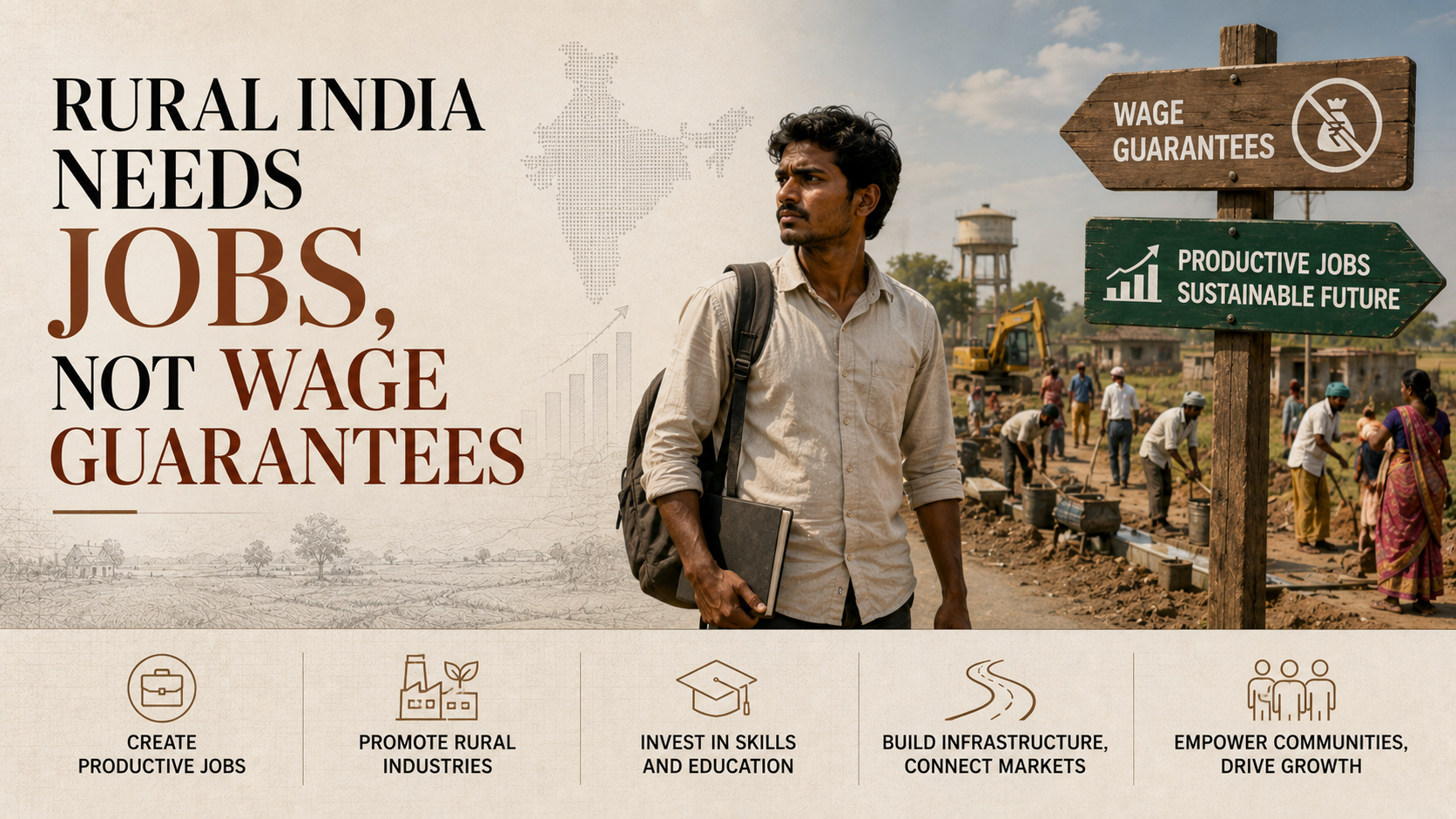
An opinion piece argues that a new rural wage-guarantee scheme has recorded low uptake among the rural workforce, and contends this shows rural India needs durable, income-generating employment rather than a guaranteed-wage safety net. The scheme pays a guaranteed wage for a fixed number of days, which the piece contrasts with sectors such as food processing, renewable energy and small and medium enterprises (SMEs), which it argues could generate sustained employment rather than a temporary income floor. The tension is between a safety-net approach to rural distress and a growth-oriented approach that builds durable non-farm jobs.
Why has the wage-guarantee scheme seen low uptake?
- Wage ceiling below market rates: Where the scheme’s guaranteed wage sits below prevailing local market wages for casual labour, workers have limited incentive to enrol, since informal market work pays more for the same effort.
- Seasonal mismatch: A fixed-day guarantee does not align well with the seasonal peaks in rural labour demand during sowing and harvest, when private demand for labour already absorbs much of the available workforce.
What alternative does the piece propose?
- Food processing: Expanding food processing capacity near production zones can absorb rural labour in agro-processing roles that persist beyond a single season.
- Renewable energy: Rural solar and biomass energy projects can generate sustained local employment in installation, operation and maintenance roles.
- Small and medium enterprises: Supporting rural SMEs with credit and market access can create employment that grows with demand, rather than being capped at a fixed number of guaranteed days.
Unemployment in India
- The International Labour Organization (ILO) defines an unemployed person as someone of working age, without work, currently available to work and actively seeking work in a reference period.
- India’s unemployment carries several distinct types: frictional, structural (a mismatch between workers’ skills and market demand), cyclical, seasonal, disguised (as in agriculture, where more people are employed than the work requires), and chronic.
- Over 90 percent of India’s workforce remains informal, which limits meaningful, secure job creation regardless of headline employment growth.
- Manufacturing contributes only about 16 to 18 percent of GDP, well below China’s roughly 26 percent, constraining the sector’s capacity to absorb surplus labour.
Government Initiatives for Employment Generation
- Mahatma Gandhi National Rural Employment Guarantee Act (MGNREGA), 2005: Guarantees 100 days of rural wage employment a year to any adult member of a rural household, and is the specific scheme this op-ed’s wage-guarantee critique concerns.
- PM Vishwakarma: Provides collateral-free loans, skilling and toolkits to artisans across 18 traditional trades.
- PM Vishwakarma Rozgar Yojana / Employment Linked Incentive (ELI) scheme: Approved with an outlay of about 99,446 crore rupees, targeting 3.5 crore jobs over two years.
- e-Shram Portal: A national database that issues unorganised workers a Universal Account Number and links them to social security schemes.
- DAY-NRLM: Mobilises the rural poor into Self-Help Groups to build self-sustained livelihoods.
Challenges in Unemployment
- Survey design undercounts informal and rural work: Household surveys do not fully capture home-based, gig or platform work within the roughly 90 percent informal workforce, and rural labour force surveys have historically run at a lower frequency than urban ones. Eg. Rural Periodic Labour Force Survey (PLFS) data was measured only annually for years, while urban data was collected quarterly, understating rural distress in real time. Fix. Move rural PLFS to the same quarterly frequency as urban surveys and explicitly incorporate underemployment into the headline definition.
- Capital-intensive growth limits absorption: Investment has flowed disproportionately toward information technology and infrastructure rather than labour-intensive sectors capable of absorbing low and semi-skilled workers. Eg. Services now drive the largest share of GDP growth while employing under 30 percent of the workforce, the jobless growth pattern this op-ed’s wage-guarantee critique responds to. Fix. Direct incentive schemes toward labour-intensive sectors such as textiles, leather, food processing and electronics assembly rather than capital-intensive ones alone.
Conclusion
The piece argues that a wage-guarantee scheme with low enrolment is evidence that rural India’s underlying problem is a shortage of durable jobs, not a shortage of a temporary income floor, and that policy should shift resources toward sectors capable of generating sustained rural employment.
Back2Basics: Periodic Labour Force Survey (PLFS)
- The PLFS is India’s principal household survey for estimating employment and unemployment, conducted by the National Sample Survey Office (NSSO) under the Ministry of Statistics and Programme Implementation (MoSPI).
- It reports unemployment on three measures: Usual Status (activity over the preceding year), Current Weekly Status, and Current Daily Status, the last of which best captures underemployment.
- It has historically surveyed urban areas quarterly but rural areas only annually, a frequency gap that limits its ability to track rural distress as it develops.
“[2023, GS3, 15 marks] Most of the unemployment in India is structural in nature. Examine the methodology adopted to compute unemployment in the country and suggest improvements.”
