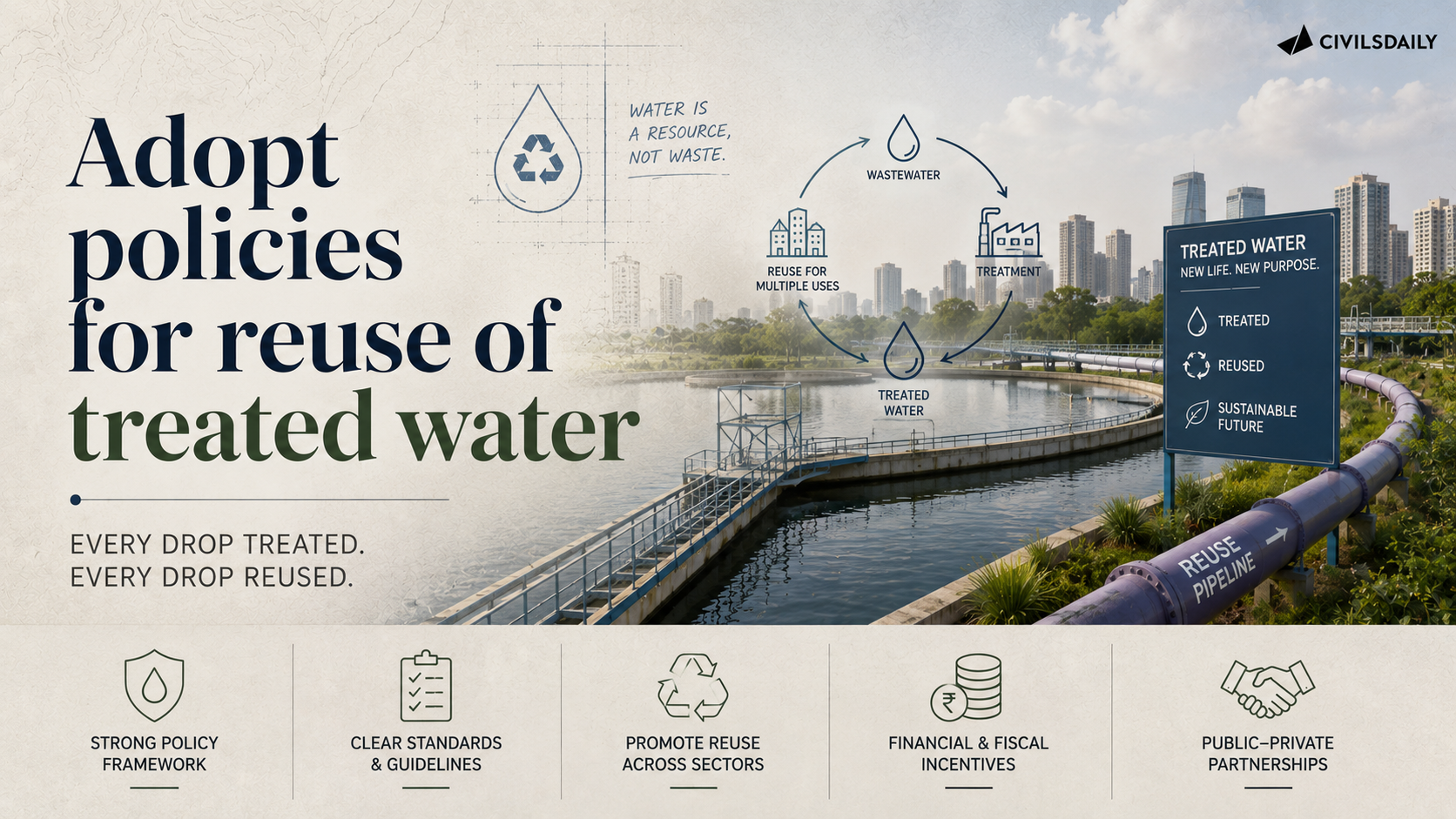
| Question (2025, GS3): “Examine the factors responsible for depleting groundwater in India. What are the steps taken by the government to mitigate such depletion of groundwater? Linkage: The safe reuse of treated water is a critical step in mitigating groundwater depletion. By directing treated wastewater to agricultural fields (“farms”) and industrial units (“factories”), states can significantly reduce their dependence on fresh groundwater extraction. |
Mentor Comment
Uttar Pradesh and Uttarakhand have notified treated wastewater reuse policies built for their own geography rather than on a single national template. Both were framed through an extensive consultative process, and both separate the needs of hill communities from those of densely populated plains. They follow the National Framework on Safe Reuse of Treated Water (SRTW), 2022, which made reuse a stated national priority and required States to frame reuse policies of their own. The tension is that sewage treatment capacity has already been built at scale under the Atal Mission for Rejuvenation and Urban Transformation (AMRUT), the central urban mission that funds water supply and sewerage, and a plant discharging into a drain rather than into a farm or a factory returns no water to the system.
What is the National Framework on Safe Reuse of Treated Water, 2022?
- What it establishes: It sets the national position that reuse of treated water is a priority rather than a peripheral option, which is a policy signal as much as a guidance document.
- How it devolves: It requires States to develop their own reuse policies, on the reasoning that water solutions are local even where the ambition is national.
What makes the two State policies a departure from template policymaking?
- Geography is written into the policy: Each policy accounts for the stark internal diversity of its State, treating hill settlements and dense plains as different reuse problems.
- Reuse is matched to purpose: Both embed fit for purpose reuse, so water is treated to the standard its end use needs rather than to a single quality for every user.
- Reuse is tied to other plans: Both integrate reuse with urban planning and with river rejuvenation, instead of running it as a standalone sanitation activity.
- Financing and monitoring are built in: Both carry community participation, blended finance and public private partnership pathways, and digital monitoring systems that make reuse accountable.
Why does built treatment capacity not become reuse?
- A plant without an offtake is idle capacity: National missions have scaled treatment infrastructure, and pipes and plants alone do not close the loop when the output goes into a drain.
- Departments do not work together: Utilities, urban departments, irrigation agencies and industries operate in silos, and reuse succeeds only where they operate as one chain.
- There is no price signal: Reuse becomes economically rational only when pricing reflects what freshwater actually costs the system.
- End users have no assurance: Quality standards are what give a farmer or a factory confidence to take treated water as an input.
- National ambition has no local plan: City level roadmaps are what convert a national framework into action by a specific municipal body.
What is the economic case for reuse?
- A supply that does not fail: Treated wastewater offers agriculture, industry, urban landscaping and ecological restoration a reliable and drought proof supply, which is increasingly rare.
- It reduces a costly dependence: Reuse cuts expenditure on sourcing fresh water and builds climate resilience into a city’s water balance.
- It removes a ceiling on growth: Industrial and urban expansion can proceed without straining existing freshwater supplies, and it supports low carbon urban development at scale.
- The case has not been made to the decision maker: Until this computable value is put clearly to State governments and planners, the policy remains an aspiration rather than a budget line.
What decides whether a State actually adopts reuse?
- Money comes from convergence, not new allocations: The financial momentum for reuse targets is unlocked by identifying synergies with already funded schemes rather than by fresh budgetary provision.
- Public resistance is the deeper constraint: Misconceptions about the safety of treated water run deep, which is why the national framework and both State policies name treated water Apna Jal, our water.
- The shift required is psychological: No document can produce acceptance on its own, and the naming choice is an attempt to change how the resource is perceived before it is used.
- Delay compounds: States without a clear reuse plan for water security are not merely behind others, they are running out of time to catch up.
Challenges to the National Framework on Safe Reuse of Treated Water, 2022
- The Framework carries no enforceable target: It directs States to frame reuse policies and fixes no volume any State must actually reuse, so a policy can be notified without a single litre changing hands. Eg. Maharashtra’s obligation to reuse 20 per cent of effluent comes from its own State water regulator rather than from any national instrument. Fix. Attach a reuse share to the consent to discharge issued under the Water (Prevention and Control of Pollution) Act, 1974, so the obligation sits on the discharger.
- Supply is continuous and demand is seasonal: A treatment plant produces a steady flow around the clock and agricultural offtake follows the cropping calendar, and the storage that bridges the two is rarely built. Eg. Chennai contracted its tertiary treatment output to industrial users in the Manali belt precisely because industry draws a steady year round volume. Fix. Contract an anchor buyer before a plant is commissioned rather than after it is built.
- Reuse in food crops carries a health exposure: Irrigation with partially treated sewage moves pathogens and heavy metals into the food chain, and the risk falls on consumers who never chose the input. Eg. The Musi river corridor downstream of Hyderabad has long been irrigated with untreated and partially treated sewage. Fix. Enforce end use specific quality tiers, with the strictest limits for crops eaten raw.
- The certifier is also the enforcer: State Pollution Control Boards must certify effluent quality and simultaneously prosecute the dischargers they certify, and they are thinly staffed for either task. Eg. Central Pollution Control Board reviews have repeatedly found a large share of sewage treatment plants operating outside discharge norms. Fix. Separate reuse quality certification from the enforcement function, and staff the certification arm to the number of plants it must clear.
Conclusion
The variable that decides reuse is not how much treatment capacity exists but who has contracted to take the output. What to watch is whether the States that have notified policies convert a stated reuse target into signed offtake agreements with irrigation agencies and industry, since that is the point at which a policy becomes a volume of water. The measure worth tracking is the share of treated sewage actually reused, not the share treated.
Reuse of Treated Water in India
- What the activity is: Sewage or industrial effluent is processed to a defined quality standard and then supplied for a use that does not require freshwater.
- How little is recovered: Around 28 per cent of India’s sewage is treated and barely 3 per cent of that is beneficially reused, per the Central Pollution Control Board (CPCB).
- The resource ahead: Over 35,000 million cubic metres of treated wastewater is expected to be available by 2050.
- Why the resource matters: India holds around 18 per cent of the world’s population and about 4 per cent of its freshwater, and per capita availability had fallen to 1,486 cubic metres by 2021, below the 1,700 cubic metre stress threshold.
Laws and Rules Governing Reuse of Treated Water
- Water (Prevention and Control of Pollution) Act, 1974: Created the Central Pollution Control Board and the State Pollution Control Boards, and made the discharge of sewage or trade effluent into a water body subject to their consent.
- Water (Prevention and Control of Pollution) Amendment Act, 2024: Rationalised the penalty regime, replacing prosecution for a set of minor offences with monetary penalties decided by an adjudicating officer.
- Environment (Protection) Act, 1986: The source of the effluent discharge standards a treatment plant must meet before its output is discharged or supplied to a reuse customer.
- Entry 17 of the State List: Water supply, irrigation and drainage are State subjects, which is why a national framework can direct States to act but cannot itself operate a reuse policy.
Government Initiatives for Reuse of Treated Water
- Namami Gange Programme: Funds sewage treatment across the Ganga basin, including colony level decentralised plants and the reuse of treated water for irrigation.
- National Water Mission: Targets a 20 per cent improvement in water use efficiency, with reuse counted as a demand side measure alongside conservation.
- Maharashtra Water Resources Regulatory Authority mandate: The State regulator requires 20 per cent effluent reuse, a model NITI Aayog has endorsed for wider adoption.
- Water Reuse Certificates: Developed by the World Bank hosted 2030 Water Resources Group, these are tradable permits on a cap and trade model, with higher quality treated water earning more credits.
