Why in the News
The Tamil Nadu Chief Minister has opened the sluice gates of the Mettur Dam, giving some relief to Cauvery Delta farmers after a delayed irrigation season. The Tamil Nadu government has ascribed the delay to a deficit in the southwest monsoon and to Karnataka’s failure to honour its water sharing obligation under the Supreme Court’s 2018 verdict.
What is the Cauvery Management Authority?
- What it was set up to do: The Authority was constituted to oversee the implementation of the Supreme Court’s 2018 verdict on the sharing of the Cauvery’s waters.
- Its statutory basis: It was created under the Inter-State River Water Disputes Act, 1956, following the Court’s direction that a scheme be framed to give effect to the award.
- How it operates: A regulation committee assesses storage, inflows and crop water requirements and advises the Authority, which then directs releases between the basin States.
- Where it works: The Authority has functioned during normal monsoon years, when the allocation the verdict fixed can simply be applied.
Why did this year’s Mettur schedule slip?
- The normal calendar: In a normal year the dam opens on 12 June and its gates are shut on 28 January, giving the region’s agriculturists a 230 day irrigation window.
- The schedule is not self executing: That calendar is contingent on the monsoon and on the release of water in the Cauvery’s upstream by Karnataka.
- What went wrong this year: The Tamil Nadu government attributed the delay to the southwest monsoon deficit and to Karnataka not meeting its release obligation.
- What the opening actually buys: With the rainfall deficit narrowing in August, the Tamil Nadu government has leeway to release water for 45 days, well short of a full season.
What does the 2018 verdict not settle?
- No distress sharing formula: The Court did not codify a formula for water sharing in years when the rains play truant, so a deficit year has no rule to fall back on.
- The sustainability direction did not bind: The Court’s emphasis on sustainable water use was lost on the two States, which continued to plan as though the allocation were guaranteed.
- The gap shows up on the first bad monsoon: The dispute flared again in 2023, the first below par monsoon after 2018, and the same pattern has repeated this year.
- Litigation is the default, not the exception: Tamil Nadu has said it will continue legal efforts to secure its share, which returns the question to a forum that has already declined to write a distress rule.
Why has the Mekedatu proposal deepened the deadlock?
- The proposal: Karnataka’s push for the Mekedatu Dam on the river has reignited old fears downstream.
- Karnataka’s case: The Karnataka government argues the dam would primarily serve Bengaluru’s water needs while allowing better regulation of releases.
- Why it has not landed: That argument has found no takers in Tamil Nadu, where a storage structure upstream reads as an instrument of control rather than of regulation.
- The underlying shift: The Cauvery today has to meet the competing demands of agriculture and urbanisation, and the two States sit on opposite sides of that shift.
What would a negotiated settlement have to contain?
- A move away from the courtroom: Rather than lean on the judiciary, the Cauvery dependent States would do well to come together and plan for the efficient use of the river’s waters.
- Demand side measures: Solutions range from disincentivising water intensive crops to encouraging decentralised water management.
- The expertise required: Any such plan will need inputs from hydrologists, economists, agricultural scientists and farmers’ organisations.
- The political precondition: Representatives of the two States will need to sit together, understand each other’s fears and shed confrontationist attitudes.
Challenges to the Cauvery Management Authority
- No enforcement machinery of its own: The Authority depends on the two State governments to execute its release directions and holds no independent field administration. Eg. Its directions in the deficit year of 2023 were contested by Karnataka and taken back to the Supreme Court.
The Fix: Give the Authority operational control over gate operations at specified control points for the duration of a declared distress period. - Storage and inflow data are State reported and contested: Each State submits its own figures on realisable flows, so the Authority arbitrates between rival datasets before it can decide anything. Eg. The two States have filed conflicting inflow estimates for the same periods at Biligundlu, the inter State measuring point.
The Fix: Place telemetry at every control point under a jointly audited third party gauge network publishing real time readings. - Groundwater sits outside the allocation: The award divides surface flows alone, so competing extraction continues unregulated on both sides of the border. Eg. The Central Ground Water Board classifies several assessment units in the Cauvery basin as over exploited.
The Fix: Notify a joint basin wide extraction cap alongside the surface allocation, so a shortfall in releases is not simply pumped out of the aquifer. - Electoral cycles set State positions: Water release becomes an electoral question in both States, which raises the political cost of any concession to the point where none is offered. Eg. Assembly resolutions and shutdowns in Karnataka have followed release orders in successive dispute years.
The Fix: Shift the release decision to a pre agreed rule curve triggered by reservoir storage, so no government has to announce a discretionary concession.
Conclusion
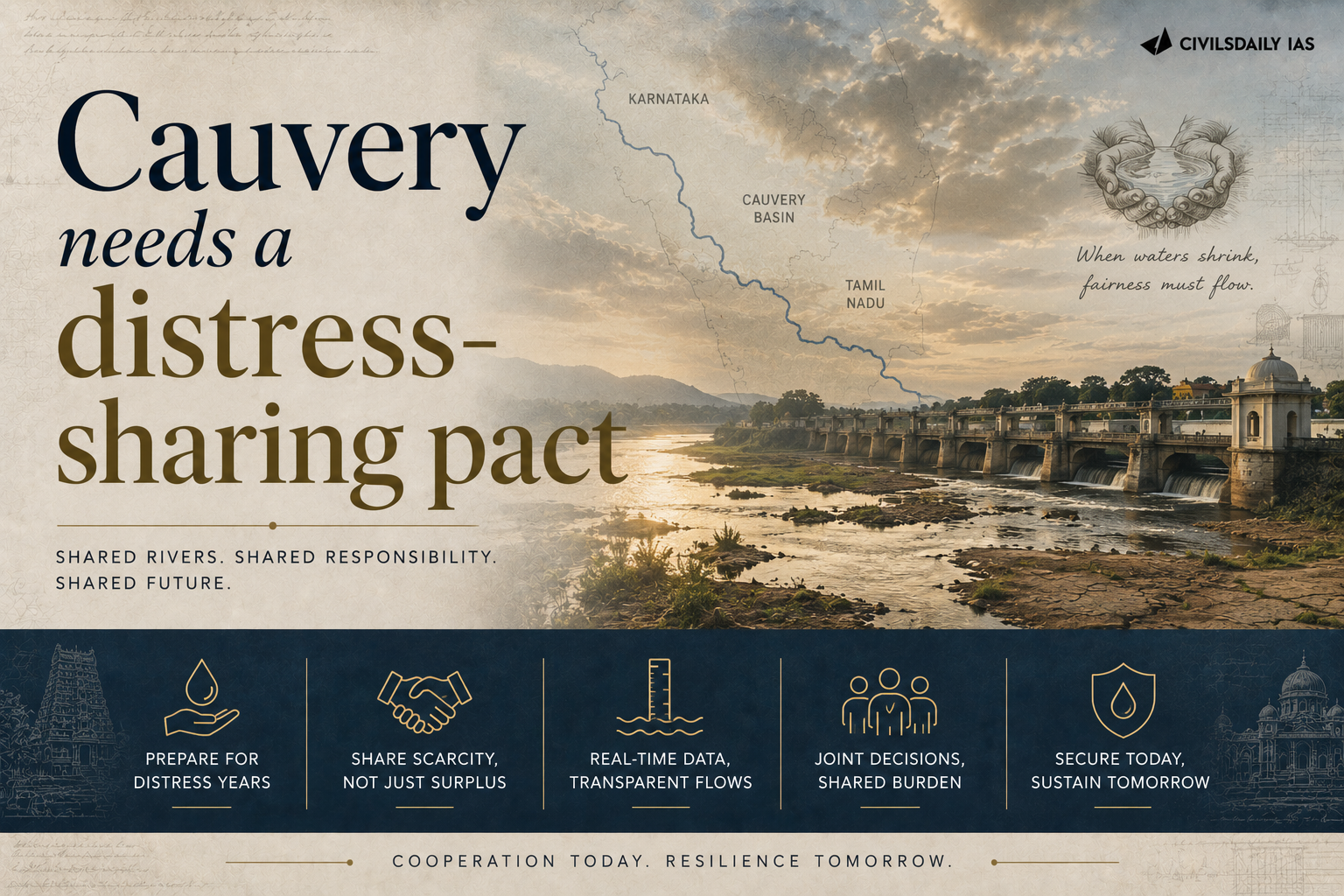
A river shared by two States needs a rule for the bad years, not only for the good ones. The Cauvery has one for the good years, and every deficit season is therefore litigated afresh. The forward step is a negotiated distress sharing pact between the basin States, agreed before the next failed monsoon rather than during it, and covering the cities as well as the fields. Until such a pact exists, each shortfall will keep arriving at a court that has already declined to supply the formula the States will not write for themselves.
Back2Basics: Mettur Dam
- Where it is: The dam is built across the Cauvery at Mettur in the Salem district of Tamil Nadu, at the point where the river enters the plains.
- When it was built: It was completed in 1934 and is one of the oldest large dams in India.
- What it holds: Its reservoir is known as the Stanley Reservoir, and it serves irrigation, drinking water and hydroelectric generation.
- What it commands: Releases from Mettur irrigate the Cauvery delta districts, which is why the date on which its gates open sets the cropping calendar for the region.
[2013, GS2, 10 marks] Constitutional mechanisms to resolve the inter-state water disputes have failed to address and solve the problems. Is the failure due to structural or process inadequacy or both? Discuss.”
