Why in the News
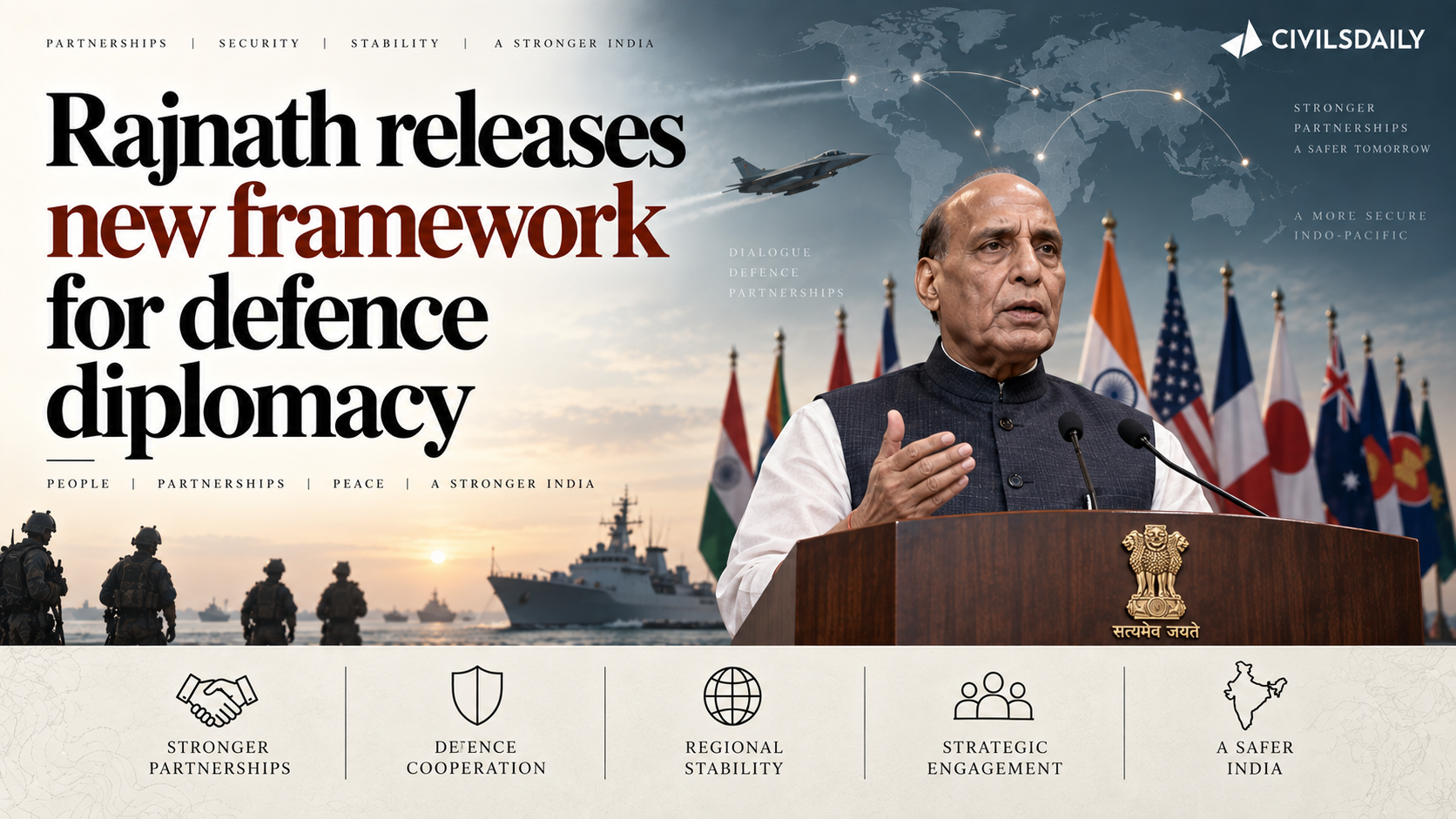
The Defence Minister has released Raksha, a strategic framework setting out India’s road map for defence diplomacy and global defence partnerships over the next ten years.
Pillars of the Raksha framework
- Bilateral and multilateral defence partnerships: Deepening defence relationships with individual states and within groupings is the first stated pillar.
- Joint military exercises: The framework provides for expanding the scale and range of joint exercises with partner forces.
- Capacity building with friendly countries: Training and capability assistance to partner militaries is treated as a distinct instrument rather than a by-product of exercises.
- Indigenous defence exports and maritime security: Promoting exports of indigenously developed systems under Make in India, and strengthening maritime security, complete the set of pillars.
How does the framework use defence exports as a diplomatic instrument?
- The industrial objective is tied to the diplomatic one: Export promotion is placed inside a diplomacy document, so a sale is treated as a partnership rather than as a transaction.
- The positioning sought: The framework seeks to establish India as a reliable global defence manufacturing partner.
- The route named: International cooperation is to be expanded around indigenously developed defence technologies, rather than around licensed or assembled platforms.
What does the net security provider role commit India to?
- A first responder duty: The framework places India as a net security provider and first responder in the Indian Ocean Region, which requires capacity to act before a partner state formally requests help.
- A stated regional commitment: The road map records a commitment to ensuring peace, stability and security across the region.
- Maritime security as the operating theatre: The Indian Ocean Region framing makes the maritime domain the principal arena in which the other pillars are exercised.
- A decade long planning horizon: A ten year design replaces case by case engagement, which changes what can be promised to a partner and over what period.
Challenges to India’s defence diplomacy
- Exports remain concentrated in low value items: Much of India’s defence export value is components and subsystems supplied to foreign manufacturers rather than complete platforms. Eg. Aerostructures, forgings and subsystems account for a substantial share of the export figure India reports each year.
The Fix: Set platform level export targets by category in the framework’s review, reported separately from the aggregate value. - Capacity building commitments outrun training capacity: Offering training slots to partner militaries requires physical capacity at Indian institutions, which is finite and allotted well in advance. Eg. Foreign officer vacancies at Indian staff and war colleges are limited and booked years ahead.
The Fix: Fund dedicated foreign trainee capacity at named institutions inside the framework, rather than from existing service training budgets. - First responder assets are committed elsewhere: The same ships and aircraft carry out relief, escort and patrol tasking in overlapping waters. Eg. Naval units deployed for anti piracy escort in the western Indian Ocean are the units nearest to most regional relief tasks.
The Fix: Ring fence a standing humanitarian assistance and disaster relief task group with pre positioned stores in the region. - Export promotion collides with partner sensitivities: A sale to one regional state can strain relations with its rival, which turns a commercial decision into a political one. Eg. India’s supply of BrahMos missiles to the Philippines drew objections from China.
The Fix: Publish a case by case political clearance process for defence exports, so industry can price the risk of refusal before bidding. - A framework document carries no reporting duty: A ten year horizon with no interim review point cannot be tested against performance at any stage before it ends. Eg. The document states pillars without naming an annual reporting mechanism against them.
The Fix: Fix a mandatory annual report against each pillar, carrying indicators for exercises held, officers trained and export value.
Conclusion
Defence diplomacy has been run through individual visits, exercises and agreements decided one at a time. A published decade long framework changes the planning horizon and states the objective, and it does not by itself create an institution to execute it. The marker to watch is whether the framework acquires a named owner and an annual review reporting against each pillar, or remains a statement of direction.
Back2Basics: Net security provider
- What the term means: A state that supplies security to others in its region, rather than only securing itself, through presence, capability and assistance extended to partner states.
- How India uses it: The formulation entered Indian strategic vocabulary around 2009 and is applied to the Indian Ocean Region, where India’s navy is the largest resident force.
- What it involves in practice: Anti piracy patrols, humanitarian assistance and disaster relief, evacuation of nationals, hydrographic survey support and maritime domain awareness shared with partner states.
- The policy vehicles: The Security and Growth for All in the Region (SAGAR) vision, the Indian Ocean Naval Symposium, and coastal radar chains built for partner countries.
[2025, GS3, 15 marks] Why is maritime security vital to protect India’s sea trade? Discuss maritime and coastal security challenges and the way forward.”