Why in the News
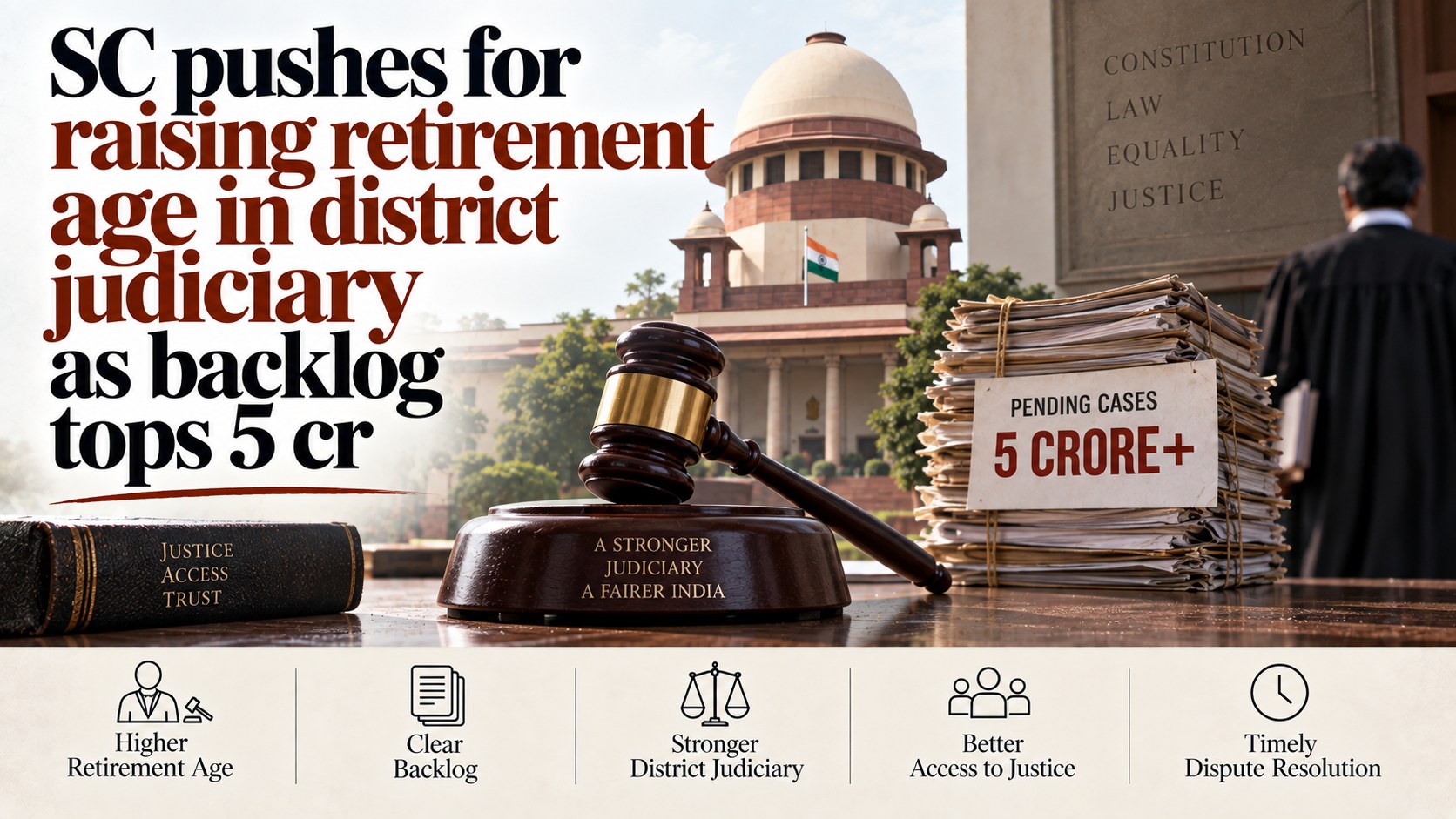
The Supreme Court has directed States to raise the retirement age of judicial officers in the district judiciary from 60 to 62 years. A three judge Bench headed by the Chief Justice of India passed the order on 1 September, and the text was published on Friday. The Court recorded that 5.18 crore cases lie pending in district courts across the country. It described stopping the attrition of experienced judicial talent as the “crying need of the hour”, warning that access to justice would otherwise remain “a mere chimera” because of unfilled posts. Only seven States have agreed so far. The rest have resisted on the ground of financial burden, which the Court has held to be arithmetically misconceived.
What has the Court directed, and to whom?
- The seven States that agreed: Chhattisgarh, Karnataka, Madhya Pradesh, Maharashtra, Sikkim, Tamil Nadu and West Bengal have agreed to enhance the retirement age of their judicial officers.
- The deadline for them: These State governments have been directed to amend their service rules within two months.
- The condition attached: The High Court concerned will enhance superannuation to 62 years for an officer on attaining 60, subject to an assessment of that officer’s suitability.
- The States and Union Territories yet to agree: Andhra Pradesh, Arunachal Pradesh, Assam, Bihar, Goa, Gujarat, Haryana, Himachal Pradesh, Jharkhand, Keralam, Manipur, Meghalaya, Mizoram, Nagaland, Odisha, Punjab, Rajasthan, Telangana, Tripura, Uttarakhand, Uttar Pradesh, the National Capital Territory of Delhi, Jammu and Kashmir and Puducherry have responded with a direct refusal or have taken no position at all.
- The deadline for them: They have been directed to take a decision on enhancement to 62 years within two weeks.
Why does the Court treat attrition rather than recruitment as the binding constraint?
- Recruitment has not filled the cadre: Most recruitment drives undertaken in the various States have not produced optimum recruitment or filled the sanctioned cadre strength.
- The gap is universal: A yawning gap between sanctioned strength and working strength persists across the board.
- Recruitment is slow by design: Selecting independent and competent judicial officers is an arduous task, so a post is not refilled at the speed at which it falls vacant.
- What that leaves as the available lever: Retaining an officer already in service is the only step that adds working strength without waiting for a recruitment cycle.
Why does the Court reject the financial burden objection?
- What the States fear: States cite the cost of paying the maximum salary in the pay scale for a further two or five years, and a higher outlay on retiral benefits.
- The parity fear: States also apprehend that employees in other State services would demand the same extension for themselves.
- Why the Court calls that misconceived: Judicial officers render a specialised service, so an extension confined to them does not found a claim by other cadres.
- The 1992 precedent quoted: The alleged burden on the State exchequer is negligible against the enormous advantage the administration of justice and society at large derive from a higher retirement age.
- The double spend: A State that retains retirement at 60 pays post retiral dues to the officer who has left and salary to the officer newly appointed, in the same period.
- What continuation does to that cost: Allowing an experienced officer to serve to 62 postpones the post retiral outlay rather than adding to it.
What safeguard have the High Courts proposed?
- Why most High Courts agreed: Most State High Courts consented to the enhancement because they are face to face with the crisis in the dispensation of justice.
- The rider: Some High Courts, including Madras, have recommended a thorough assessment of judicial work as a condition precedent to continuation in service.
- What the rider is for: Only competent officers of proven integrity would be permitted to continue in the cadre.
- The Court’s view of it: The suggestion preserves experienced officers while removing what the Court called the “clog of deadwood” that blocks the entrance of young blood into the system.
Challenges to raising the retirement age in the district judiciary
- The sanctioned strength is itself inadequate: Extending tenure fills posts within an existing cadre, and the cadre was fixed against a judge to population ratio far below what has been recommended for India. Eg. The Law Commission’s 120th report of 1987 recommended 50 judges per million population, against a sanctioned figure that has stayed close to 21.
The Fix: Revise sanctioned cadre strength against a stated case load norm, and attach a dedicated State budget line to the additional posts. - A suitability assessment can become an informal removal power: Continuation to 62 will turn on a High Court’s assessment, which inserts a discretionary stage into a service that otherwise holds tenure until superannuation. Eg. Compulsory retirement of judicial officers on the administrative side has repeatedly been challenged before the Supreme Court.
The Fix: Publish the assessment criteria in advance and require a written reasoned order with an internal review, so a refusal to extend can be tested. - Court infrastructure does not expand with tenure: A retained officer needs a courtroom, support staff and record space, and district court infrastructure is funded through a centrally sponsored scheme that depends on State matching contributions. Eg. The Centrally Sponsored Scheme for Development of Infrastructure Facilities for the Judiciary has run since 1993-94 with persistent shortfalls in court halls and residential units.
The Fix: Link the release of infrastructure funds to the number of judicial officers actually working in a district rather than to sanctioned posts. - The promotion chain below is frozen: Officers waiting for elevation to the District Judge cadre and for High Court appointment from the service quota face a two year delay in every vacancy. Eg. Appointments to High Courts from the district judiciary already move slowly through the collegium process.
The Fix: Expand the number of posts in the higher judicial service in step with the extension, so the vacancy chain continues to move. - Pendency has drivers that bench strength does not reach: Adjournments, failure of service of summons and the volume of government litigation extend case life independently of how many judges sit. Eg. Government departments and their agencies remain the largest single class of litigant before Indian courts.
The Fix: Enforce the three adjournment limit already written into Order XVII of the Code of Civil Procedure, 1908, and screen government appeals before they are filed.
Conclusion
The Court has converted a suggestion into a directed timeline, and the decision now sits with State governments rather than with the judiciary. Its reasoning treats the age of superannuation as the one lever that can be pulled without waiting for a recruitment cycle to conclude. The case is listed again on 1 October, by which time the States that have not responded are required to have taken a position.
Back2Basics: The District Judiciary under the Constitution
- Article 233: The Governor appoints district judges in consultation with the High Court exercising jurisdiction in that State.
- Article 234: Persons other than district judges are appointed to the State judicial service by the Governor, under rules made after consulting the State Public Service Commission and the High Court.
- Article 235: Control over district courts and subordinate courts, including posting, promotion and leave of judicial officers, vests in the High Court.
- Why a State government must act: Conditions of service, including the age of superannuation, are fixed by rules the State government frames, so a High Court’s consent by itself does not change a retirement age.
[2017, GS2, 10 marks] Critically examine the Supreme Court’s judgement on ‘National Judicial Appointments Commission Act, 2014’ with reference to appointment of judges of higher judiciary in India.
