Why in the News
- The Supreme Court has held that confidentiality in judicial appointments is necessary to preserve the integrity of the appointment process.
- The issue arose in Arvind Malhotra v. High Court of Himachal Pradesh, involving a judge who challenged the elevation of a junior judge to the Supreme Court.
- The case brings into focus the debate between confidentiality and transparency in judicial appointments.
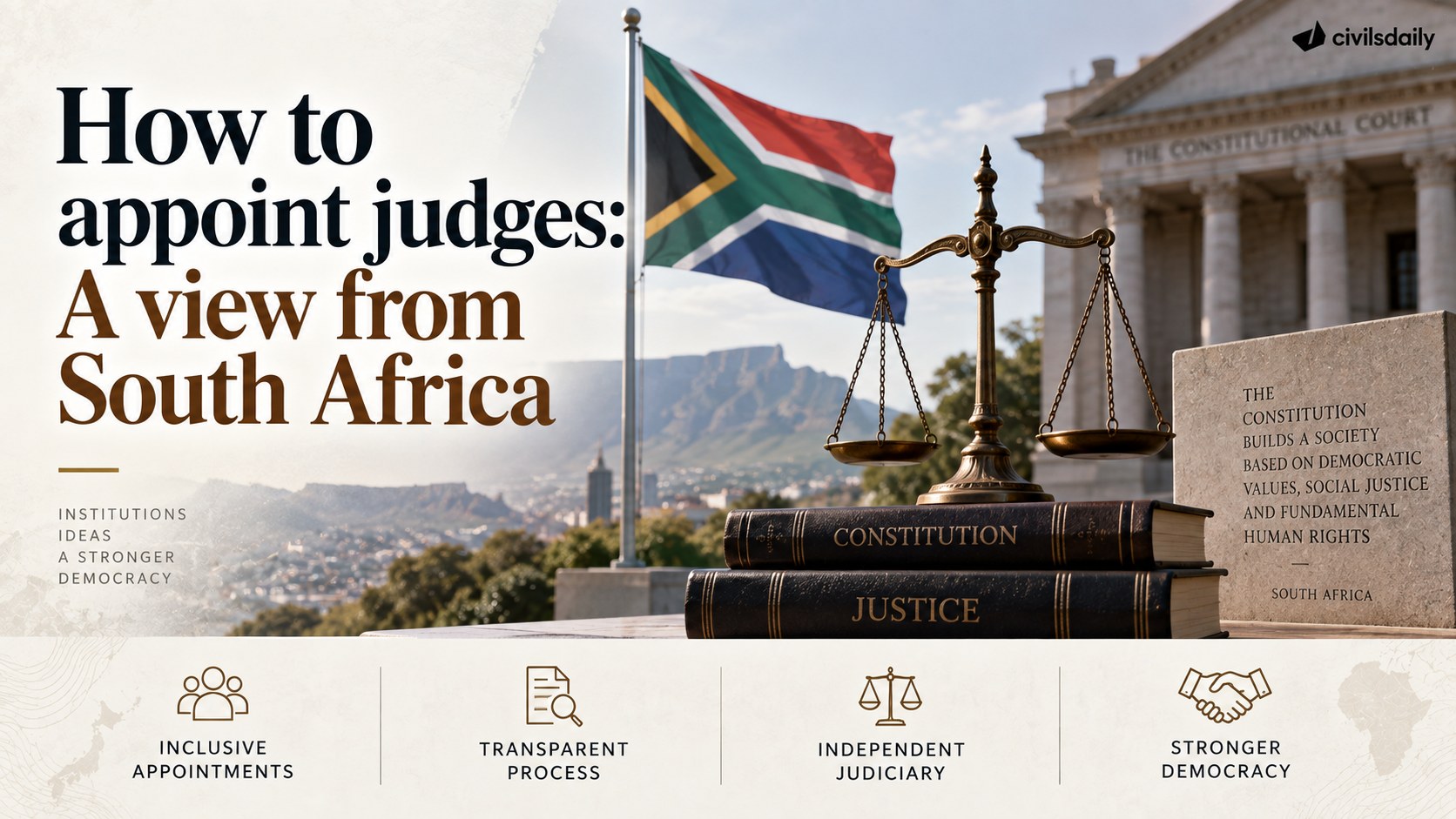
Judicial Service Commission of South Africa
- The Judicial Service Commission (JSC) is a constitutional body involved in judicial appointments in South Africa.
- It includes judges, lawyers, legal academics and political representatives.
- Its proceedings are conducted publicly and broadcast.
- Process involves:
- Calling for nominations.
- Preparing a shortlist.
- Inviting public comments.
- Conducting public interviews.
- Voting where members disagree.
- The identity of individual votes remains confidential.
Judicial Accountability in South Africa
- Judges do not enjoy special immunity from complaints regarding conduct.
- The JSC can investigate allegations of improper conduct.
- Serious cases can lead to a public enquiry and recommendations for impeachment.
Constitutional Provisions
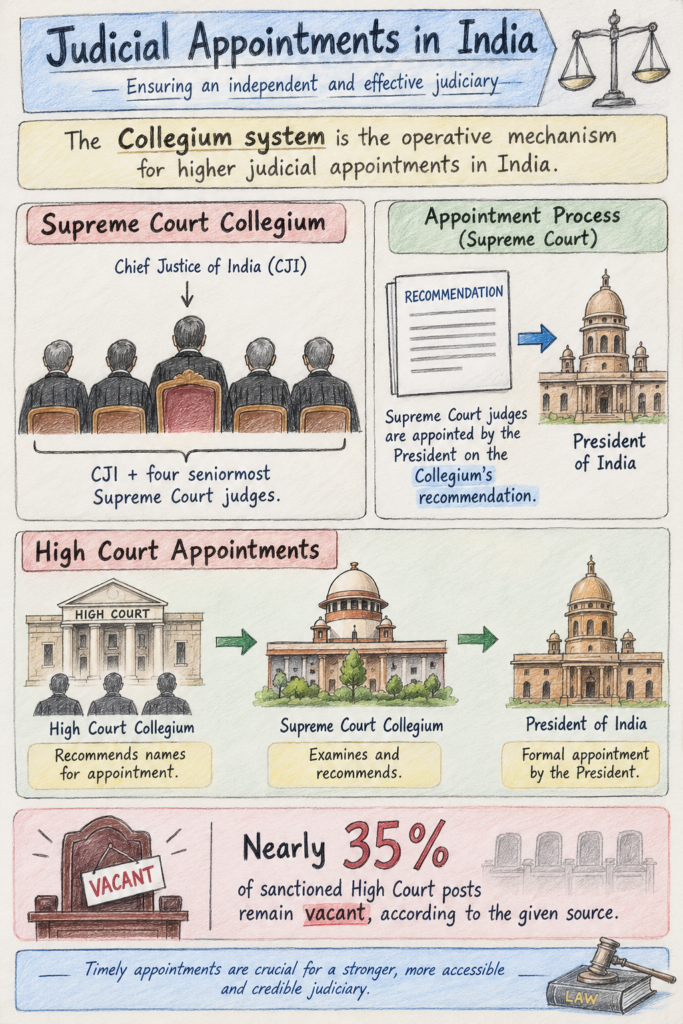
- Article 124: Appointment of Supreme Court judges.
- Article 217: Appointment of High Court judges.
- 99th Constitutional Amendment Act, 2014: Provided for the National Judicial Appointments Commission (NJAC).
- 2015: Supreme Court struck down the NJAC framework and restored the Collegium system.
Major Concerns
- Judges appointing judges: Concerns regarding limited external checks and accountability.
- Transparency: Collegium resolutions are published, but detailed reasons for selection are generally not disclosed.
- Representation: Concerns regarding social and regional diversity in higher judiciary.
- Objective merit: Absence of a publicly stated and standardised evaluation framework.
- Regional imbalance: Some High Courts remain unrepresented in the Supreme Court.
Way Forward
- Develop clear and publicly stated selection criteria.
- Improve transparency while protecting legitimate confidentiality.
- Consider regional and social representation alongside merit.
- Strengthen mechanisms for addressing complaints against judicial officers.
- Maintain the essential balance between judicial independence and public accountability.
Prelims Pointers
- Article 124 → Supreme Court judges.
- Article 217 → High Court judges.
- Collegium → Judicial appointments to higher judiciary.
- NJAC → Created through 99th Constitutional Amendment, 2014.
- NJAC struck down → 2015.
- South Africa JSC → Constitutional body involved in judicial appointments.
- TRAI vs JSC: JSC is a constitutional judicial appointments body in South Africa, while India’s Collegium is a judge-led mechanism evolved through judicial decisions.
[2012] What is the provision to safeguard the autonomy of the supreme court of India?
1. While appointing the Supreme Court judges, the president of India has to consult the CJI.
2. the SC judges can be removed by the CJI only
3. the salaries of judges are charged on the consolidated fund of India to which the legislature does not have to vote.
4. All appointments of officers and staffs of the SC are made by the govt only after consulting the CJI
Which of the statements given above is/are correct?
[A] 1 and 3 only
[B] 3 and 4 only
[C] 4 only
[D] 1, 2, 3 and 4