| Question (2025, GS2 – 10 Marks): Discuss the ‘corrupt practices’ for the purpose of the Representation of the People Act, 1951. Analyze whether the increase in the assets of the legislators and/or their associates, disproportionate to their known sources of income, would constitute ‘undue influence’ and consequently a corrupt practice. Linkage: A sudden 223% surge in the declared income of unrecognised political parties—many of which do not contest elections—raises grave concerns about financial opacity, money laundering, and misuse of tax-exempt conduits. This question examines how disproportionate financial growth intersects with corrupt practices under the Representation of the People Act (RPA), 1951. |
Mentor Comment
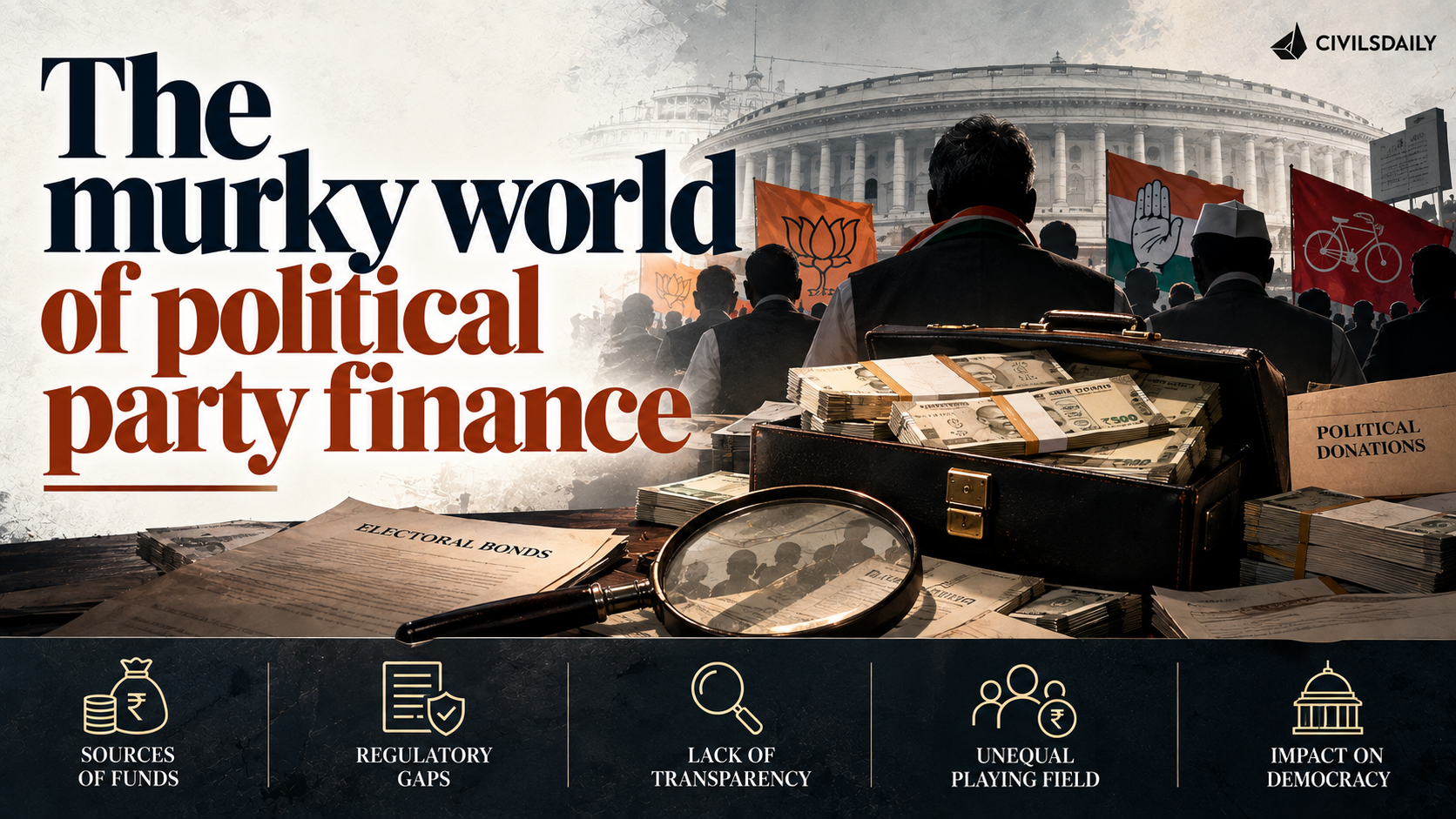
An investigation has revealed extraordinary donations received by six Registered Unrecognised Political Parties (RUPPs), which hold registration with the Election Commission of India (ECI) but have earned no electoral recognition. The disclosure follows a report of 18 July 2025 by the Association for Democratic Reforms (ADR) finding a 223 per cent rise in the declared income of RUPPs in the 2022 to 2023 financial year. Political parties hold no independent place in the Constitution, yet they receive donations and carry a standing income tax exemption on them. The ECI is the sole custodian under the law of the fate and fortunes of political parties, and it can neither deregister a party nor audit its accounts as a matter of routine. The contested point is whether that regulatory authority is genuinely absent or simply unused.
What is the legal status of a political party in India?
- Constitutional position: The Constitution does not mention political parties, except in the Tenth Schedule. They carry no independent constitutional standing.
- Legal character: Parties exist as “associations” in furtherance of the fundamental rights under Article 19. No attempt has been made to make them conform to the legal character of a company, trust, society, firm or not for profit company.
- Tax treatment: Parties enjoy income tax exemption on an unparalleled scale. The treatment of a registered party’s income is governed by Section 13A of the Income Tax Act, 1961.
- Consequence of the gap: A body with no fixed legal form and a standing tax exemption receives money without the reporting obligations attached to any of the forms it declines to take.
What does the registration and recognition framework regulate?
- Registration format: ECI guidelines prescribe the format for registration under Section 29A of the Representation of the People Act, 1951. Paragraph 3(xxiii) requires a party seeking registration to declare in its constitution that it will contest elections within five years of registration.
- The non contesting condition: The same paragraph provides that a party which does not contest elections continuously for six years shall be automatically taken off the list of recognised parties.
- Recognition: Order 6 of the Election Symbols (Reservation and Allotment) Order, 1968 distinguishes recognised from unrecognised parties for the purpose of allotting symbols, and lays down the criteria for classification.
- The withdrawal power: Order 16A of the same Order empowers the ECI to suspend or withdraw the recognition of a recognised party for failing to observe the Model Code of Conduct (MCC) or the Commission’s lawful directions.
Why has that framework produced no enforcement?
- A warning issued in 1994: An order of 16 October 1994 under the Election Symbols Order recorded the “adhocism” and the “sorry state of affairs prevailing in almost all political parties in the country”, whether recognised national or State parties or registered unrecognised parties.
- No party following its own rules: The same order recorded that the Commission had yet to come across any party whose affairs were run in accordance with the provisions of its own constitution or rules.
- A notice with no sequel: The order put all parties on “notice” to set their house in order and declared that the ECI would not remain a “mute spectator”. The Order 16A power it created has since sat in the statute book unused.
- Compliance by submission: Submitting accounts is enough to comply with the letter of the law. The ECI lacks the mandate, intent or wherewithal to question accounts that are mechanically submitted.
- The Right to Information order left unenforced: Parties united in resisting the 2013 order of the Central Information Commission (CIC) bringing them under the Right to Information Act, 2005. Neither the ECI nor the Supreme Court has shown any inclination to enforce that order.
- Tax and enforcement agencies looking elsewhere: The Income Tax Department and the Enforcement Directorate do not treat scrutiny of party accounts as a priority in the way they treat ordinary taxpayers.
Why does delisting leave the money flowing?
- Delisting is not deregistration: Taking a party off the list does not remove it from the register. The ECI is not generally empowered to deregister political parties.
- What the ECI has actually done: A press note of 9 August 2025, “Cleaning up the Electoral System”, recorded that the ECI had delisted 334 RUPPs out of 2,854 as part of a continuous strategy to clean up the electoral system.
- Contributions continue regardless: Whether delisted or unrecognised, a party remains eligible to receive contributions under Section 29B of the Representation of the People Act, 1951.
- The unanswered tax question: Whether donations to delisted parties continued to qualify for tax exemption is a matter for investigation, since the intent behind delisting was to disqualify them.
- Disclosure is largely absent: Of 2,764 RUPPs, only 739 submitted their financial records for the year to the ECI.
What is the scale of political wealth the accounts reveal?
- Funds at the 2024 general election: 22 political parties collectively held Rs 18,742.31 crore at their disposal for the 2024 general election. That included funds already in their kitty when the election was announced.
- Donations during the campaign: Rs 7,416.31 crore was raised in donations between the announcement of the election and its completion.
- What was spent and what was kept: These parties incurred Rs 3,861.57 crore in election related expenditure during the campaign period. They retained Rs 14,848.46 crore afterwards as cash in hand, bank balances and fixed deposits.
- Declared donations over a decade: Declared donations rose from Rs 714 crore across 43 parties in 2015 to 2016, to Rs 7,203 crore across 27 parties in 2023 to 2024.
- The revenue cost: The exchequer lost Rs 11,813 crore in taxes over the last decade through exemptions for political donations.
- Who claims the exemption: Individual donors and Hindu Undivided Families have overtaken corporates in donating to political parties. In the 2022 to 2023 financial year individual donors claimed exemptions worth Rs 2,275.85 crore, against corporate claims of Rs 514.4 crore and Rs 115.71 crore from firms and associations.
- Donations claimed without relief: Only 41.76 per cent of total donations, Rs 8,287 crore over nine years, were claimed as tax exempt. The incentive driving the remaining share to donate without claiming relief is not visible in any disclosure.
What did the electoral bonds scheme leave unresolved?
- The scheme and its end: Electoral bonds were introduced in 2018 and declared unconstitutional by the Supreme Court in 2024.
- Disclosure without answers: The donation details disclosed after the judgment raised questions that remain unanswered.
- RUPPs were outside the scheme: Electoral bonds were restricted to parties that had secured at least 1 per cent of the votes in the latest Lok Sabha or State Legislative Assembly elections, so most RUPPs were never eligible to receive them.
- The question that follows: Donations now traced to six ineligible RUPPs therefore arrived through some other route, and neither the donors nor their purpose sits on any public record.
Challenges to the regulation of political party finance
- Party registration used as a laundering route: Registering a party creates a vehicle that can receive money and claim exemption without ever contesting an election. Eg. Registered political parties now exceed 2,800, and setting one up has been used to legitimise unaccounted money and evade tax.
The Fix: Establish an automatic procedure to deregister any RUPP that does not contest elections in accordance with the Commission’s guidelines. - No power to deregister: The Commission cannot remove a party from its register as a matter of routine, so the only available sanction is a delisting that changes nothing about the money. Eg. A 2002 Supreme Court judgment holds that the ECI cannot review its own registration orders, leaving deregistration to a court direction on grounds of fraud or constitutional violation.
The Fix: Give the Commission a statutory power to deregister, exercised on a recorded finding and subject to appeal. - Accounts that nobody audits: Party accounts are submitted rather than examined, so the figures in them are never tested against an independent record. Eg. Article 324 was described by the Supreme Court in Kanhiya Lal Omar vs R.K. Trivedi and Others as a “reservoir of authority” for the ECI, and that authority has not been turned on party accounts.
The Fix: Order political parties to have their accounts audited by the Comptroller and Auditor General of India (CAG) or its nominee, using the Article 324 power. - No ceiling on party expenditure: Candidate spending is capped but party spending is not, so expenditure simply moves from the candidate’s account to the party’s. Eg. The ECI has recommended a limit on party expenditure during elections repeatedly and has not imposed one.
The Fix: Impose a limit on party expenditure during elections and confine tax exemption on donations to that prescribed limit, taxing every donation above it in full. - Electoral bond disclosures left unexamined: The donation records released after the scheme was struck down have not been tested against the decisions those donations preceded. Eg. Petitions alleging quid pro quo in the electoral bonds saga remain pending before the Supreme Court.
The Fix: Order a court monitored probe into the electoral bonds saga and into RUPPs that receive and spend large contributions without participating substantially in elections. - Financial data in no common format: Each party files in its own format, so no comparison across parties or across years is possible from the filings themselves. Eg. A party spending crores as “administrative expenses” discloses nothing that can be set against another party’s filing.
The Fix: Develop a centralised digital portal on which every registered party uploads its financial data in standardised formats.
Conclusion
Regulation of political money in India fails at the point of legal form rather than at the point of disclosure. A body that is neither a company, a trust nor a society owes none of the accounts that any of those forms would owe, and a disclosure rule written for an entity with no fixed form cannot be made to bite. The authority to close that gap already sits with the Commission and with the Court, which is why the question is one of will rather than of power. The marker to watch is whether the pending electoral bonds petitions produce a monitored investigation, or another set of disclosures with no examination attached.
Political Finance Regulation in India
- The party hierarchy: Parties move from unregistered, to registered unrecognised, to recognised State party, to recognised national party. Each step upward is earned by electoral performance.
- The disclosure threshold: Section 29C of the Representation of the People Act, 1951 requires every party to disclose all donations above Rs 20,000 annually to the ECI.
- Income from unnamed sources: Over 60 per cent of party income often comes from sources the party is not required to name.
- The candidate expenditure ceiling: The official expenditure limit for a Lok Sabha seat is Rs 95 lakh, raised from Rs 25,000 in 1951 to 1952.