Mains GS3: GS3-18.Conservation, Environmental Pollution and Degradation, Environmental Impact Assessment.
Why in the News?
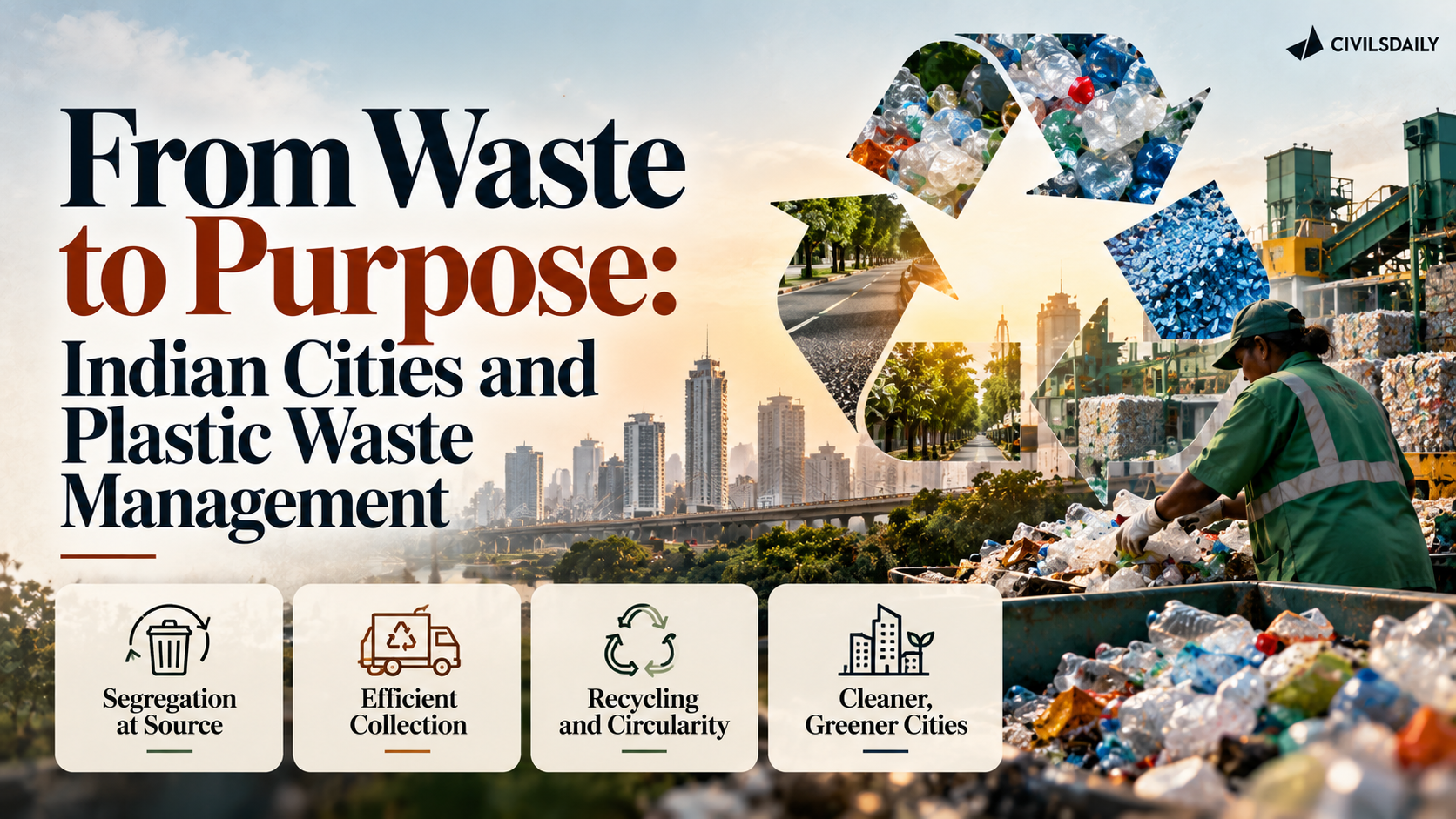
Indian cities are adopting local initiatives to reduce, reuse, return, recover and recreate plastic waste.
The Swachh Bharat Mission (SBM), launched on 2 October 2014, has strengthened waste collection, segregation and recovery systems. Identified single-use plastic items have been prohibited since 1 July 2022.
Key Highlights
Focus: Plastic waste reduction, reuse, recovery and circular economy.
Trichy: Market-level campaign to reduce single-use plastic.
Vita, Maharashtra:Thaila ATMs provide reusable cotton bags.
Andaman & Nicobar Islands: Buy-back system for used milk pouches.
Bengaluru: Material Recovery Facility under UNDP Project Prithvi.
Patiala: Multilayered Plastic (MLP) converted into durable chipboards.
SBM focuses on source segregation, door-to-door collection, scientific waste processing and material recovery.
Reduce – Trichy Market Initiative
Three farmers’ markets covered:
Tennur
K.K. Nagar
Woraiyur
220 vendors engaged.
ThunippaiThiruvizhai or Cloth-Bag Festival promoted reusable bags.
Single-use plastic avoided:
Tennur: 2,200 kg in one year
K.K. Nagar: 620 kg in four months
Woraiyur: 300 kg in six months
Reuse – Thaila ATM
Location: Vita town, Maharashtra.
Five Thaila ATMs installed at crowded locations.
Provide reusable cotton bags through a vending-machine model.
Based on Global System for Mobile Communications (GSM) technology for remote stock monitoring.
Local Self-Help Groups (SHGs) stitch the bags.
Around 6,000 bags sold.
Weekly market recorded nearly 200 bags in a day.
In Indapur, authorities seized 25 kg plastic bags and imposed a ₹90,000 fine.
Return – Milk Pouch Buy-back
Location: Andaman and Nicobar Islands.
Used plastic milk pouches exchanged for rewards such as:
Fresh milk
Discounts
Implemented with ANIIDCO and SVPMC.
By November 2024:
17,600 milk pouches collected.
352 litres of milk provided as rewards.
Uses incentives to encourage responsible disposal and recycling.
Supports circular economy and reduces landfill waste.
Prelims Quick Revision
SBM: Launched on 2 October 2014.
Identified single-use plastic items prohibited from 1 July 2022.
Trichy: 220 vendors across three farmers’ markets engaged in plastic reduction.
Vita, Maharashtra: Five Thaila ATMs provide reusable cotton bags.
Andaman & Nicobar: 17,600 milk pouches collected by November 2024.
Bengaluru: Swachhata Kendra MRF established in 2019 under Project Prithvi.
Patiala: MLP waste converted into chipboards.
The five-part plastic approach highlighted is reduce, reuse, return, recover and recreate.
UPSC Prelims Trap
MRF vs PRF: The Bengaluru initiative involves a Material Recovery Facility, while Patiala uses a Plastic Recycling Facility.
MLP: Multilayered plastics are difficult to recycle because they combine multiple material layers.
Thaila ATM: It provides reusable cotton bags, not plastic alternatives.
Circular economy: The Bengaluru and Patiala examples demonstrate conversion of discarded plastic into new productive materials/products, rather than simply disposing of it.