Why in the News
The International Day of Awareness of Food Loss and Waste (29 September) has renewed a call for India to move from individual interventions to a connected national approach with financing at its core.
What are food loss and food waste, and why do they matter?
- What they are: Food loss is produce spoiled between farm and shop through poor storage, drying or transport. Food waste is food thrown away by shops, restaurants and households.
- Hidden cost: Wasted food is like a leaking tank: the land, water and energy used to grow it are lost too.
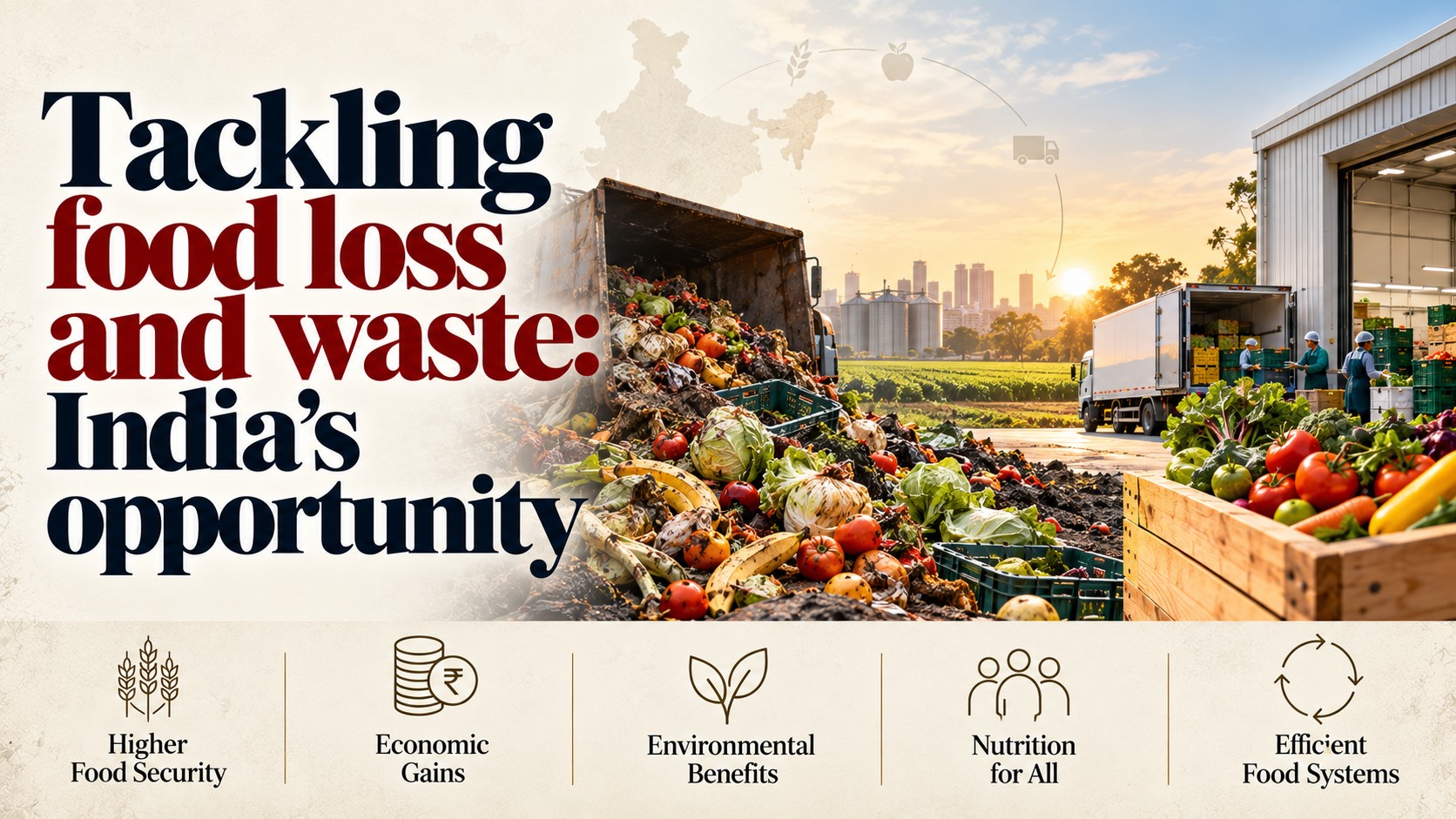
- Triple win: Cutting both strengthens food security, eases pressure on natural resources and emissions, and raises incomes and productivity.
- The takeaway: India grows enough to feed its people, so every tonne saved is food gained without extra land or water.
What evidence does India have, and what is missing?
- A global first: India alone has run three national post-harvest loss surveys, tracking losses from farm to retail. The Ministry of Food Processing Industries (MoFPI) runs them, and a fourth round is under way.
- Global reporting: The surveys feed India’s Food Loss Index reporting under the Sustainable Development Goals (SDGs), which tracks losses before food reaches retail.
- The blind spot: Waste data for retail, hotels and restaurants, and households remain far less developed, so policy cannot target them.
Why are wholesale markets an overlooked opportunity?
- Waste at the mandi: The Food and Agriculture Organization (FAO) and the National Council of Agriculture Marketing Boards (COSAMB) found a major wholesale market can generate up to 100 tonnes of organic waste daily.
- Landfill burden: In some cities, a fifth of urban organic waste reaches landfills, where rotting food releases methane, a potent greenhouse gas.
- A resource base: Nationally, this waste totals about 3.5 million tonnes a year. Treated, it could offset about 3.3 million tonnes of carbon dioxide equivalent (a common greenhouse gas measure).
- Surat model: A 50-tonne-a-day bio-CNG plant (compressed biogas for vehicles) in Surat has run through a private-sector partnership for over five years. Municipalities and market committees can adapt it.
What should a connected national approach include?
- Mainstreaming: Loss and waste belong in agricultural planning, food-processing strategy, climate action and investment decisions.
- Targeted finance: Affordable money should reach storage, drying, cooling and processing for farmers, producer organisations and small firms, with traceability systems tracking produce.
- Circular approach: Surplus food can be redistributed and residues turned into compost, biogas or energy.
- Hotspot finance: The FAO and the Small Industries Development Bank of India (SIDBI) are matching food-loss hotspots, where most produce is lost, with climate-resilient technologies. SIDBI finances small firms to adopt them.
- Package of Practices: The FAO is preparing a “Package of Practices” helping cities measure, prevent, reduce, redistribute and valorise (extract value from) waste.
Challenges
- Split responsibility: Loss and waste cut across farm, food processing, urban and climate policy, so no single agency owns the problem.
- Isolated pilots: The Surat plant and similar models remain one-offs without a national framework.
- Costly technology: Cooling, drying and storage equipment is expensive for small farmers and enterprises.
- Poor segregation: Mixed market and city waste cannot be composted or converted to biogas, so it is landfilled.
Way Forward
- Consumer-end surveys: MoFPI should extend loss surveys to retail, hotels, restaurants and households.
- Hotspot-linked credit: SIDBI and banks should scale credit for small firms at identified loss hotspots.
- Market waste plants: Market committees should set up segregation and bio-CNG units at major markets.
Conclusion
India has the technology and working models to cut food loss, but they remain pilots without finance at scale. Whether the next survey round extends to the consumer end will show if loss reduction enters urban and climate policy.
Key numbers
- Loss surveys (MoFPI): 45 commodities (2005-07), 45 (2012-14), 54 (2020-22).
- Carbon value of market waste: close to $30 million in credits a year.
- Surat plant: cuts methane-related emissions by about 7,500 tonnes a year.
Schemes and Initiatives for Food Loss Reduction
- Pradhan Mantri Kisan SAMPADA Yojana (PMKSY): MoFPI’s scheme funds cold chains, Mega Food Parks and processing units.
- Operation Greens: Extended from tomato, onion and potato to 22 perishable crops to curb price swings and losses.
- Agriculture Infrastructure Fund: A Rs 1 lakh crore facility for post-harvest and market infrastructure.
- World’s Largest Grain Storage Plan: Launched in 2023, it builds godowns at Primary Agricultural Credit Society (PACS) level.
Matching Previous Year Question
“[2011] With what purpose is the Government of India promoting the concept of “Mega Food Parks”? 1. To provide good infrastructure facilities for the food processing industry. 2. To increase the processing of perishable items and reduce wastage. 3. To provide emerging and eco-friendly food processing technologies to entrepreneurs. Select the correct answer using the code given below: (a) 1 only (b) 1 and 2 only (c) 2 and 3 only (d) 1, 2 and 3 Answer: B”