💥Join UPSC 2027,2028 Mentorship (July Batch) + XFactor Notes & Microthemes PDF

Author: Access Account

  • UPSC Eligibility Criteria: Age, Qualifications & More

    UPSC eligibility criteria refer to the essential requirements that candidates must fulfil to sit for the exam. They include nationality, age limit, educational qualification, medical fitness, etc. Applications that don’t meet the UPSC eligibility criteria will be rejected by the UPSC board. 

    On the other hand, not knowing the detailed IAS exam criteria might make one lose the chance of attempting the exam as there are limited attempts allowed. If you’re aspiring for the UPSC 2025, you should learn about the UPSC/IAS eligibility criteria and deduce whether you can apply or not. 

    What is the UPSC Exam

    UPSC (Union Public Service Commission) is a Public exam in India, conducted to select candidates for various Grade A administrative posts, including IAS, IPS, IFS, and IRS. It is conducted in three stages: UPSC Prelims, UPSC Mains, and Interview. Those who pass successfully through these stages will be inducted into the respective cadres as per their score in the exam. However, knowing the UPSC eligibility criteria is important for aspirants to make successful applications.

    UPSC Eligibility Criteria 2024-2025

    NationalityCitizen of India
    Age Limit21-32 years for the General Category21-35 years OBC Category21-37 years SC/ST Category
    Educational QualificationA graduate degree from a recognised university
    Number of Attempts6 for the General Category9 for OBC Category/PwBDUnlimited (until age limit) for SC/ST Category
    Exam FeeRs. 100 for all except Female/SC/ST
    Physical StandardsMedical Tests, Physical Fitness, Body Measurements (For IPS and Indian Railway Services, etc.)

    Detailed UPSC Eligibility Criteria

    Candidates must thoroughly check the detailed UPSC eligibility criteria along with special rules and restrictions. 

    Nationality

    When it comes to the UPSC Eligibility Criteria, nationality plays a role. 

    For Indian Administrative Service (IAS), Indian Foreign Service (IFS), and Indian Police Service (IPS):
    Candidates must be citizens of India to meet IAS eligibility criteria. This is a strict UPSC eligibility criteria for these prestigious positions, as they are integral to the Indian administrative framework.

    For Other Services:
    There are a few additional UPSC eligibility criteria:

    • They can be citizens of India.
    • Citizens of Nepal or Bhutan are also eligible.
    • Tibetan refugees who settled in India before January 1, 1962, may apply.
    • People of Indian origin who have migrated from countries like Pakistan, Burma, Sri Lanka, and certain East African nations can also be considered, provided they intend to permanently settle in India.

    There is one more IAS eligibility criterion: Citizens of Nepal, Bhutan, Tibetan refugees, and individuals of Indian origin must secure a certificate of eligibility from the Government of India. While these candidates can sit for the exam, an offer of appointment will only be made once the eligibility certificate is issued.

    Age Limit

    General Age Limit: The upper IAS age limit for the exam is 32 years for general category candidates.

    Age Relaxation:

    1. Scheduled Caste (SC) / Scheduled Tribe (ST): Up to 5 years.
    2. Other Backward Classes (OBC): Up to 3 years.
    3. Defence Services Personnel: Up to 3 years for those disabled during service.
    4. Ex-Servicemen: Up to 5 years for those with a minimum of 5 years of military service.
    5. ECOs/SSCOs: Up to 5 years if they have completed at least 5 years of military service and have a certificate from the Ministry of Defence.
    6. Persons with Benchmark Disabilities (PwBD): IAS eligibility allows up to 10 years, covering various disabilities as specified.

    To fulfil UPSC/IAS exam criteria, the proof of age must be the same as recorded in their Matriculation or equivalent certificate. Candidates must be careful, as requests for changes to the date of birth are not permitted after submitting their UPSC application, except in cases of unintentional errors, which must be rectified by a specific deadline.

    UPSC Qualification

    The UPSC eligibility criteria for education include the following requirements:

    Degree Requirement
    Candidates must hold a graduate degree from a recognised university or institution in India to fulfil UPSC qualifications.

    Awaiting Results
    Those who have appeared for a qualifying examination but are waiting for results can apply for the Preliminary Exam. Proof of passing must be provided for the Main Exam.

    Exceptional Cases
    Candidates without the required qualifications may be considered if they have passed an exam considered equivalent by the Commission.

    Professional Qualifications:
    Candidates with recognised professional or technical qualifications equivalent to a degree are also eligible.

    Medical Graduates
    Medical graduates who have completed their final MBBS exam but not their internship can apply provisionally. They must have proof of passing the exam and complete their internship before the interview.

    Number of Attempts

    Candidates meeting the UPSC eligibility criteria for the UPSC Civil Services Examination (CSE) are allowed six attempts. However, there are relaxations for certain categories:

    • Scheduled Castes (SC) and Scheduled Tribes (ST): Unlimited attempts.
    • Other Backward Classes (OBC): Up to 9 attempts.
    • Persons with Benchmark Disabilities (PwBD): Also up to 9 attempts for General, EWS, and OBC categories; unlimited for SC/ST.

    If a candidate appears in the Preliminary exam without attempting the UPSC Mains, it is counted as an attempt. Even if the candidate is disqualified or cancelled, it is counted. So every aspirant must be careful in utilising the number of UPSC attempts allowed for them. They can’t apply after exhausting their limit for the UPSC attempts, even if they fulfil the IAS exam criteria.

    Restrictions to UPSC Application

    Candidates already appointed to the Indian Administrative Service (IAS) or Indian Foreign Service (IFS) through previous exams cannot apply for the Civil Services Examination (CSE), even if they fulfil UPSC eligibility criteria. This includes those who qualify for the Preliminary Exam. 

    If they join IAS or IFS after the Preliminary Exam but before the Main Exam results, they won’t be considered for appointments based on the CSE.

    Similarly, candidates already in the Indian Police Service (IPS) cannot apply for IPS positions through the CSE, even if they fulfil the UPSC eligibility criteria.

    Physical Standards

    • Candidates must pass a medical test to meet the UPSC/IAS exam criteria for Civil Service appointments. 
    • Specific physical requirements (height, weight, chest measurements) apply mainly to:
      • IPS officers
      • Police services
      • Indian Railway services
    • UPSC eligibility criteria for non-technical positions have fewer physical requirements. But they require candidates to be fit and mentally stable.
    • Detailed physical standards are outlined in Appendix III of the Examination Rules published in the Gazette of India.

    Download the official UPSC Eligibility Criteria PDF.

    Conclusion

    Apart from the UPSC eligibility criteria, aspirants should focus on understanding the UPSC exam pattern and stages in detail. It’s equally important to be aware of how previous year question trends evolve, which could provide an edge in UPSC preparation. Building a solid strategy for each stage ensures better success. Additionally, staying informed about UPSC exam notifications and updates is key to avoiding missing important deadlines or changes.

    FAQs

    Is the UPSC age limit increased to 35?

    The age relaxation in the UPSC to 35 years applies to only OBC/PwBD candidates. General candidates have up to 32 years maximum. 

    Are the UPSC eligibility criteria for females and males the same?

    UPSC/IAS exam criteria for OBC, General, and SC/ST are the same for both men and women. However, females of all categories are exempted from paying the examination fee of Rs. 100. 

    What is the UPSC age limit for females?

    The age limit for females in the UPSC remains as that for the males. 

    • For General category females, the age limit is 21-32 years. 
    • For OBC, the age limit is 21-35 years.
    • For SC/ST, it is 21-37 years.

    Is there a UPSC age limit of 40 years?

    No, the UPSC/IAS age limit of 40 years is not applicable for general, OBC, SC/ST candidates. However, if you’re a PwBD person, you have an age relaxation of up to 42 years.
  • Fact-Checking: Balancing Independence and Legal Safeguards

    Why This?

    The Bombay High Court recently struck down a provision related to the Fact Check Unit in the 2021 IT Rules. While it’s tempting to jump straight into learning about IT Rules alone, it’s vital to see the bigger picture where governance, digital freedom, and judiciary intersect, especially in balancing individual rights vs. state interests. This article gives special focus to the evolving idea of regulated digital freedom, key rulings, and the role of institutions in shaping this critical issue.

    GS Paper 1: Indian Society: Role of Media and Social Media
    Note4Students: Examine case studies on social media’s impact on public opinion, focusing on its role in recent social movements and electoral processes.

    Microtheme: Social empowerment

    GS Paper 2: Governance, Constitution, Polity, Social Justice, and International Relations: Governance and Accountability, Regulation of Social Media, Judicial Review and Role of the Judiciary
    Note4Students: Analyze recent legislative changes regarding social media regulation and their implications for citizen rights and government accountability.

    Microtheme: Fundamental Rights

    GS Paper 3: Technology, Economic Development, Bio-diversity, Environment, Security, and Disaster Management: Cybersecurity, Digital Economy
    Note4Students: Discuss the dual aspects of cybersecurity measures—ensuring national security while maintaining individual freedoms and the implications for the digital economy.

    Microtheme: Cyber security

    GS Paper 4: Ethics, Integrity, and Aptitude: Ethics in Governance, Regulation vs. Free Speech, Transparency and Accountability
    Note4Students: Reflect on ethical dilemmas in digital governance, considering the balance between regulating harmful content and upholding free speech rights.

    Microtheme: Public/Civil Service Values

    Establishment of the Fact Check Unit

    Earlier this year, the Government of India notified the Press Information Bureau’s Fact-Check Unit (PIB-FCU) under the Ministry of Information and Broadcasting (MIB) as the Central Government’s official fact-check unit. The Ministry of Electronics and Information Technology (MeitY), under the Information Technology (Intermediary Guidelines and Digital Media Ethics Code) Rules, 2023  designated the PIB’s FCU as the fact-check unit. It amended the 2021 IT Rules. The amendment broadened the definition of ‘fake news’ to cover matters related to ‘government business’.

    Aim of the Fact Check Unit (FCU)

    • The FCU was tasked with flagging any social media posts that it deemed ‘fake,’ ‘false,’ or ‘misleading’ regarding government affairs.
    • It could compel social media platforms to remove such flagged content to maintain their “safe harbour” status and legal immunity.
    PIB’s Fact-Check Unit (PIB-FCU)Establishment: The PIB-FCU was launched in November 2019 with the aim of acting as a deterrent against the creation and spread of fake news and misinformation related to the Government of India. It provides an avenue for the public to report questionable information about government policies.Functions and Mandate:Counter Misinformation: The PIB-FCU counters misinformation about government policies, initiatives, and schemes, either proactively (suo motu) or based on complaints.Monitor and Detect: The unit actively monitors and detects disinformation campaigns and promptly exposes false information regarding the government.Content Removal: When the unit identifies a piece of content as fake, social media platforms must remove it as part of their due diligence under IT Rules. Additionally, internet and telecom service providers are required to block web links to such fake news.

    Judgement of the Bombay High Court

    ObservationDetails
    Violation of Fundamental RightsThe amended Rule 3(1)(b)(v) violated Articles 14, 19(1)(a), and 19(1)(g) of the Constitution by allowing the state to determine what is “fake, false, or misleading.”
    Right to Equality and Free SpeechThe Rule violated Articles 14, 19(1)(a), and 19(1)(g), and was declared ultra vires to the IT Act. There is no “right to the truth” under Article 19(1)(a).
    Discrimination Against Digital PlatformsThe Rule unfairly targeted digital platforms while excluding print media, with no valid reason for this difference in treatment.
    Government Cannot Be Judge in Its Own CauseThe FCU allowed the government to act as the final arbiter of “fake news,” creating a conflict of interest by allowing the government to judge itself.
    Vagueness and OverbreadthTerms like “fake, false, or misleading” were vague, making the rule excessively broad and prone to misuse, leading to potential censorship.
    Chilling Effect on Digital IntermediariesThe rule had a chilling effect on digital platforms, causing self-censorship to avoid hosting undefined “fake or misleading” content.
    Vagueness Leads to CensorshipThe lack of clear definitions for “misleading” could lead to lawful content being censored, failing the proportionality test for restricting rights.

    How is it related to the concept of regulated digital freedom ?

    The issue of notifying the PIB’s Fact-Check Unit (PIB-FCU) as the Central Government’s official fact-checking body is directly related to the concept of regulated digital freedom in several ways:

    1. Balance Between Freedom of Expression and Accountability

    • Digital Freedom: Online platforms provide individuals the freedom to express their views freely, which is a core aspect of democratic societies.
    • Regulation: The establishment of the PIB-FCU aims to regulate this freedom by ensuring that false and misleading content, especially related to government policies, is monitored and removed. While it seeks to prevent the spread of disinformation, it raises questions about whether this regulation could inadvertently suppress legitimate speech.

    2. Accountability of Social Media Intermediaries

    • Digital Freedom: Social media platforms are key enablers of free expression, providing a space for people to share opinions and information.
    • Regulation: By making social media intermediaries accountable for the removal of flagged content, the PIB-FCU adds a layer of oversight. However, this accountability may force platforms to err on the side of caution, potentially leading to over-censorship or the removal of lawful content to avoid penalties, affecting digital freedom.

    3. Preventing Misinformation and Ensuring National Security

    • Digital Freedom: The unregulated sharing of content, including misinformation, can lead to public harm, such as inciting violence or hate speech, which undermines national security.
    • Regulation: The role of the PIB-FCU in flagging fake news aims to prevent the misuse of digital platforms for illegal activities, thus supporting a safe digital environment. However, the line between misinformation and critical discourse can sometimes blur, potentially leading to overregulation.

    4. Cybersecurity and Control over Digital Platforms

    • Digital Freedom: Users enjoy open access to share and interact with content freely on digital platforms.
    • Regulation: By regulating content and enforcing the removal of harmful content (e.g., deepfakes, fake news), the PIB-FCU indirectly controls what can be shared, which can enhance cybersecurity. However, this regulation must be carefully managed to ensure it does not infringe on free speech unnecessarily.

    Way Forward

    1. Final Verdict of the Supreme Court: The Supreme Court must provide a final ruling on broader concerns in the IT Rules, such as mandates for social media platforms regarding grievance redressal and compliance mechanisms, following the Bombay HC’s ruling in the Kunal Kamra v. Union of India (2023) case, which declared fact-check units unconstitutional.
    2. Develop a Transparent and Participatory Process: The government should collaborate with civil society, media organizations, and stakeholders to create a more transparent and participatory process for identifying fake or misleading content.
    3. Establish an Independent Fact-Checking Body: An independent, non-partisan fact-checking body should be created with clear guidelines for making decisions to avoid bias or influence.
    4. Adhere to Judicial Guidelines: Any government takedown requests should follow judicial procedures, as outlined in Shreya Singhal v. Union of India or Section 69A of the IT Act, ensuring that takedowns are legal and necessary under specific conditions.

    The introduction of the PIB-FCU reflects a broader global trend toward regulated digital freedom, where governments seek to balance the benefits of digital openness with the need for accountability, cybersecurity, and the prevention of harm. However, it also raises critical concerns about the potential for overregulation, censorship, and infringement on individual freedoms, making the need for transparency and clear boundaries essential in maintaining the right balance between freedom and regulation.

    Hello,

    We have a confession: we’re here to compete with your notes! Burning Issues magazine is your go-to resource as your exam approaches, designed to help you through the anxiety and overwhelm of preparing for the Civil Services Examination.

    Many aspirants struggle despite reading current affairs for a year. This often happens because they interpret current affairs as merely news. As a UPSC aspirant, it’s essential to analyze these topics from the perspectives of General Studies 1, 2, 3, and 4, and that’s exactly what Elevate does.

    This magazine features two sections: Burning Issues and Prelims Tidbits. Burning Issues covers current affairs that may appear in your Mains papers and teaches you how to think about these topics from different GS perspectives in just two pages.

    Prelims Tidbits simplifies your Prelims preparation by distilling key facts, data, and concepts into easy-to-recall points framed around basic questions: What? Who? How? When?

    So, dive in! Every page is crafted to enhance your UPSC prep. With consistency and this magazine, you’re not just preparing; you’re mastering the exam. The journey is about understanding and applying your knowledge effectively.

  • Climate Extremes in the Arabian Sea: How Climate Change Fuels Severe Weather Patterns

    Climate Extremes in the Arabian Sea: How Climate Change Fuels Severe Weather Patterns

    Why this?

    Cyclone Asna was a rare August storm in the Arabian Sea, but just blaming climate change and discussing it is oversimplifying the topic. This article kicks off by analyzing past trends and what caused them, before diving into the rising frequency of cyclones in the Arabian Sea, especially post-monsoon. Our take offers a fresh perspective, connecting the dots between climate change and extreme weather events, making sure you’re fully prepped with the insights you need.

    GS Paper 1: Geography and Indian Society: Salient Features of World’s Physical Geography

    Note4Students: Understand the relationship between cyclones, sea surface temperatures, and climate change, and their effects on global weather patterns.

    Microtheme: Climatology

    GS Paper 2: Governance, Constitution, Polity, Social Justice, and International Relations: Government Policies and Interventions for Development in Various Sectors

    Note4Students: Learn about the necessity of climate resilience policies, especially in coastal regions vulnerable to increasing cyclone frequency.

    Microtheme: Miscellaneous

    GS Paper 3: Environment, Disaster Management, and Science & Technology: Disaster Management

    Note4Students: Explore strategies for cyclone preparedness and the role of early warning systems in minimizing damage from natural disasters.

    Microtheme: Climate change impact

    GS Paper 4: Ethics, Integrity, and Aptitude: Ethics in Climate Change and Environmental Conservation

    Note4Students: Analyze the ethical responsibilities of nations and individuals in addressing climate change and protecting the environment for future generations.

    Microtheme: Ethical Issues in International Relations and funding

    How is ‘Asna’ different ?

    “Asna” is notable because it’s the first cyclone in August in the North Indian Ocean since 1981. August is typically not part of the cyclone season in this region.  The cyclone began as a land-born depression that intensified as it moved over the warm waters of the Arabian Sea. It formed from a rare strong low-pressure system that grew unusually powerful over land. Asna’s formation is linked to the broader context of rapid warming over the Arabian Sea, influenced by climate change. The northward shift of the low-level jet stream due to warming over West Asia contributed to its development

    Trends of Cyclones in Arabian Sea

    Historical Trends: The Arabian Sea historically experienced 2-3 cyclones per year, mostly weak, with a 1:4 ratio compared to the Bay of Bengal. From 1891 to 2000, 48 tropical cyclones impacted India’s west coast, 24 of which were severe, while the east coast experienced 308 cyclones, including 103 severe storms. Cyclones typically occur in May-June (pre-monsoon) and October-November (post-monsoon). Cyclone formation in the Arabian Sea is common pre-monsoon but rare in post-monsoon, when the Bay of Bengal usually sees cyclonic activity.

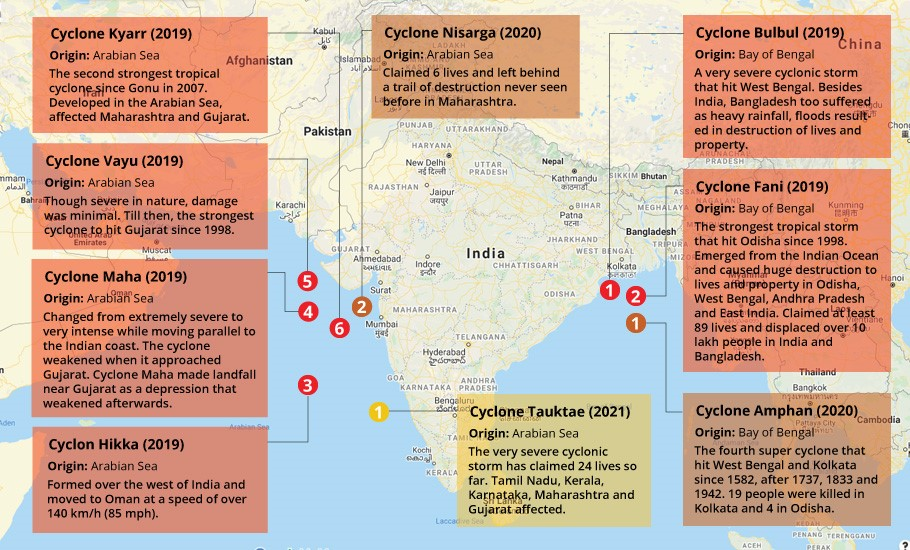
    Current Trends: Recent trends show increasing frequency and timing shifts in cyclones over the Arabian Sea. Sea surface temperatures (SST) remain abnormally high, at around 30°C, fueling cyclone formation. Since 1980, 2021 marked the first time pre-monsoon cyclones occurred four years in a row. Cyclones are also moving closer to India’s west coast, with 2018 seeing three cyclones in the Arabian Sea and 2019 witnessing five, compared to the usual one. Between 2014-2019, there was a 32% rise in cyclones. The intensity of cyclones has also increased, with Tauktae being the fifth-strongest storm in the Arabian Sea since 1998 and the strongest pre-monsoon cyclone since 2010. Severe post-monsoon cyclones, such as Nilofar (2014), Chapal, and Megh (2015), occurred unusually during October and November.

    Reasons for Increasing Frequency of Cyclones in the Arabian Sea

    ReasonExplanationSubstantiation
    Climate Change and Global WarmingRising ocean temperatures increase cyclone formation as cyclones draw energy from ocean heat.Climate scientist Hiroyuki Murakami’s study showed 64% of recent cyclones in the Arabian Sea were caused by climate change.
    Temperature Rise in Indian OceanOver the last 4 decades, the Indian Ocean’s temperature rose by 0.7°C; the western Indian Ocean unexpectedly warmed by 1.2°C in summer.The IMD noted the Arabian Sea’s surface temperature is 30-31°C, especially around Goa-Lakshadweep, where Cyclone Tauktae originated.
    Indian Ocean Dipole (IOD)A positive IOD warms the western Indian Ocean and Arabian Sea, creating low-pressure areas conducive to cyclone formation.In 2019, 5 cyclones formed in the Arabian Sea, coinciding with the strongest positive IOD recorded.
    TeleconnectionsDistant climate phenomena, such as atmospheric or oceanic changes, can impact cyclone patterns in the Arabian Sea.A study by the National Institute of Oceanography, Goa, suggested teleconnections influence cyclone activity.

    Reasons for Increased Frequency of Severe Cyclonic Storms in the Post-Monsoon Period

    ReasonExplanationSubstantiation
    Shift in Cyclone OccurrenceSevere cyclones, which typically occur in spring, are now occurring in the post-monsoon period (October-November).Severe cyclones Nilofar, Chapal, and Megh occurred in October-November. In 2019, Kyarr, Maha, and Pawan formed post-monsoon.
    Rising Sea Surface Temperature (SST)Increased SST, linked to human activity and natural variability, is intensifying cyclones, making them more severe.SST rise in the Arabian Sea leads to more intense storms, especially during the post-monsoon period.
    Delayed Winter MonsoonThe delay in the onset of the winter monsoon extends the storm season, leading to an increase in severe cyclones.Delayed monsoons contribute to longer cyclone seasons and more severe storms in the Arabian Sea.
    Anthropogenic AerosolsAerosols from post-harvest activities change SST distribution, leading to more active cyclonic storms during the post-monsoon season.After the kharif harvest, increased aerosol emissions influence SST and cyclonic storm activity in the Arabian Sea.

    #CLIMATE EXTREMES & CLIMATE CHANGE

    According to IPCC -AR6, changing climate leads to changes in the frequency, intensity, spatial extent, duration, and timing of weather and climate extremes. • While many weather and climate extremes are the result of natural climate variability (including phenomena such as El Niño), and natural decadal or multi-decadal variabilities, it is the anthropogenic activities which are the driving force in climate change. 

    As a consequence, average temperatures have risen by 1.2 C compared to pre industrial era. This additional energy is unevenly distributed and bursts out in extremes events disasters like hurricanes, heat-waves, cloud bursts, droughts etc. 

    For example: Some of the extreme events that have been experienced around the world are: 

    • A heat wave in Canada and adjacent parts of the USA pushed temperatures to nearly 50C in a village in British Columbia. 
    • Death Valley, California reached 54.4C during one of multiple heat waves in the south-western USA. 
    • A second successive year of drought in sub-tropical South America reduced the flow of river basins and hit agriculture, transport and energy production
    Extreme EventImpactExample
    DroughtClimate change is shifting the equilibrium of the water cycle, making large regions more drought-prone by 2100.The Standardized Precipitation-Evapotranspiration Index indicates more drought-prone conditions, particularly in mid-latitude regions.
    Extreme PrecipitationWarmer air holds more water vapor (7% more per degree of warming), leading to more intense and variable precipitation events, increasing both floods and droughts.Increased risk of flooding and dam failure during heavy rains, while water storage becomes critical during droughts.
    Tropical StormsTropical storms and hurricanes are shifting towards the poles due to expanding tropics caused by higher global temperatures.Warmer sea temperatures could intensify hurricane wind speeds by up to 10%. Hurricanes Florence (2018) and Imelda (2019) caused devastating floods due to this shift.
    Coastal Storms and Storm SurgesRising sea levels (by 1-4 feet globally) in low to moderate emissions scenarios will amplify the impact of coastal storms and storm surges.Hurricane Ida in 2021 hit Louisiana, US, as an extremely dangerous Category 4 storm, with increased damage due to rising sea levels and coastal storm surges.
    Warmer Sea Surface TemperaturesHigher sea surface temperatures lead to more low-pressure systems, increasing the likelihood of stronger and more frequent tropical storms.NOAA has predicted an increase in Category 4 and 5 hurricanes, with wind speeds rising by up to 10%, intensifying storms like Hurricane Florence and Hurricane Imelda.
    WildfiresWarmer, drier conditions caused by climate change increase wildfire risk by affecting temperature, soil moisture, and fuel availability (trees, shrubs).In the U.S. West, a 1°C rise could increase the median burned area by up to 600% in some forests.

    Hello,

    We have a confession: we’re here to compete with your notes! Burning Issues magazine is your go-to resource as your exam approaches, designed to help you through the anxiety and overwhelm of preparing for the Civil Services Examination.

    Many aspirants struggle despite reading current affairs for a year. This often happens because they interpret current affairs as merely news. As a UPSC aspirant, it’s essential to analyze these topics from the perspectives of General Studies 1, 2, 3, and 4, and that’s exactly what Elevate does.

    This magazine features two sections: Burning Issues and Prelims Tidbits. Burning Issues covers current affairs that may appear in your Mains papers and teaches you how to think about these topics from different GS perspectives in just two pages.

    Prelims Tidbits simplifies your Prelims preparation by distilling key facts, data, and concepts into easy-to-recall points framed around basic questions: What? Who? How? When?

    So, dive in! Every page is crafted to enhance your UPSC prep. With consistency and this magazine, you’re not just preparing; you’re mastering the exam. The journey is about understanding and applying your knowledge effectively.

  • India’s Electoral System: Democratic engagement with a digital plug-in

    India’s Electoral System: Democratic engagement with a digital plug-in

    Why this?

    Political Campaigning’s gone digital big-time lately! Morever, Elections have been a recurring theme in the UPSC- be it the challenges, role of ECI etc. Adding to this layer, is when the themes are cross cutting subject such as this one- Elections X Technology. There is a dearth of sorted content  good enough to replicated directly in the answers. We’ve packed this article with insights to help you evaluate the impact, ethics, and challenges of this shift.  We have  incorporated real-world examples into the discussions to give you a unique perspective that sets your analysis apart. Take a special note of the various regulatory reforms which can be replicated directly in the exams.

    GS1:

    Indian Society: Globalization and Social Change

    Note4Students: Analyze the influence of digital political campaigns on societal structures and voter engagement in a globalized context.

    Microtheme: Globalisation

    GS2:

    Governance, Constitution, Polity, Social Justice, and International Relations: Election and Representation

    Note4Students: Explore how digital platforms are transforming electoral processes and enhancing political participation among diverse groups.

    Microtheme: Elections

    GS3:

    Technology, Economic Development, Biodiversity, Environment, Security, and Disaster Management: Awareness in IT

    Note4Students: Examine the role of technology, such as AI and big data, in shaping political campaigns and influencing voter behavior at a granular level.

    Microtheme: Tech solutions for daily challenges

    GS4:

    Ethics, Integrity, and Aptitude: Ethical Concerns in Governance

    Note4Students: Understand the ethical implications of digital campaigns, including misinformation and the need for transparency in political advertising.

    Microtheme: Applied Ethics

    ·        Leave.EU was a pro-Brexit political campaign group led by Arron Banks and Andy Wigmore. Active during the 2016 EU referendum, it focused on national sovereignty, immigration, and economic independence. Known for its aggressive rhetoric, social media tactics, and controversy, it played a key role in the Brexit outcome.Digital political campaigns in India:·        Bharatiya Janata Party (BJP) – 2014 and 2019 Elections:
    The BJP’s use of digital platforms was a game-changer. They employed social media, mobile apps, and digital marketing to engage with voters, with Narendra Modi’s Twitter and Facebook presence playing a key role. The NaMo App also allowed direct interaction with voters.·        #MainBhiChowkidar Campaign (2019):
    The BJP launched the #MainBhiChowkidar campaign, where Prime Minister Modi and his supporters used the phrase on social media to emphasize the government’s role in fighting corruption. It went viral, with thousands adding “Chowkidar” to their Twitter names.·        WhatsApp Groups for Grassroots Campaigning:
    In various elections, political parties have extensively used WhatsApp for direct communication. Targeted messages, rally announcements, and even misinformation were circulated through community groups to influence voter behavior.·        Congress Party’s Digital Push (2019):
    The Indian National Congress ramped up its digital presence for the 2019 elections, led by Rahul Gandhi’s increased social media visibility. The #AbHogaNyay campaign used videos, infographics, and social media outreach to convey their message.

    The Economics of Digital Campaigning

    A)    Digital Spending Overview

    Political PartyElection YearEstimated Digital SpendingKey Digital Strategies
    BJP (Bharatiya Janata Party)2014 General Elections₹150-400 croresSocial media ads, NaMo App, WhatsApp, Twitter, YouTube campaigns
    2019 General Elections₹500+ crores#MainBhiChowkidar campaign, personalized outreach via NaMo App, influencer marketing
    Indian National Congress2019 General Elections₹150-200 crores#AbHogaNyay, social media ads, influencer partnerships, Twitter and Facebook outreach
    Aam Aadmi Party (AAP)2015 Delhi Elections₹10-20 croresFacebook, Twitter campaigns, YouTube ads, grassroots WhatsApp groups
    2020 Delhi Elections₹20-30 croresYouTube, Twitter ads, WhatsApp messaging, targeted video campaigns
    Samajwadi Party2022 UP Elections₹5-10 croresSocial media, Twitter campaigns, WhatsApp groups, targeted digital ads
    Trinamool Congress (TMC)2021 West Bengal Elections₹10-20 croresYouTube ads, social media, influencer campaigns, WhatsApp group targeting
    • Shift towards Digital Platform: Conventional publicity tools like flags, billboards, and public meetings made up only a small fraction of parties’ total propaganda spending in the 2023 Karnataka election. This indicates a strategic shift toward digital platforms in electoral strategies.

    Key Factors behind this shift

    CategoryDetails
    1. Rising Internet PenetrationIndia’s Digital Growth: Over 700 million internet users; affordable smartphones and data have made digital platforms the primary communication mode.
    Youth Engagement: A significant portion of the electorate is young and tech-savvy, ideal for targeting first-time voters.
    2. Cost-effectiveness and ReachLower Costs: Digital campaigns are more cost-effective than traditional advertising, offering higher ROI through targeted ads.
    Wide Reach: Social media platforms allow parties to reach diverse voter demographics; WhatsApp enables grassroots micro-targeting.
    3. Data-driven CampaigningTargeted Ads: Data analytics helps create highly targeted ads for specific voter groups based on demographics.
    Personalization: Voter behavior data allows parties to craft personalized content and engage voters directly.
    4. Social Media DominanceViral Campaigns: Platforms like Twitter and Facebook are crucial for political discourse, utilizing hashtags and viral videos.
    Influencer Partnerships: Collaboration with social media influencers amplifies messaging and expands audience reach.
    5. Real-time Feedback and EngagementDirect Interaction: Social media enables real-time interaction between politicians and voters, facilitating immediate feedback.
    Live-streaming and Virtual Rallies: Live-streamed events on platforms like YouTube and Facebook became common during elections and crises like COVID-19.
    6. WhatsApp and Messaging AppsGrassroots Campaigning: WhatsApp is used to disseminate campaign materials and organize volunteer groups at the local level.
    Micro-targeting: Personalized messaging and real-time mobilization through WhatsApp groups enhance campaign efforts.
    7. Regulatory and Ethical ChallengesMisinformation and Fake News: The digital shift has led to increased misinformation, raising ethical concerns about platform usage.
    Regulatory Scrutiny: The Election Commission of India monitors digital campaigns, enforcing rules like pre-approval of political ads for transparency.
    8. Future of Political CampaigningHybrid Campaigns: Combining traditional methods with digital initiatives is becoming the norm in political campaigning.
    Artificial Intelligence and Big Data: Parties use AI tools and big data to predict voter behavior and optimize outreach strategies.
    • Micro-targeting Capabilities: Political parties are utilizing micro-targeting to reach specific audiences down to the panchayat level based on location. One party was found to micro-target over 1,700 pin codes in a single advertisement, demonstrating digital platforms’ capacity to shape electoral narratives with precision.
    • Rise of Third-Party Campaigners: While major political parties have significant financial power, a less visible force, known as third-party campaigners, operates behind the scenes. Although spending on Google Ads is publicly available, these third-party campaigners work quietly and often go unnoticed, influencing elections without much oversight. A study by Lokniti-CSDS found that 31 third-party campaigners on Meta spent over ₹2,260 lakh in just 90 days leading up to June 29, 2024.

    What is the present Issue?

    • On Google, political ads generally avoid offensive content, but the spending by third-party groups is limited.
    • On Meta, many third-party campaigners are top spenders and often share inflammatory content.
    • This inconsistency highlights the need for unified rules across all platforms to manage harmful content and hold tech companies accountable.

    IN NEED of REGULATORY REFORMS

    Regulatory ReformDescriptionExisting Example
    Mandatory Disclosure of Ad SpendingRequire political parties to disclose digital ad spending in real-time for transparency.U.S. Federal Election Commission: Requires candidates to report ad spending, including digital platforms.
    Pre-approval of Political AdsSocial media platforms should enforce pre-approval of political ads to prevent misinformation.Facebook’s Ad Archive: Political ads must be approved and logged for public viewing.
    Cap on Digital Campaign SpendingIntroduce spending limits on digital campaigns to ensure a level playing field among political parties.Canada’s Election Act: Limits on total campaign spending, including digital ads.
    Regulating Micro-targetingImplement data protection rules and require transparency on how personal data is used for targeting.EU’s GDPR: Requires consent for data processing and provides rights to individuals regarding their data.
    Fact-checking MechanismsEstablish independent fact-checking bodies to verify content and prevent the spread of fake news.WhatsApp Fact-Checking Initiative: Collaborates with fact-checkers to verify information shared on its platform.
    6. Limits on Bulk MessagingRestrict the use of bulk messaging tools to prevent the mass dissemination of false information.WhatsApp’s Policy on Bulk Messaging: Limits forwarding messages to curb misinformation during elections.

    Hello,

    We have a confession: we’re here to compete with your notes! Burning Issues magazine is your go-to resource as your exam approaches, designed to help you through the anxiety and overwhelm of preparing for the Civil Services Examination.

    Many aspirants struggle despite reading current affairs for a year. This often happens because they interpret current affairs as merely news. As a UPSC aspirant, it’s essential to analyze these topics from the perspectives of General Studies 1, 2, 3, and 4, and that’s exactly what Elevate does.

    This magazine features two sections: Burning Issues and Prelims Tidbits. Burning Issues covers current affairs that may appear in your Mains papers and teaches you how to think about these topics from different GS perspectives in just two pages.

    Prelims Tidbits simplifies your Prelims preparation by distilling key facts, data, and concepts into easy-to-recall points framed around basic questions: What? Who? How? When?

    So, dive in! Every page is crafted to enhance your UPSC prep. With consistency and this magazine, you’re not just preparing; you’re mastering the exam. The journey is about understanding and applying your knowledge effectively.

  • Towards Indianisation of the Economy: How India Can Tackle Global Competition and Domestic Constraints

    Towards Indianisation of the Economy: How India Can Tackle Global Competition and Domestic Constraints

    Why this?

    The Indian government is exploring the possibility of allowing Chinese investments in high-tech electronics on a case-by-case basis. Impact of this move on India’s economy is something you will read multiple times till the exam. But not reading the specifics will lead to a place where you would be writing generic answers. It is important to understand that this topic needs to be understood in the context of Make in India initiative. By diving into the concept of the Indianisation of the economy, we’ve analyzed how these investments could influence India’s future trajectory and shape its industrial landscape.

    GS Paper 1:

    Economic Geography and India’s Industrialization

    Note4Students: Analyze how India’s geography, infrastructure, and natural resources influence its manufacturing capabilities. Explore how reliance on global supply chains and regional disparities affects the Indianization of the economy.

    Microtheme: Secondary Sector

    GS Paper 2:

    Governance, Policies, and Foreign Investment

    Note4Students: Examine the constitutional and policy-related challenges in balancing foreign investments, particularly from China, with national security and economic sovereignty goals like Atmanirbhar Bharat and Make in India.

    Microtheme: Neighbourhood

    GS Paper 3:

    Indian Economy, Industrial Policy, and Global Competition

    Note4Students: Assess the impact of global competition and domestic constraints on India’s industrial policies. Critically analyze the role of government interventions such as the PLI scheme in strengthening India’s position in global supply chains.

    Microtheme: Industrial Policy

    GS Paper 4:

    Ethics in Economic Policy and Foreign Investment

    Note4Students: Consider the ethical challenges of allowing foreign investments from politically sensitive countries. Reflect on the balance between economic pragmatism, national interest, and the ethical responsibility of ensuring transparency and fairness in decision-making.

    Microtheme: Utilization of public funds

    Reasons for this move?

    1. Pressure from Indian Industry: Indian companies, particularly in electronics, are urging the government to relax restrictions on Chinese investments to access advanced technology and boost domestic production.
    2. Technological Expertise: China has expertise in critical areas such as AC compressors, display panels, and semiconductors—technology that is not easily available from countries like South Korea or Taiwan.
    3. Boost to Domestic Manufacturing: The government is focusing on investments that can significantly enhance India’s domestic component manufacturing and reduce reliance on imports.

    The dilemma between ‘Make in India’ and China’s presence:

    Aspect‘Make in India’ InitiativeChina’s Presence in India
    ObjectiveTo develop India as a global manufacturing hub, reduce import dependence, and boost domestic industries.Dominates India’s smartphone market, with 4 out of 5 top-selling brands being Chinese, controlling 50%+ market share.
    Policy SupportProduction Linked Incentive (PLI) scheme to attract investment and boost large-scale electronics manufacturing.Chinese companies are taking advantage of PLI schemes by setting up local production and adapting to regulations.
    Government AllocationsUnion Budget 2024-25 allocates ₹6,125 crore for electronics manufacturing and ₹1,148 crore for R&D.Chinese firms have operated in India for over a decade, becoming major players in electronics production.
    Self-Reliance (Atmanirbhar Bharat)Focus on reducing dependence on foreign imports, promoting indigenous innovation and local talent.Chinese companies continue to integrate into India’s supply chain, although India is pushing for more local ownership and manufacturing.
    Employment and LocalizationAims to generate local jobs by encouraging domestic manufacturing and R&D in critical sectors.Chinese companies have adapted by hiring Indian executives, local production staff, and collaborating with Indian partners.
    Political and Economic ConcernsAnti-China sentiments post-Galwan conflict, push to boycott Chinese products, and reduce Chinese investments.Despite anti-China rhetoric, Chinese companies remain critical to India’s smartphone market and supply chain.
    Strategic AlliancesExploring partnerships with Taiwanese firms to further reduce dependency on Chinese manufacturers.Chinese companies continue to seek opportunities within India despite increasing government scrutiny and regulatory challenges.
    Technological AdvancementsEncourages domestic innovation, particularly in the smartphone and IT sectors, to build a competitive edge.Chinese firms bring advanced manufacturing techniques and technological expertise, raising concerns about reliance on foreign innovation.
    Long-term VisionEnvisions a self-reliant India with home-grown companies leading major industries.China continues to leverage its scale, efficiency, and market dominance in India, posing a challenge to India’s self-reliance efforts.

    #Indianisation of the economy

    A shift in economic policies and practices aimed at promoting domestic growth, reducing dependence on foreign products, and fostering a self-reliant and culturally integrated economy.

    Challenges to complete Indianisation:

    ChallengeDescriptionExample
    Lack of Advanced TechnologyIndia lacks cutting-edge technology and innovation capabilities, especially in sectors like electronics and semiconductors.The absence of a domestic semiconductor industry forces dependency on countries like Taiwan, South Korea, and China.
    Dependence on Global Supply ChainsMany critical components are imported, making self-reliance difficult without domestic supply chains.India’s smartphone production is heavily reliant on Chinese imports for critical components like chips, circuits, and cameras as evident during COVID-19 pandemic.
    Insufficient InfrastructureUnderdeveloped infrastructure in logistics, power, and manufacturing hinders competitiveness.Despite the PLI scheme for electronics, India lacks adequate manufacturing infrastructure. India’s power shortages and logistics inefficiencies further impede large-scale manufacturing.
    Skilled Labor ShortageLack of adequately skilled workers in advanced manufacturing sectors.India lacks the required skilled workforce to work in high-tech manufacturing sectors like semiconductor fabs and precision electronics manufacturing.
    Investment and Capital ConstraintsHigh investments needed for infrastructure and technology development.The Union Budget 2024-25 allocated ₹6,125 crore to electronics manufacturing under the PLI scheme, but the total investment would require tens of billions of dollars.
    Quality and Scale IssuesDifficulty in achieving consistent product quality and scaling production efficiently.Apple relies on Foxconn, a Taiwanese company, to manufacture iPhones in India, and high-end product lines are still manufactured in China due to India’s lower scale and quality consistency.
    Regulatory and Policy HurdlesBureaucratic delays and complex regulations slow down investment in manufacturing.The World Bank’s Ease of Doing Business Report ranked India 63rd in 2020. Red tape and complex approval processes have deterred some foreign manufacturers from investing in Indian factories.
    Competition from Foreign FirmsEstablished foreign firms, especially Chinese, dominate sectors like electronics due to cheaper production.Chinese companies dominate India’s smartphone market with a combined market share exceeding 50% by 2023.
    Geopolitical and Trade RelationsDisrupting trade relations with countries like China can cause supply chain bottlenecks.Following the Galwan Valley clash in 2020, restrictions on Chinese investments led to delays in projects and affected industries heavily reliant on Chinese imports, particularly electronics and telecom.
    Consumer PreferencesConsumers are accustomed to affordable, feature-rich products from foreign brands.Chinese smartphones like Xiaomi and Realme are popular due to their affordability and advanced features.

    Hello,

    We have a confession: we’re here to compete with your notes! Burning Issues magazine is your go-to resource as your exam approaches, designed to help you through the anxiety and overwhelm of preparing for the Civil Services Examination.

    Many aspirants struggle despite reading current affairs for a year. This often happens because they interpret current affairs as merely news. As a UPSC aspirant, it’s essential to analyze these topics from the perspectives of General Studies 1, 2, 3, and 4, and that’s exactly what Elevate does.

    This magazine features two sections: Burning Issues and Prelims Tidbits. Burning Issues covers current affairs that may appear in your Mains papers and teaches you how to think about these topics from different GS perspectives in just two pages.

    Prelims Tidbits simplifies your Prelims preparation by distilling key facts, data, and concepts into easy-to-recall points framed around basic questions: What? Who? How? When?

    So, dive in! Every page is crafted to enhance your UPSC prep. With consistency and this magazine, you’re not just preparing; you’re mastering the exam. The journey is about understanding and applying your knowledge effectively.

  • The Quad Alliance: A Strategic Minilateral in a Multipolar World

    The Quad Alliance: A Strategic Minilateral in a Multipolar World

    Why this ?

    The 6th Quad Summit was recently held in Delaware, USA, marking another pivotal moment in global geopolitics, especially in the Indo-Pacific. We’ve compiled the key announcements from this year’s summit and then explored why the Quad is significant, the challenges it faces, and some real-world examples that illustrate these points. Since the Quad is an example of minilateral diplomacy, we’ve also taken a closer look at the rise of minilateralism and its growing impact on the global stage.

    GS 1
    Geography: Indo-Pacific Region
    Note4Students: Understand the geopolitical significance of the Indo-Pacific in global power dynamics and India’s strategic role through the Quad partnership. 

    Microtheme : Natural resources potential

    GS 2
    International Relations: India and Quad
    Note4Students: Explore how India’s Quad partnerships strengthen ties with global powers, addressing regional security and infrastructure challenges.
    Microtheme : Geo-politics affecting India’s Interest

    GS 3
    Economic Development, Security: Technology and Infrastructure
    Note4Students: Examine Quad’s role in strengthening cybersecurity, infrastructure development, and supply chain diversification in the Indo-Pacific. 

    Microtheme : Cyber Security

    GS 4

    Ethics: International Cooperation

    Note4Students: Analyze ethical considerations in India’s foreign policy decisions, focusing on transparency and strategic autonomy in Quad collaborations.

    Microtheme : Applied Ethics

    Announcements at QUAD 2024

    AnnouncementDescription
    Quad Cancer MoonshotA groundbreaking partnership to save lives in the Indo-Pacific region by combating cervical cancer.
    Maritime Initiative for Training in the Indo-Pacific (MAITRI)Enabling Indo-Pacific partners to maximize tools provided through IPMDA and other Quad initiatives.
    First-ever Quad-at-Sea Ship Observer Mission (2025)Improving interoperability and advancing maritime safety through the inaugural Quad-at-Sea mission in 2025.
    Quad Ports of the Future PartnershipHarnessing the Quad’s collective expertise to support sustainable and resilient port infrastructure development across the Indo-Pacific.
    Quad Principles for Development and Deployment of Digital Public InfrastructureEstablishing principles for the development and deployment of digital public infrastructure in the Indo-Pacific region and beyond.
    Semiconductor Supply Chains Contingency Network Memorandum of CooperationEnhancing the resilience of the Quad’s semiconductor supply chains through a memorandum of cooperation.
    Collective Quad Effort on Energy EfficiencyA collective Quad initiative to boost energy efficiency, including the deployment and manufacturing of high-efficiency affordable cooling systems in the Indo-Pacific.
    India’s Space-based Web Portal for MauritiusIndia’s establishment of a space-based web portal for Mauritius, supporting open science for monitoring extreme weather events and climate impacts.
    Quad STEM Fellowship Sub-categoryA new sub-category under the Quad STEM Fellowship, announced by India, for Indo-Pacific students to pursue a 4-year bachelor’s level engineering programme.

    About Quad

    CategoryDetails
    AboutQuad, or Quadrilateral Security Dialogue, is a diplomatic partnership among Australia, India, Japan, and the US, focused on promoting stability, prosperity, and an open, resilient Indo-Pacific environment.
    Objectives of QuadAddresses regional challenges such as health security, climate change, infrastructure, technology, cybersecurity, humanitarian assistance, maritime security, disinformation, and counter-terrorism.
    Origins of QuadOriginated in response to the 2004 Indian Ocean tsunami, providing humanitarian assistance. Formally established in 2007 by Japanese PM Shinzo Abe. Dormant after Australia withdrew in 2008, revived in 2017.
    Expansion Potential“Quad-plus” meetings with South Korea, New Zealand, and Vietnam suggest potential for future expansion.

    STRATEGIC SIGNIFICANCE FOR INDIA

    SignificanceDetailsExamples
    Strategic Counterbalance to ChinaThe QUAD provides India a platform to counterbalance China’s assertiveness in the Indo-Pacific. This is vital due to border tensions, such as the 2020-2021 Galwan Valley clashes.2023 Malabar exercises in Australia focused on anti-submarine warfare.
    Economic and Technological CooperationQUAD gives India access to advanced technologies and economic partnerships.The Quad Critical & Emerging Technology Forum focuses on AI, quantum computing, and biotechnology, aiding India’s National Quantum Mission.
    Infrastructure and ConnectivityQUAD infrastructure initiatives offer opportunities for India to enhance regional connectivity.The QUAD Infrastructure Coordination Group aligns members’ infrastructure efforts in the Indo-Pacific, complementing India’s International North-South Transport Corridor (INSTC).
    Maritime Security and Freedom of NavigationQUAD reinforces India’s commitment to ensuring free and open sea lanes in the Indo-Pacific, crucial for its trade and energy security. Approximately 95% of the country’s trade by volume and 68% by value is moved through Maritime Transport.Indo-Pacific Maritime Domain Awareness (IPMDA) launched in 2022.
    Climate Change and Disaster ResponseQUAD provides India a platform to address climate change and disaster response, critical for a country vulnerable to climate impacts.The QUAD Climate Change Adaptation and Mitigation Package (Q-CHAMP) focuses on green shipping corridors, clean energy cooperation, and climate services.
    Cyber Security and Critical TechnologiesQUAD offers a framework for cooperation in cyber security and critical technologies.The QUAD Cybersecurity Partnership announced in 2023 focuses on improving cyber resilience and response.

    PERSISTING CHALLENGES

    CategoryDetailsExamples
    Balancing Act with ChinaIndia faces the challenge of balancing QUAD participation with managing its complex relationship with China, as Beijing views QUAD as a containment strategy amid border tensions.In 2023, China-India border talks showed progress but still highlighted persistent tensions.
    Divergent Priorities within QUADQUAD members have differing priorities; the US and Australia focus on security, while India prefers a broader approach. Diverging views on Russia’s Ukraine invasion further highlight differences.India’s neutral stance on Russia contrasts with the US and Australia imposing sanctions.
    Resource and Capacity ConstraintsImplementing QUAD initiatives strains India’s resources, given its domestic development priorities. Participation in vaccine partnerships and emerging technologies faces financial and human resource constraints.India faced initial challenges in meeting domestic vaccine demands during the QUAD Vaccine Partnership.
    Potential Economic CostsRestructuring supply chains away from China may cause short-term economic costs for India, especially in its electronics industry, which relies on Chinese components.Bilateral trade between India and China hit a record USD 135.98 billion in 2022.
    Regional Perceptions and Diplomatic ChallengesIndia must manage regional perceptions of QUAD, especially from ASEAN, to avoid diplomatic isolation, while balancing its participation in groups like BRICS.India balances participation in QUAD and BRICS, which includes China and Russia.
    Operational and Interoperability ChallengesEnhancing QUAD interoperability is challenging for India due to its diverse military equipment, including Russian-origin systems, complicating defense cooperation and potential CAATSA sanctions concerns.India’s use of Russian S-400 missile systems led to concerns about US CAATSA sanctions.

    Way Forward

    1. Issue-based Alignment within QUAD: India should pursue a flexible, issue-based alignment within QUAD, focusing on areas of mutual interest without compromising on its core strategic interests.  

    2. Enhancing Domestic Capabilities: Investing in domestic capabilities, particularly in defense and technology sectors, can reduce external dependencies and strengthen India’s position within QUAD. 

    3. Proactive Agenda Setting: India should take a more proactive role in setting the QUAD agenda, focusing on areas where it has strengths and which align with its strategic interests.  

    4. Diversified Engagement Strategy: India should continue to engage with multiple regional and global forums alongside QUAD. This includes active participation in BRICS, SCO, and ASEAN-led mechanisms.  

    5. Balanced Infrastructure Development: India should leverage QUAD’s infrastructure initiatives while maintaining its own sovereign projects.

    6.     Selective Defense Cooperation: While engaging in QUAD defense initiatives, India should maintain selectivity in its military engagements.  The focus should be on enhancing interoperability and capacity building without entering into binding defense pacts.  

    MINILATERALISM

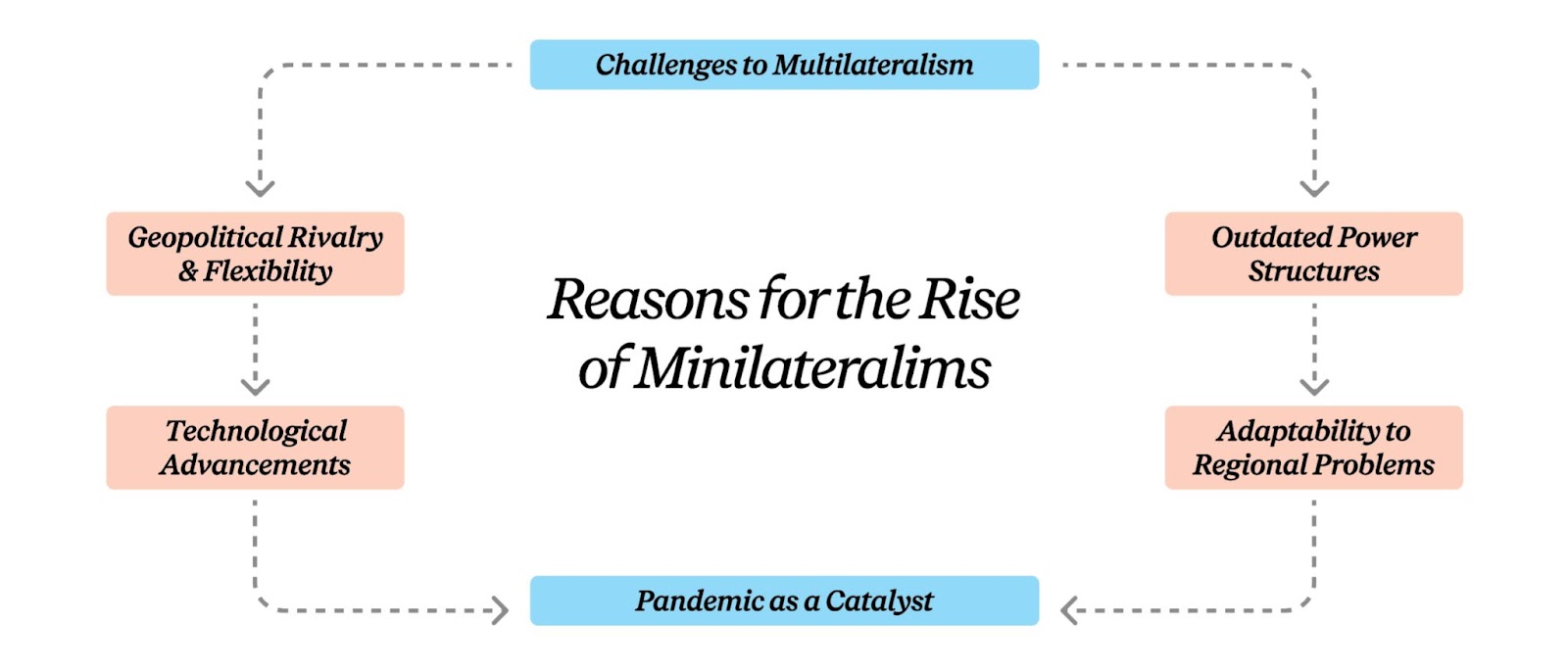
    Minilaterals refer to informal and more targeted initiatives intended to address specific threats, contingencies, or security issues with a small number of states (usually three or four) sharing the same interest in resolving it within a finite period.

    Reasons for the rise of Minilateralism

    ReasonDescriptionExample
    Challenges to MultilateralismThe evolving global order and inconsistent leadership, coupled with the rise of multipolarity, have reduced the effectiveness of multilateral organizations.WTO struggles to reach consensus due to diverse memberships.
    Geopolitical Rivalry & FlexibilityGeopolitical tensions, especially between the US and China, highlight the need for focused, flexible alliances.The Quad (US, India, Japan, and Australia) formed to counterbalance China’s influence in Indo-Pacific.
    Outdated Power StructuresInstitutions like the UN Security Council reflect outdated power structures, decreasing their effectiveness in modern geopolitics.The G7 excludes emerging powers, leading to the creation of alternative groupings like BRICS.
    Technological AdvancementsTechnological improvements have facilitated faster, more flexible communication and collaboration among smaller groups.The Arctic Council addresses region-specific environmental and security concerns among Arctic nations.
    Adaptability to Regional ProblemsMinilateral organizations can better address regional variations by providing more targeted solutions to specific local problems.ASEAN’s regional security and economic cooperation among Southeast Asian countries.
    Pandemic as a CatalystThe Covid-19 pandemic has driven the rise of strategic minilateral cooperation to tackle specific challenges like supply chains and public health.India’s SAARC Covid-19 platform for coordinating pandemic response in South Asia.

    Hello,

    We have a confession: we’re here to compete with your notes! Burning Issues magazine is your go-to resource as your exam approaches, designed to help you through the anxiety and overwhelm of preparing for the Civil Services Examination.

    Many aspirants struggle despite reading current affairs for a year. This often happens because they interpret current affairs as merely news. As a UPSC aspirant, it’s essential to analyze these topics from the perspectives of General Studies 1, 2, 3, and 4, and that’s exactly what Elevate does.

    This magazine features two sections: Burning Issues and Prelims Tidbits. Burning Issues covers current affairs that may appear in your Mains papers and teaches you how to think about these topics from different GS perspectives in just two pages.

    Prelims Tidbits simplifies your Prelims preparation by distilling key facts, data, and concepts into easy-to-recall points framed around basic questions: What? Who? How? When?

    So, dive in! Every page is crafted to enhance your UPSC prep. With consistency and this magazine, you’re not just preparing; you’re mastering the exam. The journey is about understanding and applying your knowledge effectively.

  • Best IAS Coaching in Pune

    Best IAS Coaching in Pune

    Are you in Pune and aspiring to crack the UPSC Civil Services Examination? Welcome to Civilsdaily—your trusted partner for the best IAS coaching in Pune. Our comprehensive programs are tailored to meet the unique needs of every aspirant, ensuring you have the right guidance at every step of your journey.

    Why Choose Civilsdaily for IAS Coaching in Pune?

    Civilsdaily stands out among UPSC coaching institutes in Pune due to our personalized mentorship and innovative teaching methodologies. We provide a holistic approach to UPSC preparation, integrating static concepts with current affairs to enhance retention and understanding. With us, you don’t just prepare—you prepare to succeed.

    UPSC Programs and Courses Offered

    Our courses are designed to cater to all stages of the UPSC examination, making us one of the best UPSC classes in Pune.

    Foundation Course

    The Foundation Course lays a strong groundwork for your UPSC journey. It’s perfect for beginners seeking a structured approach to cover the extensive syllabus. Our expert faculty delivers lectures in an engaging storytelling format, avoiding mundane facts and focusing on concept building.

    Prelims Program

    Our Prelims Program is meticulously crafted to enhance your problem-solving abilities and time management skills. Regular mock tests and practice sessions ensure you’re well-prepared for the preliminary examination.

    Mains Program

    The Mains Program delves deeper into advanced topics, honing your analytical and answer-writing skills. With personalized feedback and value-added points, we help you articulate your thoughts effectively.

    Interview Guidance Program

    Prepare for the final hurdle with our Interview Guidance Program. We conduct mock interviews and provide strategies to boost your confidence and communication skills.

    Mock Tests & Mentorship

    Regular mock tests combined with our unique 3-Layered Super Mentorship provide continuous evaluation and guidance, setting us apart from other IAS classes in Pune.

    Civilsdaily’s 3 layers of Mentorship for UPSC

    IAS Batch Mentors: Top Rankers


    Learn directly from UPSC toppers like AIR 48 Aaditya Pandey, AIR 50 Abhijit, and AIR 22 Pavandatta. These mentors guide small batches, offering insights that can help you secure top ranks.

    Civilsdaily’s IAS Faculty


    Our team of domain experts, including Pravin Sir, Arvind Sir, Zeeshan Sir, Parth Sir, Jatin Sir, and Venus Ma’am, provide specialized coaching through various programs like Samachar Manthan for current affairs.

    Dedicated Mentors


    Receive personalized support from mentors who have a proven track record of producing top rankers. They manage your preparation holistically, focusing on your strengths and areas for improvement.

    Key Features of Civilsdaily UPSC IAS Coaching

    • Adaptive Learning Plans
      Our study plans adapt to your individual learning curve, ensuring efficient preparation.
    • Integration of Current Affairs and Static Concepts
      We seamlessly blend current events with foundational knowledge, enhancing understanding and retention.
    • Expert Faculty and Domain Specialists
      Learn from historians, economists, and geographers who are experts in their fields.
    • Interactive Learning Environment
      Engage in active learning through discussions, doubt-clearing sessions, and collaborative study groups.
    • Proven Success Record
      Join the ranks of successful candidates who began their journey with Civilsdaily, one of the best UPSC coaching centers in Pune.

    Student Success Stories and Testimonials

    Enroll Now – Transform Your IAS Preparation with Civilsdaily

    Why wait to start your journey towards becoming an IAS officer? Enroll now with Civilsdaily—the leading UPSC coaching in Pune—and take the first step towards achieving your dream. With our expert guidance and comprehensive programs, success is within your reach.

    FAQs

    Which is the best UPSC Coaching in Pune?

    Civilsdaily is recognized as one of the best UPSC coaching institutes in Pune, offering comprehensive courses and personalized mentorship that cater to the needs of every aspirant.

    Which coaching is best for IAS in Pune?

    For those seeking top-notch IAS coaching in Pune, Civilsdaily provides expert guidance, a structured curriculum, and a proven mentorship program led by UPSC toppers and domain experts.

    What are some top IAS Coaching institutes in Pune?

    Pune hosts several reputable IAS coaching institutes, but Civilsdaily stands out due to our unique 3-Layered Super Mentorship and a holistic approach to UPSC preparation.

  • Development to Leadership: Paving the Way from Women Development to Women-led Development

    Development to Leadership: Paving the Way from Women Development to Women-led Development

    Why this ?

    The landmark passage of the Nari Shakti Vandan Adhiniyam (Women’s Reservation Bill) in 2023 saw the Vice President reshaping the Rajya Sabha panel, marking a significant shift in the perception of women’s roles. Questions on women empowerment are the most common questions that appear repeatedly. But since this topic is so common, the questions would demand a certain level of expertise on the topic. We have captured this essence by talking about the topic from empowerment to true women-led development, we’ve also covered the expanding influence of women as decision-makers, highlighting their growing impact across fields like the judiciary, politics, management, and more.

    GS 1
    Indian Society: Role of Women and Social Empowerment
    Note4Students: Analyze how women’s leadership and increased representation reshape Indian society, promoting social progress and governance reforms.

    Microtheme: Women and Associated concerns

    GS 2
    Governance, Polity, Social Justice: Women in Legislatures and Welfare Schemes
    Note4Students: Understand the impact of women’s reservation in parliament and women-led welfare schemes on gender equality and governance.

    Microtheme: Women

    GS 3
    Economic Development, Technology, Environment: Inclusive Growth and Employment
    Note4Students: Examine the role of women in fostering inclusive growth and the challenges they face in gaining leadership roles in employment sectors.

    Microtheme: Inclusive Growth

    GS 4
    Ethics, Integrity & Aptitude: Gender and Ethical Governance
    Note4Students: Explore how gender representation influences ethical decision-making in public administration and promotes gender-sensitive policies.

    Microtheme: Foundational values

    What specific measures have been recently taken to promote women’s participation in Rajya Sabha?

    • Reconstitution of the Vice-Chairpersons Panel: The Chairman of the Rajya Sabha reconstituted the panel to include only women during the historic passage of the Nari Shakti Vandan Adhiniyam (Women’s Reservation Bill), 2023.
    • Increased Representation in the Vice-Chairpersons Panel: The practice of nominating four women members (50% of the panel) was introduced, including significant figures like S. Phangnon Konyak and P.T. Usha.
    • Training of Women Officers for House Duties: Women officers of the Secretariat were trained to perform House duties, breaking the stereotype that these tasks were a male domain. Women now largely manage the Table of the House.
    • Introduction of ‘Vahan’ Application: A system to facilitate safe commutation for women officers working late hours was introduced, ensuring their safety during odd hours.
    • Appointment of Women in Key Roles: Women officers were appointed to key positions in human resources, legislative sections, and parliamentary committees.

    What are the key outcomes from Nari Shakti Adhiniyam (2023)?

    • 33% Reservation for Women in Legislatures: The Bill reserves 33% of seats for women in the Lok Sabha and State Legislative Assemblies, aiming to increase women’s participation in governance.
    • Long-term Impact on Women’s Representation: The Bill ensures that women are better represented in the political process, potentially reshaping the political landscape by empowering women as decision-makers.
    • Women as Key Participants in Development: By providing more opportunities for women in legislatures, it aligns with the goal of women-led development, where women set the agenda for governance and development policies.

    Moving from Women Development to Women-led Development

    ParameterWomen DevelopmentWomen-Led Development
    DefinitionFocuses on improving the social, economic, and political conditions of women, ensuring their empowerment and inclusion in development.Women take an active leadership role in driving economic, social, and political development, shaping policies and initiatives.
    ApproachPrimarily top-down, where external entities (governments, NGOs) design and implement policies for women’s benefit.Bottom-up approach, where women are key decision-makers, leading change and actively contributing to the development process.
    Role of WomenWomen are often recipients of development programs aimed at improving their status and welfare.Women are leaders and drivers of development, playing a central role in policy formulation, execution, and governance.
    ObjectiveAchieve gender parity by reducing gaps in education, health, employment, and political representation.Foster a more inclusive development model where women shape societal progress, ensuring their perspectives and needs are central.
    ExamplesPrograms aimed at improving maternal health, increasing female literacy, and reducing gender violence.Women-led grassroots movements, women entrepreneurs driving economic change, and female politicians spearheading reform.

    Women as Decision Makers

    Women’s participation in decision-making is essential for a country’s development and social progress. When women are involved in decision-making, it leads to positive societal changes, including improved laws, policies, and social norms. Ensuring that women have an equal voice alongside men in decisions that impact their lives, families, and communities is crucial for advancing gender equality and improving quality of life. Society must actively promote women’s equal representation and power in all areas of decision-making to build inclusive and diverse institutions.

    Women’s Political Participation in India

    1. National Politics
      • Central Council of Ministers: Women’s representation peaked at 17.8% in 2015, currently at 14.5%.
      • Election Success: Women have a higher success rate than men in elections, yet participation remains low.
      • 17th Lok Sabha: Highest women MPs in Odisha (33%), lowest in Kerala (5%).
    2. Local Governance
      • 73rd and 74th Amendments (1990s): Mandated 33% reservation for women in local bodies.
      • State-Level Initiatives: 20 states now have 50% reservation for women in Panchayati Raj Institutions.
      • Impact: Over 1 million women elected at local levels, improving grassroots political involvement.
    3. Women’s Voter Turnout
      • Improved Participation: Women’s turnout in 2019 was 67.2%, surpassing men in states like Bihar and Goa.
      • Reason for Growth: Increased literacy has led to higher political awareness among women.

    Women in Judicial Decision-Making

    1. Current Representation in India
      • Supreme Court (2022): Out of 29 judges, only 3 are women.
      • High Courts: Only 13% of judges are women.
      • Global Issue: Low representation of women in the judiciary is not unique to India; it is a global challenge.

    Women’s Representation in Management in India

    1. Data Overview
      1. Periodic Labour Force Survey (2020-2021):
        • Women in managerial positions:
          • 2020: 18.8%
          • 2021: 18.1%
      2. Highest Representation (2021):
        • Mizoram: 41.5%
        • Sikkim: 32.5%
        • Manipur: 31.1%
        • Meghalaya: 30.9%
        • Andhra Pradesh: 30.3%
      3. Lowest Representation (2021):
        • Dadra & Nagar Haveli and Daman & Diu: 1.8%
        • Uttarakhand: 3.4%
        • Jammu & Kashmir: 4.6%
        • Andaman & Nicobar Islands: 7.2%
        • Bihar: 7.3%
    2. Women in Legislative and Senior Roles: As of 2022, 22.2% of those in positions like Legislators, Senior Officials, and Managers were women.
    3. State Comparisons:
      • Better Performing States: Mizoram, Manipur, Meghalaya, and Andhra Pradesh show higher representation of women in management roles.
      • Lagging States: Dadra & Nagar Haveli, Daman & Diu, Uttarakhand, Andaman & Nicobar Islands, Punjab, and Nagaland have much lower representation of women in management.

    Hello,

    We have a confession: we’re here to compete with your notes! Burning Issues magazine is your go-to resource as your exam approaches, designed to help you through the anxiety and overwhelm of preparing for the Civil Services Examination.

    Many aspirants struggle despite reading current affairs for a year. This often happens because they interpret current affairs as merely news. As a UPSC aspirant, it’s essential to analyze these topics from the perspectives of General Studies 1, 2, 3, and 4, and that’s exactly what Elevate does.

    This magazine features two sections: Burning Issues and Prelims Tidbits. Burning Issues covers current affairs that may appear in your Mains papers and teaches you how to think about these topics from different GS perspectives in just two pages.

    Prelims Tidbits simplifies your Prelims preparation by distilling key facts, data, and concepts into easy-to-recall points framed around basic questions: What? Who? How? When?

    So, dive in! Every page is crafted to enhance your UPSC prep. With consistency and this magazine, you’re not just preparing; you’re mastering the exam. The journey is about understanding and applying your knowledge effectively.

  • Demographic Dividend and Automation: Is India’s Workforce Ready for the Future?

    Demographic Dividend and Automation: Is India’s Workforce Ready for the Future?

    Why This ?

    In today’s hustle economy, balancing India’s demographic dividend with the rise of automation is becoming super critical. The big question for aspirants? How can India make the most of its youth boom while AI takes over jobs? We’ve broken down 4 key challenges you need to know to ace the specific challenges associated with this. Plus, we’ve dug into how skilling plays a huge role in turning these challenges into opportunities, helping you handle any curveballs UPSC throws at you!

    GS 1
    Indian Society: Population and Social Empowerment
    Note4Students: Analyze the demographic dividend and the challenges of an aging population. Explore the role of skilling in promoting social empowerment.

    Microthemes: Population and associated issues

    GS 2
    Governance, Polity, Social Justice: Government Policies and Development
    Note4Students: Gain insights into labor reforms, skilling initiatives, and public-private partnerships for economic growth.

    Microthemes: Human Resources

    GS 3
    Economic Development, Technology, Environment: Growth, Employment, and Automation
    Note4Students: Assess challenges in labor-intensive sectors and the impact of AI on jobs. Examine fiscal roles in skilling programs and budgeting.

    Microthemes: Innovative Technologies

    GS 4

    Ethics, Integrity & Aptitude: Economic Growth and Corporate Responsibility

    Note4Students: Reflect on the ethical implications of automation and the corporate responsibility in reskilling efforts for equitable labor opportunities.

    Microthemes: Applied Ethics

    What is the demographic dividend?

    The UNFPA defines the demographic dividend as the potential for economic growth that occurs when a larger portion of the population is of working age (15 to 64), compared to the younger (under 15) and older (65 and above) population who are not working.

    Challenges in Leveraging India’s Demographic Sweet Spot

    India is on the brink of harnessing its demographic dividend, yet several challenges hinder its ability to fully capitalize on this potential. Below are key factors that create obstacles in the current service-led growth model and employment landscape:

    CHALLENGE 1 : SYSTEMIC CHALLENGES

     1. Inefficient Capital and Labour Ratios

    The Economic Survey 2023-24 highlighted 2 key issues: a declining capital-to-output ratio and an increasing capital-to-labour ratio. This imbalance signals inefficiencies in how capital is allocated and utilized, which undermines the potential for sustained economic growth.

    2. Misalignment of Labour Abundance

    Arvind Panagariya, Chairman of the 16th Finance Commission, noted that India’s surplus labour is not being effectively leveraged. The reliance on capital-led economic growth is ill-suited for a nation with abundant labour resources, indicating a need for a shift in growth strategies.

    3. Challenges for MSMEs

    Micro, Small, and Medium Enterprises (MSMEs) face significant hurdles due to outdated labour laws and excessive compliance burdens. These barriers discourage MSMEs from scaling, stifling their growth potential and the overall contribution to the economy.

    4. Delayed Labour Code Implementation

    Despite Parliament approving new labour codes, their delayed implementation sends negative signals to investors. This uncertainty complicates the growth landscape and impedes progress in creating a more conducive environment for investment.

    CHALLENGE 2 : Employment in Labour-Intensive Sectors

    To effectively utilize its demographic dividend, India must also address employment challenges in labour-intensive sectors:

    1. Low Contribution of Agriculture

    With 45% of the workforce engaged in agriculture, which contributes only 18% to GDP, there is a pressing need to diversify employment opportunities and boost manufacturing to enhance economic stability.

    2. Focus on the Unorganised Sector

    The unorganised and non-agricultural sectors employ 19% of the workforce but require focused attention to improve job quality and stability. Addressing these areas is vital for sustainable economic growth.

    3. Unlocking High-Growth Sectors

    Sectors like toys, apparel, tourism, and logistics present significant opportunities for labour-intensive employment. By prioritizing these industries, India can enhance job availability and stimulate economic activity.

    4. Need for Enhanced Skilling

    To support workers in transitioning to better-paying jobs, it is crucial to upgrade skills in these sectors. Skilling initiatives can enable workers to move up the value chain, fostering economic stability.

    CHALLENGE 3 : The Importance of Skilling

    Skilling is pivotal for enhancing workforce productivity and ensuring India maximizes its demographic dividend:

    1. Low Formal Skill Levels

    Currently, only 4.4% of the workforce aged 15-29 is formally skilled, underscoring the urgent need for targeted training initiatives to boost productivity.

    2. Role of Public-Private Partnerships

    Public-private partnerships are essential for developing relevant curricula and providing on-the-job training that aligns with industry needs. Collaboration can help bridge the skills gap in the workforce.

    3. Lifelong Learning Approach

    Skilling should be a lifelong endeavor, with flexible learning systems that allow workers to adapt to changing job requirements, rather than a one-time intervention.

    4. New Education Policy (NEP) 2020

    While the NEP 2020 emphasizes foundational and cognitive skills, it must be regularly reviewed to remain relevant in a fast-evolving job market.

    CHALLENGE 4 : Impact of AI and Machine Learning

    Finally, the emergence of AI and machine learning presents both challenges and opportunities for the Indian workforce:

    1. Job Threats and Opportunities

    AI and ML pose risks to low-skill, repetitive jobs but also create demand for skilled workers who can manage and utilize these technologies effectively. Addressing this shift is crucial for workforce adaptation.

    2. Need for a Regulatory Framework

    Establishing an appropriate regulatory framework for AI and ML is essential to ensure economic growth while protecting worker interests and promoting innovation.

    3. Market Growth Potential

    The AI/ML market is projected to grow nearly nine times by 2030, reaching $826.73 billion globally. This growth offers new employment avenues and innovation opportunities that India must capitalize on.

    Way Forward 

    • Sustaining Growth: Reforms are essential to sustain India’s growth trajectory and create new opportunities. 
    • Policy Focus: Finance Minister Nirmala Sitharaman emphasized the need for improving productivity and making markets more efficient in her 2023 Budget speech. 
    • State-Level Reforms: While the central government has improved the ease of doing business, state-level reforms are crucial as states are where most economic activities occur. Collaboration: Both the Centre and States must collaborate to broaden and deepen reforms for sustained economic growth.

    Skilling in the Age of Automation

    In 2019, the Organisation for Economic Co-operation and Development (OECD) predicted that automation could eliminate 14% of jobs globally and transform 32% within 15-20 years, impacting over a billion people. This underscores the urgent need for reskilling in the age of automation.

    ChallengesWay Forward
    Changing Skill Demands: Automation and AI are handling both manual and complex tasks. Skills now have an average half-life of less than 5 years, and as low as 2.5 years in tech fields.Continuous learning and reskilling must be prioritized. Governments and organizations should promote lifelong learning.
    Job Displacement: Many workers will see their jobs transformed by AI, potentially shifting them into new roles.Comprehensive reskilling programs are needed to help workers transition into new roles or industries.
    Upskilling Investment: Companies are investing up to 1.5% of their budgets in upskilling, but millions will need full reskilling, according to OECD.Large-scale reskilling programs are required to prepare workers for entirely new roles.
    Limited Impact of Current Efforts: Reskilling programs are often small-scale and not enough to address widespread automation impacts.Companies must expand and collaborate on reskilling, with support from governments and educational institutions.
    New Approaches in Reskilling: Companies are rethinking when, why, and how to reskill to adapt to AI and automation.Adopt flexible, innovative reskilling strategies like real-time assessments and adaptive learning programs.

    Hello,

    We have a confession: we’re here to compete with your notes! Burning Issues magazine is your go-to resource as your exam approaches, designed to help you through the anxiety and overwhelm of preparing for the Civil Services Examination.

    Many aspirants struggle despite reading current affairs for a year. This often happens because they interpret current affairs as merely news. As a UPSC aspirant, it’s essential to analyze these topics from the perspectives of General Studies 1, 2, 3, and 4, and that’s exactly what Elevate does.

    This magazine features two sections: Burning Issues and Prelims Tidbits. Burning Issues covers current affairs that may appear in your Mains papers and teaches you how to think about these topics from different GS perspectives in just two pages.

    Prelims Tidbits simplifies your Prelims preparation by distilling key facts, data, and concepts into easy-to-recall points framed around basic questions: What? Who? How? When?

    So, dive in! Every page is crafted to enhance your UPSC prep. With consistency and this magazine, you’re not just preparing; you’re mastering the exam. The journey is about understanding and applying your knowledge effectively.

  • Know About the IAS Training Period at LBSNAA (Salary Included)

    The IAS training period in India is a transformative journey that shapes India’s future administrators with a blend of academic rigor, field experiences, and cultural immersion. Beyond the structured curriculum, it’s a phase filled with moments that build resilience, adaptability, and a spirit of service. Every IAS aspirant must know what goes into the IAS training period at LBSNAA and how it is structured, and what each phase entails for them. 

    In a nutshell, the duration of IAS training period is 2 years. The training goes beyond textbooks, preparing officers to handle diverse on-ground challenges with confidence. But there’s much more to it.

    What is LBSNAA

    LBSNAA is the premier institution in Indian to train civil service officers in India. LBSNAA full form is Lal Bahadur Shastri National Academy of Administration. It was formerly known as the National Academy of Administration, which was established in 1959. Later, the name was changed to commemorate the India’s second Prime Minister, Lal Bahdur Sastry. Every year, new batch of IAS, IPS, IFS, IRS, and IFoS officers are trained at the LBSNAA. It is mainly known as the IAS training centre.

    IAS Training Period at LBSNAA: Overview

    Training PhaseDuration (Approx.)
    Foundation Course15 Weeks
    Phase-I22 weeks
    District Training52 Weeks
    Phase-II6 Weeks
    Assistant Secretary-ship9 Weeks

    Foundation Course

    The Foundation Course marks the start of LBSNAA IAS training period for new recruits from the All India Services, including IAS, IPS, and Indian Forest Services, among others. This 15-week course typically runs from September to December and covers a comprehensive understanding of India’s political, social, economic, and administrative landscape. 

    The course is designed to develop essential skills and instill the perspective needed to handle public service responsibilities effectively. New officers explore Indian polity, economics, history, and current affairs, gaining the knowledge necessary to address the diverse challenges of civil service. 

    The course also focuses on holistic growth, aiming to cultivate moral, intellectual, physical, and creative capacities in trainees. By nurturing camaraderie and teamwork, it builds a cohesive spirit among officers from various services, laying a solid foundation for their future roles.

    LBSNAA Training Period for IAS Phase–I

    Following the Foundation Course, IAS Officer Trainees advance to Phase-I of IAS training period. It is a comprehensive program focused on equipping them for diverse roles in their early years of service. The emphasis is on the understanding public systems and effective management practices. 

    Happening from December-May, Phase-I includes 12 weeks of academic instruction, a 7-week Winter Study Tour, and a 1-week block leave. 

    At the end of the IAS training period Phase–I, an officer trainy is expect to:

    1. Acquire a pan-India perspective of emerging socio-economic and politico-legal trends, an understanding of the emerging role of the IAS and its shared administrative responsibilities with other services.

    2. Acquire knowledge and skills needed to discharge administrative responsibilities in the first decade of their career in the following areas:

    • Law and legal instruments
    • Administrative rules, procedures and programme guidelines
    • Modern management tools, and
    • Economic analysis

    3. Demonstrate proficiency in the regional language of the allotted State to better appreciate its administrative and cultural ethos.

    4. Acquire an understanding on the cultural and socio-economic background of the State they are allotted.

    5. Demonstrate effective written/ oral communication skills both in interpersonal and organizational context.

    6. Exhibit right values and attitudes.

    7. Maintain physical fitness.

    8. Adhere to the spirit of ‘Sheelam Param Bhushanam’.

    Winter Study Tour

    In Phase I training, IAS Officer Trainees first go on Bharat Darshan, a 6-7 week Winter Study Tour. It is about exploring India’s diversity by visiting the armed forces, government bodies, NGOs, tribal areas, and more. 

    After traveling about 20,000 kilometers, they start the academic module, covering 400 hours of subjects like Law, Economics, Political Science, Management, and Public Administration, along with ICT and regional language training.

    Beyond academics, Phase I of the IAS training period includes co-curricular activities like treks, cultural fests, theater, film events, and major gatherings like the Inter Services Meet, fostering well-rounded personal growth.

    District Training

    Since 1969, IAS Officer Trainees have participated in a one-year district training within their assigned state cadre, following a hands-on ‘sandwich pattern’ of learning. During this time, they manage independent responsibilities, observing and practicing key aspects of government functions. 

    They study departmental roles, relevant laws, office procedures, budgeting, and auditing processes. Trainees also learn how programs are implemented and monitored, gaining insight into departmental challenges and areas for improvement.

    IAS Traning Period Phase-II

    The IAS Professional Course, Phase-II at LBSNAA spans six weeks, from mid-May to June. This phase of IAS training period in India consolidates theoretical knowledge from earlier courses with practical district-level experiences, encouraging trainees to share insights on effective administrative practices, strengths, and weaknesses in governance. 

    Interactive learning is enhanced with sessions by distinguished experts, and seminars focused on roles like SDO, Zilla Parishad CEO, Municipal Commissioner, and District Magistrate. These discussions involve small groups for in-depth cadre-based learning.

    Physical fitness remains essential with mandatory morning routines and adventure sports on weekends. A highlight of Phase-II is the week-long Foreign Study Tour, where Officer Trainees observe international practices and propose adaptable solutions for India.

    Upon completion of two-year induction training, IAS Officer Trainees earn a Master’s Degree in Public Management (in collaboration with Jawaharlal Nehru University), completing a 64-credit curriculum over four semesters combining academic and field-based learning.

    Assistant Secretary-Ship

    The Assistant Secretary program, introduced in 2015 for IAS officers starting from the 2013 batch. The aim of this IAS training period is to provide valuable insights into the workings of the Government of India. 

    New recruits can engage closely with central operations, improving their understanding of policy implementation and administrative processes. Each probationer receives the designation of Assistant Secretary, working under the mentorship of Joint Secretaries for a few months. 

    This hands-on experience at the Central Secretariat equips them with a deeper understanding of national-level governance. The IAS probationers also present key findings and innovative ideas to India’s Prime Minister. It is a significant part of their initial exposure to central government functions.

    IAS Training Period Salary

    The IAS training period salary consists of a fixed stipend plus certain perks. While the actual amount of salary paid is ₹56100/Month, it doesn’t include food and lodging allowances, e.g. mess or hostel charges. So, the actual stipend received would be around ₹35,000-₹40,000 per month, after deducting the expenses. 

    Except that, the LBSNAA training period salary is just the same as the starting salary of an IAS officer, which is ₹56,100/Month. For IAS officers, in addition to the salary, additional allowances will also be there. 

    In the End

    The IAS training journey at LBSNAA is more than structured modules and on-field learning—it also nurtures enduring connections. Trainees build lifelong friendships and networks with peers and mentors across services, creating a support system that lasts well beyond their training years. These bonds often let officers collaborate in diverse fields, working collectively towards India’s development and addressing the nation’s evolving administrative challenges.

    FAQs

    How long is the IAS training at LBSNAA?

    The IAS training period at LBSNAA is for 2 years.

    In which month does IAS training start?

    IAS training usually begins in September every year, kicking off the foundational phase for newly selected UPSC candidates. The total duration is 2 years. This IAS training period introduces trainees to their initial sessions.

    What is the LBSNAA training period salary for IAS trainee officers?

    IAS trainee officers at LBSNAA receive a monthly salary of INR 56,100. After deductions for food and lodging, they take home around INR 35,000 to INR 40,000 each month during training.

    Is there any IAS officer who was not able to clear his training at LBSNAA?

    Yes, IAS probationers at LBSNAA may be discharged if they fail to pass a re-exam, are found ineligible by the government, or intentionally neglect their studies or probationary responsibilities. But the cases are very rare.

    Will there be holidays during IAS training at LBSNAA?

    Yes, IAS trainees at LBSNAA do have holidays and weekends, which are often dedicated to various extracurricular activities. These include community service, adventure sports like rock climbing and river rafting, short treks, cultural programs, horse riding, and cross-country runs, allowing trainees a balanced experience beyond academics.