đŸ’„Join UPSC 2027,2028 Mentorship (July Batch) + XFactor Notes & Microthemes PDF

Author: Access Account

  • Exploring UBI: The Future of Social Welfare and Economic Equity in India

    Exploring UBI: The Future of Social Welfare and Economic Equity in India

    Why This

    With the fear of jobless growth, the talk about Universal Basic Income (UBI) has hit the public discourse hard. But let’s be real—it’s not that simple to handle this topic. Learning the challenges in implementing UBI and the opportunities it presents are the basics which everybody should know. But whats important is to analyse UBI across economic, political, social, and administrative angles. This article dives deep into each of these aspects and further breaks down whether UBI can truly work as a safety net, giving you the full picture to tackle any question thrown your way!

    GS 1
    Indian Society: Poverty and Social Change

    Note4Students: Analyze the role of UBI in mitigating poverty, unemployment, and income inequality in the context of automation and globalization.

    Microtheme: Poverty and Developmental issues.

    GS 2
    Governance, Polity, Social Justice: Welfare Schemes and Vulnerable Sections

    Note4Students: Examine UBI as a complement or alternative to welfare schemes, and its role in addressing poverty, education, and social equity.

    Microtheme: Welfare and Development Schemes

    GS 3
    Economic Development, Technology, Environment: Inclusive Growth and Employment

    Note4Students: Critically assess UBI’s potential to reduce income inequality, address automation-driven unemployment, and its fiscal implications.

    Microtheme: Inclusive Growth X Public Expenditure

    GS 4
    Ethics, Integrity & Aptitude: Social Justice and Governance

    Note4Students: Reflect on the ethical aspects of UBI, emphasizing fairness, transparency, and its role in ensuring social justice for marginalized communities.

    Microtheme: Quality of Service Delivery

    Is UBI a safety net for the Future ?

    The International Labour Organization (ILO) reports that 83% of the unemployed population in India are youth, largely due to the impact of automation and artificial intelligence (AI) on traditional jobs. This transformation of the economy has worsened income inequality, with a 1.6% global drop in labor income share between 2004 and 2024. For a developing nation like India, where a large portion of the workforce is unskilled or semi-skilled, such trends are deeply troubling.

    Additionally, inflationary pressures and geopolitical tensions have prompted aggressive monetary policies, which have only strained the labor market further. Rising unemployment rates in 2024, as projected by the ILO, highlight these structural issues within global and national labor markets.Given this context, Universal Basic Income (UBI) emerges as a potential solution to address the growing inequality and economic instability. In a nation like India, where income disparity is high, and the formal employment sector remains limited, UBI can play a transformative role by promoting economic stability, ensuring social equity, and empowering the marginalized. But like every other measure it has two sides to it. This article analyses the Pros and Cons of it.

    What is UBI ?

    Universal Basic Income (UBI) is a social welfare proposal in which all beneficiaries regularly receive a guaranteed income in the form of an unconditional transfer payment. 

    A brief dissection of various aspects:

    CategoryProsCons
    Economic1. Stimulus: UBI boosts local economies by increasing consumer spending and supporting small businesses.
    Ex: Economic Survey 2016-17 predicted UBI could shrink poverty from 22% to 0.5%.
    2. Entrepreneurial Growth: With financial security, individuals are more likely to take entrepreneurial risks.
    Ex: SEWA’s UBI pilot (2011-12) showed increased health, productivity, and financial stability.
    3. Increased Demand: UBI encourages spending, boosting demand for goods and services and spurring economic growth.
    1. High Cost: UBI is expensive and may require significant tax hikes or spending cuts.
    Ex: UBI could cost 4.9% of GDP vs. 3.7% for current welfare programs (Economic Survey 2016-17).
    2. Inflation Risk: Increased disposable income may lead to inflation if not managed properly.
    3. Financial Feasibility: UBI could lead to cuts in essential welfare programs, impacting vulnerable groups.
    Ex: Replacing welfare programs like MGNREGS may destabilize rural safety nets.
    Political1. Popularity: UBI can gain political traction by appealing to voters as a tangible solution to poverty.
    Ex: Alaska’s Permanent Fund Dividend boosted political engagement.
    2. Electoral Advantage: Political parties advocating UBI could attract a larger voter base, especially from marginalized communities.
    Ex: 2017 Economic Survey showed growing support for UBI as a policy.
    3. Political Stability: UBI can promote social cohesion by reducing economic disparities, easing tensions in divided societies.
    1. Inequity: UBI’s universal nature may disproportionately benefit the wealthy if not carefully designed.
    Ex: IMF report suggested UBI could worsen income inequality if welfare is replaced.
    2. Universality vs. Targeting: There is ongoing debate about whether UBI should be truly universal or targeted to those most in need.
    3. Rollback of Welfare: Politically challenging to phase out existing welfare schemes to fund UBI.
    Ex: Transitioning from PDS and MGNREGS to UBI raises concerns about food security.
    Social1. Poverty Reduction: UBI directly reduces poverty by providing a guaranteed income floor for all citizens.
    Ex: SEWA’s UBI pilot improved health and economic outcomes for low-income households.
    2. Empowering Women: UBI can promote gender equality by providing women with financial independence.
    Ex: 2018 data showed 75% of adult Indian women weren’t in formal employment; UBI could alleviate dependency.
    3. Health Benefits: UBI can reduce stress and improve mental health by reducing financial insecurity.
    Ex: Telangana’s “Rythu Bandhu” scheme linked to improved well-being of farmers.
    1. Dependency Risk: UBI may reduce the incentive to work, creating a reliance on government support.
    Ex: Critics argue that UBI could disincentivize job-seeking or skill development.
    2. Productivity Decline: Critics fear that UBI may foster laziness or entitlement.
    3. Administrative Issues: Complexities in reaching every citizen, especially in remote or rural areas.
    Ex: Implementing UBI in a country with varied socio-economic conditions like India faces challenges with eligibility.
    Administrative1. Simplified Welfare: UBI streamlines welfare by replacing multiple schemes, reducing administrative costs.
    Ex: Economic Survey 2016-17 highlighted UBI’s potential to reduce bureaucratic overhead.
    2. Income Security: Provides a reliable safety net without the need for eligibility assessments.
    Ex: PAHAL (LPG subsidy) is a successful income support model.
    3. Efficient Resource Allocation: UBI can free up government resources for other critical sectors like healthcare and education.
    1. Beneficiary Identification: Implementing UBI in India is challenging due to difficulties in accurately identifying beneficiaries.
    Ex: World Bank report noted India’s socio-economic diversity complicates UBI implementation.
    2. Legal and Political Challenges: Overhauling existing welfare programs and integrating UBI may face resistance from vested interests.
    3. Budget Constraints: UBI’s cost (estimated at 4.9% of GDP) could crowd out spending on crucial services like education and infrastructure.
    Ex: Economic Survey 2016-17 raised concerns about the affordability of UBI for India.

    CONCEPT : SOCIAL PROTECTION SYSTEMS IN INDIA

    Social protection systems refer to comprehensive programs and policies designed to protect individuals and households from economic and social risks, vulnerabilities, and shocks. These systems aim to promote economic stability, reduce poverty, and ensure access to essential services. Any social protection system, thus, essentially addresses one or more of the 6 Vulnerabilities.

    ADDRESSING THE 6 Vs = 6 VULNERABILITIES

    1. Economic Vulnerability: Addressing poverty and income inequality through programs like MGNREGA, PM-KISAN, and DBT.
    2. Health Vulnerability: Managing health risks and catastrophic expenses with schemes like Ayushman Bharat.
    3. Food Insecurity: Ensuring access to basic nutrition through programs like the Public Distribution System (PDS) and Mid-Day Meal Scheme.
    4. Vulnerability of Marginalized Groups: Supporting the elderly, disabled, and marginalized communities through pensions and social assistance (NSAP).
    5. Employment Vulnerability: Tackling job insecurity with schemes like MGNREGA and NRLM.
    6. Financial Vulnerability: Promoting financial inclusion and security via banking access (PMJDY) and Direct Benefit Transfers (DBT).

    Social protection systems in India are crucial for addressing the multifaceted challenges faced by vulnerable populations. By providing financial stability, healthcare access, food security, and employment support, these systems play a vital role in promoting social equity, reducing poverty, and building resilience against economic and health shocks.

    Hello,

    We have a confession: we’re here to compete with your notes! Burning Issues magazine is your go-to resource as your exam approaches, designed to help you through the anxiety and overwhelm of preparing for the Civil Services Examination.

    Many aspirants struggle despite reading current affairs for a year. This often happens because they interpret current affairs as merely news. As a UPSC aspirant, it’s essential to analyze these topics from the perspectives of General Studies 1, 2, 3, and 4, and that’s exactly what Elevate does.

    This magazine features two sections: Burning Issues and Prelims Tidbits. Burning Issues covers current affairs that may appear in your Mains papers and teaches you how to think about these topics from different GS perspectives in just two pages.

    Prelims Tidbits simplifies your Prelims preparation by distilling key facts, data, and concepts into easy-to-recall points framed around basic questions: What? Who? How? When?

    So, dive in! Every page is crafted to enhance your UPSC prep. With consistency and this magazine, you’re not just preparing; you’re mastering the exam. The journey is about understanding and applying your knowledge effectively.

  • Top 20 IAS Interview Questions with Answers

    Preparing for the UPSC interview involves more than just knowing the right answers; it requires a holistic approach that builds confidence, authenticity, and presence. Beyond mastering current affairs and refining communication skills, the process also tests your ability to think under pressure, express opinions tactfully, and uphold ethical standards. IAS interview questions are designed to assess whether candidates can handle real-world responsibilities effectively.

    Taking time to practice situational questions, engage in mock interviews, and reflect on personal motivations can make a substantial difference. Knowing IAS interview questions with answers is also an important preparatory step. However, don’t assume the answers we will discuss are exact. They’re sample answers designed to guide you in your preparation.

    20 IAS Interview Questions & Answers

    IAS interview is also graded for 275 marks. The marks obtained in the interview are considered for preparing the final list. Hence, knowing and preparing for IAS interview questions bears significance.

    1. Tell us about yourself.

    It is one of the most popular IAS interview questions. It’s essential to confidently share relevant details, including personal background, educational qualifications, and professional experiences for this question. This provides the panel with a clear understanding of your journey and motivations for joining public service.

    A sample answer would be:

    I come from a background in [Your Subject] and have always felt drawn to public service, which is why I pursued the UPSC path. My internships with government organizations have given me practical experience, and I have a strong interest in sustainable development, reinforcing my dedication to contributing effectively to public service.

    2. What motivated you to choose this career path?

    This is a standard tricky question asked in IAS interviews. The intention behind the question is to check a candidate’s clarity of thought and what motivates him to become an IAS officer.

    There’s no single “best” answer to these IAS interview questions, as each candidate has a unique story and perspective to share when responding to this commonly asked question.

    A sample response would be:

    I am driven by the belief that effective governance is essential for societal progress. My desire to contribute to our nation’s growth and create positive change motivated me to pursue the UPSC challenge and become an IAS officer.

    3. Can you discuss your educational background and how it has prepared you for this role?

    The panel wants to know how your education influenced your choice to join civil services. Share subjects or experiences that sparked your interest in governance or social service. Keep your response brief and show a clear link between your studies and your IAS goals.

    A sample response would be:

    Studying [Your Subject] gave me a clear picture of how governance works and how policies impact people’s lives. Through community projects, I saw the challenges on the ground, and it made me want to serve on a larger scale. That’s what led me to the IAS—I feel it’s the best way I can make a real difference.

    4. What are your strengths and weaknesses?

    This is one of the common IAS interview questions used by the panel to assess a candidate’s self-awareness and honesty. Honesty is essential for an IAS officer, alongside having a strong knowledge base. Remember, everyone has strengths and weaknesses, so don’t hesitate to share yours. Answer confidently and authentically for the best impression.

    A sample response would be:

    One of my strengths is clear communication, which has helped me in team projects. I am also a good team player, who likes to coordinate with people in getting things done. On the flip side, I sometimes overthink things, but I’m actively working on that.

    5. How do you handle pressure and stress?

    Civil servants handle a lot of pressure, and the panel wants to see how resilient you are. Talk about specific ways you stay calm and manage stress, both at work and in life. Instead of saying “I work hard,” share real methods like practising mindfulness, managing your time well, or staying active.

    A sample response would be:

    I manage stress by practising mindfulness and yoga, which helps me stay clear-headed and focused, especially when things get tough. I also try to prioritize tasks and tackle big challenges by breaking them down into smaller, manageable steps – it makes everything feel more achievable. I also insist on time management for my personal life, which adequately leaves room for all tasks to be done without feeling pressure.

    6. What is your understanding of the role of a civil servant?

    This is one of the UPSC interview questions used to gauge a candidate’s understanding of the fundamental values and responsibilities in public service. UPSC interview panel tries to evaluate a candidate’s dedication to ethics, accountability, and commitment to serving the public.

    A sample response would be:

    A civil servant’s role is to serve the public impartially and uphold the law, ensuring that policies benefit all sections of society. They’re responsible for implementing government programs and maintaining transparency. It’s about balancing efficient service delivery with ethical standards to build trust and bring positive change to people’s lives.

    7. How do you plan to contribute to society as a civil servant?

    This is among those IAS interview questions, which lets the interview panel see your vision for contributing to society through your role as a civil servant. They’re looking for a commitment to social impact and an understanding of how civil servants can address public needs.

    A sample answer would be:

    As a civil servant, my focus would be on inclusive development, particularly in education and healthcare. I aim to create accessible programs and strengthen community engagement, empowering citizens to be part of the solution. Promoting transparency and streamlining processes would also be priorities to build trust and ensure services reach those who need them most.

    8. What do you understand about the term ‘governance’?

    A sample response would be:

    Governance, to me, is about guiding society toward equitable progress. It involves transparent, accountable processes to ensure public welfare and uphold the rule of law. Good governance requires responsiveness, inclusiveness, and collaboration across departments. It involves addressing public needs efficiently while respecting individual rights. It’s about creating a framework where citizens feel empowered and heard.

    9. What are the biggest challenges facing India today?

    This question checks your understanding of India’s main economic, political, and social issues today. It can be one of the technical IAS interview questions. Economic problems persist, while political challenges like [mention political issues] add complexity. Social issues like [highlight social difficulties] also play a role. Tackling these requires balanced solutions, like [suggest possible strategies].

    10. How do you stay updated with current affairs?

    The question aims to assess your dedication to staying informed, ability to process diverse information sources, and readiness to address relevant issues effectively as a future civil servant.

    How to Answer: Explain your approach to staying informed about current events. Mention reliable sources like newspapers, trusted online platforms, and journals. Highlight how you use summaries, analysis, or discussions with peers for deeper insights. Emphasize consistency, focusing on well-rounded knowledge across key areas: national issues, economy, global events, and policies.

    11. Can you discuss a current event or issue that interests you?

    Keep it simple and discuss an answer briefly, expressing your interest and why it held your attention.

    Sample Answer: One issue that really interests me is the increasing focus on renewable energy in India. With rising environmental concerns, I find it crucial how the country is balancing economic growth with sustainable practices. India’s recent initiatives in solar and wind energy show a promising shift towards cleaner energy and climate responsibility.

    12. What is your opinion on the role of technology in governance?

    The panel asks this question to gauge your understanding of technology’s role in governance. As future civil servants, IAS officers need to know how technology can streamline governance, promote transparency, and improve public services. Demonstrating strategies for using tech effectively shows your awareness of modern challenges and readiness to adapt.

    A sample answer would be:

    Technology is reshaping governance now. With e-governance, digital tools, and data use, we’re seeing more transparency, efficiency, and better connections with citizens. It is handling the malpractices to a large extent this way. In the end, it is helping to deliver public services more effectively and effortlessly.

    13. How do you plan to tackle corruption if you were appointed to a position of authority?

    These type of IAS interview questions are intended to gauge your practical approach to handling corruption. The UPSC panel wants to see your understanding of implementing effective, actionable solutions within the system.

    A sample response would be:

    If appointed to a position of authority, I would focus on implementing strict internal audits, improving transparency, and encouraging whistleblowing within a safe framework. I’d work to simplify processes and use technology to track workflows, reducing the scope for discretionary power. Building a culture of integrity through regular ethics training and ensuring accountability at all levels would be central to my approach.

    14. How would you handle a situation where there is a conflict between your personal beliefs and your duties as a civil servant?

    When facing such situations, start by understanding the impact on all stakeholders and discuss with mentors for insight. Communicate any concerns openly, and aim to reach a resolution that aligns with both ethical standards and organizational goals.

    A sample answer would be: 

    In a situation where my personal beliefs conflict with my duties, I’d focus on fulfilling my responsibilities while upholding ethical standards. I would assess the impact on those affected, seek guidance if needed, and work towards a balanced solution that respects both my duties and the values of public service.

    15. What is your view on the role of youth in nation-building?

    This question assesses your perspective on the importance of youth involvement in a country’s development. The UPSC panel wants to understand your ideas on mobilizing young people for positive change.

    A sample response would be:

    I believe youth play a crucial role in nation-building by bringing energy, fresh ideas, and resilience to address challenges. With proper guidance, education, and opportunities, young people can contribute to economic progress, social reform, and innovation. Their active participation in governance, social initiatives, and skill-building programs can drive inclusive growth and foster a vibrant, forward-looking nation.

    17. Can you discuss a situation where you demonstrated leadership skills?

    This question allows the UPSC panel to assess your experience and approach to leadership, focusing on practical situations where you’ve effectively managed or inspired others. A solid response would emphasize specific actions and the outcome, showing how your decisions positively impacted a team or project.

    Sample Answer:

    In college, I led a team project addressing waste management on campus. We organized roles, worked with the administration, and coordinated cleanup drives. As issues arose, I focused on keeping the team motivated and resolving conflicts promptly. Our efforts led to a sustainable system, and the experience taught me the value of clear communication, accountability, and adaptive planning in leadership.

    18. How do you prioritise tasks and manage your time effectively?

    When this is asked in the IAS interview questions, highlight your methods for balancing responsibilities and ensuring productivity.

    Sample Answer:

    I prioritize tasks based on urgency and impact. I start by identifying immediate deadlines and then assess which tasks align with larger goals. For time management, I use a digital planner to schedule specific time slots, keeping room for unforeseen tasks. This approach has helped me stay organised and flexible. It also allowed me to handle unexpected challenges without compromising essential work.

    19. What is your opinion on the importance of ethics in public administration?

    This question is designed to understand a candidate’s grasp of ethical principles and their importance in public administration. A strong answer should highlight the role of ethics in building trust and accountability within the public sector.

    Sample Answer:

    Ethics in public administration is crucial for building public trust and ensuring accountability. Ethical practices prevent misuse of power, promote fairness, and uphold transparency. I believe that a civil servant must prioritise public interest over personal gain, as this maintains the integrity of public institutions. Adhering to ethical standards creates a culture of responsibility, cultivating trust between the government and citizens. It ultimately leads to more equitable and effective service delivery.

    20. How do you plan to address the challenges of rural development?

    The UPSC panel wants to see if the candidate can outline actionable steps, showing awareness of on-ground realities, and effective resource allocation.

    Sample Answer:
    In addressing rural development, I’d focus on basic infrastructure like roads, water, and electricity to improve connectivity and access to services. Promoting local education and skill programs, particularly in sustainable agriculture and small-scale industries, could empower communities economically. Working with local leaders would help align policies with each community’s specific needs.

    More UPSC Interview Questions

    1. Tell us about your hometown.

    2. Can you discuss a policy initiative or program that you think has been successful in India?

    3. How do you plan to promote gender equality and social justice as a civil servant?

    4. Can you discuss a book or author that has influenced your thinking?

    5. Why should we select you for this position?

    Tricky Questions Asked in IAS Interview

    Here are the tricky IAS interview questions:

    1. How would you lift a camel with one hand?

    2. Which state of India has the tallest girls?

    3. What is special about your date of birth?

    4. Name three consecutive days without using the words “Monday, Tuesday, Wednesday, Thursday, Friday, Saturday, Sunday.”

    5. If a ship sinks on the border of India & USA, how would you bury the survivors?

    6. Can you say in which state is the Indian Ocean?

    7. What will you do if I elope with your sister?

    8. Ram & Rahim are twins born in May, but their birthdays are in February. How?

    9. Is it possible for a man to stay awake for 8 days?

    10. How do you write 32 words using only 3 words?

    Tips to Answer Effectively in the UPSC Interview

    Understand Your DAF (Detailed Application Form) – Know your background, hobbies, and achievements well, as many questions are drawn from your DAF.

    Stay Updated with Current Affairs – Regularly read newspapers and reliable sources to be informed about national and international issues.

    Practice Mock Interviews – Enroll in mock interview sessions to get comfortable with the format and receive constructive feedback.

    Develop a Balanced Perspective – While forming opinions, consider multiple viewpoints on social, economic, and political issues.

    Refine Communication Skills – Practice clear, concise, and confident speaking to convey your answers effectively.

    Prepare with Real-life Examples – Link your answers to practical scenarios, showing awareness of on-ground challenges.

    Brush up on Optional Subject Knowledge – Revise core concepts from your optional subject, as questions may delve into these areas.

    Focus on Body Language and Etiquette – Maintain calmness, politeness, and respectful body language throughout the interview.

    Study Core Subjects Thoroughly – Be well-prepared in governance, ethics, and administrative topics relevant to public service.

    Practice Self-awareness and Reflection – Be ready to discuss your strengths, weaknesses, values, and motivations clearly and honestly.

    Conclusion

    Acing the UPSC interview goes beyond preparation—it’s also about mindset. Approach each question with clarity and honesty, seeing it as an opportunity to showcase your commitment to public service. Remember, the panel values candidates who are grounded, adaptable, and open to growth. Reflecting on real experiences and considering the human impact of your answers will make your responses stand out, showing your readiness to serve responsibly and effectively. Here are some common mistakes most candidates make during Interviews that you must avoid.

    FAQs

    Is it possible to get rejected at the UPSC interview stage?

    Yes, candidates can be rejected at the UPSC interview stage. The board assesses traits like integrity, judgement, and communication. Falling short in these areas can result in a lower overall score.

    Are IAS interview questions difficult?

    IAS interview questions are challenging, often testing a candidate’s knowledge, judgement, and ethical values. The questions aren’t purely academic but assess one’s ability to think critically and respond practically, and thoughtfully under pressure.

    What’s the duration of the IAS interview?

    The IAS interview typically lasts around 30 to 45 minutes. However, there’s no fixed time. It can vary based on the board’s assessment. Some interviews last up to an hour for deeper evaluation.

    What’s the score of an IAS interview?

    The IAS interview, part of the UPSC Civil Services Exam, carries 275 marks. These marks, combined with the Mains score, determine a candidate’s final ranking in the selection process.

    How to prepare for IAS interview questions?

    Preparing for IAS interview questions involves focusing on current affairs, personal background, and optional subjects. Practise mock interviews to improve communication and confidence. Reflect on past experiences to answer situational questions genuinely. Take guidance from toppers, if possible. Familiarity with national issues, ethical values, and critical analysis skills also enhance performance in the interview stage.

  • Which is the Best Optional Subject for UPSC

    UPSC syllabus is generally vast. Optional subjects in the UPSC come across as a relief for many aspirants in this scenario. By selecting the best optional subject for UPSC, aspirants can significantly maximise their score. It is also important to select an optional subject strategically. You should not do that with whim or bias, only to lose the score. But how to select the best optional subject for the UPSC? We shall discuss the factors you should consider before making the choice.

    List of Optional Subjects in the UPSC

    Source: Official

    Selecting the Best Optional Subject for UPSC

    Educational Background

    When deciding the best optional subject for UPSC, the most obvious choice is to consider your educational background. If you have an educational background that aligns with one of the optional in the UPSC, it makes the preparation effortless. For example, if you’re from an Agriculture or Medical background, the UPSC has both these optionals. There is no need for extensive preparation, except knowing the syllabus and focusing on that part. Optional papers in the UPSC occupy two papers worth 250 each. Thus, you’re at a significant advantage. 

    Popular optional subjects that overlap with Educational Background are Agriculture, Mechanical Engineering, Civil Engineering, Electrical Engineering, Animal Husbandry and Veterinary Science, Medical Science, Psychology, etc. Conversely, it is better to choose these optional subjects in the UPSC, only if you have a degree in one of these subjects. Otherwise, it is an unwise decision to take, only to decrease your score in the UPSC.

    Syllabus Overlap

    The most common metric used in selecting the best optional subject for UPSC is syllabus overlap. Certain subjects like History, Geography, Sociology, Public Administration, Political Science and International Relations have an overlapping syllabus. Subjects as they are or conceptss from these subjects are repeated in multiple phases of the UPSC exam or multiple papers of the UPSC Mains. 

    If you choose one of such optional subjects in the UPSC, it reduces your preparation time and syllabus coverage. You can prepare for the subject at once, and attempt all the questions that come from that, which is not possible if you choose other optional subjects. Indeed, if you select rare optional subjects, it doubles down on your preparation time and effort, which is undesirable. Moreover, focusing on one subject leads to quality performance, not when there are multiple subjects. 

    Complexity of the Subject

    If you have to select the best optional subject for the UPSC, which is different from your educational background or lacks overlap with the UPSC syllabus, go for the easiest. It is a blind shot. For example, when you’re not from an Engineering background, but choose Mechanical Engineering optional, the chances of scoring are very low. Plus, it adds a huge burden on your preparation and syllabus coverage. 

    There is no point in selecting Electrical Engineering as the best optional subject for the UPSC when you’re from a Mechanical Engineering background.

    So, what is the easiest optional subject for UPSC? Anthropology, PSIR, Sociology, Literature, Mathematics and Science subjects are perceived as the easiest and most scoring optional in the UPSC.

    Subjects like Mathematics and Science can help students score higher if they overcome challenges like a vast syllabus, complex concepts, and the need for prior knowledge. These technical subjects offer higher marks due to limited subjectivity.

    Humanities subjects like Anthropology, PSIR, and Sociology are also considered high-scoring due to their manageable syllabus, overlap with General Studies, and easier concepts.

    Literature is seen as scoring for candidates with a strong foundation in their regional language or mother tongue. However, data is limited to conclusively determine their scoring trends due to fewer candidates opting for these subjects.

    Personal Interest

    Your interest can determine the best optional subject for the UPSC. However, it is a tricky choice. You have to look at the ease of preparation, syllabus coverage and subject itself. The goal is to select a subject that can reduce your preparation time and offer an easy alternative. If your interest also favours a subject with these factors, you may choose that optional. 

    For example, if you have a degree in Electrical Engineering, still, selecting the same optional in the UPSC might be burdensome because of the vast syllabus. In that case, you might wanna go for History optional, which might interest you. Many students do find History and Geography to be interesting subjects. The historical events or geographical facts are easier to understand and remember too. So, you can select the best optional based on that without much hassle. After all, if you have an interest, it helps you score better in that subject. 

    Once again, you can consider syllabus overlap to make a better decision among the subjects that you’re interested in. Always check the trend of most selected optional subjects when making a decision based on your interest. Because some subjects can be complex, e.g Psychology. 

    Scoring Trends and Expert Suggestions

    If you’re not aware of the above, you can make a data-driven decision– based on popular trends and expert suggestions. Though there are 48 optional subjects, only a few are most frequently selected as the best optional subjects for UPSC. It could be for various reasons: scoring subject, syllabus overlap, educational background, or any other factor. Analysis of previous year trends shows that some subjects have more success rate than others:

    Most Selected Optionals in Previous Years

    Optional Subject20192018201720162015
    Geography19161993266940494351
    Political Science & IR16621317124613201107
    Sociology12631072142115552490
    History751842107438702090
    Public Administration705726116533017077
    Philosophy43946375520921116
    Psychology16412819310611163

    Success Rate of Popular Optional Subjects in UPSC

    Optional Subjects20202019
    Candidates AppearedPassedCandidates AppearedPassed
    Political Science & International Relations18638.3%16628.2%
    Geography13227.2%19165.5%
    Sociology12459.2%126310.0%
    Anthropology12118.3%11899.1%
    History5814.1%7516.8%
    Mathematics5805.8%5398.3%
    Public Administration5094.5%7058.2%
    Philosophy3477.5%4396.2%
    Economics23613.1%24310.7%
    Literature Of Hindi Language2268.4%1916.8%

    Success Rate of Optional in UPSC 2020

    Optional SubjectCandidates AppearedCandidates RecommendedSuccess Rate (%)
    Political Science & International Relations18631548.3
    Geography1322957.2
    Sociology12451159.2
    Anthropology12111008.3
    History581244.1
    Mathematics580264.5
    Public Administration509387.5
    Philosophy347205.8
    Economics2363113.1
    Literature of Hindi Language226198.4
    Commerce & Accountancy2102712.9
    Mechanical Engineering2012210.9
    Electrical Engineering170158.8
    Law1672313.8
    Medical Science162169.9
    Psychology155117.1
    Chemistry153159.8
    Civil Engineering13096.9
    Physics13086.2
    Agriculture11132.7
    Literature of Malayalam Language931010.8
    Literature of Kannada Language8378.4
    Literature of Tamil Language6446.3
    Literature of Gujarati Language4948.2
    Zoology41512.2
    Literature of Sanskrit Language3912.6
    Management38615.8
    Literature of Telugu Language36513.9
    Geology3525.7
    Literature of Maithili Language3139.7
    Botany2727.4
    Literature of English Language27622.2
    Literature of Punjabi Language25312
    Literature of Urdu Language1119.1
    Animal Husbandry & Veterinary Science10110
    Literature of Marathi Language9111.1
    Statistics500
    Literature of Manipuri Language4125
    Literature of Assamese Language200
    Literature of Bengali Language200
    Literature of Oriya Language200
    Literature of Sindhi (Arabic) Language100

    Thus, the above data can help you select the best optional subject for UPSC. You can get teh latest trends from the UPSC website to analyse and guide your decision.

    Another way is to ask previous IAS toppers. If you have someone from your friends and family, who cracked UPSC CSE, they can guide you in the best possible way. Or once again, look for topper interviews where you might have info.

    Preparation Time

    If you have very little preparation time, selecting the best optional subject for the UPSC should ideally be based on what reduces your preparation time. 

    Conclusion

    When selecting the best optional subject for UPSC, reviewing UPSC topper answer sheets is also useful. Understanding how successful candidates structure their answers and present key concepts can guide you in refining your approach. Additionally, joining online forums or study groups focused on your optional subject allows for idea exchange and clarification of doubts. This collaborative learning method can give you fresh perspectives. It is especially valuable for evolving subjects like Political Science or Anthropology.

    FAQs

    How to choose the best optional subject for UPSC?

    To choose the best optional subject for UPSC, consider your interest in the subject, overlap with General Studies, availability of study material, scoring potential, and past performance in similar subjects. Analyze previous years’ trends and syllabi thoroughly.

    What is the best UPSC optional subject for self-study?

    Anthropology is considered the best optional subject for UPSC for self-study. Philosophy is the next easiest subject if you’re on self-preparation.

    What is the best optional subject for UPSC engineering students?

    Mathematics is the most preferred optional subject for Engineering students. If not, they can choose respective Engineering optionals in the UPSC, if they’re available. For example, Mechanical, Electrical, and Civil Engineering are available among the optionals. 

    What is the most scoring optional in UPSC for English medium?

    Anthropology is considered one of the most scoring optionals for UPSC in English medium due to its clear syllabus, high-scoring potential, and overlap with General Studies.

  • Crumbling Infrastructure: A Wake-Up Call for India’s Future

    Crumbling Infrastructure: A Wake-Up Call for India’s Future

    Why this? An under-construction bridge collapses in Bihar and is a wake-up call (yet again) for our Infrastructure sector. UPSC will never quiz you on a stray event but would want you to analyse the twin issues of “Quality control” and “Implementation Gaps” with examples. We have 14 Issue-Example cases for you. Bihar bridge collapse is just one of them!

    —

    UPSC Syllabus Anchoring:

    GS 1
    Indian Society: Urbanization, Problems, and Remedies


    Note4Students: Analyze how poor infrastructure and urban planning worsen socio-economic inequalities. Make notes on practical solutions to urbanization challenges.

    Microtheme: Emerging Urban Issues

    GS 2
    Governance, Polity, Social Justice: Government Policies and Transparency


    Note4Students: Understand gaps in infrastructure policies and link them to transparency and accountability issues. Explore the role of NGOs and SHGs in public project monitoring.


    Microtheme: Structural reforms and Actions

    GS 3
    Economic Development, Technology, and Environment: Infrastructure and Security


    Note4Students: Critically assess challenges in energy, ports, and roads. Analyze land reforms and the environmental impact of large infrastructure projects.

    Microtheme: Infrastructure

    GS 4
    Ethics, Integrity & Aptitude: Public Administration and Probity


    Note4Students: Reflect on ethical dilemmas in public projects. Discuss how corruption undermines development efforts and explore anti-corruption strategies.


    Microtheme: Utilization of Public Funds

    ISSUE 1: QUALITY CONTROL

    Quality control in infrastructure projects refers to the set of procedures, standards, and checks that are implemented to ensure that construction projects meet specified design, safety, and performance standards. 

    IssueDescriptionExample
    Poor Material QualityUse of substandard or inferior materials leading to reduced durability and structural integrity.Several flyovers in Kolkata had to undergo repairs due to the use of low-quality cement and concrete.
    Inadequate SupervisionLack of proper monitoring during construction results in deviation from quality standards.In the Mumbai Metro, reports of structural defects were found due to insufficient supervision during construction.
    Corruption and BriberyKickbacks influence the selection of low-cost and low-quality contractors, undermining overall project quality.The Commonwealth Games infrastructure faced quality issues due to corruption in awarding contracts.
    Lack of Skilled LaborShortage of trained personnel leads to poor workmanship, impacting the quality of construction.Several road projects in rural India reported cracks due to unskilled labor being employed for construction work.
    Inadequate Testing and CertificationFailure to properly test materials and construction methods before use, leading to undetected defects.A portion of the Chennai Metro collapsed during testing due to poor preliminary checks of construction materials.
    Delayed MaintenancePost-construction, lack of timely maintenance can degrade the infrastructure quality over time.The Bandra-Worli Sea Link in Mumbai has faced issues with regular maintenance, leading to wear and tear.

    ISSUE 2: IMPLEMENTATION ISSUES

    IssueDescriptionExample
    Land Acquisition DelaysDifficulty in acquiring land due to legal disputes, inadequate compensation, or resistance from locals.The Bengaluru Peripheral Ring Road project has been delayed for years due to land acquisition issues.
    Environmental ClearancesProlonged procedures and delays in obtaining environmental approvals disrupt project timelines.The Navi Mumbai International Airport faced significant delays due to challenges in obtaining environmental clearances.
    Inefficient Project ManagementLack of coordinated project management leads to delays, cost overruns, and poor execution.The Chennai Monorail project suffered from cost overruns due to poor project management and coordination.
    Corruption and MisallocationCorruption in awarding contracts leads to delays, cost escalations, and substandard work.Corruption scandals involving the Commonwealth Games Village delayed the project and increased costs.
    Technical ChallengesLack of technical expertise or unforeseen challenges during implementation causes delays and rework.The Delhi Metro Phase IV encountered issues with tunneling in certain areas, delaying project completion.
    Contractor FailuresContractors failing to meet deadlines or delivering substandard work cause project disruptions.The Dwarka Expressway faced repeated delays due to contractor failures and missed deadlines.
    Community ResistanceLocal communities often resist infrastructure projects due to environmental, cultural, or livelihood concerns.The Narmada Dam project faced significant opposition from local communities, delaying construction.
    Political InterferenceChanging governments or political agendas can lead to project delays or cancellations.The Mumbai Metro Line 2 project faced delays due to changes in political leadership and conflicting priorities.

    Way Forward: Need to Integrate Modern Tools and Techniques

    1. Real-time Data Management: Traditional project management methods need an overhaul to incorporate modern tools like real-time data collection and analysis, which can help track progress and make timely interventions.
    2. Global Best Practices in Project Management: The government must adopt international best practices, like the UK’s Infrastructure and Projects Authority model, which emphasizes efficient project delivery.
    3. Program Management Approach: A holistic approach to managing multiple projects systematically, integrating resources, time, and information efficiently, as seen in successful projects like the Shendra-Bidkin industrial corridor.
    4. GIS-Based Platforms: Initiatives like PM Gati Shakti demonstrate the integration of GIS-based platforms for real-time monitoring, enabling better coordination among various stakeholders to meet deadlines and enhance project quality.

    INFRASTRUCTURE GAPS IN INDIA

    India’s infrastructure primarily faces 6 gaps across various dimensions.. Each of these challenges hampers the progress of infrastructure development and contributes to the overall inefficiency in project execution. These can be categorized as: 

    1. Implementation Gaps

    1. Infrastructure projects in India are frequently delayed due to a lack of coordination between central and state authorities, delays in land acquisition, and environmental clearances.
    2. For example, the Dedicated Freight Corridor (DFC), a critical railway project, has faced significant delays, with costs escalating by 120% from the original estimate due to bureaucratic hurdles and slow land acquisition.

    2. Funding Gaps

    1. There is a large shortfall in the funding needed to meet India’s infrastructure goals. According to the NITI Aayog, India requires an estimated $1.5 trillion over the next decade to close its infrastructure deficit. While initiatives like the National Infrastructure Pipeline (NIP) have been launched, they remain underfunded.
    2. Example: In the road sector, the Bharatmala Pariyojana project faced a 78% increase in funding requirements, with many stretches left incomplete due to a funding gap.

    3. Legal and Regulatory Gaps

    1. Legal and regulatory challenges, including land acquisition laws and environmental clearances, slow down projects. The Land Acquisition Act of 2013, although meant to expedite land acquisition, has increased project costs and delayed project initiation, particularly for highways and industrial corridors.
    2. Example: The Mumbai Metro Rail project was delayed due to environmental regulations and legal disputes over land acquisition.

    4. Technical and Quality Gaps

    • In many instances, infrastructure projects suffer from poor execution quality due to corruption, sub-standard materials, and inadequate supervision. The recent collapse of bridges in Bihar is a stark example, where under-construction bridges fell due to poor quality control and insufficient technical oversight.

    5. Operational Gaps

    • Many infrastructure projects, once completed, face issues in utilization due to a lack of operational efficiency. 
    • For instance, power generation projects often face a lack of distribution infrastructure, leading to under-utilization of the capacity built.  Power plants in India frequently run at low-capacity utilization due to inefficiencies in the grid and transmission lines.

    6. Institutional Gaps

    • Lack of Skilled Workforce: The infrastructure sector faces a severe shortage of skilled labor and managerial expertise, leading to delays and sub-optimal project outcomes. 
    • For instance, the construction sector, which employs over 50 million people, often lacks adequate training programs for workers.

    These gaps highlight the complex challenges that India faces in achieving its ambitious infrastructure goals. Addressing them requires comprehensive policy reforms, increased public-private partnerships, and strengthened legal frameworks.

    Hello,

    We have a confession: we’re here to compete with your notes! Burning Issues magazine is your go-to resource as your exam approaches, designed to help you through the anxiety and overwhelm of preparing for the Civil Services Examination.

    Many aspirants struggle despite reading current affairs for a year. This often happens because they interpret current affairs as merely news. As a UPSC aspirant, it’s essential to analyze these topics from the perspectives of General Studies 1, 2, 3, and 4, and that’s exactly what Elevate does.

    This magazine features two sections: Burning Issues and Prelims Tidbits. Burning Issues covers current affairs that may appear in your Mains papers and teaches you how to think about these topics from different GS perspectives in just two pages.

    Prelims Tidbits simplifies your Prelims preparation by distilling key facts, data, and concepts into easy-to-recall points framed around basic questions: What? Who? How? When?

    So, dive in! Every page is crafted to enhance your UPSC prep. With consistency and this magazine, you’re not just preparing; you’re mastering the exam. The journey is about understanding and applying your knowledge effectively.

  • UPSC Law Optional Syllabus 2024

    UPSC has optional papers in the UPSC mains, in Papers VI & VII. There are 48 optional subjects for aspirants to choose from and law is one among them. It is one of the most selected subjects for Civils after sociology. Particularly, people with a law degree find it advantageous. However, anyone can choose the subject based on their interest. Law as a subject also makes for an interesting topic due to its scope in the real world and case studies. 

    If you’re on the run towards UPSC 2024-2025, knowing the UPSC law optional syllabus is imperative. You can expectt no changes in the original law optional syllabus. Whether you have been already preparing or set to begin the journey, check out the UPSC law optional syllabus 2024 below.

    UPSC Law Optional Syllabus: Overview

    Paper IPaper II
    Constitutional Law (9 Topics)Law of Crimes (16 Topics)
    Administrative Law (5 Topics)Law of Torts (13 Topics)
    International Law (15 Topics)Law of Contracts and Mercantile Law (13 Topics)
    Contemporary Legal Developments (8 Topics)

    Detailed UPSC Law Optional Syllabus 2024

    The syllabus for Law optional UPSC 2024 contains a total of 79 topics, combining Papers I & II. While Paper I shares 29 topics, Paper II shares 50 topics. Each Paper carries 250 marks in total, holding significant weightage in one’s success in the UPSC exam and interview. 

    Paper I

    Constitutional Law

    1. Constitution and Constitutionalism: The distinctive features of the Constitution. 
    2. Fundamental Rights—Public interest litigation; Legal Aid; Legal services authority. 
    3. Relationship between Fundamental rights, Directive principles and Fundamental duties. 
    4. Constitutional Position of the President and Relation with the Council of Ministers. 
    5. Governor and his powers. 
    6. Supreme Court and the High Courts:
      1. Appointments and transfer. 
      2. Powers, functions and jurisdiction. 
    7. Centre, States and local bodies:
      1. Distribution of Legislative Powers between the union and the states
      2. Administrative relationship among Union, State and Local Bodies.
      3. Eminent domain- State property community property.
    8. Legislative powers, privileges and immunities. 
    9. Services under the Union and the States:
      1. Recruitment and conditions of services; Constitutional safeguards; Administrative tribunals. 
      2. Union Public Service Commission and State Public Service Commissions—Power and functions. 
      3. Election Commission—Power and functions.
    10. Emergency provisions. 
    11. Amendment of the Constitution.

    Administrative Law

    1. Principle of Natural Justice—Emerging trends and judicial approach. 
    2. Delegated legislation and its constitutionality. 
    3. Separation of powers and constitutional governance. 
    4. Judicial review of administrative action. 
    5. Ombudsman: Lokayukta, Lokpal etc.

    International Law

    1. Nature and Definition of International Law. 
    2. Relationship between International Law and Municipal Law. 
    3. State Recognition and State Succession. 
    4. Law of the sea: Inland Waters, Territorial Sea, Contiguous Zone, Continental Shelf, Exclusive Economic Zone and High Seas. 
    5. Individuals: Nationality, statelessness; Human Rights and procedures available for their enforcement. 
    6. Territorial jurisdiction of States, Extradition and Asylum. 
    7. Treaties: Formation, application, termination and reservation. 
    8. United Nations: Its principal organs, powers and functions and reform. 
    9. Peaceful settlement of disputes—different modes. 
    10. Lawful recourse to force: aggression, self-defense, intervention.
    11. Fundamental principles of international humanitarian law—International conventions and contemporary developments. 
    12. Legality of the use of nuclear weapons; ban on testing of nuclear weapons; Nuclear non-proliferation treaty, CTST. 
    13. International Terrorism, State-sponsored terrorism, Hijacking, International Criminal Court. 
    14. New International Economic Order and Monetary Law: WTO, TRIPS, GATT, IMF, World Bank. 
    15. Protection and Improvement of the Human Environment: International Efforts. 

    Paper II

    Law of Crimes

    1. General principles of Criminal liability: mens rea and actus reus, mens rea in statutory offences. 
    2. Kinds of punishment and emerging trends as to abolition of capital punishment. 
    3. Preparations and criminal attempts.
    4. General exceptions. 
    5. Joint and constructive liability. 
    6. Abetment.
    7. Criminal conspiracy. 
    8. Offenses against the State. 
    9. Offences against public tranquillity. 
    10. Offences against the human body. 
    11. Offences against property. 
    12. Offences against women. 
    13. Defamation. 
    14. Prevention of Corruption Act, 1988. 
    15. Protection of Civil Rights Act, 1955 and subsequent legislative developments. 
    16. Plea bargaining. 

    Law of Torts

    1. Nature and definition. 
    2. Liability based upon fault and strict liability; Absolute liability. 
    3. Vicarious liability including State Liability. 
    4. General defenses. 
    5. Joint tort lessors.
    6. Remedies.
    7. Negligence. 
    8. Defamation.
    9. Nuisance.
    10. Conspiracy.
    11. False imprisonment.
    12. Malicious prosecution.
    13. Consumer Protection Act

    Law of Contracts and Mercantile Law

    1. Nature and formation of contract/E-contract.
    2. Factors vitiating free consent.
    3. Void, voidable, illegal and unenforceable agreements.
    4. Performance and discharge of contracts.
    5. Quasi-contracts.
    6. Consequences of breach of contract.
    7. Contract of indemnity, guarantee and insurance.
    8. Contract of agency.
    9. Sale of goods and hire purchase.
    10. Formation and dissolution of a partnership.
    11. Negotiable Instruments Act, 1881.
    12. Arbitration and Conciliation Act, 1996.
    13. Standard form contracts. 

    Contemporary Legal Developments

    1. Public Interest Litigation. 
    2. Intellectual property rights—Concept, types/prospects. 
    3. Information Technology Law including Cyber Laws—Concept, purpose/prospects.
    4. Competition Law—Concept, purpose/prospects.
    5. Alternate Dispute Resolution—Concept, types/prospects.
    6. Major statutes concerning environmental law.
    7. Right to Information Act.
    8. Trial by media. 

    Download the official UPSC Law Optional Syllabus PDF.

    Law Optional Preparation Strategy for IAS

    Covering the Law optional syllabus requires a strategic approach. Keep in mind the following points:

    • Analyze and understand the UPSC law optional syllabus thoroughly. It represents the overview of topics covered in the real exam. A proper grasp of the syllabus allows you to set priorities in the subject.
    • Going through prominent case studies matters when studying the UPSC law optional syllabus. It helps you understand the subject more practically and intuitively.
    • Prepare yourself or retrieve UPSC Law Optional notes from toppers for continuous revision.
    • Go through previous UPSC Law optional question papers to comprehend patterns and the most asked topics.
    • Take as many mock tests as you can to check your preparation level regarding the UPSC law optional syllabus.
    • UPSC Mans is a predominantly descriptive exam. Ensure to practice answer-writing on a continuous basis to achieve effectiveness of presenting ideas. 

    What are the Important Topics in UPSC Law Optional Subject?

    A thorough analysis of previous UPSC law optional question papers reveals that certain topics carry more weight than others in the syllabus. However, it should be taken as a suggestion to reinforce your preparation strategy, rather than as blind law. What are they?

    1. Constitution and Constitutionalism
    2. Fundamental Rights
    3. Relationship between Fundamental rights, Directive principles, and Fundamental duties.
    4. Supreme Court and the High Courts
    5. Centre, States, and local bodies
    6. Services under the Union and the States
    7. Emergency provisions
    8. Principle of Natural Justice—Emerging Trends and Judicial Approach
    9. Nature and Definition of International Law
    10. Law of the sea
    11. Territorial jurisdiction of States, Extradition and Asylum
    12. United Nations
    13. Fundamental principles of international humanitarian law
    14. New International Economic Order and Monetary Law
    15. General principles of Criminal Liability
    16. Preparations and criminal attempt
    17. Offenses against the State
    18. Prevention of Corruption Act, 1988
    19. Protection of Civil Rights Act, 1955
    20. Law of Torts – Nature and definition
    21. Consumer Protection Act, 1986
    22. Law of Contracts and Mercantile Law
    23. Public Interest Litigation
    24. Competition Law
    25. Alternate Dispute Resolution
    26. Right to Information Act
    27. Trial by media

    Best UPSC Law Optional Books for Aspirants

    1. Indian Constitutional Law by MP Jain
    2. Administrative Law by IP Massey
    3. International Law by Malcolm Shaw
    4. International Law by SK Kapoor
    5. Starke’s International Law by JG Starke
    6. Textbook on IPC by KD Gaur
    7. Law of Torts by RK Bangia
    8. Law of Contract & Specific Relief by Avtar Singh
    9. The Constitution of India (Bare Act) by PM Bakshi
    10. Jurisprudence (Legal Theory) by B.N. Mani Tripathi
    11. Bare Acts

    For More Preparation

    Consider starting a case law diary to document landmark judgments and their implications, particularly focusing on recent Supreme Court verdicts that could impact multiple topics across the UPSC law optional syllabus. Additionally, follow legal news websites and Law Commission reports for contemporary examples for your answers. Participating in moot courts or legal debates can sharpen your analytical skills and help you develop a lawyer’s perspective—crucial for tackling law optional questions effectively.

    FAQs

    Where can I get the UPSC law optional Syllabus 2024 PDF?

    You can download the official UPSC Law optional syllabus from UPSC website

    Is Law optional difficult in UPSC?

    It is generally thought that Law is a difficult subject to choose in the UPSC. But toppers and success rates prove that wrong. Several UPSC reports point out that Law is one of the most consistent optional chosen by aspirants. If you can study with passion and dedication, Law optional is not a difficult UPSC subject.

    What is the success rate of Law optional in UPSC?

    Law as an optional subject in UPSC Mains has a success rate of around 16%. The secret lies in covering the UPSC law optional syllabus thoroughly.

    Can I choose Law optional in UPSC without a law degree?

    Yes, you can choose Law as optional subject for UPSC even without a law degree. In fact, every UPSC aspirant has the choice to select one of the 48 optional subjects.

  • Bulldozer Justice: Balancing Legal Principles and the Quest for Justice

    Bulldozer Justice: Balancing Legal Principles and the Quest for Justice

    Why this? SC called to address extra-legal demolitions like ‘Bulldozer justice’ at a pan-India level. We have drawn a chronology of SC judgments from 1978 to 2024 so you get comfortable with legal concerns. However, the quick revision table for Legal Principles & Bulldozer violations is the most important takeaway. You can use it for any other form of ‘extra-legal’ justice.

    —-

    UPSC Syllabus Anchoring:

    1.⁠ ⁠GS1: Indian Society: Communalism, Urbanization, their problems, and remedies

    Note4Students: Understand “Bulldozer Justice” and analyse societal inequalities and communal conflicts in urban contexts. Make value added notes on social challenges and remedies.

    Microtheme: Emerging Urban Issues

    2.⁠ ⁠GS2: Polity, Governance, Constitution, and Social Justice: Separation of Powers, Fundamental Rights, Issues related to Poverty and Hunger

    Note4Students: Link governance actions to constitutional safeguards, addressing state overreach and rights violations. Strengthen arguments on constitutional rights, governance, and judicial checks.

    Microtheme: Local Self-government, Government Schemes and Policies

    3.⁠ ⁠GS3: Economy, Development, Security: Government Policies and Interventions

    Note4Students: Enhance your critique of urban developmental interventions and their socio-economic consequences.

    Microtheme: Climate Change Impact, Disaster Risk Reduction, Disaster Preparedness

    4.⁠ ⁠GS4: Ethics, Integrity, and Aptitude: Ethics in Public Administration, Conflict of Interest, Transparency, and Accountability, Case Studies

    Note4Students: Build your practical, ethical reasoning in governance-related case studies and dilemmas. Explore ethical dilemmas in public administration, focusing on fairness, accountability, and integrity in governance decisions.

    Microtheme: Social influence and persuasion, Attitude for Individuals, Probity in Governance

    —-

    What is bulldozer justice?

    The practice where authorities demolish properties, often bypassing due process and legal procedures. While it is used to curb illegal constructions or encroachments, it raises concerns about constitutional rights, fairness, and the rule of law. The lack of judicial oversight in such actions undermines principles like due process, natural justice, and equal protection under the law.

    Critics argue that bulldozer justice disproportionately impacts marginalized communities and violates Article 14 (equality before the law) and Article 21 (right to life and personal liberty) of the Indian Constitution. On the other hand, supporters see it as a swift and effective response to lawlessness and encroachments.

    Opinions of Supreme Court:

    1. Maneka Gandhi vs Union of India (1978): SC ruled that executive actions must be fair, just, and reasonable.
    2. Municipal Corporation of Ludhiana vs Inderjit Singh (2008): SC held that no demolition can occur without notice and a hearing to the occupant, even in cases of illegal construction.
    3. Olga Tellis vs Bombay Municipal Corporation (1985): SC stated that eviction without due process violates the right to livelihood under Article 21.
    4. Punjab and Haryana HC on Nuh Demolitions (2023): The HC stopped the demolitions citing lack of due process and concerns of ethnic targeting.
    5. Supreme Court bench comprising Justices Bhushan R Gavai and KV Viswanathan (2024):
      1. Condemned the practice of demolishing properties based solely on accusations or convictions of individuals, stressing the importance of due process and natural justice.
      2. Emphasized that even in cases of unauthorized construction, demolitions must follow proper legal procedures, underscoring the need for fairness and lawful action.
      3. Called for the formulation of nationwide guidelines to ensure uniformity in demolition practices across all states, preventing arbitrary actions by authorities.

    Legal Principles violated by Bulldozer Justice:

    Legal PrinciplesQuick ExplanationViolation by Bulldozer Justice
    Due Process of LawLaw requires fair treatment and legal procedures before action.Demolitions without legal procedure.No judicial oversight or recourse.
    Right to PropertyIndividuals have the right to own and protect property under the law.Properties demolished without notice.No legal backing for actions taken.
    Equality Before Law (Article 14)All individuals must be treated equally by the law.Marginalized groups targeted.Inconsistent application of law.
    Rule of LawLaw must govern the actions of both citizens and authorities.Arbitrary state actions.Legal frameworks bypassed by local authorities.
    Right to ShelterEvery person has the right to adequate housing and protection.People left homeless.No rehabilitation or alternative shelter provided.
    Natural JusticeFairness in legal processes with an opportunity to be heard.No fair hearings before demolition.No opportunity to defend or appeal.
    Separation of PowersClear division between judicial, executive, and legislative powers.Municipal authorities exceed powers.Judiciary’s role in oversight bypassed.
    Proportionality PrincipleGovernment actions must be proportionate to the offense committed.Collective punishments via demolitions.Excessive response to minor or alleged offenses.

    What should be done?

    1. UN Guidelines: The United Nations Basic Principles and Guidelines on Development-based Evictions and Displacement (2019) provide humanitarian directives, yet court rulings have been inconsistent and piecemeal which needs a comprehensive approach.
    2. Exceptional Circumstances: Demolitions should only occur in exceptional cases and must adhere strictly to established legal processes.
    3. Need for Proposed Phased Procedures:
      1. Pre-Demolition Phase: Provide a reasoned notice with details on land records and resettlement plans, allowing adequate time for responses.
      2. During Demolition Phase: Requires the presence of neutral government officials during demolitions.
      3. Rehabilitation Phase: Need to establish a swift mechanism for affected persons to challenge demolition decisions and seek remedies such as compensation and restitution.

    Back2Basics

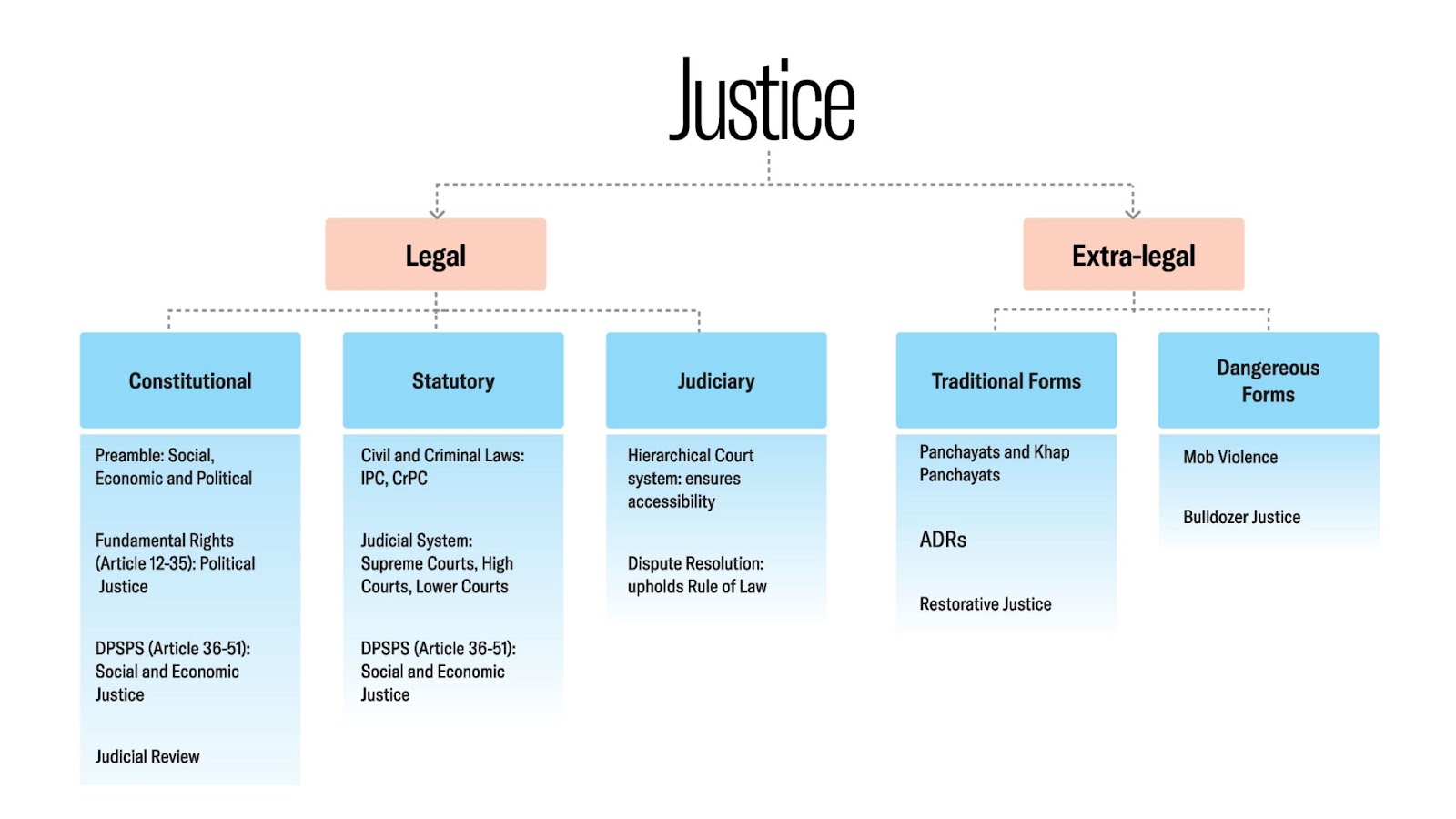
    Justice

    Justice is the maintenance of what is just and fair. In the modern state, justice implies ensuring and protecting minimum rights and entitlement for all.

    “Injustice anywhere is a threat to justice everywhere.” – Martin Luther King Jr.

    “A democracy cannot thrive where power remains unchecked and justice is reserved for a select few. Ignoring these cries and failing to respond to this movement is simply not an option — for peace cannot exist where justice is not served.” – John Lewis

    Types of Justice:

    Hello,

    We have a confession: we’re here to compete with your notes! Burning Issues magazine is your go-to resource as your exam approaches, designed to help you through the anxiety and overwhelm of preparing for the Civil Services Examination.

    Many aspirants struggle despite reading current affairs for a year. This often happens because they interpret current affairs as merely news. As a UPSC aspirant, it’s essential to analyze these topics from the perspectives of General Studies 1, 2, 3, and 4, and that’s exactly what Elevate does.

    This magazine features two sections: Burning Issues and Prelims Tidbits. Burning Issues covers current affairs that may appear in your Mains papers and teaches you how to think about these topics from different GS perspectives in just two pages.

    Prelims Tidbits simplifies your Prelims preparation by distilling key facts, data, and concepts into easy-to-recall points framed around basic questions: What? Who? How? When?

    So, dive in! Every page is crafted to enhance your UPSC prep. With consistency and this magazine, you’re not just preparing; you’re mastering the exam. The journey is about understanding and applying your knowledge effectively.
  • How Many Exams Are There in UPSC?

    The Union Public Service Commission (UPSC) is instrumental in shaping India’s administrative framework by selecting competent candidates for various civil services. Beyond just examinations, the UPSC also emphasises the significance of ethical governance and public service values in its recruitment process. It is responsible for conducting various exams for recruitment to Civil Services. 

    In that connection, the often-asked question is: How many exams are there in UPSC India? There are around 15 different types of exams, conducted for different purposes. Of them, the UPSC Civil Services Exam (CSE) is the most sought-after; and the toughest. Let’s learn more in this discussion. 

    UPSC Full Form

    The full form of UPSC is the Union Public Service Commission. It is India’s premier central agency responsible for conducting various competitive examinations for recruitment to various civil services and posts under the Government of India. Established on October 1, 1926, UPSC plays a role in selecting candidates for key positions, including the Indian Administrative Service (IAS), Indian Foreign Service (IFS), and Indian Police Service (IPS), among others. 

    The commission conducts exams like the Civil Services Examination, Engineering Services Examination, and Combined Medical Services Examination, ensuring a transparent and merit-based selection process for civil services in India.

    How Many Exams are there in UPSC?

    1. Civil Services Examination (CSE)
    2. Indian Forest Service Examination (IFoS)
    3. Indian Economic Service/Indian Statistical Service Examination (IES/ISS)
    4. Employees Provident Fund Organisation EO/AO Examination
    5. Combined Geo-Scientist Examination
    6. Combined Defence Services Examination (I and II)
    7. National Defence Academy (I and II)
    8. Naval Academy Examination (I and II)
    9. SO-Steno (GD-B-GD-I) LDCE 
    10. CISF AC(EXE) LDCE
    11. Combined Medical Services Examination
    12. Engineering Services Examination
    13. Central Armed Police Forces (ACs) Examination
    14. Geologist Examination

    Purpose Key UPSC Exams

    ExaminationPurpose
    Civil Services Exam (CSE)Selects candidates for public administration roles. Indian Administrative Service (IAS), Indian Police Service (IPS), Indian Foreign Service (IFS), etc.
    Engineering Services Examination (ESE)Selects candidates for Indian Engineering Services (IES). Various engineering positions in government departments
    Combined Medical Services Examination (CMS)Selects medical professionals for various government services
    Combined Defence Services Examination (CDS)Selects candidates for admission to defence academies, e.g. Indian Military Academy, Indian Naval Academy, Air Force Academy
    National Defence Academy (NDA)Selects candidates for the National Defence Academy
    Indian Naval Academy ExaminationAdmission to the Indian Naval Academy
    Special Class Railway Apprentices (SCRA)Selects candidates for Mechanical Engineering in Indian Railways
    Indian Forest Service Exam (IFoS)Selects candidates for the Indian Forest Service

    UPSC IAS Exam Pattern (UPSC CSE)

    UPSC CSE exam pattern is considered one of the toughest in the world. The exam goes through three primary stages: UPSC Prelims, UPSC Mains, and UPSC Personality Test. UPSC Prelims is an objective type exam, while UPSC Mains is a descriptive type exam, and the Personality Test is an in-person test. The whole exam is conducted over an year, approximately. 

    The total mark of the UPSC is 2025, including the marks for the interview test. Candidates who clear all three stages of the exam will be inducted into various Civil services positions, including for IAS and IPS. So, how many exams are there in UPSC CSE? You can safely say there are three exams.

    UPSC Prelims Exam Pattern

    SubjectsNo. of questionsTotal MarksDurationNegative marks
    General Studies (GS)1002002 hours (9:30 AM to 11:30 AM)0.66 Marking
    CSAT802002 hours (2:30 PM to 4:30 PM)0.83 Marking

    How many exams are there in UPSC Prelims? UPSC exam structure for prelims consists of two papers: General Studies and CSAT. However, both are qualifying exams only. Candidates who qualify in the UPSC Prelims with a minimum of 33% of marks will be eligible for entry to UPSC Mains. 

    The total marks in UPSC Prelims are 400, but they’re not counted for final merit list preparation. Candidates must attend both the papers if they want to proceed to UPSC Mains. 

    Moreover, UPSC Prelims is completely an objective type exam. Candidates have to answer multiple-choice questions. An OMR sheet will be provided for candidates to mark their answers. Wrong answers, for any reason, will attract a penalty. The success rate in UPSC Prelims is said to be 5% of the candidates who appeared for the UPSC Prelims. 

    UPSC Mains Paper Pattern

    UPSC Mains PaperPaper DurationTotal MarksNature of Paper
    Paper A – Compulsory Indian Language Paper3 hours300Qualifying in nature
    Paper B – English Language Paper3 hours300
    Essay3 hours250Considered for Merit List
    General Studies I3 hours250
    General Studies II3 hours250
    General Studies III3 hours250
    General Studies IV3 hours250
    Optional Paper I3 hours250
    Optional Paper II3 hours250
    Total Marks in UPSC Mains1750
    Interview/ Personality Test275Considered for Merit List
    Grand Total2025

    How many exams are there in UPSC Mains? That is the most asked question. UPSC Mains consists of 9 exams in total. Each of the exams is compulsory. While the first two papers are language papers, there are 4 General Studies Papers and two optional subject papers. It is an entirely descriptive exam, where candidates have to write answers in a booklet. 

    The total marks in the UPSC Mains are 1750. Marks obtained are counted towards the final merit list. Those who clear the UPSC Mains proceed towards the interview stage. However, as with the Prelims, candidates can get rejected at this stage. 

    Posts Recruited through UPSC CSE

    All India Services

    • Indian Administrative Service (IAS)
    • Indian Police Service (IPS)
    • Indian Forest Service (IFoS)

    Group ‘A’ Civil Services

    • Indian Foreign Service (IFS)
    • Indian Audit and Accounts Service (IAAS)
    • Indian Civil Accounts Service (ICAS)
    • Indian Corporate Law Service (ICLS)
    • Indian Defence Accounts Service (IDAS)
    • Indian Defence Estates Service (IDES)
    • Indian Information Service (IIS)
    • Indian Ordnance Factories Service (IOFS)
    • Indian Post & Telecommunication Finance Services (IP&TAFS)
    • Indian Postal Service (IPoS)
    • Indian Revenue Service (IRS)
    • Indian Trade Service (ITS)
    • Armed Forces Headquarters Civil Service (AFHQ CS)

    Group ‘B’ Civil Services

    • DANICS
    • DANIPS
    • Pondicherry Civil Service
    • Pondicherry Police Service

    UPSC Eligibility Criteria (CSE)

    CriteriaRequirements
    NationalityIndian citizen, Nepalese/Bhutanese subject, or Tibetan refugee who came to India before 1962
    Age LimitMinimum 21 years, Maximum 32 years (relaxations for reserved categories)
    Educational QualificationGraduate degree from a recognised university (final-year students can apply)
    Number of AttemptsGeneral: 6 attempts, OBC: 9 attempts, SC/ST: unlimited attempts until age limit
    Physical StandardsMust meet physical fitness standards set by UPSC for respective services

    Conclusion

    How many exams are there in UPSC? We have learned that there are 14 main exams. But the UPSC journey requires more than academic preparation; it demands resilience and adaptability, especially the Civil Services Exam. Candidates should cultivate a strong understanding of governance, ethics, and social issues, as these are integral to the role of civil servants in shaping India’s future and addressing the challenges faced by society.

    FAQs

    How many papers are there in UPSC mains?

    There are total 9 papers in the UPSC Mains: 2 language papers, 4 General Studies, and 2 Optional subject papers. All are conducted in descriptive mode only.

    How many exams are there in UPSC in India?

    There are around 15 exams in the UPSC India, including the Civil Services Examination (CSE), Engineering Services Exam (ESE), and Combined Medical Services Examination (CMS).

    What is the list of exams conducted by UPSC after the 12th?

    • National Defence Academy (NDA) Examination
    • Naval Academy Examination
    • Combined Defence Services (CDS) Examination
    • Special Class Railway Apprentices (SCRA) Examination

    What are the total marks of the UPSC CSE exam?

    The total marks for the UPSC Civil Services Examination (CSE) is 2025, which includes 1750 marks from the Mains exam and 275 marks from the Personality Test (interview).

  • List of Compulsory Subjects for UPSC Exam (Prelims & Mains)

    UPSC (Union Public Service Commission) Civils exam is conducted in two stages: Prelims and Mains. While Prelims is qualifying, UPSC Mains is the main scoring exam. There are both compulsory and optional subjects in the exam for aspirants. Compulsory subjects for the UPSC exam are mandatory for every candidate to attend, while optional subjects allow choice of selection. These optional subjects are confined to the UPSC Mains exam, distributed in the last two Papers.

    Knowledge of the compulsory subjects for the UPSC exam is essential because they carry scoring weightage. Some of them may overlap with optional subjects, proving advantageous for candidates. Without proper knowledge, candidates could seriously compromise their ability to score maximum in the UPSC.

    Compulsory Subjects for UPSC Exam

    UPSC PrelimsUPSC Mains
    General Studies IGeneral Studies II (CSAT)
    Current affairs of national and international importanceEnglish Language ComprehensionIndian Language Paper
    Environment, Ecology, and BiodiversityInterpersonal skills including communication skillsEnglish Language Paper (Qualifying Nature)
    Ancient, Medieval and Modern History of IndiaLogical Reasoning and Analytical AbilityEssay Paper
    Indian polity and governanceBasic Numerical ProblemsGS Paper I: Indian Heritage and Culture, History and Geography of the World and Society
    General science and technologyDecision-making and problem-solvingGS Paper II: Governance, Constitution, Polity, Social Justice, and International Relations
    Indian and world geographyData InterpretationGS Paper III: Technology, Economic Development, Biodiversity, Environment, Security, and Disaster Management
    Economic and social developmentGeneral Mental AbilityGS Paper IV: Ethics, Integrity, and Aptitude
    Art and CultureOptional Paper 1
    Social IssuesOptional Paper 2

    UPSC Exam: Overview

    UPSC Exam StageCompulsory Papers
    UPSC PrelimsGeneral Studies IGeneral Studies II (CSAT)
    UPSC MainsIndian Language Paper (Qualifying Nature)English Language Paper (Qualifying Nature)Essay PaperGeneral Studies IGeneral Studies IIGeneral Studies IIIGeneral Studies IVOptional Paper IOptional Paper II

    UPSC Exam is conducted mainly in two stages: Prelims and Mains. The prelims exam is an objective type examination with multiple choice questions. It is a qualifying exam for UPSC Mains containing two compulsory papers: General Studies I & II. Only those candidates who obtain cut-off in the Prelims will reach UPSC Mains. Thus, marks obtained in UPSC prelims are not counted in preparing the final merit list. 

    Compulsory Subjects for USPC Exam: Prelims

    Paper (Type)Subjects CoveredExam DurationTotal Marks
    General Studies I (Objective)History, Geography, Polity, Economy, Environment2 Hours200
    General Studies II (CSAT) (Objective)Logical Reasoning, Quantitative Aptitude, English Comprehension2 Hours200

    General Studies Paper I

    As indicated, General Studies I involves subjects like History, Geography, Polity, Economy, Environment and General Science. The compulsory subjects for UPSC exam prelims are:

    1. Current events of national and international importance.
    2. History of India and Indian National Movement.
    3. Indian and World Geography: Physical, Social, Economic Geography of India and the World.
    4. Indian Polity and Governance: Constitution, Political System, Panchayati Raj, Public Policy, Rights Issues, etc.
    5. Economic and Social Development: Sustainable Development, Poverty, Inclusion, Demographics, Social Sector Initiatives, etc.
    6. General issues on Environmental ecology, Bio-diversity and Climate Change (Do not require subject specialisation)
    7. General Science.

    General Studies Paper II (CSAT)

    This paper is also known as CSAT (Civil Services Aptitude Test). The compulsory subjects for the UPSC exam CSAT are largely about English language comprehension and logical and numerical aptitude.

    1. Comprehension
    2. Interpersonal skills including communication skills
    3. Logical reasoning and analytical ability
    4. Decision-making and problem-solving
    5. General mental ability
    6. Basic numeracy: Numbers and their relations, orders of magnitude, etc. (Class X level)
    7. Data Interpretation: Charts, graphs, tables, data sufficiency etc. (Class X level)

    UPSC Prelims is an objective type exam, containing multiple choice questions. There is no descriptive part. The minimum qualifying mark in the UPSC Prelims is 33%. Only those candidates who obtain the qualifying marks will be allowed for UPSC Mains. 

    Moreover, since both GS I & II contain compulsory subjects for the UPSC exam, candidates not appearing in any of the exams will be disqualified in the UPSC exam.

    Compulsory Subjects for USPC exam: Mains

    UPSC Mains is a descriptive exam that tests a candidate’s overall intellectual ability and depth of understanding. There will be 9 compulsory subjects for the UPSC exam, of which the last are optional* papers. While 7 papers contain questions that require no specialised study, optional papers require minimum degree level qualification in a chosen subject. 

    The compulsory subjects for UPSC exam mains are as follows:

    Compulsory English Language UPSC: Passage Comprehension, Precis Writing, Usage and Vocabulary, Essay Writing.

    Compulsory Indian Language UPSC: Passage Comprehension, Precis Writing, Usage and Vocabulary, Essay Writing, Translation from Indian language to English and vice versa.

    Paper I (Essay): Essay

    General Studies I (Indian Heritage and Culture, History and Geography of the World and Society): Indian culture, modern Indian history, the freedom struggle, post-independence reorganisation, and key global events from the 18th century. It also examines Indian society, diversity, globalisation, social issues, physical geography, natural resource distribution, and major geophysical phenomena like earthquakes, tsunamis, and cyclones, and much more.

    General Studies II (Governance, Constitution, Polity, Social Justice and International Relations): Indian Constitution, its evolution, features, amendments, and federal structure. It covers the separation of powers, Parliament, state legislatures, executive, judiciary, and constitutional bodies. Topics include government policies, welfare schemes, social sector issues (health, education), governance, e-governance, transparency, and the role of civil services. International relations with India’s neighbours, global groupings, and the impact of foreign policies on India are also addressed.

    General Studies III (Technology, Economic Development, Bio diversity, Environment, Security and Disaster Management): Covers economic issues like resource mobilization, inclusive growth, budgeting, agriculture, and food security. It also includes industrial policy, infrastructure, and investment models. Science, technology, environmental conservation, disaster management, and internal security challenges such as extremism, cyber security, and border security are also key topics.

    General Studies- IV (Ethics, Integrity and Aptitude): It tests candidates on their ethical mindset and problem-solving skills using case studies. Key topics include ethics in public and private life, attitude, emotional intelligence, contributions of moral thinkers, values for civil service, and probity in governance. It also covers ethical issues in administration, public service, transparency, and corruption challenges.

    Optional Paper I: Descriptive Examination on Chosen Subject.

    Optional Paper II: Descriptive Examination on Chosen Subject.

    *Optional papers allow a candidate to the subject of their choice in the exam, from 48 subjects. However, optional papers are MANDATORY to clear UPSC. 

    Compulsory Subjects for IAS: Preparation Tips

    The syllabus of compulsory subjects for the UPSC exam is generally not taken from books. UPSC says that most of the exams can be attended well by highly educated people, except for optional papers. Optional papers require a minimum bachelor’s degree in the chosen subject. That is why, UPSC Civils is thought of as a difficult exam by most. To perform well, the following tips should help you.

    Understand Syllabus: The first step is to understand the syllabus well. If you can understand the syllabus well, obtaining relevant books, and focusing on relevant subject areas would be easy. 

    Choose Standard Books: There is no prescribed book to prepare for UPSC. That is why selecting the right book to study compulsory subjects for the UPSC exam is very important. Go for expert-recommended and comprehensive books.

    Practice Answer Writing: UPSC Mains is a descriptive exam. Getting hold of the compulsory subjects for the UPSC exam is not sufficient. You have to practice writing answers to questions from the previous year’s papers. You should learn to express your ideas clearly in writing.

    Time Management: Managing time effectively in the UPSC Mains is essential due to the limited time per paper. Focus on practising previous Mains question papers within the given timeframe and regularly attempt mock tests to boost your speed and efficiency in answering questions within the allotted time.

    Prepare Notes: Continuous revision is the backbone of effective UPSC preparation. However, going through reference books every time is a poor strategy. Prepare sufficient notes of the compulsory subjects for the UPSC exam to make your preparation efficient and effective. Alternatively, you can also get notes from toppers or outside resources. 

    Current Affairs: Most questions in the UPSC mains might combine subject knowledge and related current affairs. Staying updated on current affairs is thus imperative if you want to gain maximum marks when attempting compulsory subjects for the UPSC exam. 

    Conclusion

    One often overlooked aspect of UPSC preparation is maintaining a balanced mindset throughout the journey. Mental well-being is as crucial as academic preparation. UPSC aspirants should schedule breaks, engage in physical activity, and practice mindfulness to manage stress effectively. This approach fosters resilience, enabling candidates to stay focused, overcome setbacks, and enhance productivity during the rigorous exam preparation phase.

    FAQs

    Is Maths compulsory for UPSC?

    No, Maths is not a compulsory subject in UPSC. It is one of the 48 subjects that candidates can choose for their optional Papars in UPSC Mains. You can skip Mathematics if you wish and choose any other subject.

    What are the compulsory subjects for UPSC?

    UPSC exam happens in two stages with compulsory and optional subjects. Prospects have no choice in selecting the compulsory subjects for the UPSC exam. However, they can choose from 48 optional subjects in UPSC Mains’s last two papers (Paper VI & VII). The last two papers are thus known as optional papers.

    What is the maximum mark in UPSC?

    UPSC Civils is conducted for a total of 1750 marks. 

    Can I directly write UPSC Mains?

    No. You can not directly enter UPSC mains without getting qualifying marks in the UPSC Prelims. Currently, it is set at 33% marks in the UPSC Prelims.

    Can I skip one of the papers in UPSC Prelims?

    No. UPSC Prelims consists of General Studies Paper I & II. Both papers are mandatory for all candidates. Skipping any of these leads to disqualification from the exam.

  • UPSC Medical Test for IAS Candidates

    The UPSC Medical Test is a critical step for IAS aspirants. It ensures that candidates are not only mentally prepared for the rigours of public service but also physically capable of handling the demands of the role. While most focus on passing the exam and interview stages, the medical test often gets overlooked, despite its importance in the selection process. 

    Beyond basic fitness, the UPSC Medical test helps identify conditions that could affect long-term performance. Moreover, the test underscores the significance of mental wellness, an essential yet less discussed aspect of leadership. Hence, knowing the key details of this stage of UPSC is important.

    Why UPSC Medical Test for IAS

    • Ensures physical and mental fitness for service, detecting any issues that could affect performance.
    • Protects public safety by identifying health problems that could impact decision-making.
    • Ensures long-term capability to meet career demands over time.
    • Assesses candidates’ ability to handle the job’s physical and mental demands.
    • Identifies pre-existing health conditions to prevent complications.
    • Evaluates mental fitness to handle stress and lead effectively.
    • Maintains professional standards and public trust through fitness checks.

    Types of IAS Medical Tests

    Blood and Urine Tests: Samples will be taken for specific medical evaluations.

    Blood Pressure: Candidates should stay calm to avoid elevated readings. In some cases, the doctor may ask the candidate to perform physical activity like jumping to check the response.

    Diabetes Mellitus: Tests for fasting blood sugar and HbA1C will be conducted after 8-10 hours of fasting to check for diabetes.

    Hearing Ability: The candidate’s hearing will be examined, along with any ear conditions. If hearing can be corrected with an aid or surgery, the candidate is not automatically disqualified as long as there’s no serious ear disease.

    X-ray: Chest X-rays and additional tests will be performed to check for conditions like hernia, and bone density will also be measured.

    Lungs and Heart: The doctor will use a stethoscope to check if the heart and lungs are functioning normally, sometimes asking the candidate to vary their breathing pattern for accuracy.

    Hernia: A test is conducted to assess the risk of hernia development.

    Weight: The candidate’s weight is recorded in kilograms. Any fraction over half a kilogram is rounded up, while fractions below half are rounded down.

    Ophthalmic Test:

    • Normal Vision: Involves identifying letters of different sizes from a distance.
    • Colour Vision: Requires recognizing characters or following a maze based on colour differentiation.

    Where is UPSC Medical Test Conducted

    The Medical Test would be conducted in the below-listed hospitals in Delhi.

    1. Safdarjung Hospital
    2. Ram Manohar Lohia Hospital
    3. Lok Nayak Jai Prakash Narayan Hospital
    4. Succheta Kriplani Hospital
    5. Guru Teg Bahadur Hospital
    6. Deen Dayal Upadhyay Hospital
    7. BR Ambedkar Hospital

    The candidates belonging to the Physically Handicapped (PH) Category will be examined in the below hospitals.

    1. Safdarjung Hospital
    2. Ram Manohar Lohia Hospital
    3. LHMC
    4. Guru Teg Bahadur Hospital
    5. Lok Nayak Jai Prakash Narayan Hospital

    UPSC Medical Test for Female

    For female candidates, the UPSC Medical Test includes a dedicated lady doctor as part of the Medical Board to ensure comfort and appropriate examination. This addition provides a gender-sensitive approach during the medical evaluation. It addresses specific health concerns while maintaining the same thorough standards required for all candidates.

    UPSC Medical Test Requirements

    There are no specific height, weight, or chest girth requirements for IAS candidates, unlike technical services. However, if a candidate’s body proportions are deemed abnormal, further investigation, including chest X-rays, may be required. Technical services, however, have strict minimum requirements.

    Vision: The candidate must have distant vision of 6/6 or 6/9 in the better eye. Corrections like glasses, contact lenses, and surgeries like LASIK or ICL are allowed. Those with myopia causing macular degeneration are unfit. A squint is allowed, and night blindness is not grounds for disqualification.

    Blood Pressure: If blood pressure exceeds 140/90, further tests are necessary to ensure it is not due to an underlying health issue. Only candidates without complications from hypertension will be considered fit.

    Diabetes: Candidates with diabetes must not have any related complications to be declared fit.

    Hearing: Good hearing is required in both ears. If a defect is present, further testing will determine if it can be corrected by surgery or hearing aids.

    Pregnancy: Pregnant women are generally fit unless the role requires physical training. In such cases, they will be declared fit after childbirth.

    Teeth, Heart, and Lungs: Teeth should be in good order, and the heart and lungs must function properly. Abdominal diseases must be absent.

    Limbs and Joints: Feet, hands, and limbs must be well-formed with full joint mobility, and there should be no congenital deformities or signs of chronic illness.

    Vaccination and Disease: Candidates must show marks of vaccination and be free from any communicable diseases.

    Medical Conditions: Those with hernias, varicose veins, or haemorrhoids are temporarily unfit but can be declared fit after surgery. Grade I haemorrhoids are acceptable. Candidates with malignancies or transplanted organs are unfit, except for corneal transplants.

    Process of Medical Test

    • Medical examinations (except for the PwBD category) are conducted in specific hospitals across New Delhi.
    • UPSC informs candidates of the examination dates and venues after the Interview/Personality Test.
    • The examination involves a physical assessment and a radiographic (X-ray) test.
    • Candidates are expected to participate actively and cooperate during the process.
    • PwBD candidates undergo their General Medical Examination at Safdarjung Hospital, New Delhi.
    • Benchmark Disability confirmation tests for PwBD candidates are conducted by the Benchmark Disability Expert Panel (BDEP) at AIIMS, New Delhi.

    Post UPSC Medical Test

    1. Candidates will interact with the Medical Board to complete any necessary procedures related to the UPSC medical test.
    2. Medical Examination findings will be available on a secure website accessible to the candidates.
    3. Those declared ‘Temporarily Unfit’ should not wait for final results but undergo re-examination promptly.
    4. A Fitness Certificate from a Registered Medical Practitioner can be submitted for re-assessment.
    5. Appeals against the Medical Board’s findings may result in delayed allocation and training if not resolved quickly.
    6. Candidates can file an appeal online through DoPT’s website if dissatisfied with the Medical Board’s findings.
    7. PwBD candidates can appeal a Benchmark Disability percentage under 40% via the DoPT website.
    8. If the ADMB (Appellate Disability Medical Board) suggests a different percentage from BDEP (Benchmark Disability Expert Panel) at AIIMS, the higher percentage will apply.
    9. Candidates should regularly check the DoPT website for updates on Medical Examination results and allocation status.
    10. It is important to follow all instructions from the Department regarding the Medical Examination process.

    How to Prepare for IAS Medical Test

    1. Candidates should fast for at least 10 hours before the medical examination.
    2. Do not take any medicine before the medical examination.
    3. If using spectacles or a hearing aid, bring them along with their prescription.
    4. If using contact lenses, stop using them at least 48 hours before the medical examination.
    5. Candidates in the Physically Handicapped (PH) category must bring their ‘Disability Certificate’ from a Disability Medical Board, if applicable.
    6. Pregnant candidates are fit for all services except those requiring physical training.

    What Happens in case of UPSC Medical Test Failure

    Failing the UPSC medical test can result in disqualification from the designated service. Candidates who do not meet the required health standards may be deemed unfit for their role. So, even if a candidate has cleared the three stages of UPSC examination, their induction into Civil services is not guaranteed. It highlights the importance of maintaining good physical and mental health to clear the examination and pursue a career in government services. In a way, it also underscores the decision of UPSC to safeguard the health of individuals from daily work pressures of the Civil Service roles.

    IPS Physical Requirements

    CategoryMaleFemale
    Height165 cm (General)160 cm (ST except SC/OBC)150 cm (General)145 cm (ST except SC/OBC)
    ChestMinimum 84 cmExpansion: 5 cmMinimum 79 cmExpansion: 5 cm
    Eyesight (Distant Vision)6/6 or 6/9 for good eye6/12 or 6/9 for worst eye
    Eyesight (Near Vision)Not specifiedJ1 for good eyeJ2 for worst eye

    Conclusion

    While the UPSC medical test assesses physical and mental fitness, candidates should also be mindful of the psychological impact of the examination process. Anxiety or stress during the test could affect results, such as elevated blood pressure readings. To avoid this, practising mindfulness techniques or breathing exercises before the medical exam can help candidates stay calm and composed, ensuring more accurate results and a smoother evaluation experience.

    FAQs

    Is there any medical test for IAS?

    Yes, there is a mandatory medical test for IAS. Candidates who successfully clear UPSC Prelims, UPSC Mains, and the final personality test will be called to take upa medical test at the designated hospitals. It is possible ot get disqualified at this stage, if health requirements aare not fitting the elgibility criteria.

    What are IAS eyesight requirements?

    The minimum required distant vision is 6/6 (20/20) for the better eye and 6/9 (20/30) for the worse eye. Candidates must not have conditions like color blindness or night blindness.

    What is UPSC medical test eligibility?

    The eligibility for UPSC medical test is passing UPSC Prelims and UPSC Mains along with the presnoality test. Only those candidates who cliear these three stages are eligible to under UPSC medical test. 

    Is there UPSC medical test for HIV?

    There is no explicit mention of HIV test in the UPSC medical test. However, if candidates are found to be HIV positive, there is no law at present which can prevent them from becoming an IAS or IPS, or any Civil servant. 

  • Why is the UPSC Exam the toughest Exam in India?

    UPSC (Union Public Service Commission) exam is conducted to select candidates for various administrative posts in India like IAS, IPS, IFS, IRS, and more. It is considered the most prestigious exam as successful candidates are inducted into the top bureaucrat positions across the Indian administration. However, there is a general perception that UPSC is one of the world’s toughest exams. 

    Is the UPSC exam tough? Given the fierce competition, many stages of the examination, the vast syllabus, and low success rates, it is a difficult exam. On average, 12-15 lakh people apply every year, out of which, only 1000 people make it. Since 2007, UPSC prelims also have had negative scores. So, Is the UPSC exam tough? Perhaps. Let’s explore what makes it the world’s toughest exam.

    UPSC Exam Pattern 2025

    StagesNameNo. of PapersType of ExamTotal Marks
    Stage 1UPSC Prelims 2 PapersObjective400
    Stage 2UPSC Mains9 PapersDescriptive1750
    Stage 3UPSC InterviewIn-Person with Interview PanelPersonality Test275

    The final merit list is prepared based on the total marks obtained in three stages, which is 2025. 

    Is the UPSC Exam Tough?

    Before answering the question, we must explore the nature of the UPSC exam. 

    UPSC Exam Structure

    The UPSC exam pattern is one aspect that leads to the question, “Is the UPSC exam tough?” The UPSC exam has three stages: UPSC Prelims, UPSC Mains, and UPSC Interview. 

    Candidates can get eliminated at any stage. UPSC Prelims is a qualifying exam, where attaining minimum marks is necessary to advance to UPSC Mains. Of course, the difficulty level increases at every stage. While the UPSC Prelims are purely objective, UPSC mains are purely descriptive. Even though many candidates clear the first two stages, most get rejected at the interview stage, which is an in-person test. 

    Moreover, the UPSC exam pattern has evolved and continues to evolve, maintaining unpredictability for aspirants. So, is the UPSC exam tough given its exam pattern? There is indeed a general perception among seekers due to this rigorous exam pattern.

    Competitive Levels

    Every year, lakhs of candidates compete for around 1000 UPSC posts. Only a quarter make it to the UPSC Mains. Of these, only around 15% clear the UPSC Mains and advance to the interview stage. The UPSC interview stage has a 50% rejection rate. Finally, around 1% make it to the final merit list. 

    For example, in 2023, an estimated 13,00,000 candidates applied for 1,255 vacancies available. The pass percentage is also very low. In 2019, only 829 cleared the UPSC (three stages) against the applied 1,135,261. 

    The fierce competition for the UPSC is due to the limited number of attempts. A general category aspirant has a maximum of 6 attempts in his lifetime, after which they can’t apply for the exam. That is why the competition levels soar every year. 

    Is the UPSC exam tough? Turns out. But with the right strategy and dedication, you can always be in that 1% of candidates. 

    The Nature of the UPSC Syllabus

    The vastness of the UPSC Syllabus is another factor that leads to the question “Is the UPSC exam tough?”. Unlike many other competitive exams, where knowledge in one or two specific subjects is sufficient, UPSC aspirants need to cover a large amount of syllabus. Moreover, though the syllabus is outlined by the official examination board, there is no pin-pointed study material to cover the syllabus. Which makes the UPSC syllabus less tangible, adding to the difficulty level of the exam.

    Subjective Evaluation

    While UPSC Prelims has an objective type exam with clearly defined marks and evaluation criteria, UPSC Mains is a descriptive exam with no defined evaluation criteria. It is strictly a subjective evaluation based on the effectiveness of answer-writing. That makes many candidates raise the question “Is the UPSC exam tough?”. There is no standard for evaluating the responses of a candidate in the UPSC mains. It depends on the examiner’s judgement, making it very difficult.

    UPSC Preparation Time

    Is the UPSC exam tough? Yes, its lengthy preparation time contributes to this perception. Candidates typically spend around a year studying, though some may take ten months or up to a year and a half. Despite its challenges, with the right strategy and focused preparation, success is possible.

    Length of the Exam

    The unique aspect of the UPSC exam is its duration. The total exam through three stages lasts over a year. During this time, candidates have to remain focused without any distractions, while handling the constant mental pressure that might arise. Is the UPSC tough? It is so if you are not prepared for the long duration of the exam. If you can maintain enthusiasm throughout and enjoy the process of the exam, you can succeed. 

    Is the UPSC Prelims Tougher than Mains?

    Many candidates find the UPSC Prelims tougher than the Mains. It is due to the challenging objective questions and the negative marking, which heightens the pressure. Is the UPSC exam tough? The Prelims require quick thinking and time management, while the Mains focus on in-depth knowledge and analytical writing, making both stages uniquely demanding.

    How Difficult is the UPSC?

    Despite the challenges of the exam, many toppers have admitted that cracking the UPSC will not be difficult with the right preparation strategy, focus, and healthy life. First of all, UPSC aspirants must start preparation in the early stages itself. Ideally, they can start during their final years of the degree. 

    They must understand the syllabus well, for example, by dividing it into static and dynamic parts. While static parts like Indian and World History, Geography, etc., remain the same, current affairs form the dynamic part. They have to focus on the up-to-date events more closely. With such strategies, it is possible to handle the journey more easily.

    Conclusion

    So, Is the UPSC exam tough? It is undeniably challenging due to its extensive syllabus, fierce competition, and subjective evaluation. But it is not impossible to crack. Candidates who approach their preparation with a strategic mindset and a positive attitude can navigate the complexities of the exam. Recognising both the difficulties and the growth opportunities, aspirants can transform the challenge of the UPSC into a rewarding journey towards their goals in public service.

    FAQs

    Why UPSC is tough?

    UPSC is tough due to its vast syllabus, intense competition, and multi-stage exam process. It requires deep conceptual understanding, analytical thinking, and consistent preparation to clear its prelims, mains, and interview stages. However, with adequate preparation and strategy approaching the UPSC becomes easier.

    Is the UPSC exam tougher than the NEET?

    Yes, the UPSC exam is considered tougher than NEET because of its broader syllabus and the complexity of questions. Unlike NEET, which focuses on medical subjects for undergraduate admission, UPSC covers diverse topics. UPSC syllabus requires a deeper understanding and analytical thinking across multiple stages of the exam. 

    Moreover, even after clearing the UPSC exam, candidates may get rejected at the interview stage. But clearing NEET is enough to get admission to a top-tier medical university. 

    Is the UPSC exam tougher than the JEE?

    Yes, the UPSC exam is considered tougher than the JEE due to its higher competition, unpredictable paper patterns, and vast syllabus. Additionally, the UPSC exam spans nearly a year, while the JEE exam is only for a few hours of duration. The success rates also show a large variation in UPSC compared to the JEE.

    Is UPSC the toughest exam in the world?

    Yes, the UPSC exam is considered one of the toughest in the world. This is due to the vast syllabus, unpredictable questions, and low success rate. The selection process is challenging, where subjective evaluation is involved, unlike any other exam. Aspirants must master diverse subjects, including current affairs, making it difficult to crack.

    Which UPSC exam is easy?

    The UPSC Civil Services Preliminary Exam is often considered easier than the Mains and Interview stages, as it focuses on objective-type questions. However, it still requires extensive preparation and strategic thinking.

    Is UPSC tougher than CA?

    Comparing UPSC and CA reveals distinct challenges. CA focuses heavily on accounting, finance, and taxation, requiring specialised expertise. In contrast, UPSC tests a wide range of topics, including history, geography, and current affairs. The level of difficulty largely depends on a candidate’s strengths and interests.