💥Join UPSC 2027,2028 Mentorship (July Batch) + XFactor Notes & Microthemes PDF

Author: CD Staff

  • Polity Titbits: Panchayati Raj- Local governance


    24th Apr 2021

    Local self-government: various committees

    Urban Local Government: Composition and  Functions

    74th Constitutional Amendment

    This act added a new part IX-A to the Constitution entitled as ‘The Municipalities’ and a new Twelfth Schedule containing 18 functional items for municipalities. The main provisions of this Act can be grouped under two categories–compulsory and voluntary. Some of the compulsory provisions which are binding on all States are:

    1. Constitution of Nagar panchayats, municipal councils and municipal corporations in transitional areas (areas in transition from a rural area to urban area), smaller urban areas and larger urban areas respectively;
    2. Reservation of seats in urban local bodies for Scheduled Castes / Scheduled Tribes roughly in proportion to their population;
    3. Reservation of seats for women up to one-third seats;
    4. The State Election Commission, constituted in order to conduct elections in the panchayati raj bodies (see 73rd Amendment) will also conduct elections to the urban local self- governing bodies;
    5. The State Finance Commission, constituted to deal with financial affairs of the Panchayati Raj bodies will also look into the financial affairs of the local urban self governing bodies;
    6. Tenure of urban local self-governing bodies is fixed at five years and in case of earlier dissolution fresh elections are to be held within six months;

    Some of the voluntary provisions which are not binding, but are expected to be observed by the States are:

    1. Giving representation to members of the Union and State Legislatures in these bodies;
    2. Providing reservation for backward classes;
    3. Giving financial powers in relation to taxes, duties, tolls and fees etc;
    4. Making the municipal bodies autonomous and devolution of powers to these bodies to perform some or all of the functions enumerated in the Twelfth Schedule added to the Constitution through this Act and/or to prepare plans for economic development.

    In accordance with the 74th Amendment, municipal corporations and municipalities (municipal boards or municipal committees) are now regulated in a fairly uniform manner in all the States. However, one must remember that local self-government continues to be a subject in the State List.

    Thus, the 73rd and 74th amendments provide a framework for the States in respect of local government. Thus, each State has its own Election Commission which conducts elections to all local bodies after regular intervals of five years.

    Each State has its Finance Commission to regulate finances of the local bodies. Seats are reserved in the corporations and municipalities for Scheduled Castes and Tribes. One-third seats are reserved for women in all local bodies – urban and rural.

    Composition

    The Municipal bodies are constituted of persons chosen by direct election from the territorial constituencies (known as wards) in the municipal area.

    However, the Legislature of a State may, by law, provide for the representation in a municipal body of persons having special knowledge or experience of municipal administration, the members of Rajya Sabha, Lok Sabha and the members of Legislative Council and Legislative Assembly of the State, representing constituencies, which comprise wholly or partly the Municipal Area.The state legislature may also provide the manner of the election of the Chairpersons of a municipality.

    The state legislature may also provide the manner of the election of the Chairpersons of a municipality.

    Empowerment of weaker sections of society and women by reserving seats for such groups is one of the important constitutional provisions of the Constitutional Amendment.

    The offices of chairperson are also reserved for SC/ST and women. Thus, at least one year, out of five year duration of Municipal Corporation of Delhi, the office of Mayor is reserved for a woman, and for one year is reserved for a Councillor of Scheduled Caste. It gives a term of five years to the municipalities and if any of them is to be dissolved, it must be given an opportunity of being heard.

    Functions of Urban Local Bodies

    It is a common practice to divide the organisation of a corporation or a municipality into two parts:

    (a) deliberative and (b) executive part

    The corporation, council or municipal board or council consisting of the elected representatives of the people constitutes the deliberative part. It acts like a legislature.

    It discusses and debates on general municipal policies and performance, passes the budget of the urban local body, frames broad policies relating to taxation, resources raising, pricing of services and other aspects of municipal administration.

    It keeps an eye on municipal administration and holds the executive accountable for what is done or not done. For instance, if water supply is not being properly managed, or there is an outbreak of an epidemic, the deliberative wing criticises the role of the administration and suggests measures for improvement.

    The executive part of municipal administration is looked after by the municipal officers and other permanent employees. In the corporations, the Municipal Commissioner is the executive head, and all other departmental officers like engineers, finance officers, health officers etc. function under his/her control and supervision.

    In a large corporation, such as Delhi or Mumbai Municipal Corporation, the Commissioner is usually a senior IAS officer. In municipalities, the executive officer holds a similar position and looks after the overall administration of a municipality.

    Municipal functions are generally classified into obligatory and discretionary types.

    The obligatory (compulsory) functions are those that the municipal body must perform. In this category fall such functions as water supply; construction and maintenance of roads, streets, bridges, subways and other public works, street lighting; drainage and sewerage; garbage collection and disposal; prevention and control of epidemics.

    Some other obligatory functions are public vaccination and inoculation; maintenance of hospitals and dispensaries including maternity and child welfare centres; checking food adulteration; removal of slums; supply of electricity; maintenance of cremation and burial grounds; and town planning. In some States some of these functions may be taken over by State Government.

    The discretionary functions are those that a municipal body may take up if funds permit. These are given less priority. Some of the discretionary functions are construction and maintenance of rescue homes and orphanages, housing for low income groups, organising public receptions, provision of treatment facilities, etc.

    Type of urban governments

    There are eight types of urban governments in India.

    1. Municipal Corporation: Municipal corporations are created for the administration of big cities like Delhi, Mumbai, Hyderabad and others. A Municipal Corporation has three authorities namely, the council (legislative wing of the corporation), the standing committee (to facilitate the working of the council) and the commissioner (chief executive authority of the corporation).The council consist of councillors directly elected by people and is headed by a Mayor while the Commissioner is appointed by state government and is generally an IAS officer.
    2. Municipality: The municipalities are established for the administration of towns and smaller cities. They are known by various other names like municipal council, municipal committee, municipal board, borough municipality, city municipality and others. In composition they are quite similar to municipal corporations except that head of council is called President /chairman and in place of commissioner they have a chief executive officer/chief municipal officer.
    3. Notified Area Committee: A notified area committee is created for the administration of two types of areas- a fast developing town due to industrialisation, and a town which does not yet fulfill all the conditions necessary for the constitution of a municipality, but which otherwise is considered important by the state government. It is called so because it is created by a notification and unlike the municipality it is an entirely nominated body, i.e. all members, including the Chairman, are nominated by the state government. Thus, it is neither a statutory body (created by law) nor an elected body.
    4. Town Area Committee: It is set up by a separate act of state legislature for the administration of a small town. It is a semi-municipal authority entrusted with limited number of civic functions. It may be wholly elected or wholly nominated or partly elected and partly nominated as provided by state government.
    5. Cantonment Board: It is established for municipal administration for civilian population in the cantonment areas (area where military forces and troops are permanently stationed). It is set up under the provisions of the Cantonment Act, 2006 by central government and works under Defence ministry of central government. It is partly elected and partly nominated body having the Military officer commanding the station as its ex-officio President. Vice president is elected amongst by the elected members of board. The executive officer of the cantonment board is appointed by the President of India.,
    6. Township: It is established by large public enterprises to provide civic amenities to its staff and workers, who live in the housing colonies built near the plant. It is not an elected body and all members, including the town administrator, is appointed by the enterprise itself.
    7. Port Trust: The port trusts are established in the port areas like Mumbai, Kolkata, Chennai and so on for two purposes: (a) to manage and protect the ports; (b) to provide civic amenities. It is created by an Act of Parliament and it consists of both elected and nominated members.
    8. Special Purpose Agency: The states have set up certain agencies to undertake designated activities or specific functions that legitimately belong to the domain of municipal corporations, municipalities or other local urban governments. In other words, these are function based, not area based. They are known as ‘single purpose’, ‘uni-purpose’ or ‘special purpose’ or ‘functional local bodies’ like town improvement trust, housing boards, pollution control boars etc. They are established as statutory bodies by an act of state legislature or as departments by an executive resolution. They function as an autonomous body and are not subordinate agencies to local municipal bodies.
  • Polity Titbits: Constitutional and Quasi-judicial bodies.


    23rd Apr 2021

    Constitutional bodies

      Appointment Tenure Removal Process of removal Eligibility for reappointment w/i govt
    Attorney general (Advocate general) President (governor) Pleasure of President (governor) President (governor) No reason needs to be mentioned Yes
    Election Commission (SEC) President (governor) 6 years/ 65 President CEC and SEC by a special majority


    Other ECs on the recommendation of CEC

    Yes
    Finance commission (SFC) President (governor) Specified by president NA NA Yes
    UPSC (SPSC) President (governor) 6 years/ 65 President After enquiry by supreme court Members can become Chair, state members can become chair or member or chair of UPSC
    CAG President 6 years/ 65 President Special majority No


    Statutory bodies

      Appointment Committee members Other members Tenure Removal
    NHRC (SHRC) President (Governor) 6 (PM + LOP Lok Sabha) Speaker, Deputy CP RS, LOP RS, home minister 3 years*/ 70 President after Supreme Court inquiry
    CIC (SIC) President (Governor) 3 ((PM + LOP Lok Sabha) Cabinet Minister nominated by PM As prescribed by the Central Govt*./ 65 President (governor for SIC) after supreme court inquiry
    CVC President (governor) 3 ((PM + LOP lok sabha) Home minister 4 years/ 65 President after Supreme court inquiry
    Lokpal President 5 (PM + LOP lok sabha Speaker, CJI, eminent jurist 5 years/ 70 Like a Supreme Court judge

    *  After amendments in the respective acts in 2019.

    In the news: 

    1. Amendment to the RTI Act (July 2019)

    • Section 13 of the original Act sets the term of the central Chief Information Commissioner and Information Commissioners at five years (or until the age of 65, whichever is earlier). The amendment proposes that the appointment will be “for such term as may be prescribed by the Central Government”.
    • The amendment proposes that the salaries, allowances and other terms of service of the Chief Information Commissioner and the Information Commissioners “shall be such as may be prescribed by the Central Government” which was earlier at par with Chief Election Commissioner.

    2. Amendment to Protection of Human Rights Act (July 2019)

    • It reduced the term of the Chairperson and Members of the Commission and the State Commissions from five to three years and shall be eligible for re-appointment.
    • Provision was added which says a person who has been a Judge of the Supreme Court is also eligible to be appointed as Chairperson of the Commission in addition to the person who has been the Chief Justice of India.
    • The amendment made provision that a person who has been a Judge of a High Court is also made eligible to be appointed as Chairperson of the State Commission in addition to the person who has been the Chief Justice of the High Court.
    • It conferred upon State Commissions, the functions relating to human rights being discharged by the Union territories, other than the Union territory of Delhi, which will be dealt with by the Commission.

  • Polity Titbits: Constitution- Special provisions


    22nd Apr 2021

    Emergency provisions


      National emergency


    (art 352)

    State Emergency/ President’s rule  (Art 356) Financial emergency
    Grounds War, External aggression, armed rebellion <threat or actual> Failure of constitutional machinery of state or can’t comply with the directions of centre Threat to financial credit
    Who declares President after written cabinet recommendation President President
    Parliamentary approval w/i 1 month by both houses w/i 2 month by both houses w/i 2 month by both houses
    Type of majority Special Simple Simple
    Duration 6 months from approval 6 months from approval Indefinitely
    Reapproval Any number of times Max 3 years Not applicable
    Revocation By president or by LS only by simple majority By president, By president
    Legislature and laws on state list Continues, both parliament and state can pass laws Suspended or dissolved and only parliament can make laws Can issue directions to reserve money bill and finance bills for president
    Executive Continues, both union govt and state govt have powers Dismissed, president administers through governor Can issue direction to reduce salaries including those of supreme court and high court judge
    FRs, Art 19 automatically suspended, 20 and 21 can’t be, right to move courts for others can be suspended by presidential orders NA NA


    Schedule 5 and 6

      Schedule 5 Schedule 6
    Deal with – Scheduled area and STs in any state except ATMM Administration of tribal areas Assam, Tripura, Meghalaya, Mizoram
    Autonomy Limited autonomy. Only tribal advisory council at state level More autonomy, autonomous districts
    Schedule area President declares, can increase or decrease the area Governor can organize, reorganize autonomous districts
    Executive power of state Applicable but special responsibility of governor Same
    Acts of parliament or legislature Governor can modify the law or state that they are not applicable same

    Special Provisions for the Other States

    Part XXI of the Constitution
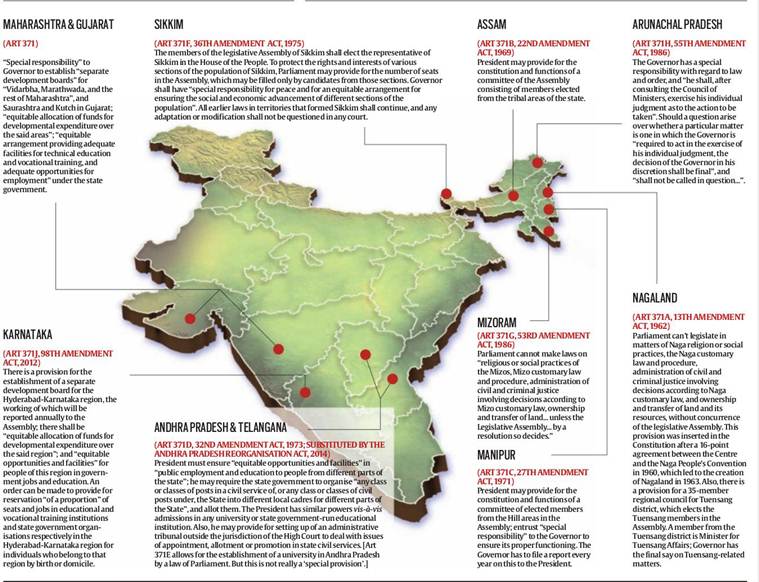
     The part ‘Temporary, Transitional and Special Provisions’, includes, apart from Article 370 (Temporary Provisions with respect to the State of Jammu and Kashmir) Articles 371, 371A, 371B, 371C, 371D, 371E, 371F, 371G, 371H, and 371J.
     These define special provisions with regard to other states of the Indian Union.

    Special Provisions but not special treatment
     All these provisions take into account the special circumstances of individual states, and lay down a wide range of specific safeguards that are deemed important for these states.
     In these range of Articles from 371 to 371J, Article 371I, which deals with Goa, stands out in the sense that it does not include any provision that can be deemed “special”.
     Article 371E, which deals with Andhra Pradesh and Telangana, too, is not that “special”.
     The special provisions laid down in Article 370 before it was modified were obviously much more farreaching than the special provisions for other states, described in Articles 371, 371A-H, and 371J.
    The following special provisions are guaranteed by the Constitution to states
    other than Jammu and Kashmir:
    Maharashtra and Gujarat (Article 371)
    The Governor has a “special responsibility”-
     To establish “separate development boards” for “Vidarbha, Marathwada, and the rest of Maharashtra”, and Saurashtra and Kutch in Gujarat;
     To ensure “equitable allocation of funds for developmental expenditure over the said areas”, and “equitable arrangement providing adequate facilities for technical education and vocational training, and adequate opportunities for employment” under the state government.

    Nagaland (Article 371A, 13th Amendment Act, 1962)
     Parliament cannot legislate in matters of Naga religion or social practices, the Naga customary law and procedure, administration of civil and criminal justice involving decisions according to Naga customary law.
     Parliament also cannot intervene in ownership and transfer of land and its resources, without the concurrence of the Legislative Assembly of the state.

     This provision was inserted in the Constitution after a 16-point agreement between the Centre and the Naga People’s Convention in 1960, which led to the creation of Nagaland in 1963.
     Also, there is a provision for a 35-member Regional Council for Tuensang district, which elects the Tuensang members in the Assembly.
     A member from the Tuensang district is Minister for Tuensang Affairs. The Governor has the final say on all Tuensang-related matters.
    Assam (Article 371B, 22nd Amendment Act, 1969)
     The President of India may provide for the constitution and functions of a committee of the state Assembly consisting of members elected from the tribal areas of the state.
    Manipur (Article 371C, 27th Amendment Act, 1971)
     The President of India may provide for the constitution and functions of a committee of elected members from the Hill areas of the state in the Assembly, and entrust “special responsibility” to the Governor to ensure its proper functioning.
     The Governor has to file a report every year on this subject to the President.
    Andhra Pradesh and Telangana (Article 371D, 32nd Amendment Act, 1973; substituted by the Andhra Pradesh Reorganization Act, 2014)
     The President must ensure “equitable opportunities and facilities” in “public employment and education to people from different parts of the state”.
     He may require the state government to organise “any class or classes of posts in a civil service of, or any class or classes of civil posts under, the State into different local cadres for different parts of the State”, and allot them.
     The President has similar powers vis-à-vis admissions in any university or state government-run educational institution.
     Also, he may provide for setting up of an administrative tribunal outside the jurisdiction of the High Court to deal with issues of appointment, allotment or promotion in state civil services.
     Article 371E allows for the establishment of a university in Andhra Pradesh by a law of Parliament. But this is not really a ‘special provision’ in the sense of the other provisions in this part of the Constitution.
    Sikkim (Article 371F, 36th Amendment Act, 1975)
     The members of the Legislative Assembly of Sikkim shall elect the representative of Sikkim in the House of the People.
     To protect the rights and interests of various sections of the population of Sikkim, Parliament may provide for the number of seats in the Assembly, which may be filled only by candidates from those sections.
     The Governor shall have “special responsibility for peace and for an equitable arrangement for ensuring the social and economic advancement of different sections of the population”.
     All earlier laws in territories that formed Sikkim shall continue, and any adaptation or modification shall not be questioned in any court.
    Mizoram (Article 371G, 53rd Amendment Act, 1986)
     This provision lays down that Parliament cannot make laws on “religious or social practices of the Mizos, Mizo customary law and procedure, administration of civil and criminal justice involving decisions according to Mizo customary law, ownership and transfer of land… unless the Legislative
    Assembly… by a resolution so decides”.
    Arunachal Pradesh (Article 371H, 55th Amendment Act, 1986)
     The Governor has a special responsibility with regard to law and order, and he shall, after consulting the Council of Ministers, exercise his individual judgment as to the action to be taken.
     Should a question arise over whether a particular matter is one in which the Governor is “required to act in the exercise of his individual judgment, the decision of the Governor in his discretion shall be final”, and “shall not be called in question”
    Karnataka (Article 371J, 98th Amendment Act, 2012)
     There is a provision for the establishment of a separate development board for the Hyderabad-Karnataka region, the working of which will be reported annually to the Assembly.
     There shall be “equitable allocation of funds for developmental expenditure over the said region”, and “equitable opportunities and facilities” for people of this region in government jobs and education.
     An order can be made to provide for reservation “of a proportion” of seats and jobs in educational and vocational training institutions and state government organisations respectively in the Hyderabad-
    Karnataka region for individuals who belong to that region by birth or domicile.

  • Polity Titbits: Functions/powers of Judiciary


    21st Apr 2021

    Appointments:

    1. Parliament decide the number of judges of supreme court while president decide the numbers in high courts
    2. Both supreme court and high court judges are appointed as well as removed by president
    3. Salaries of high court judges is charged on CFS while pension is charged on CFI
    4. Appointment by collegium system (CJI plus 4 seniormost supreme court judges) after 3rd judges case
    5. District judges are appointed by governor in consultation with high courts
    6. Both SC and HC judges need 10 year practice in high court but SC judge need 5 year judgeship in high court while HC judge needs 10 years of judgeship
    7. A distinguished jurist can be appointed as judges of supreme court but not high court
    8. Removal by special majority of parliament on grounds of proved misbehavior or incapacity
    9. SC judges can’t practice w/i india post retirement: high court judges can in supreme court or other high courts <but there is no bar on further appointments such as chairperson or members of NHRC etc>
    10. Constitution provided for 1 high court for each state but 7th amendment allowed parliament to establish common high courts

    Jurisdictions of courts

    Exclusive (original by default) Original <concurrent with high courts> Appellate Advisory
    Petition only in supreme court (directly by default) Directly in supreme court Appeals from high court President refers(art 143)
    Federal disputes, inter state matters, disputes regarding election of president, VP Writ under art 32 Appeals, SLP Not necessary to tender opinion except on pre constitutional matters


    Types of Writs

    Writ Habeas Corpus Mandamus Prohibition Certiorari Quo Warranto
    Meaning -To produce the body


    -Against arbitrary detention

    -We command


    -to perform Official duty

    -To forbid


    – from exceeding jurisdiction

    – to be certified


    -transfer a case or quash an order

    -by what authority


    -legality of claim to public office

    Issued against public as well as private authority Public official, court, tribunal Judicial, quasi Judicial Judicial, quasi Judicial and administrative authorities Substantive public office created by constitution or statute
    Can’t be issues against Lawful detention private Private, administrative, legislative Private, legislative Ministerial, private
    Who can file Aggrieved person Aggrieved person Aggrieved person Aggrieved person Any person

    Writ jurisdiction of Supreme court v/s High Court

    Court Supreme court High Court
    Article 32 226
    Scope Only for FRs FRs plus legal rights

    Powers of High Court and Supreme Court

    There are different types of jurisdictions and powers of the Supreme Court. Some of them are listed below :

    1. Original Jurisdiction

    Being a Federal court, the Supreme Court decides disputes between –

    • Two or more states
    • Centre and the state/states
    • Centre and states on one side and the other states on the other side

    In any of the above-mentioned disputes, the supreme court has the exclusive original jurisdiction.

    However, this jurisdiction does not apply to the following cases-

    • A dispute that arose out of any pre-Constitution treaty, agreement, covenant, engagement, and or any other similar instruments.
    • Any Inter-state water disputes.
    • Matters that are referred to the Finance Commission.
    • Recovery of the damages by a state against the Centre.
    • An ordinary dispute that is commercial between the Centre and the states.
    • A dispute that arose out of any treaty, agreement, etc., which specifically provides that the said jurisdiction does not extend to such a dispute.
    • An adjustment of certain expenses and pensions between the Centre and the states.

    2. Writ Jurisdiction

    The Supreme Court is granted the power to issue writs, like habeas corpus, mandamus, prohibition, quo-warranto, and certiorari for the enforcement of the fundamental rights of an aggrieved citizen.

    However, this jurisdiction of the Supreme Court is not exclusive as the High Courts are also granted the power to issue writs for the enforcement of the Fundamental Rights.

    3. Appellate Jurisdiction

    Several appeals can be made in the Supreme Court of India. These appeals can be broadly classified into four categories, that are, Constitutional Matters, Civil Matters, Criminal Matters, and Special Leaves.

    4. Advisory Jurisdiction

    Under Article 143, the President of India has the right to seek the advice of the Supreme court when any question of law or fact of public importance which has arisen or is likely to arise or if any dispute is arising out of any pre-constitution treaty, agreement, covenant, engagement, or other similar instruments.

    5. Court of record

    Herein, the Supreme Court of India has two powers, that are –

    • It is given the authority to punish for the contempt of court, either with simple imprisonment for a term up to six months or with fine up to 2,000 or both.
    • The judgments, proceedings, and acts of the Supreme Court are recorded for perpetual memory and testimony and they are recognized as legal precedents and legal references.

    Some of the Powers that are granted to the High Court are the following –

    1. Original Jurisdiction

    The high courts are empowered to issue writs to enforce fundamental rights, as and when needed. Adding to this, they have original jurisdiction in cases that are related to will, divorce, contempt of court, and admiralty. Furthermore, election petitions can also be heard in the High Court.

    2. Appellate Jurisdiction

    An appeal can be made to the High Court against a district court’s decision, in the civil cases. If the dispute involves a value that is higher than Rs. 5000/- or on a question of fact or law, then an appeal can be made from the subordinate court, directly.

    A person can move to the High Court if he has been awarded imprisonment of seven years and above under a criminal case. Appeals on constitutional matters can also be taken up in the High Court.

    3. Administrative Powers

    The high court is the controller of all the subordinate courts. It also has the right to ask for the details of the proceedings from the subordinate courts. The rules regarding the working of the subordinate courts are also issued by the High court.

    The High Court can also appoint its administration staff and determine their salaries and allowances, and conditions of service.


    4. Power of Judicial Review

    High Courts hold the power of judicial review. They have the right to declare any law or ordinance as unconstitutional if it is found to be against the Constitution of India.

    5. Power of Cancellation

    A High Court alone can choose to certify the cases that it feels are fit for an appeal before the Supreme Court of India.

    Qualification and Appointment

    The Qualification that is needed to be a Judge in the Supreme Court of India are that he/she –

    1. Should be a citizen of the country.
    2. Should have been the judge of one of the high courts of the country for at least 5 years.
    3. The president of the country shall consider him to be a distinguished jurist.
    4. Should have been an advocate in any one of the high courts of the country for a period of 10 years.

    It shall be noted that no minimum age of a Judge of the Supreme Court has been mentioned in the Indian Constitution.

    The Qualification that is needed to be a judge in the Judge in the high court of the country is that he/she should –

    1. Have held a judicial office in the Indian territory for 10 years, OR
    2. Have been an advocate of the high court(s) for a minimum period of ten years.

    Removal procedure

    1. A Supreme Court or a High Court Judge shall be removed from his post concerning an order passed by the President of the Country. However, this order of removal can only be issued after the Parliament presented and addressed him on the same matter.
    2. The address in the parliament shall need a majority of two-thirds of the members that are present and voting in the house.
    3. The two grounds on which a Supreme Court or a High Court judge shall be removed are proved misbehavior or incapacity.
    4. The procedure relating to the removal of a judge of the Supreme Court or the High Court is regulated by The Judges Enquiry Act (1968).
    5. It must also be noted that to date, no judge of the Supreme Court of India has been impeached by the Parliament and the President.

    Constitutional Provisions

    Articles 13, 32, 131-136, 143, 145, 226, 246, 251, 254, and 372 are the constitutional provisions that guarantee judicial review of legislation.

    1. Article 13 considers any law void which contravenes any of the provisions of the part of Fundamental Rights.
    2. Article 372 talks about the judicial review of the pre-constitution legislation.
    3. Both Articles 32 and 226 entrusts the roles of the protector of the constitution and guarantor of fundamental rights to the Supreme and the High Courts.
    4. Article 246 (3) makes sure that of the state legislature’s exclusive powers on matters that are about the State list.
    5. Article 245 of the Indian Constitution says that the powers of both Parliament and State legislatures are subject to the provisions of the constitution.
    6. All Articles from 131 to 136 entrusts the Indian court with the power to adjudicate the disputes between the individuals, between the individuals and the state, between the states and the union. However, the court may be required to interpret the provisions of the constitution and the interpretation that is given by the Supreme Court becomes the law that shall be honored by all courts of the land.

    Recent Controversies

    1. Back in the year 2016, Justice Nagarjuna Reddy of the High Court of Andhra Pradesh and Telangana got all lights on him when 61 Rajya Sabha members moved a petition for his impeachment on charges of him misusing his position to “victimize” a “Dalit” judge. However, later, nine of the 54 members of the Rajya Sabha, who proposed the initiation of proceedings against him, withdrew their signatures.
    2. On 20 April 2018, a petition seeking impeachment of CJI Dipak Misra was submitted by seven opposition parties to the Vice President, Venkiyah Naidu. The petition was rejected by the Vice President.
    3. On 19 April 2019, a junior court assistant and a former employee in CJI Gogoi’s office sent a complaint-letter attached with a detailed affidavit to 22 Judges of the Supreme Court of India, narrating a series of events, spelling out how CJI Gogoi had allegedly sexually harassed her.


  • Polity Titbits: Functions/powers of executive


    20th Apr 2021

    Executive

    Titbits

    1. President, VP both elected indirectly by proportional representation by means of single transferable vote and voting is by secret ballot
    2. Electoral college of president contains elected MPs and elected MLAs (including that of UTs of Delhi and Puducherry) while that of VP includes all MPs (nominated MPs and nominated MLAs not included in presidential electoral college where as nominated MPs are included in Vice presidential but none of the MLAs )
    3. MLCs not included in electoral college of either president or VP
    4. Value of votes of all elected MPs = Value of votes of all elected MLAs
    5. Min age 35 years for both president and VP (LS, MLA = 25, RS, MLC = 30, local bodies =21)
    6. Oath to preserve, protect and defend the constitution to president by CJI while by president to VP
    7. Impeachment for violation of constitution by ⅔ absolute majority
    8. Vacancy in presidential office, VP and in his absence CJI
    9. President acts in accordance with aid and advice of CoM except where situational discretion is necessary (govt losing no confidence motion, no clear majority)
    10. President appoints judges of supreme court as well as high court
    Issue President Governor
    Head Head of the country, head of govt is PM Head of a state, head of govt is CM
    Executive power All executive action in his name Same
    Oath Preserve, protect and defend the constitution Same
    Appointment Indirect election Nominated by president; representative of union in states
    Removal Impeachment President can remove him any time/ pleasure principle
    Grounds of removal Violation of constitution No grounds mentioned
    Advice of council of minister Binding (42nd amendment), can return the advice once (44th amendment) binding save for exceptional circumstances (various supreme court judgements)
    Ordinance Art 123, when either house is not in session, not for CAB Art 213, same
    Ordinary bill Can be sent for reconsideration once to parliament, bound to give assent after that same
    Money bill Can’t send for reconsideration (after all president himself recommends the bill) same
    Constitution amendment bill Has to give his assent (24th amendment) No role
    if governor reserves the bill for president (article 200) Can assent/ withhold assent or send the bill for reconsideration (except money bill which can’t be resent) (article 201) No further role of governor
    If house sends the bill back in the same form Not bound to give assent <governor is bound to give assent after repassage> No role
    Clemency power Can pardon death sentence and court martial sentences Can’t pardon death sentence, no role in military matters


    Bills which must be reserved for President’s consideration

    1. bills derogating the powers of the High Court (art 200)
    2. imposition of taxes on water or electricity in certain cases (Article 288)
    3. during a Financial Emergency (art 360)


    Bills which may be reserved for President’s consideration and assent for specific purposes

    a). To secure immunity from operation of Articles 14 and 19. These are Bills for

    1. acquisition of estates, etc.  (Article 31A(I (b))
    2. giving effect to Directive Principles of State Policy (Article 31C)

    (b) A Bill relating to a subject enumerated in the Concurrent List, to ensure operation of its provisions despite their repugnancy to a Union law or an existing law, by securing President’s assent in terms of Article 254(2)

    (c) Legislation imposing restrictions on trade and commerce


    Titbits

      1. President (governor) appoints the leader of the majority party as PM (CM). Discretion in case of no clear majority.
      2. Ministers are appointed on the advice of PM or CM (no discretion)


    • CM of UTs is appointed by President not Lt. Governor


    1. Ministers hold office during pleasure of president (governor) and are collectively responsible to house of people
    2. Total strength of CoM including PM (CM) not to exceed 15% of membership of LS (91st CAA)
    3. Ministers can be appointed w/o being part of LS or RS but have to get elected w/i 6 months
    4. Ministers/ Attorney general who are not member of a house/ committee can attend the meetings but can’t vote
    5. The cabinet is a subset of CoM and includes only ministers of cabinet rank (article 352)


    Governor of state  v/s LG of Delhi

      Governor/ state LG/ Delhi
    Appointment of CM/ ministers By governor By president
    Ministers hold office till pleasure of Governor President
    Discretion Very limited Can refer any matter to president if not satisfied
    Who can make Laws on state list Only state legislature ordinarily Parliament as well as state legislature


    Civil services

    While ministers are political executives, civil servants are permanent executives as they don’t have to seek the mandate of people every five years.

    All India Services: Common to both centre and states

    1. Recruitment by the centre, serve under states
    2. 3 all India services – IAS, IPS and Indian forest services <created in 1968>
    3. Parliament can create a new IAS if RS passes a resolution by ⅔ majority
    4. Central govt makes service rules in consultation with state govt
    5. Work under the pleasure of the president with safeguards

  • Polity Titbits: Functions/powers of legislature


    19th Apr 2021


    Legislature

    Parliament –

    Loksabha (house of people) + RajyaSabha (Council of states) + President

      LokSabha RajyaSabha
    Other names Lower house, house of people Upper house, council of states
    Total strength (state+UT+nominated) 530+13+2 29 elected from states + 4 from UTs + 12 Nominated by president
    Maximum strength (state+UT+nominated) 530+20+2 238 +12
    Mode of election Direct election – First past the post Indirect by MLAs – proportional representation by single transferable vote
    Life cycle 5 yr or until dissolved Continuing chamber (6 year of MP)
    Min age to contest polls 25 30
    Presiding officer Speaker Vice President (Ex officio
    Who can be nominated Anglo Indians
    Special knowledge in Literature, art, science,social service  
      LS RS
    Money Bill, certification and voting on it Introduced here, speaker certifies can vote and amend Can’t be introduced, can’t vote, can only send recommendation within 14 days
    Estimate committee members All 30 from LS No role
    Joint sitting presided by Speaker > deputy speaker Not by VP
    National emergency discontinuation Resolution by LS No role
    No confidence motion, censure motion adjournment motion Only in LS  
      RS LS
    Parliamentary law on state list Authorizes (Art 249)  
    Creation of new AIS Authorizes (Art 312)  
    Introduction of motion to remove VP Introduced here and passed by effective majority LS – simple majority required

    Presiding officers

    Speaker of previous LS vacates post before first meeting of new LS

    President appoint speaker Pro Tem – usually senior most member

    Presides over first meeting, oath to members, election of speaker

    Speaker is elected and pro tem cease to exist

    Speaker fixes the date for election of deputy speaker

    Nominates panel of =<10 chairpersons to preside in his/ deputy’s absence


    Election and removal (Speaker, deputy and vice CP) and salary

    Election -By the members of particular house by simple majority

    Removal – 14 days notice and effective majority of house

    Charged on CFI and thus non votable

    Titbits:

    1. President is part of parliament but not the presiding officer of any house
    2. VP is not the part of parliament yet presiding officer and ex officio chairperson of RS
    3. President can not chair joint sitting even in the absence of speaker and deputy speaker. Deputy CP chairs the sitting in such eventuality
    4. Being elector of same state is not a requirement to contest election of RS or LS (elector in any constituency in India)
    5. Bills introduced by ministers are public bills, those by other members (including members of ruling party) are private bills

    Unique provisions

    1. Question hour and not Zero hour is first hour of parliamentary proceeding.
    2. Indian innovation – Zero hour and Calling attention motion
    3. Not mentioned in rule of procedure – Zero hour (calling attention motion is in rules)
    4. Censure motion should state the reasons and can be initiated against individual minister as well; no such requirement for no confidence motion, only against CoM
    5. Adjournment motion is extraordinary device to draw attention to urgent matter of public importance
      Ordinary Bill Money bill CAB
    Government approval No Required (introduced by minister only) No
    Introduction Either house Only LS Either house
    Passage Simple majority Simple Special
    Amendments Simple majority RS only recommends changes within 14 days Special majority
    Deadlock President can call Joint session after 6 month LS doesn’t have to accept recommendations, bill is passed as such No joint sitting
    Returning by President Can return once for reconsideration or withhold assent Can’t return, either assent or reject Shall assent

    Titbits:

    1. Only 3 joint sittings so far – dowry bill, banking services bill and POTA bill
    2. Only 14 private member bills have been passed so far, last bill (supreme court enlargement of jurisdiction bill )was in 1968
    3. Right of transgender persons bill was passed by RS (1st private member bill to get the nod of upper house in 45 years)

    Budget (Annual Financial Statement, Article 112)

    1. Presentation of budget by FM
    2. General discussion – discuss as a whole
    3. Scrutiny by departmental committees – for 3 to 4 weeks
    4. Voting on demand for grants – voting only in LS and only on non charged expenditure (cut motions at this stage). On last day all remaining demands are put together and put to vote – guillotine
    5. Passing of appropriation bill – voted demands plus charged expenditure, no amendments can be moved here
    6. Passing of finance bill – financial proposals (taxes), amendments to reduce taxes can be moved
    Fund Consolidated fund Contingency Public accounts
    What comes All receipts and payments Money comes from CFI to meet unforeseen expenditure All public money except CFI (provident fund, remittances etc)
    Parliamentary approval Yes No. finance secretary on behalf of president Not required, executive operates

    Titbits:

    1. Charged expenditure can be discussed but not voted
    2. Salary and allowance of SC judges, UPSC members, CAG, President, VP, Speaker, deputy, vice CP etc are charged on CFI
    3. Salaries and Expenditure of election commission is not charged on CFI
    4. Salary of high court judges is charged on CF of states while their pension in charged on CFI

    State legislative assembly (Vidhansabha)

    Vidhan Sabha is equivalent to LS and Vidhan Parishad to RS

    Differences are mentioned below

    Vidhan Parishad (legislative council): 7 states, Andhra, Bihar, J&K, K’taka, Maharashtra, Telangana, UP

    Creation and Abolition of Vidhan Parishad: Vidhan Sabha passes resolution by special majority and Parliament agrees to that resolution by simple majority

    Titbits:

    1. Bill passed by Vidhan Sabha – Vidhan Parishad can amend w/i 3 months – Vidhan Sabha accepts or rejects amendments – Vidhan Parishad can hold the bill for 1 more month
    2. Bill passed by Vidhan Parishad – Vidhan Sabha rejects – bill is killed
    3. No provision for joint sitting in states
    4. Maximum strength of Vidhan Parishad ⅓ of Vidhan Sabha, min 40
    5. ⅚ indirectly elected, ⅙ nominated

    Governor can reserve all the bills for presidential assent

    Once he reserves the bill, his role is over and president can assent, hold back, reject or send the bill for reconsideration

    Situations where Parliament can pass bill on state subject

    Condition Duration
    National emergency 6 months after expiry of emergency
    President’s rule Indefinitely but legislature can repeal or modify
    International treaty/ agreement Indefinitely
    RS passes a resolution by ⅔ majority 1 year of resolution plus 6 months <resolution can be passed again>
    2 or more states pass the resolution <applicable only ti those states> Indefinitely

    Types of majority

    Eg. Total seats – 545

    Vacancies due to death and resignation – 10

    Absence – 20

    Total vote cast – 500 ( 15 present did not cast vote)

    Type Simple Effective Absolute ⅔ majority Special Absolute ⅔
    Definition 50% present and voting +1 50% of (total – vacancies) +1 50% of total + 1 ⅔ present and voting +1 Absolute and ⅔ simultaneously ⅔ of total +1
    Example (500/2) +1 (545-10)/2 +1 (545/2) +1 (⅔*500) +1   (⅔*545)
    Used Ordinary bill, money bill Removal of speaker, deputy speaker in LS, VP and vice Cp in RS No where Art 249, 312, 169 Art 368, removal of judges of supreme court, high court, CAG Impeachment of president

    Parliamentary committees

    Committee Estimates committee Public accounts committee Departmentally related standing committees (24)
    Membership 30 (LS) 22 (15+7) 21+10
    Appointment Elected every year by proportional representation Elected every year by proportional representation Nominated by Speaker and CP
    Chairperson Ruling party member Opposition member from 1967  
    Role Examine estimates included in budget and suggest economies in expenditure Examines audit report of CAG Demand for grants and bills

    Other Standing Committees in each House, divided in terms of their functions, are:

    • Committees to Inquire:
      • Committee on Petitions examines petitions on bills and on matters of general public interest and also entertains representations on matters concerning subjects in the Union List; and
      • Committee of Privileges examines any question of privilege referred to it by the House or Speaker/Chairman;
    • Committees to Scrutinise:
      • Committee on Government Assurances keeps track of all the assurances, promises, undertakings, etc., given by Ministers in the House and pursues them till they are implemented;
      • Committee on Subordinate Legislation scrutinises and reports to the House whether the power to make regulations, rules, sub-rules, bye-laws, etc., conferred by the Constitution or Statutes is being properly exercised by the delegated authorities; and
      • Committee on Papers Laid on the Table examines all papers laid on the table of the House by Ministers, other than statutory notifications and orders which come within the purview of the Committee on Subordinate Legislation, to see whether there has been compliance with the provisions of the Constitution, Act, rule or regulation under which the paper has been laid;
    • Committees relating to the day-today business of the House:
      • Business Advisory Committee recommends allocation of time for items of Government and other business to be brought before the Houses;
      • Committee on Private Members’ Bills and Resolutions of the Lok Sabha classifies and allocates time to Bills introduced by private members, recommends allocation of time for discussion on private members’ resolutions and examines Constitution amendment bills before their introduction by private members in the Lok Sabha. The Rajya Sabha does not have such a committee. It is the Business Advisory Committee of that House which recommends allocation of time for discussion on stage or stages of private members’ bills and resolutions;
      • Rules Committee considers matters of procedure and conduct of business in the House and recommends amendments or additions to the Rules; and
      • Committee on Absence of Members from the Sittings of the House of the Lok Sabha considers all applications from members for leave or absence from sittings of the House. There is no such Committee in the Rajya Sabha. Applications from members for leave or absence are considered by the House itself;
    • Committee on the Welfare of Scheduled Castes and Scheduled Tribes, on which members from both Houses serve, considers all matters relating to the welfare of Scheduled Castes and Scheduled Tribes which come within the purview of the Union Government and keeps a watch whether constitutional safeguards in respect of these classes are properly implemented;
    • Committees concerned with the provision of facilities to members:
      • General Purposes Committee considers and advises Speaker/Chairman on matters concerning affairs of the House, which do not appropriately fall within the purview of any other Parliamentary Committee; and
      • House Committee deals with residential accommodation and other amenities for members;
    • Joint Committee on Salaries and Allowances of Members of Parliament, constituted under the Salary, Allowances and Pension of Members of Parliament Act, 1954, apart from framing rules for regulating payment of salary, allowances and pension to Members of Parliament, also frames rules in respect of amenities like medical, housing, telephone, postal, constituency and secretarial facility;
    • Joint Committee on Offices of Profit examines the composition and character of committees and other bodies appointed by the Central and State governments and Union Territories Administrations and recommends what offices ought to or ought not to disqualify a person from being chosen as a member of either House of Parliament;
    • The Library Committee consisting of members from both Houses, considers matters concerning the Library of Parliament;
    • On 29 April 1997, a Committee on Empowerment of Women with members from both the Houses was constituted with a view to securing, among other things, status, dignity and equality for women in all fields;
    • On 4 March 1997, the Ethics Committee of the Rajya Sabha was constituted. The Ethics Committee of the Lok Sabha was constituted on 16 May 2000.
  • Polity Titbits: Important articles/schedules of Constitution


    17th Apr 2021

    The Constitution of India is the supreme law of India. The document lays down the framework demarcating fundamental political code, structure, procedures, powers, and duties of government institutions and sets out fundamental rights, directive principles, and the duties of citizens. 

    It was adopted by the Constituent Assembly of India on 26 November 1949 and became effective on 26 January 1950. The constitution replaced the Government of India Act 1935 as the country’s fundamental governing document, and the Dominion of India became the Republic of India. To ensure constitutional autonomy, its framers repealed prior acts of the British parliament in Article 395. 

    The constitution declares India a sovereign, socialist, secular, democratic republic, assuring its citizens justice, equality and liberty, and endeavours to promote fraternity. The original 1950 constitution is preserved in a helium-filled case at the Parliament House in New Delhi. The words “secular” and “socialist” were added to the preamble in 1976 during the emergency.

    The Indian constitution is the world’s longest for a sovereign nation. At its enactment, it had 395 articles in 22 parts and 8 schedules. At about 145,000 words, it is the second-longest active constitution – after the Constitution of Alabama – in the world.

    Articles in Indian Constitution: As the written constitution is a compact document like a book, it has various parts, parts have various chapters, chapters have various articles.

    The constitution has a preamble and 395 articles, which are grouped into 25 parts. With 12 schedules and five appendices, it has been amended 103 times; the latest amendment became effective on 14 January 2019. Despite various amendments, the number of articles in the Constitution still remains 395. There is nothing like Article 396. The new articles are always inserted in between i.e. Article 31A.

    IMPORTANT TITBIT:  If counted separately there are 444 Articles but in the Constitution of India there are only 396 Articles. The rest are merely clauses or sub-clauses added later. The reason behind this is that there is a rule that no one can alter the basic structure of the COI. Now a problem came up, which was how to include more articles as you cannot add a 397th article as it would be against the Basic Structure Doctrine, so a solution that came up, which was that to include the new articles in clauses or sub-clauses of the existing articles.

    Here are the lists of various important Articles of the Indian Constitution. 

    S.No

    Article

    Deals with

    1 1 Name and Territory of Union
    2 3 New States Formation, Alteration of Boundaries, etc.
    3 13 Laws inconsistent with or in derogation of the Fundamental Rights
    4 14 Equality before Law (popularly known as Right to Equality)
    5 15 Prohibition of Discrimination (on basis of religion, race, caste, sex or place of birth)
    6 16 Equality in case of Public Employment
    7 17 Abolition of Untouchability
    8 18 Abolition of Titles
    9 19 Protection of Certain Rights to Freedom (popularly known as Right to Freedom)
    10 19a Freedom of Speech & Expression
    11 19b Right to Peaceful Assembly
    12 19c Freedom of Association
    13 19d Right to Move Freely through India
    14 19e Freedom of Settlement & Residence
    15 19f (Omitted as a fundamental right – governed by article 300A.) Right to Own Personal Property.
    16 19g Freedom to Practise any Profession, Occupation, Trade or Business
    17 21 Right to Life and Personal Liberty
    18 21A Right to Education
    19 23 Prohibition of Human Trafficking and Forced Labour
    20 24 Prohibition of Child Labour
    21 25 Freedom to Practise & Propagate Religion Freely
    22 29 Protection of Interests of Minorities
    23 32 Remedies for enforcement of Fundamental Rights including writs
    24 44 Uniform Civil Code
    25 50 Separation of Judiciary from Executive
    26 51 Promotion of International Peace and Security
    27 51A Fundamental Duties
    28 72 Powers of President to Grant Pardons etc.
    29 76 Attorney-General of India
    30 78 Duties of Prime Minister
    31 85 Sessions of Parliament, Prorogation and Dissolution
    32 93 The Speaker & Deputy Speaker of Lok Sabha
    33 100 Voting in Houses
    34 105 Powers, Privileges, etc. of Members of Parliament
    35 106 Salaries and Allowances of Members of Parliament
    36 108 Joint Sitting of both Houses of Parliament
    37 109-110 Money Bills
    38 112 Budget
    39 123 President’s Power to Promulgate Ordinance while Parliament in Recess
    40 127 Appointment of ad hoc Judges in the Supreme Court
    41 139 Supreme Court’s Powers to Issue Certain Writs
    42 141 Supreme Court’s Law Binding on All Courts
    43 148-149 Comptroller and Auditor-General of India
    44 155 Appointment of Governor
    45 161 Power of Governors to Grant Pardon etc.
    46 165 Advocate-General for the State
    47 167 Duties of Chief Minister
    48 224 Appointment of Additional & Acting Judges in High Courts
    49 224A Appointment of Retired Judges in High Courts
    50 226 Power of High Courts to issue writs
    51 280 Finance Commission
    52 312 All India Services
    53 324 Election Commission
    54 335 SCs and STs claim to Services and Posts
    55 343 Official Language
    56 352 National Emergency
    57 356 President’s Rule in case of Failure of Constitutional Machinery in States
    58 360 Financial Emergency
    59 368 Power of Parliament to Amend the Constitution
    60 370 Temporary provisions with respect to the state of Jammu and Kashmir
    61 392 Power of the President to remove difficulties


    Schedules of the Indian Constitution:

    Like a book contains appendices to explain things and provide extra info, the constitution contains various schedules. They are Lists that categorize and tabulate bureaucratic activity and policy of the Government. They are kept separate because it is a lengthy document and hence, not included in the original text of constitution but they are very much part of the constitution. 


    Important Titbits:

    1. Originally they were 8 in number, now they are 12. 
    2. The 4 new schedules were added: IX through the 1st Constitution Amendment Act 1951); X through Anti-Defection Law 52nd CAA 1985; XI through the 73rd CAA Panchayati Raj 1992 and XII through the 74th CAA Municipality 1992.
    3. Matters added to the 9th schedule after 24th April 1973 (Kesavananda Bharati Case) are not immune to judicial review (I.R. Coelho case)


    Schedules of Indian Constitution


    Numbers

    Subject Matter

    First Schedule
    1. Names of the States and their territorial jurisdiction.
    2. Names of the Union Territories and their extent.
    Second Schedule Provisions relating to the emoluments, allowances, privileges and so on of:


    1. The President of India
    2. The Governors of States
    3. The Speaker and the Deputy Speaker of the Lok Sabha
    4. The Chairman and the Deputy Chairman of the Rajya Sabha
    5. The Speaker and the Deputy Speaker of the Legislative Assembly in the states
    6. The Chairman and the Deputy Chairman of the Legislative Council in the states
    7. The Judges of the Supreme Court
    8. The Judges of the High Courts
    9. The Comptroller and Auditor-General of India
    Third Schedule Forms of Oaths or Affirmations for:


    1. The Union ministers

    2. The candidates for election to the Parliament

    3. The members of Parliament

    4. The judges of the Supreme Court

    5. The Comptroller and Auditor-General of India

    6. The state ministers

    7. The candidates for election to the state legislature

    8. The members of the state legislature

    9. The judges of the High Courts

    Fourth Schedule Allocation of seats in the Rajya Sabha to the states and the union territories.
    Fifth Schedule Provisions relating to the administration and control of scheduled areas and scheduled tribes.
    Sixth Schedule Provisions relating to the administration of tribal areas in the states of Assam, Meghalaya, Tripura and Mizoram.
    Seventh Schedule Division of powers between the Union and the States in terms of List I (Union List), List II (State List) and List III (Concurrent List). Presently, the Union List contains 100 subjects (originally 97), the state list contains 61 subjects (originally 66) and the concurrent list contains 52 subjects (originally 47).
    Eighth Schedule Languages recognized by the Constitution. Originally, it had 14 languages but presently there are 22 languages. They are: Assamese, Bengali, Bodo, Dogri (Dongri), Gujarati, Hindi, Kannada, Kashmiri, Konkani, Mathili (Maithili), Malayalam, Manipuri, Marathi, Nepali, Oriya, Punjabi, Sanskrit, Santhali, Sindhi, Tamil, Telugu, and Urdu. Sindhi was added by the 21st Amendment Act of 1967; Konkani, Manipuri and Nepali were added by the 71 st Amendment Act of 1992; and Bodo, Dongri, Maithili and Santhali were added by the 92nd Amendment Act of 2003.
    Ninth Schedule Acts and Regulations (originally 13 but presently 282) 19 of the state legislatures dealing with land reforms and the abolition of the zamindari system and of the. Parliament dealing with other matters. This schedule was added by the 1st Amendment (1951) to protect the laws included in it from judicial scrutiny on the ground of violation of fundamental rights. However, in 2007, the Supreme Court ruled that the laws included in this schedule after April 24, 1973, are now open to judicial review.
    Tenth Schedule Provisions relating to the disqualification of the members of Parliament and State Legislatures on the ground of defection. This schedule was added by the 52nd Amendment Act of 1985, also known as Anti-defection Law.
    Eleventh Schedule Specifies the powers, authority and responsibilities ofPanchayats. It has 29 matters. This schedule was added by the 73rd Amendment Act of 1992.
    Twelfth Schedule Specifies the powers, authority, and responsibilities of Municipalities. It has 18 matters. This schedule was added by the 74th Amendment Act of 1992.


  • Polity Titbits: Fundamental Rights and DPSP, Fundamental Duties


    16th Apr 2021

    Fundamental Rights

    Fundamental rights Constitutional rights Legal rights
    Included in part 3 (magna carta of India) of constitution Not in part 3 Not in constitution
    Can directly move supreme court for enforcement under article 32 no no
    Parliament can abridge these rights only in very special circumstances Can be abridged by constitutional amendment By simple legal amendment
    6 Rights included in part 3 No taxation with authority (278),Right to property (Art 300A), freedom to trade (art 301) Right to employment under MGNREGA

    Amendability of Fundamental rights

    Article 13 Laws inconsistent with part 3 (FRs) null and void
    Shankari Prasad Case Amendment under article 368 not law, can be amended
    Golaknath case Law, can not be amended
    Kesavananda Bharati (24/04/73) Not law, can be amended but basic structure can’t be amended
    Minerva mills case Basic structure can’t be amended to implement DPSP

    Special cases

    Fundamental rights not available to foreigners Article 15, 16, 19, 29, 30
    Available against private citizens Article 17
    Suspended automatically during an emergency on grounds of war or external aggression Article 19
    Can’t be suspended even during emergency Article 20,21
    Against exploitation Article 23, 24
    Most fundamental of FRs/ Right to constitutional remedies Article 32

    Procedure Established by Law v/s Due Process

    Procedure Established Due Process
    British, Japanese American constitution
    Arbitrary Administrative actions Arbitrary administrative as well as legislative
    A. K. Gopalan case Maneka Gandhi
    Action according to procedure established by law Law must also be just fair and reasonable

    Titbits:

    1. FRs are not absolute. Parliament can impose reasonable restrictions.
    2. Right to property (art 31) has been deleted from part 3 by 44th amendment and is now a constitutional right under art 300A
    3. Article 31B put acts include under 9th schedule (added by 1st CAA) outside judicial review
    4. But Matters added to 9th schedule after 24th April 1973 (Kesavananda Bharati Case) are not immune to judicial review (I.R. Coelho case)

    DPSPs

      DPSP FRs
    Taken from Ireland America
    Part of constitution Part 4 Part 3
    Legal validity Non-justiciable Justiciable
    Aim Social and Economic Democracy (welfare state) Political democracy


    (limit state power)

      Fundamental to governance of country (instrument of instructions under GOI act 1935)  

    Titbits:

    1. DPSPs can be classified into socialist, Gandhian and liberal – intellectual categories
    2. 42nd, 44th, 86th and 97th amendment added new DPSPs

    Fundamental duties: Learn by heart

    Titbits:

    1. Right and duties are correlative yet the original constitution didn’t have FDs
    2. Part 4A, article 51A of the constitution by 42nd amendment
    3. 11th duty added by 86th amendment in 2002 (education of kids)
    4. Taken from USSR constitution based on Swaran Singh Committee report
    5. Applicable only to citizens not to foreigners
    6. Non-justiciable.
  • [Prelims Spotlight] Polity Titbits: Fundamentals of Polity and Constitution


    15 Apr 2021

    Form of Government:

    1. Autocracy/ Absolute Monarchy – Concentration of power in one unelected hand
    2. Democracy – government on the basis of elections
    3. Constitutional Monarchy – head of state is king/ queen but acts on the aid and advice of elected council of ministers
    4. Republican Govt.- head of state is elected not a monarch

    Democracy

    Direct -people vote on every issue, they make laws for themselves

    Indirect/ Representative – people choose their representatives who make laws on their behalf

    Referendum -people voting on certain important issues in representative democracies

    Plebiscite – vote where people choose whether or not they want to remain in a state

    In representative democracy

    Written constitution – Laws can not be in violation of constitution. Constitution is supreme. Two types of laws – ordinary laws and constitutional laws

    Unwritten constitution – Laws framed by parliament is supreme i.e parliament is supreme. Ordinary law and constitution law one and the same

    So constitution basically limits the power of state. It has to abide by the constitution

    Who will interpret the constitution – Judiciary. It can review laws and policies of govt – not violative of constitution i.e Judicial review

    Legislature will frame the laws.

    Who will implement – Executive

    Two systems here

    1. Parliamentary form – Executives/ ministers come from Parliament/ must get themselves elected within 6 months.
    2. Presidential form – Executive is not part of legislature
    System of Govt Presidential Parliamentary/ Cabinet form
    Executive Not part of legislature Part of legislature
    Separation of Power Complete Incomplete
    Responsibility to legislature Not responsible Responsible to LokSabha
    Term Fixed term of both legislative and executive Loksabha and cabinet can be dissolved any time
    Govt and state Both head of govt and state Head of state, head of govt is PM, real power vests in PM

    Titbits

    1. In parliamentary form, head of government is prime minister while head of state is president (republic) or monarchy (constitutional monarchy) whereas president is both head of government as well as head of state in presidential form
    2. Incomplete separation of power in parliamentary form; complete separation of power in presidential form

    Form of Govt

    1. Unitary – Only 1 tier of govt for the whole country. Units do not get any power directly from the constitution. There may be local bodies and provinces but parliament delegates power to them
    2. Federal – more than 1, generally 2 tier. Units i.e states/ provinces derive power directly from the constitution

    Shades of Federalism:

    Federal features Unitary features
    Written constitution Area, names, boundaries of states can be changed
    Dual govt, Separate lists – union, state and concurrent Governor
    Judicial review Integrated and unified Judiciary – Supreme court at top
    Rigid constitution – when amending articles having interest of state Emergency provisions
    Bicameral legislature – RS is council of state CAG, EC, All India services, Single citizenship, single constitution

    Note:

    1. Federal government is possible only in countries with written constitution
    2. 3rd tier of governance i.e Panchayati Raj and Municipalities is not federalism but more decentralisation and local self governance.

    Various constitutional doctrines

    1. Separation of Powers – among legislative, executive and judiciary so that no one becomes all powerful
    2. Checks and Balances-  among the three: for instance, judicial review is judicial check on executive and legislature
    3. Doctrine of repugnancy – state law on concurrent list liable to be struck down if inconsistent with central law
    4. Doctrine of harmonious reconstruction – Constitutional provisions interpreted not in isolation but to be construed as to harmonize with those other parts
    5. Doctrine of pith and substance – finding out the true nature of a statute, an act or a provision created by the State is valid if the true nature of the act or the provision is about a subject that falls in the State list
    6. Doctrine of colorable legislation- Whatever legislature can’t do directly, it can’t do indirectly It is most commonly applied wrt article 246 (3 lists)when a Legislature does not possess the power to make law upon a particular subject but nonetheless indirectly makes one
    7. Basic Structure – Constitution has some basic structure which can not be amended even if all members of both the house vote to amend that provision (Keshvananda Bharati Case)
    8. Judicial review – Constitutional courts to examine whether laws or policies violate the constitution

    Historical background

    Timeline

    1. Regulating Act, 1773 – Governor of Bengal became Governor General of Bengal (not india) i.e Bombay and Madras presidency subordinate, Supreme court in Calcutta
    2. Pitts Act 1784 – Board of Control for political affairs, 1st time called British Possession in India
    3. Charter Act of 1833 – Centralization complete, Governor General of Bengal became that of India, law member introduced in the council
    4. Charter Act 1853 – Open competition for civil services
    5. Government of India Act 1858 – Act for good govt, abolished EIC, under direct rule of British govt/ crown now, Secretary of state post created
    6. Act of 1861 – Recognition to portfolio system, some indians nominated to council
    7. Act of 1892 – same story
    8. Act of 1909/ Morley – Minto – element of election introduced, 1st Indian in executive council of viceroy, Separate Electorate
    9. Act of 1919/ Montagu – Chelmsford – Dyarchy or dual govt in provinces – transferred and reserved subject, Bicameral legislature
    10. GOI Act 1935 – Federation, Autonomy to provinces, 3 lists, residuary powers in viceroy

    Titbits:

    1. From 1858 under direct control of British govt. Therefore, GOI acts, before that charter act (EIC charter) and regulating act
    2. Concurrent list was borrowed from GOI act 1935 as well as Australian constitution. Residuary power vests with centre now while it vested in viceroy in GOI act 1935
    3. 1st name is secretary of state and 2nd name is viceroy i.e Montagu and Morley are secretaries
    1st Governor General (GG) of Bengal (1773) Warren Hastings
    1st GG of India (1833) William Bentinck
    Last GG and 1st Viceroy (1858) Lord Canning
    1st law member (1833) Macaulay
    1st Indian to Viceroy’s executive council Satyendra Sinha

    Features from other constitution (Only Imp things)

    USA Federalism, Bill of rights, Judicial review, due process of law
    Britain Parliamentary system, Rule of law, Bicameralism
    Russia Fundamental duties, Justice
    France Republic, liberty, equality, fraternity
    Ireland DPSP, Nomination to RS
    Australia Concurrent list, Joint sitting
    Canada Federation with strong centre, residuary powers with centre, office of governor.
  • [Prelims Spotlight] Important summits, conventions and Declarations (Part 2)

    Prelims Spotlight is a part of “Nikaalo Prelims 2020” module. This open crash course for Prelims 2020 has a private telegram group where PDFs and DDS (Daily Doubt Sessions) are being held. Please click here to register.

    Important Summits, Conventions and Declarations (Part 2)


    11 May 2020

    1.Convention on biological diversity

    The Convention on Biological Diversity (CBD), a legally binding treaty to conserve biodiversity has been in force since 1993.

    Objectives-

    • It has 3 main objectives: The conservation of biological diversity.
    • The sustainable use of the components of biological diversity.,fair and equitable sharing of the benefits arising from the use of genetic resources.
    • The CBD, one of the key agreements adopted during the Earth Summit held in Rio de Janeiro in 1992, is the first comprehensive global agreement which addresses all aspects relating to biodiversity.

    2.Asia Lpg summit 2019

    The summit will offer a unique opportunity to the global LPG industry to interact with development agencies, NGOs and non-profit organizations who have facilitated last-mile access to LPG for the beneficiaries.

    Objectives-

    • The summit will also bring together academia and private sector to exchange their views on the use of LPG and how pathbreaking initiatives such as ‘Pradhan Mantri Ujjwala Yojana’ can bring remarkable socio-economic transformation.
    • The WLPGA promotes the use of LPG to foster a cleaner, healthier and more prosperous world.
    • With over 200 members and presence in more than 125 countries, the WLPGA represents the interests of private and public companies from the entire LPG value chain under one umbrella.
    • The WLPGA provides a platform for the exchange of best practices, facts and figures among its members.
    • The Association regularly organises interactive meetings between technical experts, members and key stakeholders to demonstrate the benefits of LPG.

    3.Global Digital Health Partnership Summit

    The Global Digital Health Partnership (GDHP) is an international collaboration of governments, government agencies and multinational organisations dedicated to improving the health and well-being of their citizens through the best use of evidence-based digital technologies.

    Objectives-

    • Governments are making significant investments to harness the power of technology and foster innovation and public-private partnerships that support high quality, sustainable health and care for all. The GDHP facilitates global collaboration and co-operation in the implementation of digital health services.The GDHP is committed to improving health and care through promoting its principles of equality, co-operation, transparency and responsibility.
    • Equality: All participants will have an equal opportunity to participate and contribute to the development of the GDHP deliverables and share in the lessons learnt and outputs of the GDHP.
    • Co-operation: Participants are helpful and supportive and participate in debates thoughtfully, constructively and respectfully.
    • Transparency: Participants act with openness in their engagement with fellow participants to contribute to improved health services, promote innovation and create safer and healthier communities.
    • Responsibility: Participants are responsible for their country’s input through their active contribution to GDHP activities that are guided by the annual work plan. Each participant shall endeavour to ensure that outcomes from meetings, such as tasks appointed to them or in general, are carried out effectively and efficiently. Participants will make decisions and participate in discussions in a transparent and fair manner, using evidence, and without discrimination or bias, ensuring they act in the public interest and not for commercial purposes.

    4.TIR

    The Convention on International Transport of Goods Under Cover of TIR Carnets is a multilateral treaty that was concluded at Geneva on 14 November 1975 to simplify and harmonise the administrative formalities of international road transport.

    Objectives-

    • The TIR Convention establishes an international customs transit system with maximum facility to move goods:in sealed vehicles or containers;
    • from a customs office of departure in one country to a customs office of destination in another country;
    • without requiring extensive and time-consuming border checks at intermediate borders;
    • while, at the same time, providing customs authorities with the required security and guarantees.

    5.International Workshop on Disaster Resilient Infrastructure

    The workshop aims to i) identify good practices of disaster risk management in key infrastructure sectors, ii) identify specific areas and pathways for collaborative research on DRI (Transport, Energy, Telecom and Water), iii) discuss and co-create the broad contours of the Coalition for Disaster Resilient Infrastructure (CDRI) as well as a notional roll-out plan for the next three years, and iv) build a forum for members to work on areas of common interest and make specific commitments.Various international agreements have also reiterated the importance and long-term benefits of investing in resilient infrastructure.

    Objectives-

    • The Sendai Framework for Disaster Risk Reduction (SFDRR), 2015-2030, which is the first major agreement of the post-2015 development agenda, identifies investing in Disaster Risk Reduction (DRR) for resilience and to build back better in reconstruction as priorities for action towards reducing disaster risk.
    • Similarly, Goal 9 of the Sustainable Development Goals (SDGs) recognizes disaster resilient infrastructure as a crucial driver of economic growth and development.
    • Besides reducing infrastructure losses, disaster resilient infrastructure will also help achieve targets pertaining to reduction in mortality, number of affected people and economic losses due to disasters.

    6.International Chemical Weapons Convention (CWC)

    The Chemical Weapons Convention is an arms control treaty that outlaws the production, stockpiling, and use of chemical weapons and their precursors.

    Key points of the Convention

    Objectives-

    • Prohibition of production and use of chemical weapons
    • Destruction (or monitored conversion to other functions) of chemical weapons production facilities
    • Destruction of all chemical weapons (including chemical weapons abandoned outside the state parties territory)
    • Assistance between State Parties and the OPCW in the case of use of chemical weapons
    • An OPCW inspection regime for the production of chemicals which might be converted to chemical weapons
    • International cooperation in the peaceful use of chemistry in relevant areas

    7.Convention on Supplementary Compensation for nuclear Damage (CSC)

    The Vienna Convention on Civil Liability for Nuclear Damage is a 1963 treaty that governs issues of liability in cases of a nuclear accident. It was concluded at Vienna on 21 May 1963 and entered into force on 12 November 1977. The convention has been amended by a 1997 protocol. The depository is the International Atomic Energy Agency.

    Objectives-

    • The Convention on Supplementary Compensation (CSC) aims at establishing a minimum national compensation amount and at further increasing the amount of compensation through public funds to be made available by the Contracting Parties should the national amount be insufficient to compensate the damage caused by a nuclear incident.
    • The Convention is open not only to States that are party to either the Vienna Convention on Civil Liability for Nuclear Damage or the Paris Convention on Third Party Liability in the Field of Nuclear Energy (including any amendments to either) but also to other States provided that their national legislation is consistent with uniform rules on civil liability laid down in the Annex to the Convention.

    8.Hague Code of Conduct

    The International Code of Conduct against Ballistic Missile Proliferation, also known as the Hague Code of Conduct (HCOC), was established on 25 November 2002 as an arrangement to prevent the proliferation of ballistic missiles.

    Objectives-

    • The HCOC is the result of international efforts to regulate access to ballistic missiles which can potentially deliver weapons of mass destruction. The HCOC is the only multilateral code in the area of disarmament which has been adopted over the last years.
    • It is the only normative instrument to verify the spread of ballistic missiles.
    • The HCOC does not ban ballistic missiles, but it does call for restraint in their production, testing, and export.

    9.Refugee Convention

    The Convention Relating to the Status of Refugees, also known as the 1951 Refugee Convention, is a United Nations multilateral treaty that defines who is a refugee and sets out the rights of individuals who are granted asylum and the responsibilities of nations that grant asylum. In the general principle of international law, treaties in force are binding upon the parties to it and must be performed in good faith. Countries that have ratified the Refugee Convention are obliged to protect refugees that are on their territory, in accordance with its terms. There are a number of provisions that States parties to the Refugee Convention must adhere to.

    10.Biological weapons convention

    The Convention on the Prohibition of the Development, Production and Stockpiling of Bacteriological and Toxin Weapons and on Their Destruction was the first multilateral disarmament treaty banning the production of an entire category of weapons.

    Objectives-

    • Each State Party to this Convention undertakes never in any circumstances to develop, produce, stockpile or otherwise acquire or retain:
    • Microbial or other biological agents, or toxins whatever their origin or method of production, of types and in quantities that have no justification for prophylactic, protective or other peaceful purposes;
    • Weapons, equipment or means of delivery designed to use such agents or toxins for hostile purposes or in armed conflict.”
    • The United States Congress passed the Bioweapons Anti-Terrorism Act in 1989 to implement the Convention. The law applies the Convention’s convent to countries and private citizens, and criminalizes violations of the Convention.

    11.Sendai Framework

    The Sendai Framework for Disaster Risk Reduction (2015-2030) is an international document which was adopted by UN member states between 14th and 18th of March 2015 at the World Conference on Disaster Risk Reduction held in Sendai, Japan and endorsed by the UN General Assembly in June 2015. It is the successor agreement to the Hyogo Framework for Action (2005–2015), which had been the most encompassing international accord to date on disaster risk reduction.

    Objectives-

    • The Sendai Framework sets four specific priorities for action:
    • Understanding disaster risk;
    • Strengthening disaster risk governance to manage disaster risk;
    • Investing in disaster risk reduction for resilience;
    • Enhancing disaster preparedness for effective response, and to “Build Back Better” in recovery, rehabilitation and reconstruction.

    12.Outer Space Treaty

    The Outer Space Treaty, formally the Treaty on Principles Governing the Activities of States in the Exploration and Use of Outer Space, including the Moon and Other Celestial Bodies, is a treaty that forms the basis of international space law. The 1967 Outer Space Treaty bans the stationing of weapons of mass destruction (WMD) in outer space, prohibits military activities on celestial bodies, and details legally binding rules governing the peaceful exploration and use of space.

    13.Kyoto Protocol

    The Kyoto Protocol is an international treaty which extends the 1992 UNFCCC that commits State Parties to reduce greenhouse gas emissions, based on the premise that

    (a) global warming exists and (b) human-made CO2 emissions have caused it.

    Objectives-

    • The main feature of the Protocol is that it established legally binding commitments to reduce emissions of greenhouse gases for parties that ratified the Protocol.
    • The commitments were based on the Berlin Mandate, which was a part of UNFCCC negotiations leading up to the Protocol.
    • Minimizing Impacts on Developing Countries by establishing an adaptation fund for climate change.

    14.U.N. Frame Work Convention on Climate Change (UNFCCC)

    Objectives-

    • A framework for international cooperation to combat climate change by limiting average global temperature increases and the resulting climate change, and coping with impacts that were inevitable.
    • The primary goals of the UNFCCC were to stabilize greenhouse gas emissions at levels that would prevent dangerous anthropogenic interference with the global climate.
    • The convention embraced the principle of common but differentiated responsibilities which has guided the adoption of a regulatory structure.

    15.Basel Convention

    • The industrialized world in the 1980s had led to increasing public resistance to the disposal of hazardous wastes, in accordance with what became known as the NIMBY (Not in My Back Yard) syndrome, and to an increase of disposal costs.
    • This, in turn, led some operators to seek cheap disposal options for hazardous wastes in the developing countries.
    • Environmental awareness was much less developed and regulations and enforcement mechanisms were lacking. The objectives of the convention are to reduce trans-boundary movements of hazardous wastes, to minimize the creation of such wastes and to prohibit their shipment from developed countries to the LDCs.

    16.Montreal Protocol

    Objectives-

    • The protocol set targets for reducing the consumption and production of a range of ozone-depleting substances.
    • In a major innovation, the protocol recognized that all nations should not be treated equally.
    • The agreement acknowledges that certain countries have contributed to ozone depletion more than others.
    • It also recognizes that a nation‘s obligation to reduce current emissions should reflect its technological and financial ability to do so.
    • Because of this, the agreement sets more stringent standards and accelerated phase-out time tables to countries that have contributed most to ozone depletion

    17.World Conservation Strategy

    Objectives-

    • It set out fundamental principles and objectives for conservation worldwide and identified priorities for national and international action.
    • It is considered one of the most influential documents in 20th-century nature conservation and one of the first official documents to introduce the concept of sustainable development.

    18.Convention on Migratory Species of Wild Animals (Bonn Convention)

    Objectives-

    • Aims to conserve terrestrial, marine and avian migratory species throughout their range.
    • The Convention facilitates the adoption of strict protection measures for endangered migratory species, the conclusion of multilateral agreements for the conservation and management of migratory species, and co-operative research activities.

    19.World Sustainable Development summit

    • WSDS has replaced TERI’s earlier called Delhi Sustainable Development Summit (DSDS). The first DSDS was organised in 2005. It underscored the need for businesses and the private sector to take lead in poverty reduction and to ensure rapid and sustained adoption of Sustainable Development Goals (SDGs).
    • It had brought together Nobel laureates, decision-makers political leaders from around the world to deliberate on issues related to sustainable development.
    • The aim of the summit is to provide various stakeholders with a single platform in order to provide long-term solutions for the benefit of the global community.

    20.Kigali Agreement

    The Kigali Amendment amends the 1987 Montreal Protocol to now include gases responsible for global warming and will be binding on countries from 2019.

    Objectives-

    • It also has provisions for penalties for non-compliance.
    • It is considered absolutely vital for reaching the Paris Agreement target of keeping global temperature rise to below 2-degree Celsius compared to pre-industrial times.
    • Under it, developed countries will also provide enhanced funding support estimated at billions of dollars globally. The exact amount of additional funding from developed countries will be agreed at the next
    • Meeting of the Parties in Montreal in 2017 to reduce the emissions of category of greenhouse gases (GHGs) which leads to hydro fluorocarbons (HFCs)