💥Join UPSC 2027,2028 Mentorship (July Batch) + XFactor Notes & Microthemes PDF

Author: Dr V

  • Beggar thy neighbour

    China devalued renminbi by 2% in a single day last August and sent stock markets in a tizzy. Currency was devalued again by 0.5% in January this year. Overall, it has depreciated some 8% against the dollar. Immediately, charges of competitive devaluation were levied and China was accused of stating a global currency war. Japan, European union all are trying to keep their rates down. Meanwhile, the rupee has also depreciated and has now reached 68, 2 years low. Yet exports are falling month after month and exporters are claiming rupee to be overvalued.

    So why are major economies trying to devalue their currency? How does devaluation help? And if low exchange rate is really such a great thing, why were we crying when rupee was falling in the wake of taper tantrum in September 2013? What do we actually want??

    But first thing first

    What’s the exchange rate and how is exchange rate determined?

    Exchange rate is the rate at which one currency will be exchanged for another. It is the value of one country’s currency in terms of another currency. So if for 1 $, we get 100 rupees, $/rupee exchange rate is 100. This is nominal bilateral exchange rate.

    Nominal because it is just a numeric term and does not tell us anything about purchasing power or competitiveness of a currency.

    Bilateral as only 2 countries are compared while we might be trading with n number of counties.

    Then, what’s real exchange rate ?

    It’s real because it tells us about purchasing power and competitiveness aspects as well. It is nominal exchange rates multiplied by the price indices of the two countries i.e. takes inflation into account.

    NOTE- In economics, real means adjusting for inflation. For instance,Real GDP is GDP adjusted for inflation.

    How does real exchange rate provide us with more information? Let’s understand by an example-

    Suppose India and USA ,both only produce apples and there is free trade with zero tariff. At present exchange rate is 100. 1 kg apples cost 1$ in US and 100 rs in India. Now, because of technological improvements combined with cheaper labour costs,  prices in India declined to 90, everyone will convert their $ to rupee and buy from India. Now there’s more demand for Indian rupee i.e. rupee value will go up.  It will force exchange rate to move up to 90 and trade is balanced again. That’s how markets determine nominal exchange rates. As productivity levels rise, inflation declines, exchange rate moves up.

    Note here, Real rates haven’t changed. Real rate remains 100 ( 90 (nominal rate)* 100 ( US price level)/ 90 (Indian Price Level).

    But what if RBI tried to con the market and maintained exchange rate at 100 ? While nominal rates remain unchanged, rates have depreciated in real terms because real rate is inflation adjusted i.e. 100* 100/ 90.

    Or we can say, US dollar has appreciated in real terms. What’s the effect? Nobody would buy apples from US. US farmers would go bankrupt.

    In effect, lower real rates make domestic prices cheaper and promotes export while at the same time making imports costlier. That’s the reason central banks resort to devaluation to make their currencies competitive in world market.

    But is is that simple?? More demand for your products # more demand for currency # exchange rate moving up # trade balancing??

    If only goods and services were traded, determination of exchange rates would have been so simple. Inflation would put downward pressure on exchange rate while rising competitiveness would put upward pressure. Nominal rates will move up and down but real rates will remain stable and there will be balance of trade.

    But currencies also move in financial markets for investment and speculation and that creates complication.

    So if US companies invest in Indian stock markets or bring FDI, they would buy rupees, demand for rupee high, exchange rate will go up. Real rate also goes up as there’s no immediate change in inflation-competitiveness dynamics. Bad news for exporters.

    How would rates adjust?

    More rupee in the economy now ( dollars converted into rupee). If no increase in production, it would result in inflation and nominal exchange rate would come down, real rate would readjust to previous value.

    In capital starved countries like India, investment results in building of new infrastructure, new products # production increased to blunt some effect of rising money supply # nominal exchange rates would come down according to inflation differential.

    Now you can understand, why rupee was 40 to $ a decade back and is 68 to $ today. High inflation in India reduces purchasing power of rupee and it has to depreciate to maintain competitiveness.

    Why were we panicking when rupee was plunging during taper tantrum days?

    At that time, FII withdrew money in droves as Fed hinted at raising US interest rate # increased demand for dollar # rupee fall precipitously. Precipitous fall creates huge volatility and uncertainty in the minds of investors. Uncertainty is not good for anyone. That’s why RBI steps in to defend the rupee and curtail the volatility. It dips into reserves and sells Dollars but reserves are limited and that creates further doubts in the minds of investors about the ability of central bank. Net result- Investment environment takes a beating and we panic.

    What is China trying to do by devaluing it’s currency?

    China grew by over 10% for last 3 decades on back of export led growth. But growth has now slowed down and China just posted slowest growth in a quarter century. Devaluing currency helps-

    As we saw above Chinese products will become cheaper for foreigners to buy, more exports from Chinese economy. High growth, jobs etc.

    1. Things Chinese import will become costlier so high oil, gas mineral costs. resulting in inflation. Inflation tends to drive down currencies. China might just enter that vicious circle. Falling competitiveness # depreciation # inflation # depreciation.
    2. Those who invested in Chinese currency would book losses . If u had invested 100 dollars for 100 yuan, now u get, say 98 dollars back.  It will result in Capital fight from China. Will put further downward pressure on yuan. Stock markets will be down.
    3. Chinese corporations and banks who had borrowed in dollars would find it difficult to repay the loan. Earlier if they had borrowed 100$ and got 100 Yuans, they will have to shell out 102 Yuans to pay back same 100$. Banks and corporations will go bust.

    Most importantly,

    Other countries would want to protect their market. In tat for tat move, they will bring down their exchange rates . Chaos in market. Not good for anyone . Beggar thy neighbor policy. Everyone wanting to grow at the expense of other countries.

    Fact is total world exports = total world imports

    If no country is willing to import, total imports will come down but since total imports = total exports, overall trade will come down, bad for everyone.

    How does it affect India?

    1. Weak renminbi will lead to widening of trade deficit.
    2. Markets in which China and India compete, Chinese will price out Indians.
    3. Chinese will dump cheaper products in our market resulting in factory closure, job losses etc.

    Rupee has fallen to 68 against the dollar this January. Why are exporters still complaining about rupee being overvalued?

    We don’t trade with only US but with other economies as well . Their exchange rate movement w.r.t. dollar affects us, as rupee will inch up or down relative to those currencies. Russian, Brazilian, Turkish, Indonesian all currencies have fallen more than ours and that makes Rupee overvalued in trade based terms.

    To take value of other currencies we trade with into account, we calculate trade weighted exchange rates.  We determine value of our currency w.r.t. a basket of currencies with which we trade. There are two ways of doing this.

    1. NEER or Nominal effective exchange rate –  To calculate NEER, we weight the nominal exchange rate of the rupee against the currencies of these trading partners by their share in India’s trade. Then, by summing the weighted exchange rates, we get the NEER.

    For instance, suppose we trade only with China and Russia. Earlier, value of 1$ was 100 rupee = 100 yuans = 100 roubles. Now rupee depreciates to 110, yuan to 120 and rouble to 130. Note here that though rupee has depreciated w.r.t. dollar, it has relatively appreciated w.r.t. yuan and rouble. Bilateral nominal exchange rate will not tell that story, but NEER will.

    2. REER  or Real effective exchange rate is to NEER what Real rate was to nominal exchange rate. It takes into account inflation and competitiveness.

    In REER terms rupee has appreciated significantly i.e. rupee is overvalued or less competitive w.r.t.  currencies with which we trade.

    A few Final Comments-

    We saw how markets determine exchange rates and central banks intervene to reduce volatility. This type of regime is called managed floating exchange rate regime. When a currency moves up and down, it’s called Appreciation and Depreciation of currency, respectively. Eg. India, USA etc.

    In some countries, central banks fix exchange rate and intervene to defend the currency at that value. This type of regime is called Fixed exchange rate regime. When currency moves up and down, it’s called revaluation and devaluation respectively. Eg. Pre reform India, China.
  • RSTV | The Big Picture | Crisis in Banking Sector

    Context : A report in Indian Express that banks have written off  many zeros ( lesser than 2G scam though) of debt in last 2 years.

    Q. What is the state of banks in India at present?

    1. Situation is very alarming with mounting bad loans.

    2. Bad loans haven’t bottomed out. They are only going up and expected to reach up to 6.5% from more than 5% right now in a year.

    3. Bad loansn are putting strain on return on asset, profitability.

    4. Substantial erosion in the valuation of banks. Valuation of all PSBs is half of private banks. It will put problems in bank recapitalization.

    Q. Why are NPAs rising?

    1. General economic downturn. Sectors such as steel, commodities even infrastructure are feling the pinch.

    2. Policy paralysis leading to stalled projects.

    3. Improper management of loans by the banks leading to assets remaininh underutilized.

    4. Crony capitalism.

    5. Judicial system which take years and years to resolve cases and in the process all the value of asset is lost.

    Q. But why the pace has increased in last few quarters?

    1. RBI governor has asked banks to clean up the balance sheets by march 2017. Earlier loans were not being shown as NPAs, now same loans are being shown as NPAs.

    2. General economic downturn esp commodity collapse

    Q. Why is situation of public sector banks so alarming compared to private sector banks?

    1. Social banking distorts public sector culture.

    2. Loans under various political compulsion.

    3. Crony capitalism, political interference. They have to back up govt policies.

    4. Do not have autonomy. They have to act counter cyclically i.e. lend more at the time of general economic downturn to turn the economy around.

    Q. But why the write off ? Will any good come out of it?

    1. Balance sheets will be cleaned up. Actual state of NPAs will be out in public domain.

    2. At present banks linger on with bad loans, do not classify that as NPA, keep on lending to repay the loan, eventually promoters lose interest. So called ever greening the loans and extend and pretend policy.

    3. Beside write off, must include infusion of promoter equity and appropriate govt policy to resolve sector wise problems like debt of state electricity board.

    Q. What is the way forward now?

    to recover existing loan

    1. Pass the bankruptcy code.

    2. Create Asset Restructuring company (ARC) backed by govt and RBI and let it be handled by professionals.

    3. Though standing committee reports that Corporate Debt Restructuring(CDR) has failed, where CDR is done, throw the old management out and run those companies by professionals.

    On long term basis

    1. Let PSBs run on commercial lines, give them autonomy and ensure day to day functioning is handed over to professionals without govt interference.

    2. Provide subsidies via budgetary provision, don’t ask banks to subsidize.

    3. Delink banks from deptt of banking to avoid political interference.

    Now it’s mandatory to pass all the credit information to Credit Information Bureau of India Ltd. (CIBIL) and find out standing of promoters, company before sanctioning any new loan. make this institution even more effective. It will bring transparency and sunlight is the best disinfectant.


  • RSTV | Desh-Deshantar | Siachen: What’s the issue

    Video discussion is in Hindi. Because the issue is very important, it has been translated and discussed here in English.

    Context: 10 Indian soldiers martyred in an avalanche on Siachen glacier a few days back.

    Q. Tell us a few things about Siachen?

    1. It’s world’s highest battlefield.

    2. Outside of polar region, it is world’s longest glacier(76km)

    3. It is a disputed region being a part of Kashmir.

    4. It was considered so inhabitable that its coordinates were not even demarcated during Karachi agreement (1949) and shimla agreement.

    5. The Glacier region is not just the glacier per se but includes the Saltoro Ridge, a crucial mountainous stretch which acts as a watershed.

    Q. What’s the dispute over this region?

    Dispute is as to which side (India or Pakistan) this glacier belongs to.

    1. The origin of Siachen dispute lies in the fact that both the Karachi Agreement of 1949 and the Shimla Agreement of 1972 have left the status of Indo-Pak boundary vague North of Pt NJ 9842.
    2. While the Karachi Agreement says, “From Pt NJ 9842, the ceasefire line will run Northwards to the Glaciers”, Shimla Agreement does not even make a mention of it.’
    3. Pakistan, on the other hand, believes that the alignment of the boundary runs in a north-easterly direction to the Karakoram Pass.

    This conflicting interpretation is the source of conflict.

    Q. When so many soldiers die due to extreme weather, why don’t we come to an understanding and vacate the post?

    It’s true that it costs us 5 crore daily and  more than 1000 soldiers have martyred due to avalanche and extreme conditions, we can’t even think of vacating the posts due to its strategic significance.

    1. The Saltoro Ridge overlooks the area of Gilgit–Baltistan of Pakistan Occupied Kashmir (POK).

    2.  It guards the routes leading to Leh, the principal town and capital of Ladakh.

    3.  it overlooks and dominates the Shaksgam Valley, which was illegally ceded to China by Pakistan

    4. it is close to the Karakoram Pass through which the Karakoram Highway passes connecting Gilgit-Baltistan to Xinjiang Province of China.

    Before thinking of vacating the posts, we should question ourselves whether the reasons for which we went there in the 1st place, for which 1000s of soldiers have lost their lives, still exist or they have disappeared. Short answer is situation is even more complex now with the unwarranted entry of the PLA in the garb of road builders, and the administration in the Northern Areas and the POK.

    Q. So why did we go there in the 1st place?

    1. Pakistan had been sending expeditions there and giving passes to foreign expeditions in effect trying to establish it’s sovereignty there.

    2.  Pakistan was buying high altitude equipment to occupy the heights. Fortunately, same company which supplied equipment to India also supplied them to Pakistan and India came to know about it.

    3.  To thwart the Pakistani designs to occupy the undemarcated region, India troops had to occupy the heights and passes in 1984 (Operation Meghdoot)

    Fact remains if we vacate the posts, Pakistan will occupy them the next week and it will be next to impossible for us to dislodge them from there.

    Q. So what’s the solution? I thought, it was considered a low hanging fruitt.

    1. Alternative is demilitarisation with a bilateral agreement not to reoccupy the heights at any cost and eventual delimitation or demarcation.

    2. Pakistan demands demilitraisation 1st followed by demarcation while India wouldn’t demilitarize without delineating teh actual ground position line (AGPL) first. Who can trus pakis!

    3. Ultimate solution is solution of Kashmir issue. siachen is part of kashmir. We need holistic solution, piecemeal solutions won’t do.

    The basic issue is of lack of trust which will not be addressed by withdrawal and may not lead to delimitation.


  • RSTV | The Big Picture | A decade of NREGA: Hits and Misses

    Context: MGNREGA scheme just turned 10 years old.

    Q. What are some of the salient features of this scheme which made it different from other government schemes?

    1. It’s a ground up, not a top down scheme. Even the law was passed on demand of people.
    2. This is a demand driven scheme not supply driven i.e. if people demand work, govt can not deny them work.
    3. Self selecting, no apl/bpl funda. Rich would not be willing to do hard manual labour.
    4. Inbuilt provision of social audit

    Q. How successful the scheme has been?

    1. It has made a fundamental difference in the lives of poeple, it could have made more with more govt support.
    2. Generated employment in the countryside and prevented distress migration.
    3. It has created assets in the villages, improving agriculture productivity.
    4. Raised rural wages.

    Fact is where it runs well, it has achieved great things, where it doesn’t run well, it has given people bargaining power, dignity, a sort of marketing mechanism.

    Q. What are the concerns articulated by critics?

    1. Money is being allotted for earth work (temporary work), not for creation of permanent assets. Dig the pits, fill the pits.
    2. Work design is very poor. For instance, wells are dug on impermeable surface. Project completion rate is poor.
    3. Huge corruption in implementation, fake job cards etc.

    We need to link this scheme to skill development and focus on creation of permanent assets which increase productivity.

    Q. What are the concerns raised by the proponents regarding implementation of scheme?

    1. A demand driven scheme can not run without money. Govt is killing the scheme by benign neglect.
    2. Lag in issuance of work is dissuading people from seeking work. Demand is being artificially suppressed.
    3. Linking of adhar to bank accounts will be a disaster. Biometric do not work in Indian conditions for manual labourers.
    4. Person-day employment has come down.

    Q. What’s the way forward?

    1. Let us identify the problems that exist, let us overcome them.
    2. There should be more participation. People should own the project. Empower the people.
    3. Use social audit mechanism to weed out corruption.
    4. There should be more frequent evaluation along with social impact assessment of the projects undertaken.
    5. Prepare a proper plan according to which the work would be done. Work has to be prioritized.


  • RSTV | The Big Picture | Smart City Project: Expectations and Concerns

    Context: Government just released the list of 1st batch of 20 cities selected for the smart city project.

    Q. What is a smart city?

    1. Smart city is one that “enables a decent life to the citizens, and green and sustainable environment, besides enabling adoption of smart solutions”.

    2. Smart cities would create virtually new business districts in several cities, marking a departure from the disaggregated urban development witnessed in the past.

    Q. How was selection of these 20 cities done?

    1. Selection was based on city challenge competition.

    2. Selection process has been very transparent and competitive.

    3.  It was a very rigorous process with detailed criteria and marking on 41 questions on template.

    Q. Now that cities have been chosen, what are the issues on which further clarity is needed?

    Smart cities will be developed by by a special purpose vehicle (SPV). Clarity is needed on –

    1. How will SPVs function?

    2. How much of freedom of action will they get?

    3. Where will they get funds from?

    4. Interaction b/w civil services and elected municipal representatives?

    5. Role of SPV and role of elected representatives need some clarity.

    Q. What’s the concern with regard to role of SPV?

    1. We seem to be handing over entire governance responsibility to SPV against the whole democratic framework.

    2. Smart cities have to be led by mayors not bureaucrats and consultants. There is a democratic deficit.

    3. There’s a provision that an officer from the central govt. will be appointed as executive in SPV who can only be removed from the permission of centre. In such circumstances what would elected representatives do.

    Q. Then why is such model chosen and how does govt intend to hold SPVs accountable?

    1. Municipalities don’t have the type of capacity to implement such projects.

    2. Project selection itself will be in the domain of elected bodies. They will make the policies while SPVs which have the capacity will execute it.

    3. SPVs are created precisely for the purpose that generation of resources is possible, there is accountability, results are delivered rather than process lingering on.

    4. Will have to build a working system, SPV will have to be accountable to municipalities.

    5. SPVs will be held accountable for generating resources, executing projects, deliver smart solutions.

    Q. Where will funding come from?

    1. For every city 500cr by centre, equal amount by state and roughly 1500cr by outside sources.

    2. It is here that functioning of SPVs would be imp. Do they freedom to go out and generate resources?

    3. But there are concerns that only way funding is gonna come from is real estate and prime land will be given to builders.

    Q. There’s is also concern that already better off cities are selected which would result in even more regional disparity?

    Yes. It’s true.

    1. There’s too much focus on limited no. of cities, earlier programmes were open to all.

    2. Northern belt and eastern belt is virtually empty.

    3. Selection criteria itself favour better off cities.

    State is supposed to help cities which are not up to the mark, have the potential are gonna grow but whole philosophy is reversed here.

    Moreover they are planning to develop only a part of city in effect creating gated colonies. There will be only 1 pan city programme.

    Counter argument is that whole city could not be turned smart overnight and one had to start from somewhere.

    Q. What about consultation? Were citizens consulted in choosing area to be developed or amenities they would want in smart city?

    Yes, consultation with citizens was imp. Citizens were involved in every process.

    Counterargument- Consultation was a sham. Citizen were asked to give their opinions on FB, twitter and via email. In a country like India, this is no consultation.


  • RSTV | India’s World | Impact of Chinese Slowdown

    Context: Chinese economy grew by 6.9% in 2015, slowest in a quarter century. IMF expects the Chinese economy to slow down to 6.3% in 2016.

    Q. Why is China slowing down?

    1. It was only expected for no economy can continue to grow at 10% forever. China is still among one of the fastest growing economy.

    2.  As incomes rise, most economies encounter what is called a middle income trap. To come out of it, china will have to innovate.

    3. Slow down in exports as world demand has slowed down.

    4. Rebalancing away from exports and investment towards domsetic consumption.

    5. Ageing demography

    6. Moving away from GDP growth rate obsession to sustainable development.

    Q. If slowdown was expected, why is China devaluing its currency?

    1. Chinese policymakers want China to still grow at a faster clip hence further devaluation to boost exports.

    2. Chinese currency being pegged to US$ had appreciated with appreciation of US$.

    Q. Is Chinese restructuring proving to be painful? How deep a trouble China is in? What about its debt level?

    2 aspects of restructuring

    1. From investment towards consumption

    2. From manufacturing towards services

    Percentage of GDP coming from consumption has increased. Also in 2015, services sector grew faster than manufacturing at 8% and now accounts for 50% of GDP.

    Restructuring will certainly be painful. Worst aspect is nobody believes Chineses numbers and many analyst believes China is growing at 4% not 7%.

    Debt Crisis – China invested huge amounts after 2008 financial crisis and its growth since than has been on a credit boom. Debt to GDP ratio increased many times in such a short span and there are no historic parallel of such a huge rise in debt in such a short span of time.

    Good news is most of the debt is internally owned. Bad news is nobody knows the scale of debt and who owes to whom.

    Q. why is their sudden capital flight from China?

    1. 700b$ have been withdrawn from China in last 1 year and prime reason being policy uncertainty. Nobody knows what might be coming.

    2. Stock market is volatile, bank returns are very low, real estate market is no longer suitable for investment (ghost cities you know), Chinese are parking their funds abroad.

    3. Yuan devaluation will make it even more attractive to park funds outside as purchasing power of Yuan goes down.

    Q. How does Chinese slowdown affect world economy?

    1. With a major source of demand going down, world economy is heading towards recession.

    2. It majorly affects commodity exporting countries of Africa and latin America. China was after all buying about 50% of incremental commodity output.

    3. With China moving towards competitive devaluation, bad bad news for world economy.

    Q. What about India? Rajan says not good for India while Jaitley says opportunity for India?

    Jaitley’s / Pangariya’s view point

    1. China slow down # commodity prices down # india major importer # good for India as forex outgo decreases plus input costs come down

    2. Investment going towards China shift to India

    3. We anyway don’t export much to China so our exports to china can’t go down any further.

    4. We don’t compete with China in very many markets.

    If we can put our house in order, put in place right policies, predictable tax structure and leverage competitive advantage of low cost labour, we can become global manufacturing hub and provide jobs to 1m people entering workforce every month.

    Rajan’s view point-

    1. In a globally connected world, Chinese slowdown can not be an unmitigated blessing.

    2. Crude prices down but it affects economies of gulf whom we export, our exports down,

    3. Expats will lose jobs there, remittances will come down plus social tension of rehabilitating them back.

    4. South East Asian nations who export to China will slow, they will not buy from us.

    5. Global currency war will be a disaster.

    In a globally connected world, we can not grow because others are slowing, we will have to growing by improving our productivity. World demand will only help our growth story.


  • RSTV | India’s World | Causes and Impact of Fall in Oil Prices

    Today onwards, we will try to discuss one RSTV or DD NEWS video everyday. We shall not restrict ourselves to issues discussed in video but take a more holistic look at all the issues involved in a very simple yet comprehensive manner. Doubts if any can be asked in the comment box below.

    Please note that this is on best effort basis. An alarming lack of participation will see me packing my bags and going of to himalayas for nirvana or a frostbite (whichever comes first!)


    Today we discuss causes and impact of falling oil prices.

    Context : Crude oil price has been in free fall and Brent crude price has declined from 110$ a barrel in mid 2014 to 30$ a barrel.

    Q. What are the reasons behind this sudden decline?

    1. Glut in the market (increased supply)-

    US shale oil, Rising production in post war Iraq

    2.  Slowdown in demand for oil

    Global slowdown, Chinese slowdown, climate change concerns

    3. Tactic by S. Arabia to price out US shale producers

    4. Geopolitical conspiracy theory– to punish Russia and Iran, both being heavily dependent on oil revenues

    Q. Earlier OPEC used to cut supplies to stabilize the prices, why has it not done so this time?

    1. S. Arabia is the swing producer. It can produce oil at 10$ a barrel. It declined to cut production to maintain market share.

    2. After shale bonanza, US seemed to be withdrawing from middle east oil market, thus effectively from middle east geopolitics,  backing Saudis got from US will no longer be forthcoming in such a scenario. Saudi seems to want to suck US back into the equation.

    Q. Will prices remain at such low level?

    1. At very broad macro level, such prices reflect very weak global economy. Global demand is very muted. In fact almost all commodities are down. Global demand is unlikely to pick anytime soon. Prices are likely to hover around at 20 to 40$ a barrel.

    2. After sanctions relief, Iranian crude will enter the market, Iraq is increasing its supply leading to further glut in the market and putting downward pressure on prices.

    Q. What will be the impact of falling crude prices on Major oil producing nations?

    They are in for a very tough time.

    1. Russia is already into recession due to sanctions and falling prices.

    2. S. Arabia is likely to run 20% budget deficit, yes 20%. IMF has warned that, at this rate, huge war chest of 1t$ of forex reserves will exhaust within 5 years.

    3. Dubai has already started raising user charges.

    Effect of all this would be breakdown of compact b/w state and citizen where citizens have sort of parted with their democratic rights in lieu of cheap services which would no longer be forthcoming.

    Q. What will be its impact on emerging economies?

    1. Most of them are oil importers. To the extent low prices bring down input costs, it will benefit them.

    2. But low oil prices also reflect weakening of global demand and that harms emerging market exports.

    3. World financial system is very petrodollar dependent. Pull out of sovereign wealth funds from markets would bring down stock market, that may have negative effect on demand through wealth effect.

    Q. What would be its impact on India? How should India best utilize this opportunity?

    1. Massive forex savings- 10$ decline in crude price improve our net trade or current account balance by 9.4b$.

    2. Decreases our subsidy bill, this fiscal deficit.

    3. Brings down input cost, increasing competitiveness and reducing inflation.

    4. Govt. mop up revenue by increasing indirect taxes on petrol and diesel.

    To take full benefit of falling oil prices, govt. need to use the money to boost public investment in infrastructure. It would generate demand in the short term while improving productivity growth in the long term.

    Today onward, we shall discuss one RSTV or DDNEWS video everyday. We shall not restrict ourselves to issues discussed in video but take a more holistic look at all the issues involved in a very simple yet comprehensive manner. Doubts if any can be asked in the comment box below.

    Today we discuss causes and impact of falling oil prices.

    Context : Crude oil prices have been in free fall and Brent crude prices have declined from 110$ a barrel in mid 2014 to 30$ a barrel.

    Q. What are the reasons behind this sudden decline?

    1. Glut in the market (increased supply)-

    US shale oil, Rising production in post war Iraq

    2.  Slowdown in demand for oil

    Global slowdown, Chinese slowdown, climate change concerns

    3. Tactic by S. Arabia to price out US shale producers

    4. Geopolitical conspiracy theory– to punish Russia and Iran, both being heavily dependent on oil revenues

    Q. Earlier OPEC used to cut supplies to stabilize the prices, why has it not done so this time?

    1. S. Arabia is the swing producer. It can produce oil at 10$ a barrel. It declined to cut production to maintain market share.

    2. After shale bonanza, US seemed to be withdrawing from middle east oil market, thus effectively from middle east geopolitics,  backing Saudis got from US will no longer be forthcoming in such a scenario. Saudi seems to want to suck US back into the equation.

    Q. Will prices remain at such low level?

    1. At very broad macro level, such prices reflect very weak global economy. Global demand is very muted. In fact almost all commodities are down. Global demand is unlikely to pick anytime soon. Prices are likely to hover around at 20 to 40$ a barrel.

    2. After sanctions relief, Iranian crude will enter the market, Iraq is increasing its supply leading to further glut in the market and putting downward pressure on prices.

    Q. What will be the impact of falling crude prices on Major oil producing nations?

    They are in for a very tough time.

    1. Russia is already into recession due to sanctions and falling prices.

    2. S. Arabia is likely to run 20% budget deficit, yes 20%. IMF has warned that, at this rate, huge war chest of 1t$ of forex reserves will exhaust within 5 years.

    3. Dubai has already started raising user charges.

    Effect of all this would be breakdown of compact b/w state and citizen where citizens have sort of parted with their democratic rights in lieu of cheap services which would no longer be forthcoming.

    Q. What will be its impact on emerging economies?

    1. Most of them are oil importers. To the extent low prices bring down input costs, it will benefit them.

    2. But low oil prices also reflect weakening of global demand and that harms emerging market exports.

    3. World financial system is very petrodollar dependent. Pull out of sovereign wealth funds from markets would bring down stock market, that may have negative effect on demand through wealth effect.

    Q. What would be its impact on India? How should India best utilize this opportunity?

    1. Massive forex savings- 10$ decline in crude price improve our net trade or current account balance by 9.4b$.

    2. Decreases our subsidy bill, this fiscal deficit.

    3. Brings down input cost, increasing competitiveness and reducing inflation.

    4. Govt. mop up revenue by increasing indirect taxes on petrol and diesel.

    To take full benefit of falling oil prices, govt. need to use the money to boost public investment in infrastructure. It would generate demand in the short term while improving productivity growth in the long term.


  • Economy Doubts Clearing Forum

    This thread is dedicated to queries related to economy. Ask any economy related query and get that resolved within 48 hours.  Members are requested to chip in to resolve queries of fellow community members.

    For queries related to other subjects, use this thread for the time being.

    https://www.civilsdaily.com/cdhub/topic/doubts-clearing-forum/


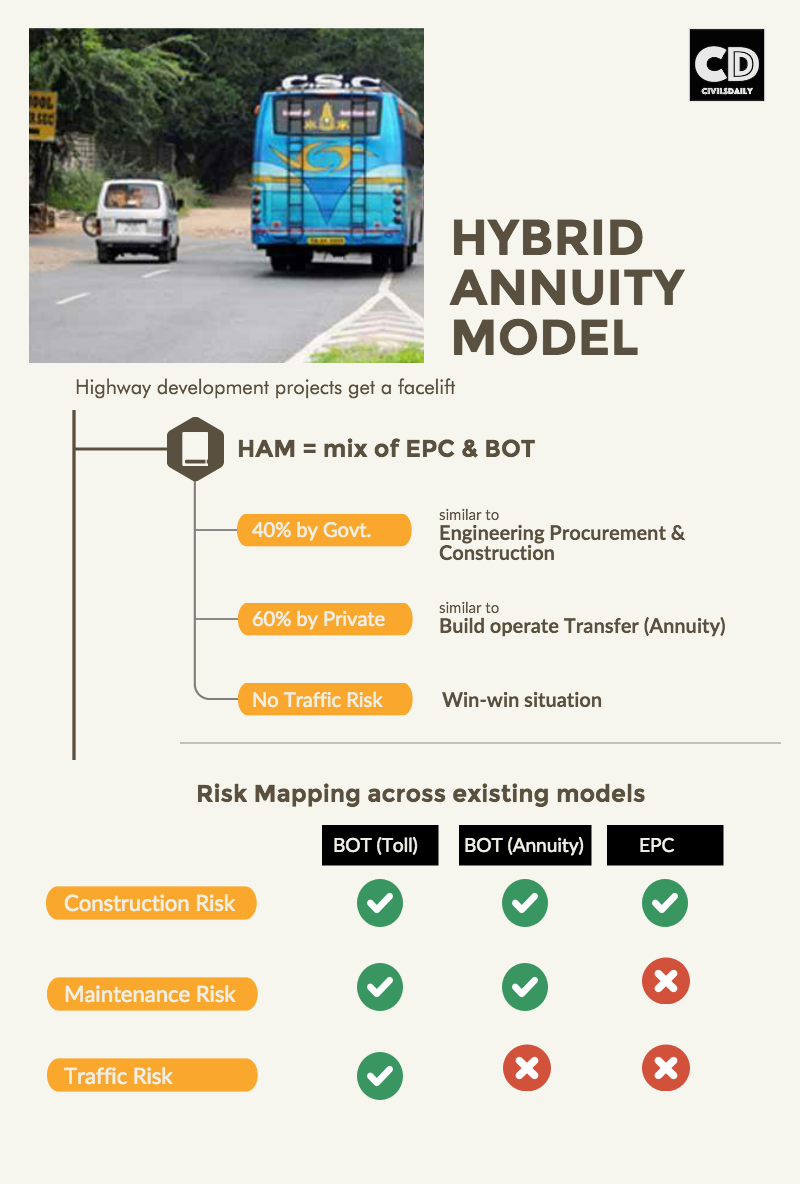
  • Hybrid Annuity Model: A win- win for everyone. But how?

    Last week, government approved the hybrid annuity model ( HAM ) as one of the modes for implementing highway development projects. This model was proposed by NHAI as investment dried up in other modes of road development projects such as BOT (Toll) and BOT (annuity).

    In this article, we shall understand different modes of PPP projects for highway development.

    There are 4 modes under which projects are awarded to private developers –

    #1. BOT (toll) – Build Operate Transfer and Toll

    As the name suggests, private party is responsible for building the project i.e. acquire land, procure raw material, design and construct the road i.e. private party bears construction risk.

    They operate and maintain (O&M) the road during concession period as per agreed specifications i.e. private party bears O&M risk.

    During concession period, they collect the toll. They recover their costs via toll collected during concession period i.e. private party bears Traffic or Commercial risk.

    If traffic does not materialize as per their projections, they won’t be able to recover their investment or if goons of Shiv Sena assaults toll operators, private players again lose.

    Private party has to arrange all the finance to build the project. Government awards contract to the party which is willing to share maximum toll revenue with the govt. Sometimes upfront viability gap funding (VGF) is provided for financially unviable projects.

    Clearly private party bears maximum risk in BOT  (toll).

    #2. BOT (annuity)

    What is annuity?

    An annuity is a series of equal payments at regular intervals. Eg. pension payments, insurance payments etc.

    BOT (annuity) was designed because BOT (toll) entailed too much risk and private developers were not willing to invest in the project.

    This model is exactly similar to BOT (toll) except that private party does not bear traffic or commercial risk.

    How do they recover their investment then?

    NHAI pay them regular annuity during concession period. Obviously developer that demands minimum annuity will be selected.

    #3. EPC – Engineering Procurement Construction

    Govt policy paralysis, difficulty in land acquisition, high cost of financing etc meant that private interest dried up even in BOT (annuity) and govt. brought EPC mode to award the projects.

    As the name suggests, private party only design the project, acquire raw material and construct the road i.e. private party bears only construction risk.

    Immediately after the construction, the road is transferred to NHAI. 100 % upfront funding comes from government coffers. Government acquires the land, provides all the regulatory clearances.

    In strict terms, EPC is not actually a PPP project. Private player bears virtually zero risk. Private player behaves as a contractor and constructs the road just as contractors build our houses.

    As you could imagine, EPC model was putting lot of strain on government finances. Why? Well, one of the main motive of bringing private players is that private players will bring capital and supplement limited public capital. But here private players were bringing ZERO capital. Govt. had to think of an innovative project and along came… 

    #4. Hybrid Annuity Model (HAM)

    What is hybrid? Simply put, it’s a mix of EPC and BOT (annuity)

    • Annuity? Private players don’t collect toll but recover investment via annuities
    • EPC? Govt. provide 40% of project cost

    BOT (annuity) part – Private player brings 60 % of capital. NHAI will pay annuity over concession period. Private player will be responsible for O&M of the project.

    Other features of the project-

    1. Life cycle cost will be the bidding parameter
    2. Separate provision for O & M payments 
    3. Provision for inflation adjusted project cost over time


    How it is a win – win situation?

    1. Private player has to arrange for only 60% of project cost. Exposure and risk reduces
    2. All regulatory clearances risk, compensation risk, commercial risk and traffic risk is borne by government, so risk for private sector is minimal
    3. Govt. has to cough up only 40 % of initial funding
    4. Operation and maintenance by private player. Better expertise, better quality of services
    5. Finally comfort to lenders ( banks ) through assured annuity payments


    Hope you got the key differences! If I left out something, feel free to ping back on the comments.


    #Q1. What do you mean by the hybrid annuity model? Does this model provide for optimal risk sharing? Suggest some measures to reform overall PPP framework in the country with special reference to reasons for stalled PPP projects in last few years.

    #Q2. Funding for infrastructure projects remain weak in India. Discuss various steps taken by govt to provide funding to infrastructure sector. Also suggest measures govt. can take to develop corporate bond market to fund infrastructure projects.

  • Doubts Clearing Forum

    Doubts constantly crop up while reading newspapers, books, taking a test? Don’t understand some concepts, unable to make sense of evolving story? Google it up, not very clear yet? That ‘aha moment’ just does not arrive?

    well, well, well. You have landed exactly at the right place. Ask any query here and get it resolved most satisfactorily, within next 48 hours, by our awesome community members and CD team. You won’t have to wait for your ‘aha moment’ to arrive.

    Have queries related to magazine, website or app?

    Wanna suggest any improvement?

    Comment here