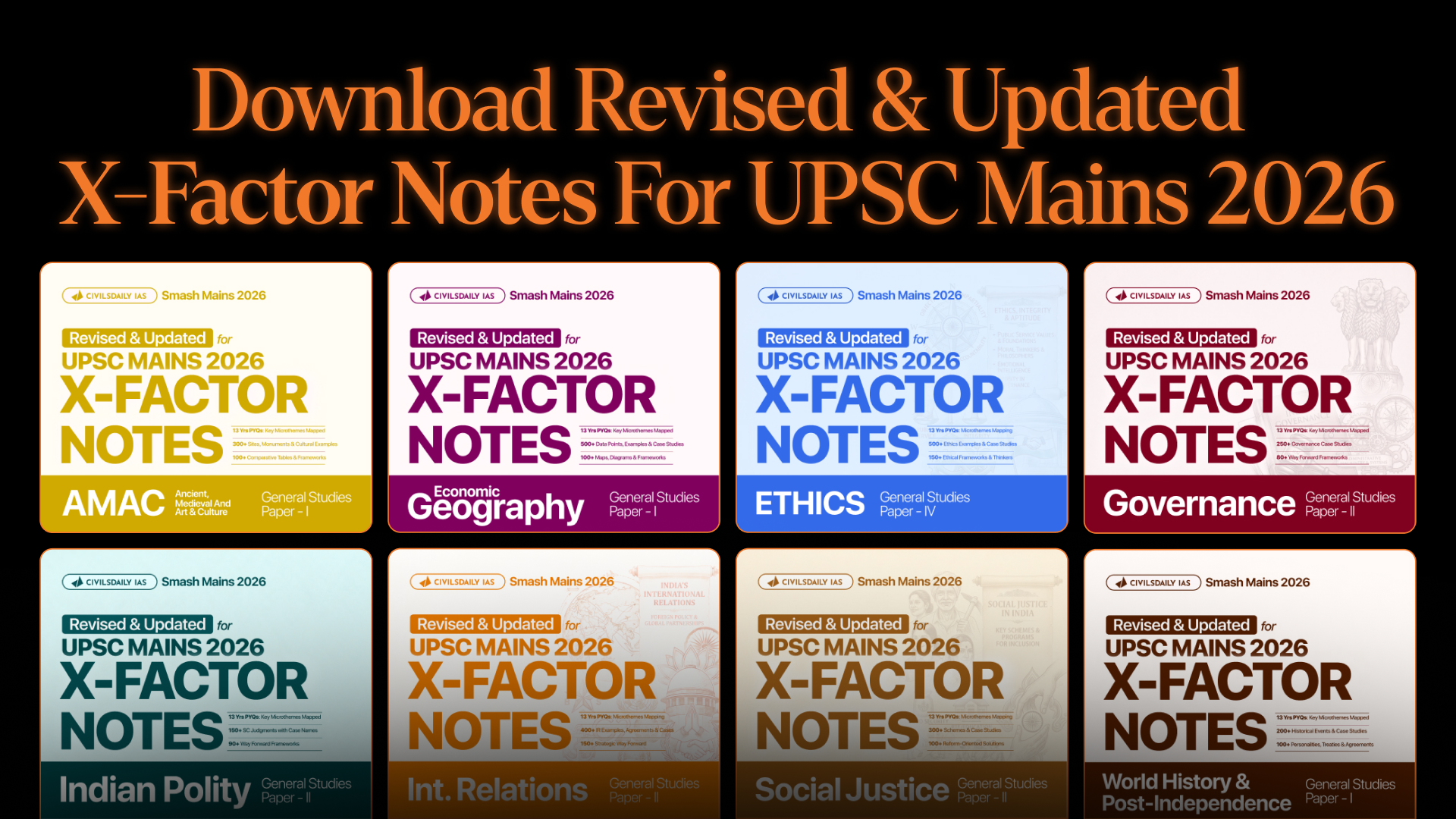
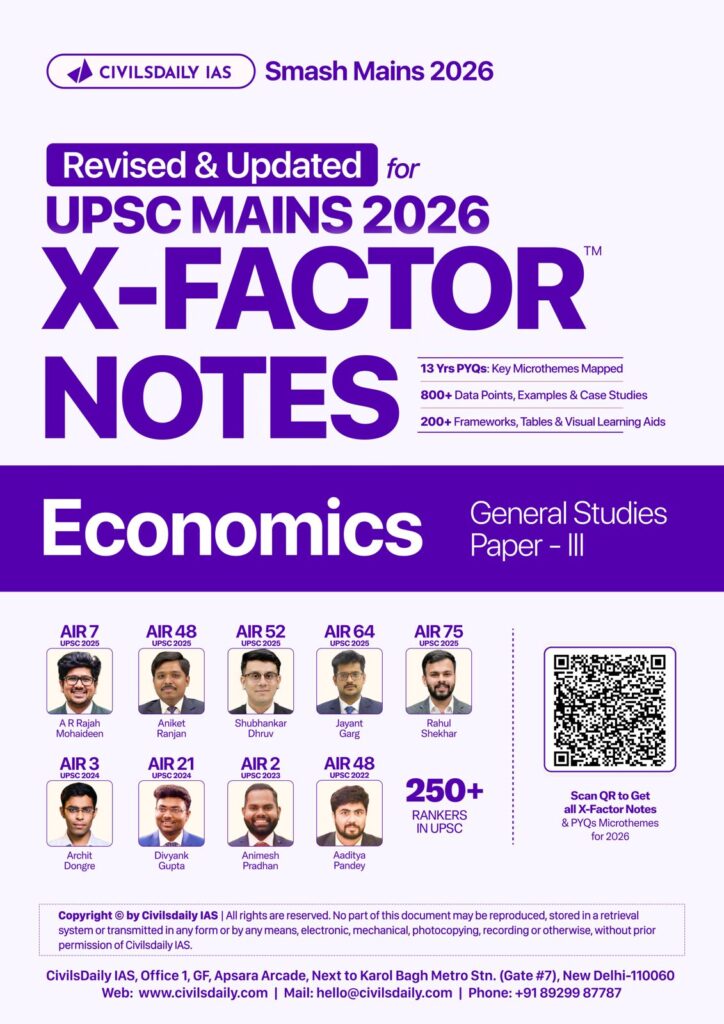
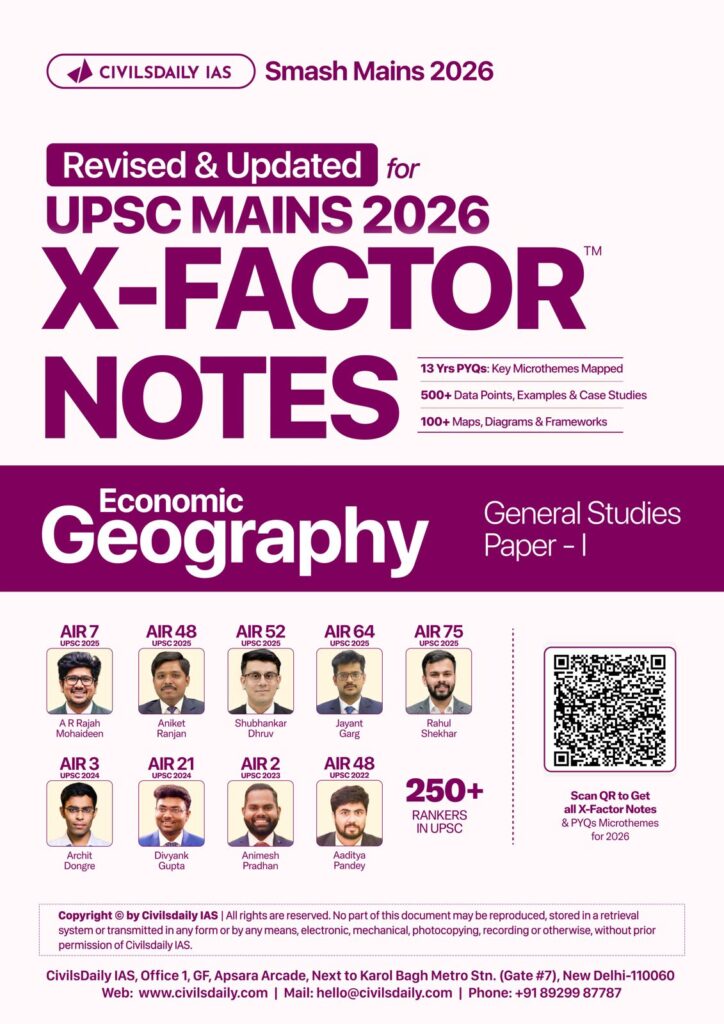
Introducing the Revised & Updated X-Factor Notes for UPSC Mains 2026. Built after analyzing 13 years of PYQs and the latest developments, these notes convert current affairs into Mains ready content that you can actually reproduce in the exam.
Whether it’s Governance, Polity, International Relations, Economy, Society, Ethics, Security or Environment, every topic is structured around:
PYQ-based Microthemes
Case Studies & Contemporary Examples
Thinker Quotes & Committee Recommendations
Way Forward Frameworks
Value Addition for 10 & 15 Mark Answers
Ready to use diagrams, data and answer enrichments
No 500 page reports. No random PDFs. Just exam-oriented content that helps you write better answers.
Most aspirants don’t fail in Mains because they lack content.
They fail because they keep repeating the same mistakes in answer writing, mistakes that silently reduce marks across every GS paper.
The problem is that these mistakes often go unnoticed.
You write more answers. You attend more tests. You work harder.
But your scores remain average.
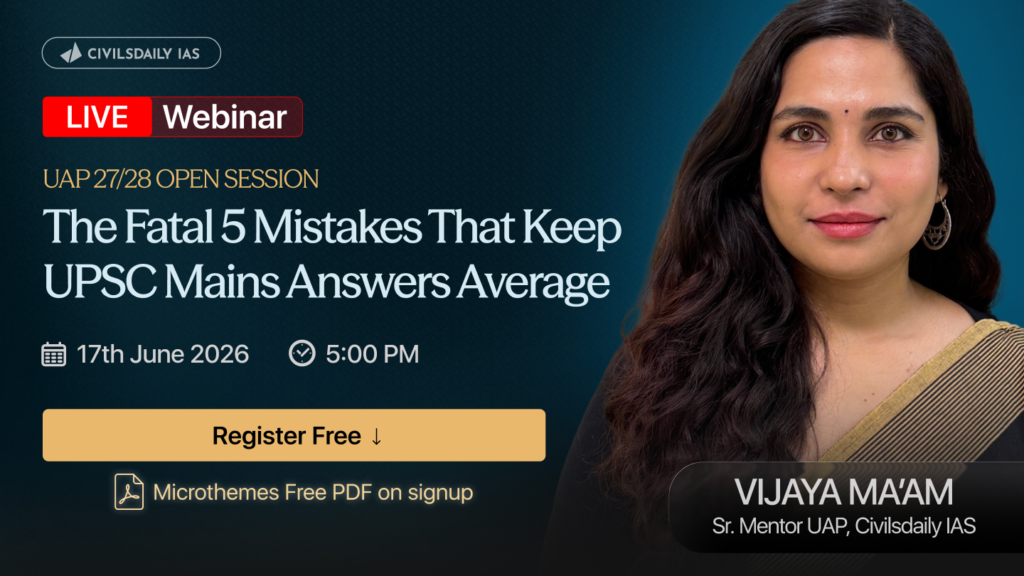
In this session, I will break down the 5 most common answer writing mistakes that keep aspirants stuck in the average range and explain how to fix them systematically.
What I will cover
1. Why Good Content Doesn’t Always Translate Into Good Marks
• The gap between preparation and presentation • Why knowledgeable aspirants often score average marks • Understanding what evaluators actually reward
2. The Fatal 5 Mistakes in UPSC Answer Writing
Including:
• Not addressing the exact demand of the question • Weak introductions and generic conclusions • Poor structure and flow of arguments • Using content as filler instead of analysis • Mismanaging time and space across answers
These are mistakes that cost marks irrespective of how much you’ve studied.
3. How to Diagnose Your Own Answer-Writing Problems
• Identifying patterns in low-scoring answers • Understanding where marks are being lost • Building awareness of recurring mistakes
Most improvement begins with correct diagnosis.
4. Simple Fixes That Create Visible Score Improvement
• Better structuring techniques • Improving clarity and articulation • Writing more examiner-friendly answers • Converting the same content into higher-scoring responses
Small changes can create surprisingly large gains.
5. Building Better Answer-Writing Habits
• What to focus on during daily practice • How to improve without writing hundreds of answers • Developing a process-oriented approach to Mains preparation
Because answer writing is a skill, and skills can be improved systematically.
Who Should Attend :
• Aspirants preparing for UPSC Mains 2026
• Candidates whose answer writing scores have plateaued
• Students looking to improve GS marks through better execution
It will be a 45 minute session, post which we will open up the floor for all kinds of queries which a beginner must have. No questions are taboo and Vijaya Ma’am is known to be patiently solving all your doubts.
Join us for a Zoom session on 17th June at 5PM. This session is a must attend for you If you are attempting UPSC for the first time or have attempted earlier and now preparing for 2027, then it is going to be a valuable session for you too.
See you in the session”
Register for the session for a complete in-depth UPSC Prep
(Don’t wait—the next webinar/session won’t be until End June’26)
These masterclasses are packed with value. They are conducted in private with a closed community. We rarely open these webinars for everyone for free. This time we are keeping it for 300 seats only.
Most beginners start their UPSC preparation by collecting resources.
Toppers start by understanding the exam.
And there is no better way to understand UPSC than through its Previous Year Questions.
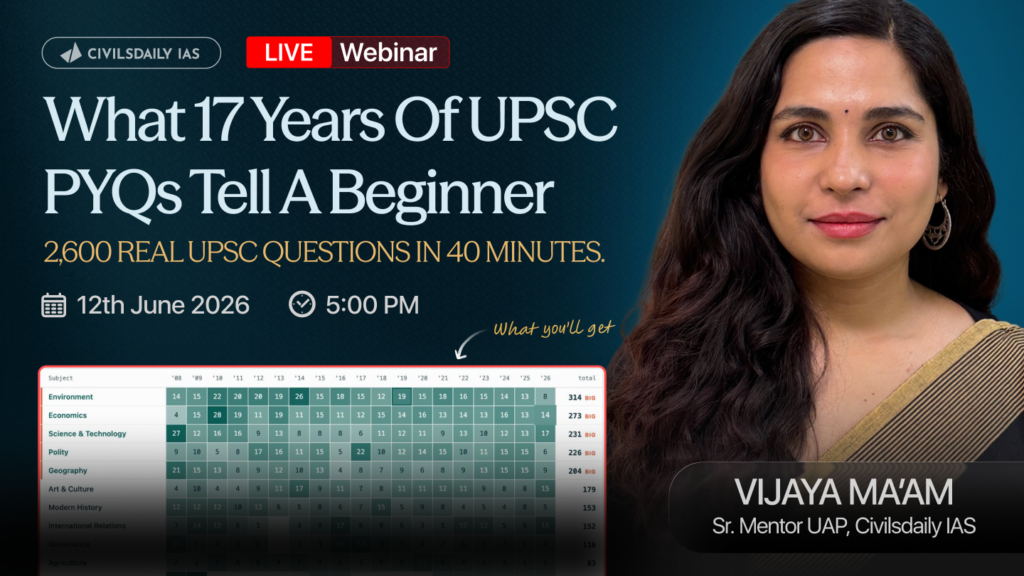
In this special session, I will decode 17 years of UPSC Prelims and Mains PYQs, covering nearly 2,600 real questions, to help beginners understand what UPSC actually rewards and what it consistently ignores.
This is not a question solving session.
It is a session on understanding the DNA of the UPSC examination.
What I will cover :
The recurring themes UPSC asks year after year
What PYQs reveal about UPSC’s thinking process
The difference between important topics and merely popular topics
How beginners should use PYQs before reading standard books
The evolution of UPSC questions over the last 17 years
The hidden patterns behind Prelims and Mains questions
How PYQs help eliminate resource overload and preparation anxiety
A practical roadmap for UPSC 2027 and 2028 aspirants
Why This Session Matters:
Many aspirants spend months studying without understanding what UPSC actually demands.
As a result, they read more but retain less, study harder but score lower.
PYQs are not just old questions.
They are the most authentic guidance UPSC has ever provided.
By studying them correctly, you can identify high yield areas, understand the examiner’s expectations, and build a preparation strategy aligned with the examination.
If you are a beginner wondering where to start, this session may save you months of confusion and help you build the right foundation from Day One.
17 Years. 2,600 Questions. One Session. A clearer understanding of UPSC than most aspirants gain in an entire year.
It will be a 45 minute session, post which we will open up the floor for all kinds of queries which a beginner must have. No questions are taboo and Vijaya Ma’am is known to be patiently solving all your doubts.
Join us for a Zoom session on 12th June at 5PM. This session is a must attend for you If you are attempting UPSC for the first time or have attempted earlier and now preparing for 2027, then it is going to be a valuable session for you too.
See you in the session”
Register for the session for a complete in-depth UPSC Prep
(Don’t wait—the next webinar/session won’t be until End June’26)
These masterclasses are packed with value. They are conducted in private with a closed community. We rarely open these webinars for everyone for free. This time we are keeping it for 300 seats only.
Most UPSC aspirants spend years collecting resources, watching strategy videos, and changing plans.
Very few understand what actually separates a rank holder from the thousands who remain stuck in the cycle of preparation.
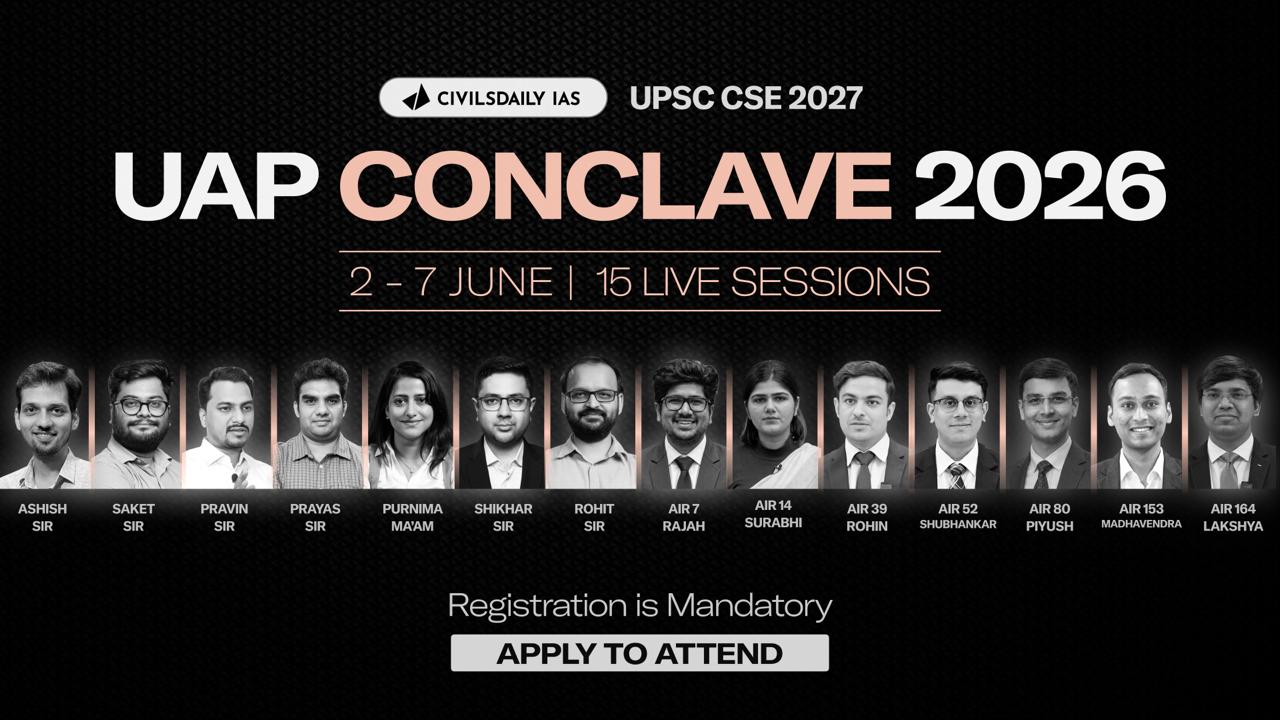
The UAP Conclave 2026 is designed to bridge that gap.
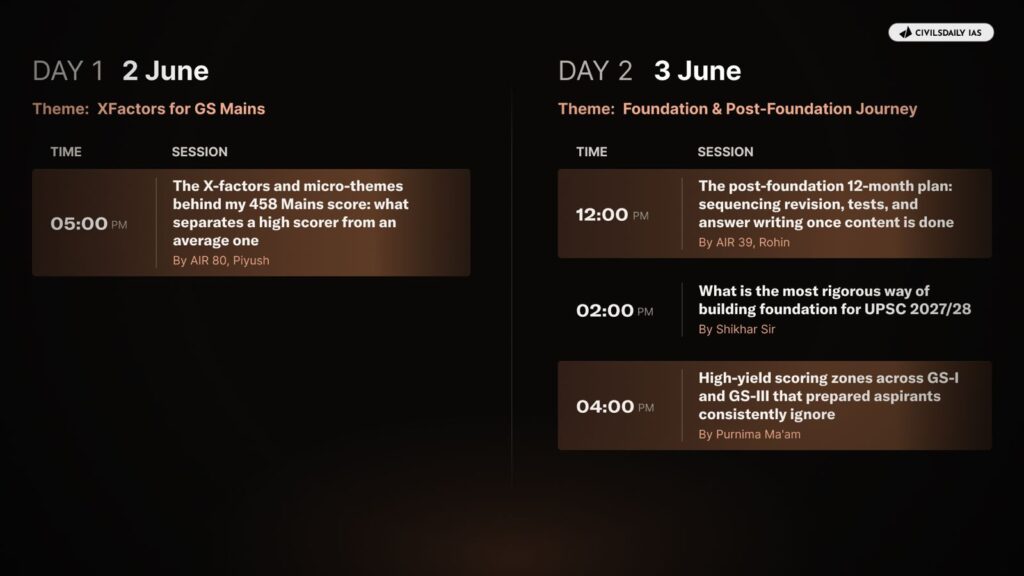
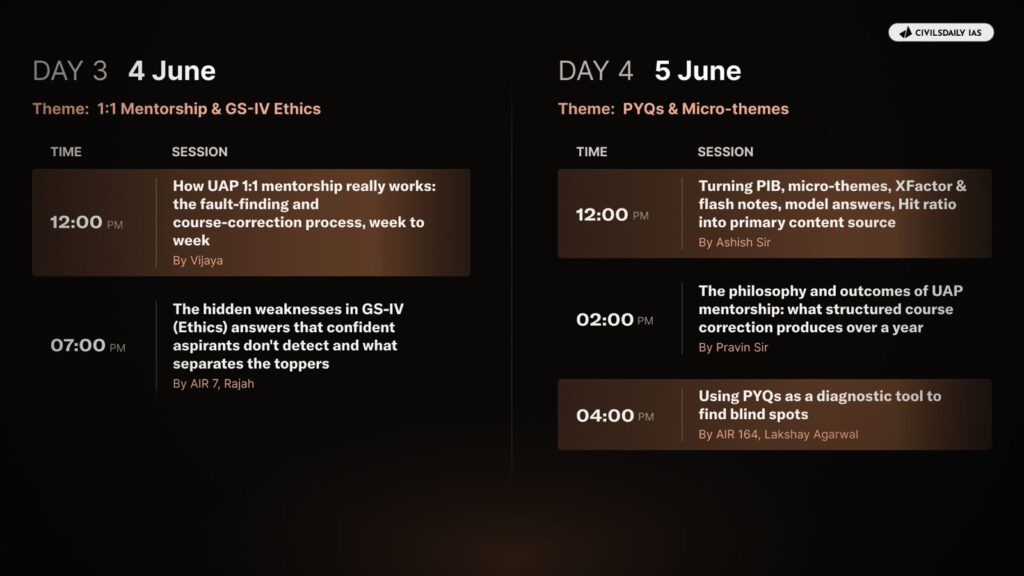
Over 6 days, you’ll learn directly from UPSC rankers, mentors, and faculty who have not only cracked the exam but have also mentored hundreds of successful candidates. The focus is not on motivation. The focus is on systems, execution, mistakes, corrections, and the hidden X-factors behind consistent performance.
What will you learn? 1. The microthemes and X-factors behind high GS scores
2. What separates a 450+ GS scorer from an average Mains candidate
3. How to build a rigorous foundation for UPSC 2027/28
4. The post-foundation 12-month plan for revision, answer writing, and test practice
5. High-yield scoring areas in GS-I, GS-III, and Ethics that aspirants often ignore
6. The actual process behind one-to-one mentorship and course correction
7. Hidden weaknesses in Ethics answers that toppers identify early
8. How to use PYQs as a diagnostic tool instead of just a question bank
9. Converting Current Affairs, PIB, Microthemes, Flash Notes, and Model Answers into a powerful preparation ecosystem
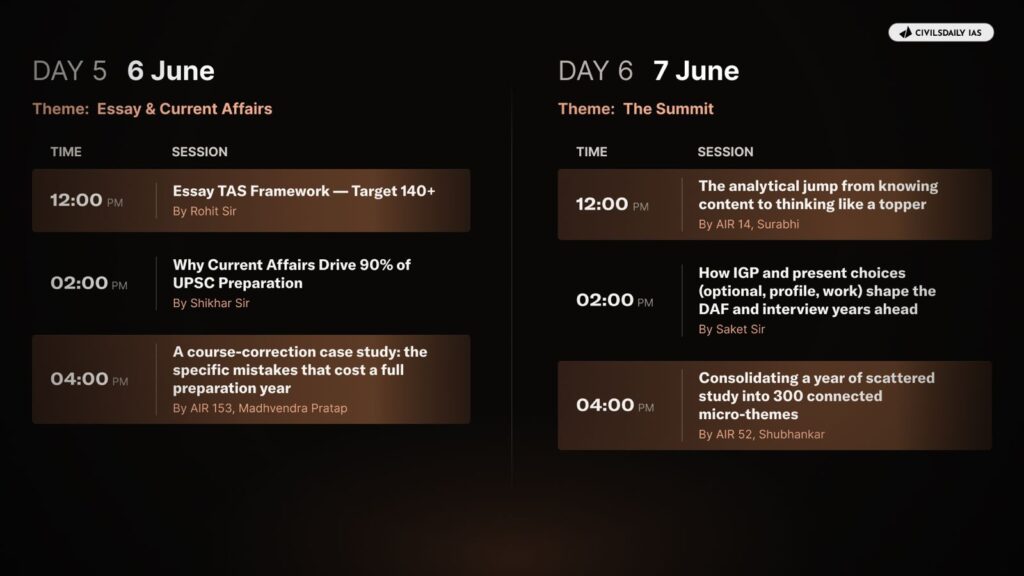
10. The TAS Framework for Essays and the path to 140+ marks
11. Why Current Affairs drives almost every stage of UPSC preparation
12. Real case studies of mistakes that cost aspirants an entire preparation year
The sessions will be led by Civilsdaily’s in house mentors along with UPSC toppers who scored well in GS and Essay papers. They will be sharing the exact study plans, timelines, and writing methods they used in their own attempts.
Learn From
•AIR 7 Rajah Mohaideen • AIR 14 Surabhi Yadav • AIR 39 Rohin Kumar • AIR 52 Shubhankar Dhruv • AIR 80 Piyush • AIR 153 Madhavendra Pratap • AIR 164 Lakshay Agarwal
Along with:
• Shikhar Sir • Rohit Sir • Ashish Sir • Purnima Ma’am • Prayas Sir • Pravin Sir • Saket Sir
Whether you are just starting your UPSC 2027 journey or looking to build a structured roadmap after the Foundation phase, these sessions will help you avoid common mistakes and understand what serious preparation actually looks like.
By the end of the 6 day event, you will have a much clearer understanding of how to plan your UPSC preparation day by day, how to prioritize your topics using microthemes, and how to approach answer writing in a way that improves your score.
Live from 02nd June to 07th June.
Civilsdaily ,2nd floor(206), Apsara Arcade, Pusa Rd Next to Gate No.6 Karol Bagh, Metro, North Extn Area, Rajinder Nagar, New Delhi, Delhi 110060
Join us for a Zoom session from 02nd June to 07th June. This session is a must attend for you If you are attempting UPSC for the first time or have attempted earlier and now preparing for next year, then it is going to be a valuable session for you too.
See you in the session”
Register for the session for a complete in-depth UPSC Mains Prep
(Don’t wait—the next webinar won’t be until Mid June 26)
These masterclasses are packed with value. They are conducted in private with a closed community. We rarely open these webinars for everyone for free. This time we are keeping it for 300 seats only.
Smash Mains 2026 – A Structured, High-Discipline Initiative for Serious Aspirants Preparing For UPSC CSE Mains2026
We are looking for a small group of serious aspirants preparing for Mains 2026, who have already covered the basics but are still not able to translate their preparation into consistent, high-quality answer writing. We specifically want to work with aspirants who have studied sincerely, have gone through standard GS material, and yet find themselves unable to produce structured, exam-ready answers across all four GS papers.
The objective of this initiative is simple: to help you build the discipline, structure and consistency needed to cross the 450+ mark in General Studies.
If you are preparing for Mains 2026 and you already have your basics in place, the next few months can define your entire attempt. The purpose of this programme is simple: to put you through a disciplined, carefully sequenced routine that builds your Mains answer-writing ability, improves content depth, and gets you exam-ready.
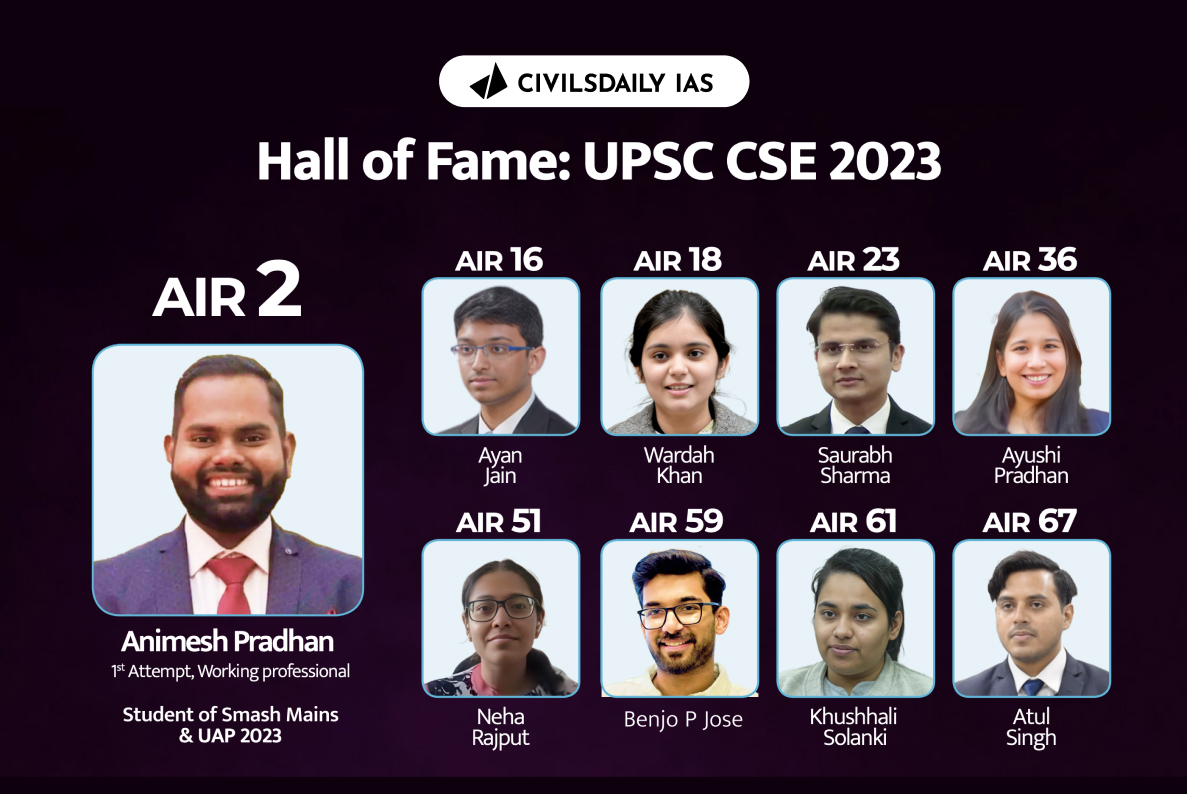
Over the past few years, we have seen a clear pattern in our results. Many of our top performers including those who secured ranks in earlier attempts and again found themselves in the Top 100 were students who engaged in sustained, high-quality answer writing with us. When students combine disciplined practice with guided improvement, their scores in General Studies rise sharply.
We have tested and refined our approach quietly over the years. We are convinced that with the right direction, the right mindset, the right daily effort securing a top rank is not only possible but predictable. The purpose of the Smash Mains is to help you achieve exactly that by building the foundation for a top score in General Studies.
This programme is designed to help you cultivate mains exam skills, in a systematic manner, over next few disciplined months. If you are willing to work every single day, follow the schedule, write answers, and internalise feedback, this plan will help you move from scattered preparation to targeted performance in Mains 2026.
Most aspirants know the syllabus. Many even write answers. But very few achieve consistency, structure, and exam-relevant content across all four GS papers.
The aim of this initiative is to fix exactly that.
Under this program, you will:
cover each GS theme with intent
focus on high-probability areas
write regularly
get feedback that actually tells you what to change
learn to present answers the UPSC way
and most importantly, build the discipline to sustain this till the exam
What the Programme Gives You
A complete Mains’26 prep timetable
Microtheme wise coverage for all GS papers
Mock questions based on UPSC’s evolving pattern
Model answers showing structure + value addition
Mentorship for improvement
Full-length mocks at strategic points
Revision loops built into the plan
A realistic chance at scoring 450+ in GS
6 Pillars of Smash Mains
Mentorship:
Focus on developing your unique style rather than copying top scorers or model answers.
Post-test mentor calls prioritize improvement areas for future tests, with question-level evaluation.
Mentors stay updated on evolving UPSC standards and guide students based on their writing style.
Question Framing:
Each question is designed to align with emerging UPSC trends and maximize hit-ratio.
Focus on repeating themes (e.g., in Art and Culture) to prepare students for probable questions.
Questions follow a balanced distribution that mirrors UPSC’s subject-wise weightage.
Detailed questions ensure that the theme and demand align with UPSC standards.
Answer Writing Frameworks:
Answer writing should stay aligned with the theme and demand of the question.
Use of structured frameworks like DAE (Dimension-Argument-Example) to make arguments more powerful.
Focus on coherence, enriched introductions, well-structured body content, and thoughtful conclusions.
Answer Evaluation:
Civilsdaily’s evaluation ensures consistent scoring across evaluators, reflecting true progress.
Feedback is structured and geared towards improving question comprehension and presentation.
Beyond simple marks, evaluators focus on theme demand and writing improvements.
Model Answers:
Model answers go beyond basic requirements, offering enriched study content.
Includes data, reports, and examples with clear structure (Introduction, Body, Conclusion).
Specialized questions for nuanced topics help students practice effectively for the exam.
X-Factor Notes:
Smash Mains provides a structured approach to building notes aligned with the Mains syllabus.
Notes cover all keywords from the syllabus, based on PYQs, ensuring relevance for the exam.
Regular guidance on note-making ensures better preparation and higher scores in Mains.
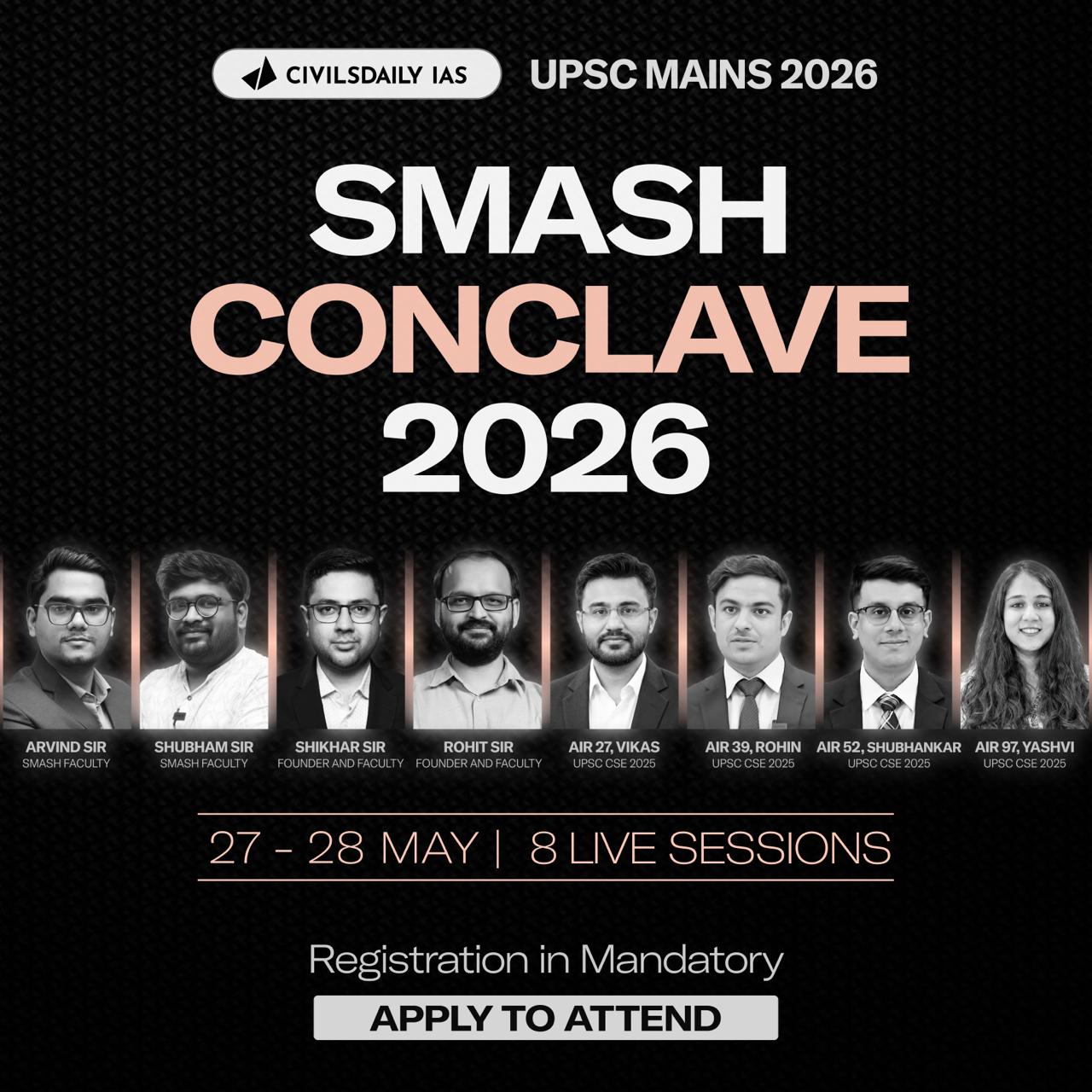
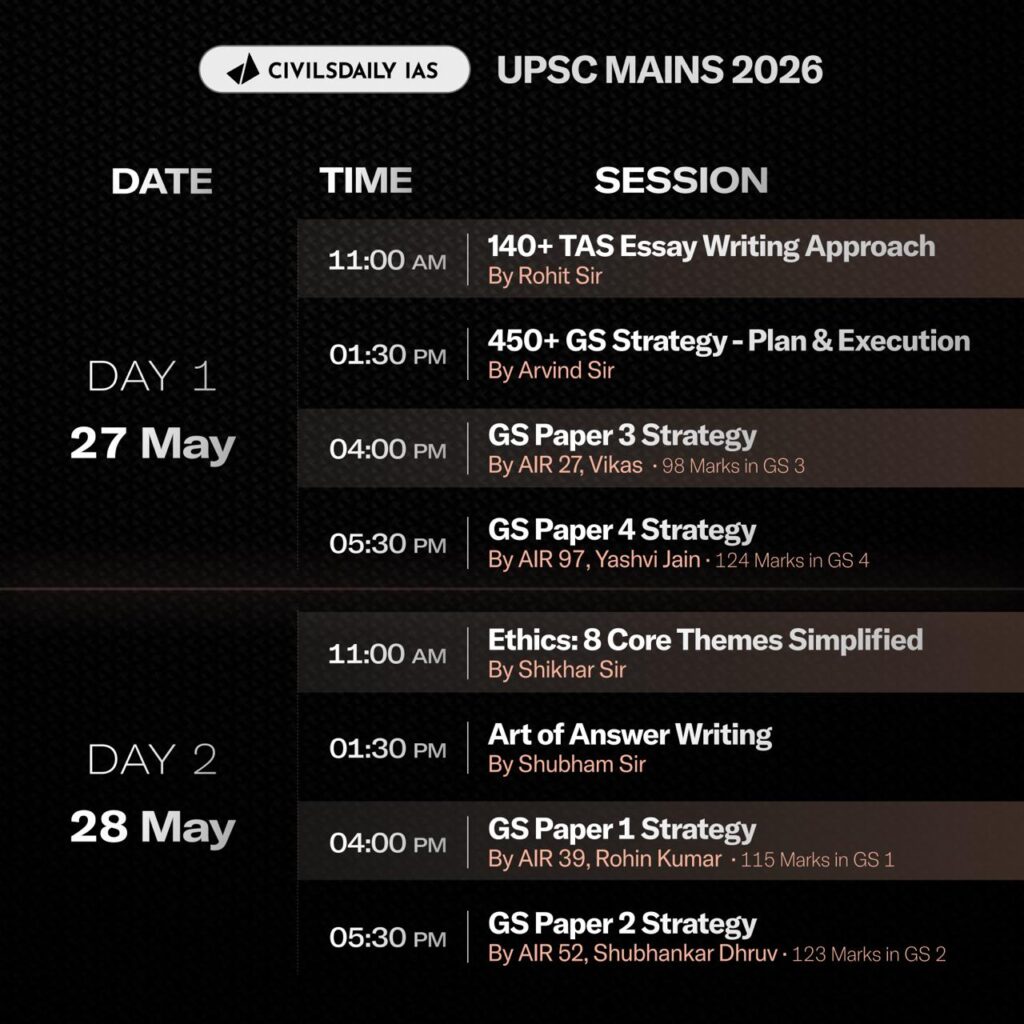
Smash Conclave 2026 is a 2 day UPSC Mains strategy event designed to help aspirants prepare more effectively for the UPSC Mains 2026 exam. This event is organized by Civilsdaily and will take place from 27th May to 28th May, featuring 8 live sessions conducted by experienced faculty and recent UPSC rankers.
Many aspirants struggle with how to approach UPSC Mains even after clearing Prelims. They often focus only on reading content, without understanding how to structure their answers, how to revise efficiently, or how to apply what they’ve learned to actual exam questions. Smash Conclave aims to solve these problems by showing practical strategies that have worked in real UPSC Mains exams.
Over two days, you will learn:
How to divide the next 85–90 days across GS, Essay, and Optional subjects
What microthemes are, and how they help in focused and repeated revision
How to approach each GS paper differently, using paper-specific tricks
How to create effective essay frameworks and improve your presentation
Why smart work and planning matter more than reading too many sources
How to avoid common mistakes like over-preparation, burnout, and poor time usage
The sessions will be led by Civilsdaily’s in house mentors along with UPSC toppers who scored well in GS and Essay papers. They will be sharing the exact study plans, timelines, and writing methods they used in their own attempts.
This conclave is especially useful for:
First time Mains writers who need a complete overview of what to do
Repeaters who want to avoid the mistakes of their last attempt
Aspirants feeling confused, scattered, or overwhelmed by too many resources
Those who want to prepare with more structure and less guesswork
By the end of the 2 day event, you will have a much clearer understanding of how to plan your Mains preparation day by day, how to prioritize your topics using microthemes, and how to approach answer writing in a way that improves your score.
Live from 27th May to 28th May.
Civilsdaily ,2nd floor(206), Apsara Arcade, Pusa Rd Next to Gate No.6 Karol Bagh, Metro, North Extn Area, Rajinder Nagar, New Delhi, Delhi 110060
Join us for a Zoom session on 27th May to 28th May. This session is a must attend for you If you are attempting UPSC Mains for the first time or have attempted earlier and now preparing for next year, then it is going to be a valuable session for you too.
See you in the session”
Register for the session for a complete in-depth UPSC Mains Prep
(Don’t wait—the next webinar won’t be until June 26)
These masterclasses are packed with value. They are conducted in private with a closed community. We rarely open these webinars for everyone for free. This time we are keeping it for 300 seats only.
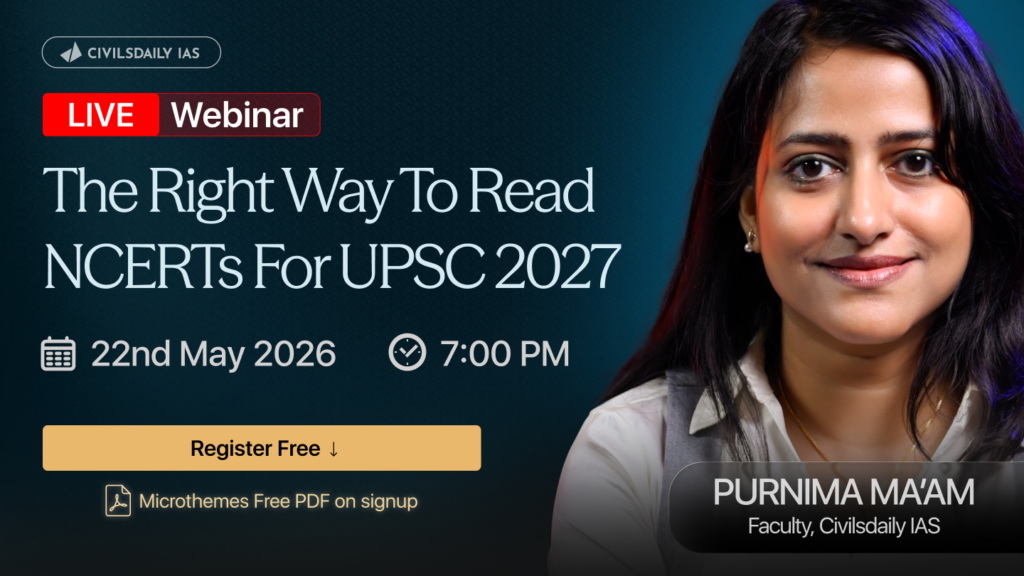
Most UPSC aspirants spend months reading NCERTs, yet fail to build clarity, retention, or exam oriented understanding.
The problem is not the books. The problem is the approach.
UPSC requires aspirants to read NCERTs differently, through concepts, microthemes, interlinkages, and revision-oriented preparation instead of passive chapter-by-chapter reading.
In this LIVE session, I will break down the right strategy to study NCERTs for UPSC 2027 preparation.
What I will cover :
Which NCERTs are actually important for UPSC
Subject wise approach to reading basics
How to make short notes from NCERTs
How to connect NCERTs with Current Affairs & Microthemes
Common mistakes beginners make while reading basics
How toppers revise NCERTs effectively
Transitioning from NCERTs to standard books
Who Should attend this session:
• UPSC 2027 beginners • Anyone looking to build a structured preparation system early
This session is designed especially for beginners and early stage aspirants who want to build a strong foundation for UPSC 2027.
It will be a 45 minute session, post which we will open up the floor for all kinds of queries which a beginner must have. No questions are taboo and Purnima Ma’am is known to be patiently solving all your doubts.
Join us for a Zoom session on 22nd May at 7PM. This session is a must attend for you If you are attempting UPSC for the first time or have attempted earlier and now preparing for 2027, then it is going to be a valuable session for you too.
See you in the session”
Register for the session for a complete in-depth UPSC Prep
(Don’t wait—the next webinar/session won’t be until End May’26)
These masterclasses are packed with value. They are conducted in private with a closed community. We rarely open these webinars for everyone for free. This time we are keeping it for 300 seats only.
Most students know elimination techniques. Very few know how to apply them effectively inside the exam hall.
UPSC Prelims is no longer just about information. It is increasingly becoming a test of smart decision making, option analysis, and risk management under pressure.
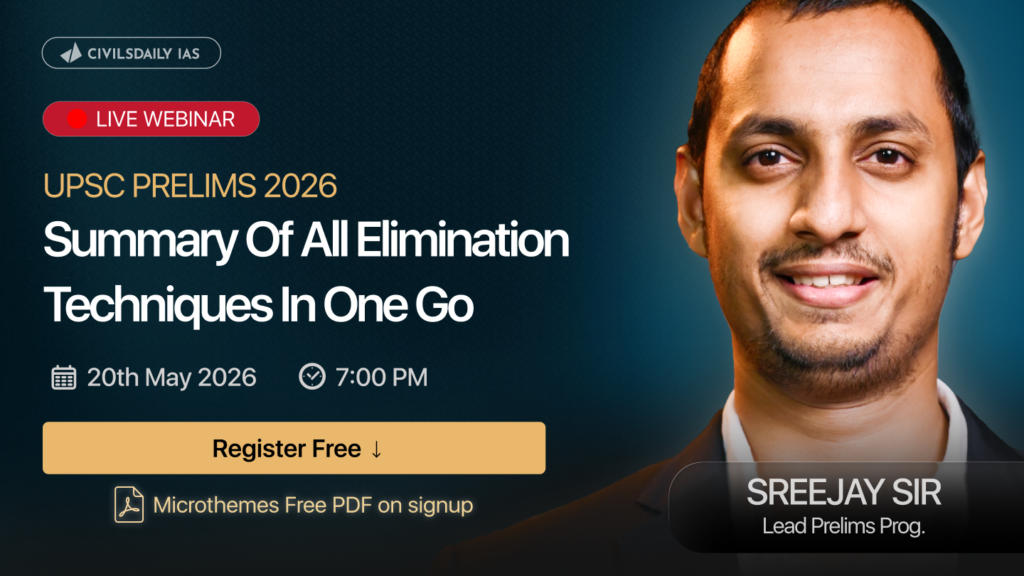
In this LIVE session, Sreejay Sir will revise all major elimination techniques in one go, along with the practical strategy needed to maximize marks in the final phase before Prelims 2026.
Sreejay Sir, Civilsdaily IAS
What this session is really about:
• The most effective elimination techniques used in UPSC Prelims • How to approach difficult and confusing options • Intelligent guessing vs risky guessing • PYQ-based patterns and recurring traps • How toppers eliminate statements quickly under pressure • Final revision strategy for the last phase before Prelims • How to improve accuracy while attempting more questions
Who should attend: •UPSC Prelims 2026 aspirants •Candidates struggling with revision overload •Aspirants stuck in the 75–90 marks range •Anyone looking for a structured final revision roadmap
This is not a theoretical session. It is a practical revision-focused class designed for serious Prelims aspirants looking to improve scores in the final stretch.
It will be a 45 minute session, post which we will open up the floor for all kinds of queries which a beginner must have. No questions are taboo and Sreejay sir is known to be patiently solving all your doubts.
Join us for a Zoom session on 20th May at 7 PM. This session is a must attend for you If you are attempting UPSC for the first time or have attempted earlier and now preparing for 2026, then it is going to be a valuable session for you too.
See you in the session”
Register for the session for a complete in-depth UPSC Prep
(Don’t wait—the next webinar/session won’t be until End May’26)
These masterclasses are packed with value. They are conducted in private with a closed community. We rarely open these webinars for everyone for free. This time we are keeping it for 300 seats only.
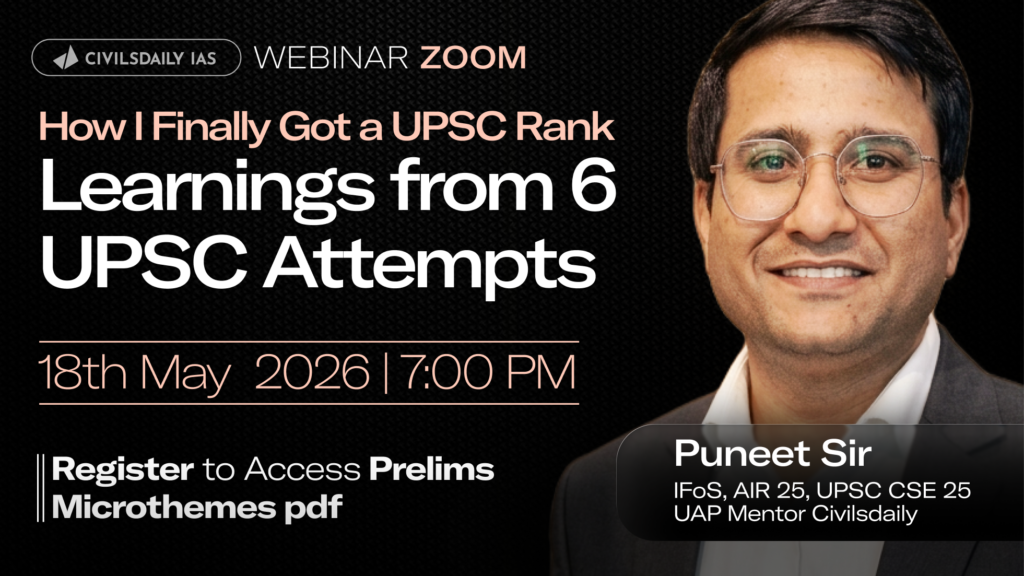
• Common preparation mistakes aspirants repeat for years • The illusion of “studying hard” without improving scores • Why many aspirants remain stuck despite giving multiple attempts • The emotional and psychological side of repeated failures
You’ll understand why UPSC often demands strategic evolution, not just more effort.
2. The Turning Point in Preparation
• What changed in the final successful attempt • The importance of clarity over excessive resources • How answer writing, revision and PYQ analysis were approached differently • Building consistency without burnout
Sometimes small strategic corrections create massive score differences.
3. Lessons From 6 Years of UPSC Preparation
This section will cover:
• What genuinely matters in long term preparation • What beginners should avoid from Day One • The role of patience, adaptability and mentorship • Why comparison with others damages preparation
These are lessons usually learned after years of trial and error.
4. The Mindset Required to Sustain UPSC Preparation
UPSC is not just an academic exam.
It tests:
emotional resilience
consistency
self awareness
discipline under uncertainty
You’ll learn how to: • handle setbacks • avoid preparation fatigue • stay mentally stable during long preparation cycles • rebuild confidence after failures
Who should attend: • Beginners targeting UPSC 2027 • Candidates struggling after unsuccessful attempts • Beginners wanting to avoid common mistakes early • Aspirants feeling stuck despite hard work
It will be a 45 minute session, post which we will open up the floor for all kinds of queries which a beginner must have. No questions are taboo and Puneet Sir is known to be patiently solving all your doubts.
Join us for a Zoom session on 18th May at 7 PM. This session is a must attend for you If you are attempting UPSC for the first time or have attempted earlier and now preparing for 2027, then it is going to be a valuable session for you too.
See you in the session”
Register for the session for a complete in-depth UPSC Prep
(Don’t wait—the next webinar/session won’t be until End May’26)
These masterclasses are packed with value. They are conducted in private with a closed community. We rarely open these webinars for everyone for free. This time we are keeping it for 300 seats only.
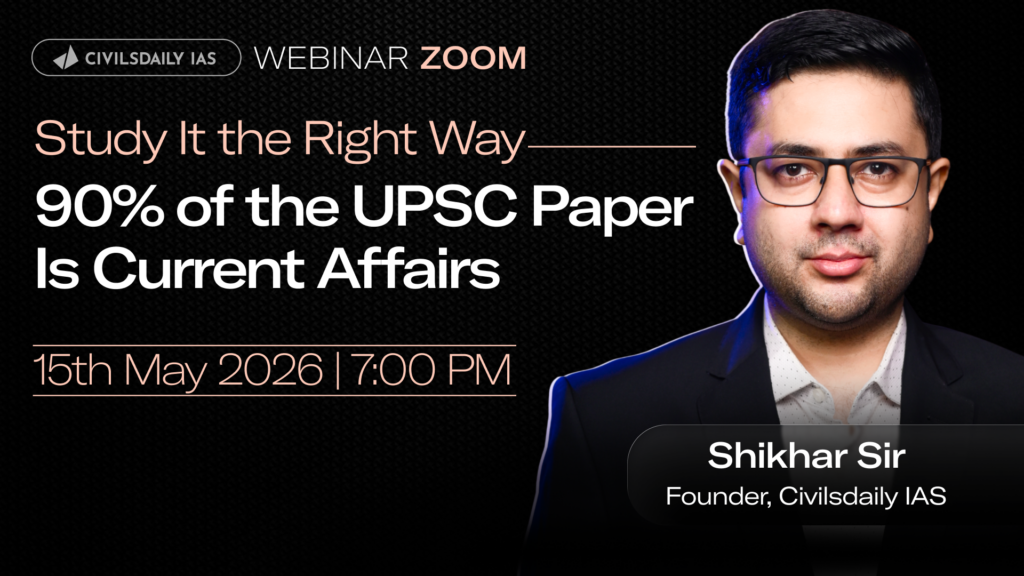
UPSC is no longer asking isolated factual questions. Whether it is Polity, Economy, Environment, Geography or International Relations Current Affairs now shapes almost every part of the paper.
The issue is not lack of reading. The issue is studying without direction.
Shikhar Sir, Faculty and Founder, Civilsdaily IAS
What You’ll Learn in This Session
1. Why Current Affairs Now Dominate UPSC Papers
I will break down how UPSC has evolved over the last few years:
Shift from factual recall to applied understanding
Increase in interdisciplinary questions
Why static only preparation is becoming less effective
How Current Affairs are influencing even static looking questions
You’ll understand why many aspirants feel shocked after the paper despite completing the syllabus.
2. The Difference Between Reading News & Preparing for UPSC
Most aspirants become passive consumers of information.
This session will explain:
What to read
What to skip
What deserves notes
What deserves revision
What is only noise
Because reading everything is not preparation. Filtering intelligently is.
3. How to Study Current Affairs Through Microthemes
This is where serious preparation begins.
You’ll learn:
What microthemes are
How toppers prepare subjects through interconnected themes
Why chapter wise reading is often insufficient
How one Current Affairs issue can connect with multiple GS topics
Example: A simple issue like inflation can connect to:
Monetary policy
RBI tools
Fiscal deficit
Food security
Agriculture
Global crude prices
Welfare economics
This is how UPSC expects aspirants to think.
4. Identifying High-Yield Current Affairs
Not every topic deserves equal attention.
You’ll learn how to identify:
Dead areas that rarely matter
High frequency recurring themes
Topics UPSC repeatedly revisits
Issues likely to become important due to recent developments
This section will help you reduce FOMO and focus on what actually matters.
5. Current Affairs Revision Strategy Before Prelims
Most aspirants read too much and revise too little.
This session will cover:
How to revise Current Affairs efficiently
The role of microtheme based revision
How to consolidate scattered notes
Last 60-day and last 15 day revision strategy
Because retention matters more than collection.
6. Common Mistakes That Destroy Scores
We will also discuss:
Overdependence on multiple sources
Random note making
Reading without PYQ linkage
Ignoring revision cycles
Treating Current Affairs as isolated facts
Most score stagnation comes from strategic mistakes, not lack of effort.
Who Should Attend:
UPSC 2027 aspirants
Beginners confused about Current Affairs preparation
Aspirants struggling with retention and revision
Candidates overwhelmed by newspapers, compilations, and coaching material
Anyone who wants to study smarter instead of studying endlessly
Join me on 14th May at 7:00 PM, live for a Zoom session. In one session, I will help you rebuild your preparation and move forward with confidence.
It will be a 45 minute session, post which we will open up the floor for all kinds of queries which a beginner must have. No questions are taboo and Shikhar Sir is known to be patiently solving all your doubts.
Join us for a Zoom session on 15th May at 7 PM. This session is a must attend for you If you are attempting UPSC for the first time or have attempted earlier and now preparing for 2027, then it is going to be a valuable session for you too.
See you in the session”
Register for the session for a complete in-depth UPSC Prep
(Don’t wait—the next webinar/session won’t be until End May’26)
These masterclasses are packed with value. They are conducted in private with a closed community. We rarely open these webinars for everyone for free. This time we are keeping it for 300 seats only.

![🔴[UPSC Webinar for 2027] By Vijaya Ma’am, Civilsdaily IAS | The Fatal 5 Mistakes That Keep UPSC Mains Answers Average | Join on 17th June at 5PM](https://d18x2uyjeekruj.cloudfront.net/wp-content/uploads/2026/06/VIJAYA-thumb1-1.png)
![🔴[UPSC Webinar for 2027] By Vijaya Ma’am, Civilsdaily IAS | What 17 years of UPSC PYQs tell a beginner | 2,600 real UPSC questions in 40 minutes | Join on 12th June at 5PM](https://d18x2uyjeekruj.cloudfront.net/wp-content/uploads/2026/06/VIJAYA-thumbd.png)
![[Accepting Admissions For UPSC Mains’26] Smash Mains 2026](https://d18x2uyjeekruj.cloudfront.net/wp-content/uploads/2026/05/Smash-Mains-2026-Thumb.jpg)
![🔴[UPSC Webinar for 2027] By Purnima Ma’am, Civilsdaily IAS | The Right Way to Read NCERTs for UPSC 2027 | Join on 22nd May at 7PM](https://d18x2uyjeekruj.cloudfront.net/wp-content/uploads/2026/05/PUrnima-thumb-4-1.png)
![🔴[UPSC Webinar for 2026] By Sreejay Sir, lead Prelims Prog, Civilsdaily IAS | Summary of all Elimination techniques in One Go | Join on 20th May at 7PM](https://d18x2uyjeekruj.cloudfront.net/wp-content/uploads/2026/05/Sreejay-thumb-5.png)
![🔴[UPSC Webinar for 2027] By Puneet sir, UAP Mentor, Civilsdaily IAS, IFoS Rank 25, UPSC 25 | How I Finally Got a UPSC Rank | Learnings from 6 UPSC Attempts | Join on 18th May at 7PM](https://d18x2uyjeekruj.cloudfront.net/wp-content/uploads/2026/05/Puneet-thumb.png)
![🔴[UPSC Webinar for 2027] By Shikhar Sir, Founder & Faculty, Civilsdaily IAS | 90% of the UPSC Paper Is Current Affairs | Study It the Right Way | Join on 15th May at 7PM](https://d18x2uyjeekruj.cloudfront.net/wp-content/uploads/2026/05/shikar-sir-thumb-4-1.png)