💥Join UPSC 2027,2028 Mentorship (August Batch) + XFactor Notes & Microthemes PDF

Category: Ranker Webinars

  • [Prelims Spotlight] Indian Geography- Physiography

    Physiography of India

    India can be divided into following physical divisions viz.
    • The Northern Mountains
    • The North Indian Plain
    • The Peninsular Plateau
    • Great Indian Desert
    • The coastal Regions
    • Islands

    The Northern Mountains / Himalayan Mountains

    • Young and structurally fold mountains stretch over thenorthern borders of India
    • Run in a west-east direction fromthe Indus to the Brahmaputra formed by the tectonic collision of the Indian plateau with the Eurasian plateau
    • Loftiest and one of the most rugged mountain barriers of the world
    • form an arc, which covers a distance of about 2,400 Km in length with varying width from 400 Km in Kashmir to 160 Km Arunachal Pradesh
    • The altitudinal variations are greater in the eastern part than in the western

    The Himalayas

    The Trans Himalayas

    • Himalayan Ranges immediately to the north of the The Great Himalayan Range are called the Trans Himalayas.
    • Most of the part of this Himalayan range lies in the Tibet and hence also called Tibetan Himalaya
    • The Zaskar, K2 (Godwin austin), the Ladakh, the Kailash and the Karakoram are the main ranges of the trans Himalayan system


    Greater or Inner Himalayas / Himadri

    • Most continuous range consisting of the loftiest peaks with an average height of 6,000 metres
    • Contains all the prominent Himalayan peaks with core of this part of Himalayas is composed of granite
    • Perennially snow bound, and a number of glaciers descend from this range
    • Prominent Ranges include Mt. Everest, Kamet, Kanchenjunga, Nanga Parbat, Annapurna

    Greater Himalayas

    The Lesser Himalaya or Himachal

    • Altitude varies between 3,700 to 4,500 metres and the average width is of 50 Km
    • While the Pir Panjal range forms the longest and the most important range, the Dhaula Dhar & the Mahabharat ranges are also prominent ones
    • Consists of the famous valley of Kashmir and the Kangra & Kullu Valley in Himachal Pradesh (Majority of hill stations lies in this range)


    The Shiwaliks

    • The altitude varies between 900 to 1100 km and the width varies between 10 to 50 km
    • The longitudinal valleys lying between the Himachal and Shiwaliks are called ‘Dun’ for ex. DehraDun, Kotli Dun and Patli Dun


    Eastern hills and mountains

    • The Brahmaputra marks the eastern border of the Himalayas. Beyond the Dihang gorge, the Himalayas bend sharply towards south and form the Eastern hills or Purvanchal.
    • These hills run through the north eastern states of India & are mostly composed of sandstones for ex. Patkai Hills, Naga Hills, Manipuri Hills and Mizo Hills

    Purvanchal Himalayas

    Himalayan Regions from East to West

    Classification of Himalayas on Geographic location

    Punjab Himalayas
    • This part lies between the Indus and Sutlej –  560 km
    • From west to east, this is also known as Kashmir Himalaya and Himachal Himalaya; respectively.
    • Karakoram, Ladakh, Pir Panjal, Zaskar and Dhaola Dhar are the main ranges of this section


    Kumaon Himalayas
    • This part lies between Sutlej and Kali rivers – 320 km
    •  Its western part is called Garhwal Himalaya while the eastern part is known as Kumaon Himalaya
    • The general elevation is higher as compared to Panjab Himalayas
    • Nanda Devi, Kamet, Trisul, Badrinath, Kedamath, Gangotri are important peaks.
    • The sources of sacred rivers like the Ganga and the Yamuna are located in the Kumaon Himalayas
    • Nainital and Bhimtal are important lakes


    Nepal Himalayas
    • This part lies between the Kali and Tista rivers – 800 km
    • This is the tallest section of the Himalayas and is crowned by several peaks of perpetual snow
    • Importantpeaks include Mount Everest, Kanchenjunga, Lhotse I, Makalu, Dhaula Giri and Annapurna
    • Kathmandu is a famous valley in this region


    Assam Himalayas
    • This part lies between the Tista and Dihang rivers – 750 km
    • Has elevation much lesser than that of the Nepal Himalayas
    • The southern slopes are very steep but the northern slopes are gentle
    • Important peaks of this region are Namcha Barwa, Kula Kangri and Chomo Lhari


     The Northern Plain

    • Formed by the interplay of the three major river systems, namely– the Indus, the Ganga and the Brahmaputra along with their tributaries
    • Composed of alluvial soil which has been deposited over millions of years, about 2400 km long and about 240 to 320 km broad.
    • With a rich soil cover combined with adequate water supply and favourable climate it is agriculturally a very productive part of India
    • Divided into three sections, viz. the Punjab Plain, the Ganga Plain and the Brahmaputra Plain.

    Indo Gangetic plains

    Punjab Plains Form the western part of the northern plain & formed by the Indus and its tributaries with major portion of this plains in Pakistan
    Ganga Plains Extends between Ghaggar and Tista rivers. The northern states, Haryana, Delhi, UP, Bihar, part of Jharkhand and West Bengal lie in the Ganga plains.
    Brahmaputra Plains This plain forms the eastern part of the northern plain and lies in Assam

    Northern Plain India

    Based on the relief features; the northern plain can be divided into four regions, viz. bhabar, terai, bhangar and khadar.

    Bhabar
    • After descending from the mountains, the rivers deposit pebbles in a narrow belt.
    • The width of this belt is about 8 to 16 km; lies parallel to the Shiwaliks.
    • All the streams disappear in this region
    Terai
    • The terai region lies towards south of the bhabar belt.
    • In this region, the streams reappear and make a wet, swampy and marshy region
    Bhangar
    • Bhangar is the largest part of the northern plain and is composed of the oldest alluvial soil.
    • They lie above the flood plains & resemble terraces.
    • The soil of this region is locally known as kankar and is composed of calcareous deposits
    Khadar
    • The floodplains formed by younger alluvium are called khadar.
    • The soil in this region is renewed every year and is thus highly fertile.

    The Peninsular Plateau

    • The peninsular plateau is triangular in shape & surrounded by hills, composed of the oldest rocks as it was formed from the drifted part of the Gondwana land
    • Broad & shallow valleys and rounded hills are the characteristic features of this plateau.
    • The plateau can be broadly divided into two regions, viz. the Central Highlands and the Deccan Plateau.

    Peninsular Plateau


    The Central Highlands

    • The Central Highlands lies to the north of the Narmada River & covers the major portion of the Malwa plateau.
    • The rivers in this region flow from southwest to northeast; which indicates the slope of this region.
    • It is wider in the west and narrower in the east.
    • Bundelkhand and Baghelkhand mark the eastward extension of this plateau.
    • The plateau further extends eastwards into the Chhotanagpur plateau

    Physiography of India


    The Deccan Plateau

    • Largest plateau in India, making up most of the southern part of the country, lies to the south of the Naramada River & shaped as downward-pointing triangle.
    • It is located between two mountain ranges, the Western Ghats and the Eastern Ghats.
    • Each rises from its respective nearby coastal plain almost meet at the southern tip of India.
    • The average elevation of Western Ghats is 900 – 1600 metres; compared to 600 metres in case of Eastern Ghats.
    • It is separated from the Gangetic plain to the north by the Satpura and Vindhya Ranges, which form its northern boundary
    • Home of thick dark soil (called regur), suitable for cotton cultivation


    The Indian Desert

    • The Indian desert lies towards the western margins of the Aravali Hills.
    • This region gets scanty rainfall which is less than 150 mm in a year, Hence they climate is arid and vegetation is scanty.
    • Luni is the only prominent river but some streams appear during rainy season.

    Indian Desert Thar


    The Coastal Plains

    The Peninsular plateau is flanked by stretch of narrow coastal strips which run along the Arabian Sea on the west and along the Bay of Bengal on the east.

    Western Coastal Plains

    • The Western Coastal Plainsis a thin strip of coastal plain 50 kilometres in width,  much less than its eastern counterpart, between the west coast of India and the Western Ghats hills, which starts near the south of river Tapi
    • The plains begin at Gujarat in the north and end at Kerala in the south including the states of Maharashtra, Goa and Karnataka
    • The Gulf of Kutch and the Gulf of Khambat lie on the northern part
    • Western coastal plane is mainly divided into following sections
    • Kathiawar Coast → Kutch to Daman (Tapti, Narmada, Sabarmati & Mahi river deposit huge load of sediments in the Gulf of Cambay & form estuaries)
    • Konkan Coast →  Between Daman & Goa
    • Kannada Coast →  Between Goa to Cannanore
    • Kanyakumari Coast →  Between Cannanore to Cape Camorin
    • Malabar coast à Kannada Coast + Kanyakumari Coast

    Coastal Plains India

    Eastern Coastal Plains

    • Refer to a wide stretch of landmass of India, lying between the Eastern Ghats and the Bay of Bengal.
    • These plains are wider and level as compared to the western coastal plains.
    • It stretches from Tamil Nadu in the south to West Bengal in the north.
    • Eastern coastal plane is mainly divided into following sections
    • Utkal coast →  Deltaic plains of Ganga to Mahanadi delta (Famous Chilka lake is located in this plain)
    • Andhra Coast →  Utkal plains to Pulicat lake (Contains deltas of Godavari & Krishna Rivers, & famous Kolleru lake)
    • Northern Circars → Utkal Coast + Andhra Coast (Between Mahanadi & Krishna)
    • Coromandal Coast → Between Krishna & Kanyakumari (Consist of Kaveri Delta)

    The Islands

    Islands in India

    • Total 247 islands in India → 204 islands in Bay of Bengal and 43 in the Arabian Sea
    • Few coral islands in the Gulf of Mannar also
    • Andaman and Nicobar Islands in Bay of Bengal consist of hard volcanic rocks
    • The middle Andaman and Nicobar Islands are the largest islands of India
    • Lakshadweep islands in the Arabian Sea are formed by corals
    • The southern – most point of India is in Nicobar Island, known as Indira Point
    • Formerly Indira point was called Pygmalion Point, it is submerged now, after 2004 Tsunami
  • [Prelims Spotlight] Theatre, Literature, Art, Dance in news

    1.Hornbill Festival 2018

    1. The Hornbill Festival is a celebration held every year from 1 – 10 December, in Kohima, Nagaland.
    2. The first festival was held in the year 2000.
    3. The festival is named after the Indian hornbill, the large and colourful forest bird which is displayed in the folklore of most of the state’s tribes.
    4. Organized by the Nagaland State Tourism and Art & Culture Departments, the Festival showcases a mélange of cultural displays under one roof.
    5. Festival highlights include the traditional Naga Morungs exhibition and the sale of arts and crafts, food stalls, herbal medicine stalls, flower shows and sales, cultural medley – songs and dances, fashion shows etc.

    About Great Indian Hornbill

    1. The great hornbill (Buceros bicornis) also known as the great Indian hornbill or great pied hornbill, is one of the larger members of the hornbill family.
    2. The great hornbill is long-lived, living for nearly 50 years in captivity.
    3. It is predominantly fruit eating, but is an opportunist and preys on small mammals, reptiles and birds.
    4. Its impressive size and colour have made it important in many tribal cultures and rituals.
    5. IUCN status: Vulnerable (uplisted from Near Threatened in 2018). It is also listed in Appendix I of CITES.

    2.UNESCO lists wrestling, reggae and raiho-shin rituals under “intangible heritage”

    • amaican reggae, Georgian wrestling and Japanese rituals are among the six new elements added by UN cultural agency UNESCO to its list of “intangible heritage” for the world to treasure.

    Chidaoba Wrestling

    1. From the border between Asia and Europe, in Georgia, it added Chidaoba, which combines elements of wrestling, music, dance and special garments.
    2. The practice encourages a healthy lifestyle and plays an important role in intercultural dialogue, according to UNESCO, which called its code of conduct “chivalric”.
    3. It noted that occasionally the wrestlers leave the arena with a Georgian folk dance.

    Jamaican Reggae

    1. It is a style of popular music with a strongly accented subsidiary beat, originating in Jamaica.
    2. It became widely known in the 1970s through the work of Bob Marley; its lyrics are much influenced by Rastafarian ideas.
    3. Reggae contributes to international discourse on issues of injustice, resistance, love and humanity underscores the dynamics of the element as being at once cerebral, socio-political, sensual and spiritual.

    Japan’s Raiho-shin rituals

    1. They are used to admonish laziness and teach children good behavior.
    2. Stemming from folk beliefs that deities visit communities and usher in the new year or season, local people dress in outlandish costumes and visit houses as deities.
    3. By performing the rituals, local people — notably children — have their identities moulded, develop a sense of affiliation to their community, and strengthen ties among themselves.

    3.9 Indian Arts forms which found their way into the UNESCO’s List of the Intangible Cultural Heritage

    #1. Koodiyattam, Sanskrit Theatre, Kerala

    1. Koodiyattam is the oldest existing classical theatre form in the entire world, having originated much before Kathakali and most other theatrical forms
    2. Koodiyattam was traditionally a part of the temple rituals
    3. Traditionally, Koodiyattam is presented by Chakyars, a temple caste of Kerala, and Nangiars, the women of Nambiar caste

    #2. Mudiyett: a ritual theatre of Kerala

    Kerala again!

    1. A traditional ritual theatre and folk dance drama from Kerala that enacts the mythological tale of a battle between the goddess Kali and the demon Darika
    2. Mudiyettu is a communal undertaking in which each caste of the village plays a specific role
    3. Being a community based art form it is the community that has traditionally encouraged and trained the next generation to preserve the art form

    #3. The Tradition of Vedic Chanting

    source

    The traditional way of reciting the Vedas is called Vedic chanting. Vedas are the primary source of knowledge on Hindu traditions. They comprise of the Hindu philosophy, myth, poetry and dialogue. The Vedas go back to about 3,500 years to the time of the Aryans, though they were written down much later. There are four chief Vedas – Rig, Yajur, Sama and Atharva.

    #4. Ramlila – the Traditional Performance of the Ramayana

    source

    #5. Ramman: religious festival and ritual theatre of the Garhwal Himalayas

    source

    The Ramman is a religious festival manifested in the form of ritual theatre annually held at Saloor Dungra village, in the Painkhanda Valley of Chamoli district of Uttarakhand, India.

    The Ramman is not replicated or performed at any other site in the Himalayas, being specific to both location and time.

    #6. Kalbelia: folk songs and dances of Rajasthan

    source
    1. Kalbelia is actually an untouchable community from Rajasthan who has always lived on the outskirts of villages and relied on entertaining people for their livelihood
    2. They are also the community who are traditionally snake charmers
    3. Most famous for their sensuous form of dancing, also called Kalbelia, which mimics the movements of snakes in some sense

    #7. Buddhist chanting of Ladakh

    source

    #8. Sankirtana, ritual singing, drumming and dancing of Manipur

    source

    Performed to mark religious occasions and various stages in the life of the Vaishnava people of the Manipur plains
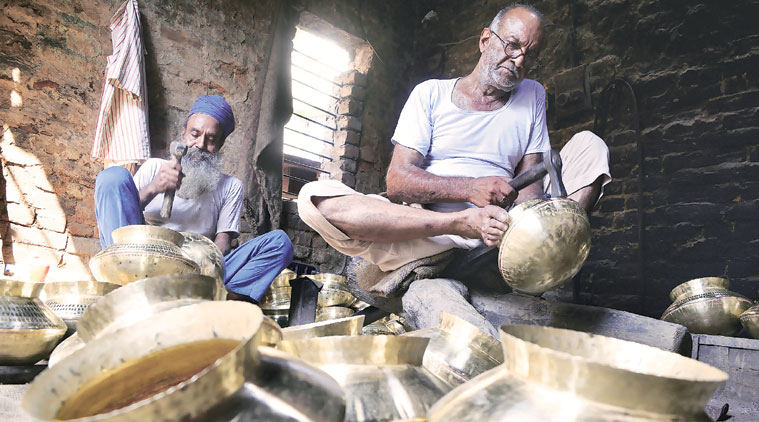
    #9. Traditional brass and copper craft – Thatheras

    source

    The craft of the Thatheras of Jandiala Guru constitutes the traditional technique of manufacturing brass and copper utensils in Punjab.

    4.17th World Sanskrit Conference in Vancouver, Canada

    Aim & Objective

    To promote, preserve and practice the Sanskrit language all over the world by the people.

    Particulars of the Conference

    1. The World Sanskrit Conference is being held in various countries across the globe once in every three years and so far it has been held thrice in India.
    2. The Delhi International Sanskrit Conference of 1972 is considered to be the first World Sanskrit Conference.
    3. This year more than 500 scholars and delegates from over 40 countries will be participating and exchange their knowledge by presenting papers on various subjects followed by discussions from amongst the members.
    4. There will be a special panel discussion on over a dozen topics like;
    • History & Education of Women in Vedic Literature;
    • Sanskrit Buddhist Manuscripts;
    • Mimamsa Beyond the Yagasala;
    • The Yuktidipika Forging a Place for Sankhya;
    • Introducing Bhagavata Purana Commentaries;
    • Research on the Gargiyajyotisa.

    5.Four-day Ambubachi Mela begins in Guwahati

    1. Ambubachi Mela, a four-day fair to mark the annual menstruation of the goddess at Kamakhya temple in Guwahati has begun.
    2. Ambubachi Mela is also an occasion to promote awareness on menstrual hygiene.
    3. Priests at the temple said doors of the temple were shut for visitors at 4 p.m. to let the goddess go through her period.

    About Kamakhya Temple

    1. Kamakhya, atop Nilachal Hills in Guwahati, is one of 51 shaktipeeths or seat of Shakti followers, each representing a body part of the Sati, Lord Shiva’s companion.
    2. The temple’s sanctum sanctorum (garbhgriha) houses the yoni — female genital — symbolized by a rock.

    6.The Vaishnav monks of Assam’s Majuli island

    History of Vaishnavism in Assam

    1. Vaishnava saint Srimanta Sankardev came to Majuli island in the 15th century
    2. He along with his disciples, set up 65 sattras—which is said to translate to “unique monasteries”
    3. Sankardev developed an equally unique way of worship through dance and drama, called the Sattriya Nritya
    4. The neo-Vaishnavite movement, held together by Sankardev, saw a division into four sub-sects after his passing

    About Sattriya Nritya

    1. It is a dazzling retelling of the Ramayan and Mahabharat—complete with comedy, action, suspense and make-up to match
    2. Until the 20th century, it was the preserve of male monks but has since brought women into the fold
    3. In the year 2000, the Sangeet Natak Akademi recognized this dance form as classical

    Majuli Island

    1. It is the world’s biggest river island in the Brahmaputra River, Assam
    2. In 2016 it became the first island to be made a district in India
    3. The island is formed by the Brahmaputra river in the south and the Kherkutia Xuti, an anabranch of the Brahmaputra, joined by the Subansiri River in the north
    4. Hidden chars (temporary islands formed by sedimentary deposits) and sandbars are features of this island

    7. India to host European Union Film Festival

    1. Putting a spotlight on the latest European cinema, the European Union Film Festival (EUFF) will premiere in New Delhi on 18th June, 2018 at the Siri Fort Auditorium.
    2. 24 latest European movies from 23 European countries are to be screened.
    3. Slovakian Movie Little Harbour to be the opening film for the festival
    4. The festival will traverse through 11 cities in India including New Delhi, Chennai, Port Blair, Pune, Puducherry, Kolkata, Jaipur, Visakhapatnam, Thrissur, Hyderabad and Goa from 18th June till 31st
    5. Celebrating diversity, the EUFF will screen movies from Austria, Belgium, Bulgaria, Croatia, Cyprus, Czech Republic, Denmark, Estonia, Finland, France, Germany, Greece, Hungary, Italy, Latvia, Lithuania, Luxembourg, Netherlands, Poland, Portugal, Slovakia, Spain and Sweden.
    6. The European Union Film Festival, organized by the Directorate of Film Festivals, Ministry of Information and Broadcasting, Government of India, and European Union will be hosted at the Sirifort Auditorium Complex.

    8. Modi honours Tibetan institute

    Honoring Buddhist Institute

    1. PM Modi honored a prominent institute of Tibetan studies as part of celebrations to mark Buddha Purnima
    2. He awarded Central Institute of Higher Tibetan Studies (CIHTS) with the Vaisakh Samman Prasasti Patra
    3. This was done at the Buddha Jayanti celebrations organized by the Ministry of Culture in collaboration with the International Buddhist Confederation (IBC)

    Buddhist Circuit

    1. The government has also initiated the process for the development of the Buddhist circuit
    2. This will help in developing Buddhist spots in U.P., Bihar, Madhya Pradesh, Gujarat, and A.P.
    3. The Buddhist Circuits are the Places of all High Significance Holy Sites of Buddhism; where Lord Buddha was born, attained Enlightenment, preached the first Sermon and reached Nirvana

    9.Over 40 Indian languages, dialects heading to extinction

    Endangered dialects

    1. More than 40 languages or dialects in India are considered to be endangered
    2. They are believed to be heading towards extinction as only a few thousand people speak them

    Languages in the country

    1. According to a report of the Census Directorate, there are 22 scheduled languages and 100 non-scheduled languages in the country
    2. These are spoken by a large number of people — one lakh or more
    3. There are 42 languages which are spoken by less than 10,000 people
    4. A list prepared by UNESCO has also mentioned about the 42 languages or dialects in India are endangered and they may be heading towards extinction
  • Gear up for This week’s Samachar Manthan lecture on 21st April Sunday

    Dear students,

    We understand that the UPSC exam is a generalist exam. It’s more important to cover more issues than to cover one issue in more depth. Hence, through Samachar Manthan, we are trying to maintain a fine balance of covering many important news items and having a detailed discussion on selected topics which require the same. On daily basis a news gets repeated multiple times. Scattered knowledge is not adequately useful when you have to write a 200 words answer within 6-7 minutes. To handle this, Samachar manthan covers such issues in a comprehensive and consolidated manner which is the smart strategy.

    Benefits of Samachar Manthan

    • Packed 3 – 3.5 hours Weekly videos will focus on news and its importance from both prelims and mains perspective.
    • This program will also help you understand how to utilize current affairs in all your prelims and mains papers.
    • This ideology makes this course the best utilization of your time.
    • Detailed coverage would mean analysis from all the angles like background or history, features, significance, challenges and way forward. Also, multiple sources like epw, diplomat magazine etc will be referred to in the video lectures.
    • Such an approach will help in writing multidimensional answers.
    • Also which part of the topic is important from mains and prelims perspective will also be discussed.
    • Audio Visual Learning is more impactful than simply glancing through the material. So that you are able to retain information for long also interlink with any new information you get.
    • 4 stage structure of Video->Notes->testing->review to perfect your preparation
    • The sequence of video->Notes->testing->review is the best way to ensure maximum retention and a rock solid preparation. Each component of the program has been meticulously crafted.

    For example this week, we will be covering the following issues;

    Economics

    India highest recipient of remittances in 2018: World Bank

    [op-ed snap]Drastic reforms needed to bridge inequality

    [Op-ed Snap] Agricultural policy needs to shift to a pro-farmer focus

    Bamboo Rice shows up in Odisha

    RailWire Wi-Fi Zones

    Environment & Biodiversity

    Discolouration of Periyar

    [op-ed snap] India stares at pile of solar e-waste

    [op-ed snap]US vs Europe in India

    Centre denies RTI plea on CIC appointments

    [op-ed snap]Is there a problem with the 10% quota?

    [op-ed snap]Rafale rebuff

    PCI issues guidelines for objective reporting on polls

    9 professionals selected as joint secys in biggest lateral induction into govt service


    International Relations

    Explained: A new high in Maldives

    US names Iran’s Revolutionary Guards a terrorist group

    IMO’s new rule on electronic information exchange between ships and ports comes into force

    PM to get Russia’s highest civilian award

    Polity

    [op-ed snap]Open up the Supreme Court

    [op-ed snap] Trickeries of the money bill

    [op-ed snap] Election Omission

    [op-ed snap] Bonds and binds

    Science Tech & Art Culture

    Explained: Snapping of Black Hole

    IIT Bombay’s bacteria preferentially degrade aromatic compounds


    Security Issues

    India, US set up first ever secure communication link under COMCASA

    Exercise Bold Kurukshetra

    Army gets Dhanush artillery guns

    Trivia:

    [op-ed snap] Jallianwala Bagh massacre:

    And these issues will be covered in detail

    • Election Commission
    • Money Bill
    • Electoral Bonds
    • Reservations
    • Inequality
    • Agricultural Policies

    So to be thorough in your preparation and to have an integrated approach, join Samachar Manthan here.


  • [Prelims Spotlight] Important reports and indexes ( Part 1 )

    1.Economics

    Global Economy

    1.Report name – Asian Development Outlook

    Issuing agency – Asian Development Bank


    2.Report name – World Economic Outlook

    Issuing agency – International Monetary Fund


    3.Report name – Global Economic Prospects

    Issuing agency – World Bank


     2.Development

    1.Report name – World Development Report

    Issuing agency – IBRD (World Bank)


     2.Report name – Ease of Doing Business

    Issuing agency – IBRD (World Bank)

    Latest in news – India has moved  rank up . This improvement came on the back of slight improvement in four indicators — getting electricity, enforcing contracts, trading across borders and registering property. To read in detail about the Ease of Business ranking, click here.


    3.Report name – Industrial Development Report

    Issuing agency – UNIDO (United Nations Industrial Development Organization)


    4.Report name – World Investment Report

    Issuing agency – UNCTAD (United Nations Conference on Trade and Development)


    5.Report name – Travel and Tourism Competitiveness Report

    Issuing agency – WEF (World Economic Forum)


     6.Report Name – World Cities Report

    Issuing Agency – UN-Habitat


    7.Index name – Logistics Performance Index

    Issuing agency – World Bank


    3.Global Financial System

    1.Report name – Global Financial Stability Report

    Issuing agency – International Monetary Fund


    2.Report name – Global Financial System Report

    Issuing agency – BIS (Bank for International Settlements)


    3.Report name – Global Money Laundering Report

    Issuing agency – FATF (Financial Action Task Force)

    2. Environment

    1.Report name – India State of Forest Report

    Issuing agency – Forest Survey of India

    Latest in news –  Click here to read more.


    2.Report name – Actions on Air Quality

    Issuing agency – UNEP (United Nations Environment Programme)


    3.Report name – Global Environment Outlook

    Issuing agency – UNEP (United Nations Environment Programme)


     4.Report name – The Rise of Environmental Crime

    Issuing agency – UNEP & INTERPOL


    5.Report name – Global Assessment Report

    Issuing agency – UNISDR (United Nations Office for Disaster Risk Reduction)


    6.Report name – The Living Planet Report

    Issuing agency – WWF (World Wildlife Fund)

    Latest in news – With wildlife disappearing at an “unprecedented” pace across the world, the Living Planet Report  identifies India as an ecological black spot where around half of the wildlife lives in the danger of being wiped out. The report highlights the pressure on water and land India faces because of unsustainable human activities. Around 70% of surface water is polluted and 60% of ground water will reach critical stage — where it cannot be replenished — in the next one decade,

  • Prelims and Mains Scorecards Released – Check your marks + Special Surprise for people who missed by a margin

    *UPDATE 1 – Please post your scorecards for authenticity. 


    Dear Students,

    UPSC has released marks for CSE 2018 attempt. Students who missed prelims by a margin of 5 marks are requested to post their scorecards below. Civilsdaily will provide you with certain exclusive study materials to aid your prelims preparation + 50% off on the Full-Length Test Series (8 full-length tests + 3 CSAT tests).

    Our FLTs are designed to ensure maximum repeat questions in actual exams. 

    Those who have cleared prelims & missed mains should email us with their DAF to know about special discounts. 

    Please go through the following links (will redirect to UPSC site) –

    1. FOR CANDIDATES QUALIFIED IN WRITTEN EXAMINATION – Click Here
    2. FOR CANDIDATES NOT QUALIFIED IN WRITTEN EXAMINATION – Click  Here
    3. CIVIL SERVICES (PRELIMINARY) EXAMINATION – Click Here
  • [Prelims Spotlight] Innovations in Sciences, IT, Computers, Robotics and Nanotechnology

    1.Atmospheric Water Generator (AWG)

    • A Navratna PSU Bharat Electronics Ltd (BEL) has unveiled the Atmospheric Water Generator (AWG).
    • It can be used to provide drinking water in community centres and public places.

    Atmospheric Water Generator

    1. The AWG is being manufactured by BEL in collaboration with CSIR-IICT and MAITHRI, a start-up company based in Hyderabad.
    2. It employs a novel technology to extract water from the humidity present in the atmosphere and purify it.
    3. It uses heat exchange for condensing the atmospheric moisture to produce pure, safe and clean potable water.
    4. It comes with a Mineralization Unit, which is used to add minerals which are required to make the water potable.
    5. The AWG is configurable in static and mobile (vehicular) versions and is available in 30 litres/day, 100 litres/day, 500 litres/day and 1,000 litres/day capacities.

    2.Quantum Computing

    Advent of quantum computing

    1. Classical internet is constrained by a binary thought process
    2. With quantum computing, information is held in “qubits” that can exist in two states at the same time
    3. A qubit can store a “0” and “1” simultaneously
    4. If you build two qubits, they can hold four values at once—11, 10, 01, and 00
    5. Adding on more qubits can greatly increase the computing capability of such a machine

    Towards quantum internet

    1. The logical extension of quantum computing is a quantum internet, where computers don’t just compute in isolation, they also communicate with one another
    2. Scientists are now working on how a quantum internet might work
    3. To accomplish this, they are beginning by providing a vision of fundamentally new technology protocols to enable network communications between any two quantum computing machines on Earth
    4. They say that such a quantum internet will—in synergy with the “classical” internet that we have today—connect quantum computers in order to achieve unparalleled capabilities that are impossible today
    5. Several major applications for the quantum internet have already been identified, including secure communication, secure identification, achieving efficient agreement on distributed data, as well as secure access to remote quantum computers in the cloud

    Advantages of the quantum internet

    1. The ability of a quantum internet to transmit “qubits” that are fundamentally different than classical “1” and “0” bits is what is paramount
    2. Qubits also cannot be copied, and any attempt to do so can be detected
    3. This makes qubits well suited for security applications.

    3.World’s standard definition of kilogram now redefined

    Redefining Kilogram

    1. CGPM is the highest international body of the world for accurate and precise measurements and comprises of 60 countries including India and 42 Associate Members.
    2. The 26th meeting of the General Conference on Weights and Measures (CGPM) was held during November 13-16 2018 at Palais des Congréss, Versailles, France.
    3. In the meeting, the members have voted for the redefinition of 130 years old “Le grand K – the SI unit of kg” in terms of the fundamental Planck’s constant (h).
    4. The new definitions will come into force on 20 May 2019.

    How will this take place?

    1. The International Bureau of Weights and Measures (BIPM), the main executive body of CGPM has the responsibility of defining the International System of Units (SI).
    2. This revision of the SI is the culmination of many years of intensive scientific cooperation between the National Metrology Institutes (The national Physical Laboratory for India) and the BIPM.
    3. The dissemination of SI units for the welfare of society and industries in the country is the responsibility of Legal Metrology, Department of Consumer Affairs, GoI.

    International prototype of kilogram (IPK)

    1. The International prototype of kilogram (IPK) is kept at the BIPM, Paris and serves as the international standard of kilogram.
    2. It is made of 90% platinum and 10% iridium and is a cylinder of 39 mm diameter and 39 mm height.
    3. Replicas of the IPK are made of the same material and used at BIPM as reference or working standards and national prototype of kilogram (NPK), kept at different National Metrology Institutes (NMIs).
    4. NPK-57, kept at CSIR- National Physical Laboratory, is sent periodically to BIPM for calibration.
    5. NPK further is being utilized through transfer standards of mass to provide unbroken chain of traceability for dissemination of mass through Legal Metrology to the user industries, calibration laboratories etc.
    6. The precise and accurate measurements help country in the production of international quality products and help commerce through elimination of the technical barrier to trade.

    Using a Kibble Balance

    1. Kibble balance is a self-calibrating electromechanical balance and provides the measurements of mass, traceable in terms of electrical parameters and provides linkage of macroscopic mass to the Planck constant (h).
    2. NPL-UK, NIST-USA,NRC- Canada, PTB-Germany etc. have successfully developed Kibble balance for 1 kg with an uncertainty of measurement in order of 10-8.
    3. The advantages of Kibble balance would be that the NPK need not to be sent to BIPM for calibrations and the accuracy and stability of Kibble balance is very high.
    4. This is very important where low weights with high accuracies are essential, for example in pharmaceuticals and biotechnologies.

    4.World’s fastest man-made spinning object developed

    Fastest rotor

    1. Scientists have developed the fastest man-made rotor in the world, which they believe will help them study quantum mechanics
    2. At more than 60 billion revolutions per minute, this machine is more than 100,000 times faster than a high-speed dental drill

    Working of the rotor

    1. The team synthesised a tiny dumbbell from silica and levitated it in a high vacuum using a laser
    2. The laser can work in a straight line or in a circle – when it is linear, the dumbbell vibrates, and when it is circular, the dumbbell spins
    3. A spinning dumbbell functions as a rotor, and a vibrating dumbbell functions like an instrument for measuring tiny forces and torques, known as a torsion balance.

    5.Pigment in Goa mushroom may help fight cancer

    World’s first sulphur-rich edible melanin

    1. The mycological laboratory of the Department of Botany, Goa University has reported the discovery of a new pigment from local wild mushrooms
    2. The new sulphur-rich melanin biopigment is obtained from local Roen alamis (wild variety of Goan mushrooms that grows on termite hills) or Termitomyces species

    About the research

    1. This discovery shows the chemical nature of the brown or black colour that is seen in these wild edible mushrooms
    2. The problem had eluded the scientific community from 40 countries for the past 100 years
    3. The scientist claim it to be the world’s first sulphur-rich edible melanin. Its structure is similar to black pigment found in human hair.

    6.Central task force on AI recommends setting up of N-AIM

    National Artificial Intelligence Mission (N-AIM)

    1. A central task force on Artificial Intelligence (AI) has suggested creating a National Artificial Intelligence Mission (N-AIM)
    2. It will serve as a nodal agency for coordinating AI related activities in the country

    Defining AI

    1. Artificial Intelligence is the science and engineering of making intelligent machines, especially intelligent computer programmes

    About the mission

    1. The mission shall involve itself in core activities, coordination of AI-related projects of national importance and establish Centers of Excellence
    2. The core activities include funding establishment of a network among Academia, services industry, product industry, startups and Government ministries, besides helping studies to identify concrete projects in each domain of focus
  • Kamyaa (AIR 172) & Kunal (AIR 211): Strategies with Highest ROI | Student driven Q&A Session

    Dear students,

    This is a must watch! A student-driven Q&A session.

    Presenting the most interesting and enriching discussion – Civilsdaily invited two toppers who represent the extremes of the CSE-prep spectrum.

    Kunal gives the most practical tips. Debunks myths around the number of questions to attempt, whether to go for high-valued questions. His outlook on life remains admirable.

    While Kamyaa (AIR 172) exemplifies the ‘happy-go-lucky attitude’ who cracked the exam with little planning; Kunal (AIR 211) personifies the ‘meticulous planner with never-say-die philosophy’.

    It is difficult to find a video that combines such diverse wisdom so methodically.

    For holistic guidance for IAS 2020, join Foundation 2020: http://bit.ly/foundation2020