💥Join UPSC 2027,2028 Mentorship (August Batch) + XFactor Notes & Microthemes PDF

Distribution: weekly

  • [2nd September 2025] The Hindu Op-ed: The rise and risks of health insurance in India

    PYQ Relevance

    [UPSC 2023] Examine the pattern and trend of public expenditure on social services in the post-reforms period in India. To what extent this has been in consonance with achieving the objective of inclusive growth?

    Linkage: The expansion of Pradhan Mantri Jan Arogya Yojana (PM-JAY) and State Health Insurance Programmes (SHIPs) shows rising public expenditure on health but largely towards insurance reimbursements rather than strengthening primary health infrastructure. This trend benefits private hospitals and tertiary care but fails to reduce out-of-pocket costs or enhance inclusivity, as utilisation remains low. Thus, the expenditure pattern reflects growth without true inclusiveness, misaligned with the objectives of inclusive growth.

    Mentor’s Comment

    The debate on health insurance in India has intensified in recent years, especially with the expansion of State-sponsored schemes like Pradhan Mantri Jan Arogya Yojana (PM-JAY). While these initiatives provide some relief, the core question remains: can insurance-driven models substitute for robust public health infrastructure? This article unpacks the illusion of universal health coverage (UHC) through insurance, its systemic risks, and the urgent need for course correction.

    Introduction

    The Bhore Committee Report (1946) defined UHC as guaranteed access to quality health care for every citizen irrespective of their ability to pay. Eight decades later, India still falls far short of this goal. Instead of strengthening public health infrastructure, India has leaned heavily on health insurance schemes like the PMJAY and State Health Insurance Programmes (SHIPs). Though they provide relief to some, these schemes have created new distortions, risks, and inequities in the health system.

    The Surge of Health Insurance Schemes

    1. PMJAY Launch (2018): Landmark scheme under Ayushman Bharat with ₹5 lakh annual cover per household for in-patient care.
    2. Massive Coverage: In 2023–24, PMJAY covered 58.8 crore individuals with an annual budget of ₹12,000 crore.
    3. Parallel SHIPs: State-level schemes cover a similar number with a budget of at least ₹16,000 crore.
    4. Rising Budgets: SHIP allocations grew at 8–25% annually (2018–19 to 2023–24) in States like Gujarat, Kerala, Maharashtra.

    Commercialisation of Healthcare under Insurance

    1. Two-thirds of the PMJAY budget flows to private hospitals, often profit-oriented.
    2. Study findings: Minimal change in hospitalisation rates, but rise in private hospital use.
    3. Weak regulation: India’s poorly regulated profit-seeking providers dominate the system.

    Hospitalisation Bias in Insurance Models

    1. Bias towards hospitalisation: Insurance covers only in-patient care, neglecting primary and outpatient care.
    2. Ageing challenge: Expanding coverage to elderly (70+) risks disproportionate spending on tertiary care.

    Challenges in Effective Utilisation of Coverage

    1. High theoretical coverage: 80% of the population enrolled under PMJAY + SHIPs.
    2. Low effective use: Only 35% of insured patients could utilise benefits (2022–23 HCES).
    3. Barriers: Lack of awareness, procedural hurdles, and discrimination by providers.

    Discrimination in Healthcare Delivery

    1. Private hospitals: Prefer uninsured patients for higher commercial charges.
    2. Public hospitals: Prefer insured patients for reimbursement incentives.
    3. Result: Discriminatory treatment and pressure on patients to enrol immediately.

    Financial Strains Leading to Hospital Withdrawals

    1. Pending dues: PMJAY arrears reached ₹12,161 crore, more than its annual budget.
    2. Provider dissatisfaction: Low reimbursement, long delays.
    3. Hospital exits: 609 hospitals opted out of PMJAY since inception.

    Corruption and Irregularities in PMJAY and SHIPs

    1. Fraudulent practices: NHA flagged 3,200 hospitals for irregularities.
    2. Common issues: Overcharging, denial of treatment, unnecessary procedures.
    3. Weak safeguards: No evidence of effective audits or transparency in scheme portals.

    The Systemic Risk of Insurance-Led Health Care

    1. Profit over patients: Insurance reinforces commercial medicine rather than correcting it.
    2. Underfunded public health: India spends only 1.3% of GDP on health (World Bank, 2022), vs world average of 6.1%.
    3. Comparative failure: Unlike Canada and Thailand, India’s schemes lack universal coverage and non-profit focus.
    4. Result: Insurance becomes a “painkiller”, not a cure for India’s broken public health system.

    Conclusion

    Health insurance in India has expanded rapidly, but it remains a fragile foundation for UHC. It fosters profit-driven medicine, neglects primary care, suffers from poor utilisation, and is riddled with corruption. Without massive investment in public health infrastructure, primary care, and regulation, India cannot hope to achieve universal health coverage. Insurance schemes, at best, provide temporary relief, not sustainable health security.

    Value Addition

    1. National Health Policy, 2017: Targets increasing government health expenditure to 2.5% of GDP by 2025, but current levels remain at ~1.3%.
    2. High Out-of-Pocket Expenditure (OOPE): As per NSSO 2017–18, OOPE in India still accounts for over 50% of total health expenditure, one of the highest in the world.
    3. Lancet Commission on Global Surgery (2015): Highlighted that nearly 5 billion people worldwide lack access to safe, affordable surgery, underscoring the gaps in India’s insurance-driven, hospitalisation-focused approach.
    4. WHO Recommendation: For effective Universal Health Coverage (UHC), countries need to strengthen primary health systems — India still lags here, with sub-centres and PHCs facing severe staff shortages.
    5. National Health Accounts (NHAI) 2019–20: Show that private sector spending dominates health financing in India, with households bearing the brunt, unlike in OECD nations where governments fund the majority.
    6. Insurance Penetration vs. Health Security: India’s insurance penetration (life + non-life) is about 4.2% of GDP, but penetration does not automatically translate to healthcare access or financial protection.
    7. Ayushman Bharat Health and Wellness Centres (AB-HWCs): Intended to provide comprehensive primary healthcare (preventive + promotive), yet remain underfunded compared to PMJAY, skewing priorities.
    8. Equity Gap – Rural vs. Urban: Rural populations face doctor-population ratio deficits, with most PMJAY empanelled hospitals concentrated in urban centres, worsening regional disparities.
    9. Digital Health Mission (NDHM 2020): Aims to create digital health IDs and improve transparency, but challenges include digital divide and privacy concerns.
    10. Economic Survey 2020–21: Stressed that public health investment has high multiplier effects on productivity and human capital formation — much higher than insurance subsidies.
  • Geography uncover why some rivers stay single while others split

    Introduction

    For decades, scientists wondered why some rivers flow as single channels while others split into braided systems. Researchers at the University of California, Santa Barbara (UCSB), after studying 84 rivers over 36 years using satellite data, have uncovered the mechanism. Their findings resolve a geomorphological puzzle and offer fresh insights for managing rivers amid climate change, rising floods, and human interventions.

    Why is this discovery significant?

    The UCSB study shows that erosion, not equilibrium, drives multi-threading. Single-thread rivers balance erosion and deposition, while braided rivers erode banks faster than they deposit, making them unstable. This overturns earlier models assuming fixed depth and width. In an era of extreme weather, such insights are vital for flood prediction, ecosystem restoration, and sustainable infrastructure.

    Understanding the dynamics of single-thread and multi-thread rivers

    1. Single-thread rivers: They maintain equilibrium between bank erosion and bar accretion, ensuring stable width.
    2. Multi-thread rivers: They are characterised by imbalance, where erosion exceeds deposition, causing channels to widen and split repeatedly.
    3. Example: Brahmaputra’s braided channels erode laterally at a rapid pace, making them inherently unstable.

    Scientific breakthrough in decoding river channel behavior

    1. Data analysed: 84 rivers across climates and terrains, spanning 36 years (1985–2021).
    2. Technology used: Particle Image Velocimetry (PIV) on satellite images, generating 4 lakh+ measurements of erosion and accretion.
    3. Outcome: Identification of patterns showing why some rivers remain stable and others split into multiple channels.

    The ecological role of vegetation in shaping river morphology

    1. Earlier belief: Vegetated banks were considered essential for meandering rivers.
    2. Stanford study finding: Vegetation alters river bend migration:
    3. Vegetated bends → Move outward, creating levees, limiting sinuosity.
    4. Unvegetated bends → Drift downstream, forming different sedimentary deposits.
    5. Implication: River evolution is not only hydrological but also ecological.

    Implications for India’s river systems: Ganga and Brahmaputra in focus

    • Case studies: Ganga near Patna, Farakka, Paksey; Brahmaputra near Pandu, Pasighat, Bahadurabad.
    • Findings: Multi-thread rivers like Brahmaputra are inherently unstable due to rapid lateral erosion.
    • Problem: Artificial confinement by embankments has worsened risks in India.
    • Implication: Flood forecasting models (rating curves) need frequent updates as channel shapes shift.

    Nature-based solutions and strategies for sustainable river management

    1. Remove artificial embankments
    2. Restore natural floodplains
    3. Create vegetated buffer zones along banks
    4. Reactivate abandoned channels
    5. Build wetlands in braided sections
    6. Advantages: Lower cost of restoration, better flood absorption, reduced disaster risk.

    Conclusion

    The new understanding of why rivers split reshapes our approach to flood management, river restoration, and ecological conservation. For India, where rivers like the Ganga and Brahmaputra are lifelines but also sources of recurrent floods, this research is a wake-up call. Emphasising natural solutions over artificial confinement could pave the way for sustainable water governance in the climate change era.

    PYQ Relevance

    [UPSC 2016] Major cities of India are becoming more vulnerable to flood conditions. Discuss.

    Linkage: The recent UCSB study highlights that multi-thread rivers like the Ganga and Brahmaputra are inherently unstable because erosion outpaces deposition, causing channels to split and shift rapidly. In India, this instability is often worsened by human interventions such as embankments, damming, and encroachment, which artificially confine rivers. As these channels change, urban centres located along floodplains (Patna, Guwahati, Kolkata, etc.) become highly flood-prone. The research also suggests that relying on outdated models assuming rivers are stable leads to poor flood prediction in cities. Thus, insights from this study strengthen the argument that urban flooding in India is not only due to unplanned urbanisation but also due to the geomorphological instability of river systems and flawed management practices.

  • Noise pollution is rising but policy is falling silent

    Introduction

    Noise pollution in India has emerged as a silent but significant public health crisis. With urban decibel levels routinely breaching permissible limits near schools, hospitals, and residential zones, the constitutional promise of dignity and peace is being eroded. Despite a robust legal framework in place since 2000, fragmented enforcement, civic fatigue, and policy inertia have left the issue largely unaddressed. Unlike Europe, where noise-induced illnesses shape policymaking, India remains institutionally and politically silent.

    Why is noise pollution in the news?

    Noise pollution has resurfaced as a pressing issue because of increasing violations in silence zones, lack of updated enforcement mechanisms, and alarming ecological findings. The Central Pollution Control Board’s National Ambient Noise Monitoring Network (NANMN), launched in 2011 as a flagship real-time monitoring system, has become a passive repository with little accountability. In 2024, the Supreme Court reaffirmed that excessive noise is a violation of Article 21. A 2025 ecological study added urgency, revealing that even one night of urban noise disrupts bird song and communication.

    Weaknesses in India’s noise monitoring system

    1. Flawed sensor placement: Many noise monitors are mounted 25–30 feet high, violating CPCB’s 2015 guidelines and recording misleading data.
    2. Data without enforcement: NANMN has been reduced to a dashboard of figures with no link to penalties or compliance.
    3. Fragmented institutions: State Pollution Control Boards, traffic police, and municipalities act in silos, preventing unified action.
    4. Opacity in data: RTI queries remain unanswered, and States like Uttar Pradesh have not released first-quarter 2025 data.

    Noise pollution as a constitutional and legal challenge

    1. Right to life with dignity (Article 21): Supreme Court reaffirmed in 2024 that unchecked urban noise directly undermines mental well-being.
    2. Directive Principle (Article 48A): The State has a duty to protect and improve the environment, but silence on noise policy reflects neglect.
    3. Failure of Silence Zones: Hospitals and schools often record 65–70 dB(A) against the permissible 50 dB(A) daytime and 40 dB(A) nighttime limits set by WHO.

    Human and ecological costs of unchecked urban noise

    1. Mental health erosion: Chronic noise exposure causes disturbed sleep cycles, hypertension, and reduced cognitive function.
    2. Children and elderly at risk: Sensitive groups face aggravated anxiety and cardiovascular problems.
    3. Biodiversity disruption: 2025 Auckland study shows even one night of noise alters bird song complexity, affecting species survival and ecological communication.
    4. Cultural normalisation: Honking, drilling, and loudspeakers have become ambient irritants, tolerated rather than resisted.

    Fragmented governance and symbolic compliance

    1. Weak legal update: Noise Pollution Rules, 2000 have not been revised to reflect rapid urbanisation and logistics-heavy economies.
    2. Institutional silos: No coordination between police, local bodies, and SPCBs, leaving sporadic enforcement drives without systemic change.
    3. Judicial reminders: Despite Noise Pollution (V), In Re (2005, reaffirmed in 2024), state capacity to enforce remains symbolic.

    Towards a national acoustic policy and cultural change

    1. Decentralise monitoring: Grant local governments access to real-time NANMN data.
    2. Link data with penalties: Without enforcement, monitoring becomes performative.
    3. National acoustic policy: Define permissible decibel limits across zones with periodic audits.
    4. Urban planning reforms: Embed acoustic resilience into city designs, zoning, and transport planning.
    5. Sonic empathy campaigns: Similar to seatbelt norms, honking reduction must be internalised through community education.

    Conclusion

    Noise pollution is not an invisible irritant, it is a public health emergency, an ecological disruptor, and a constitutional concern. Without a rights-based framework that treats silence as essential to dignity, India’s urban future risks becoming unliveable. The challenge is not only regulatory but also cultural: fostering a shared ethic of sonic empathy. Silence must not be imposed, but enabled through design, governance, and civic will.

    PYQ Relevance

    [UPSC 2023] What is oil pollution? What are its impacts on the marine ecosystem? In what way is oil pollution particularly harmful for a country like India?

    Linkage: Both oil and noise pollution are invisible pollutants with severe but often neglected impacts — oil disrupts marine ecosystems while noise erodes mental health and biodiversity.

    Like India’s vulnerability to oil spills due to its long coastline, rapid urbanisation makes it highly exposed to noise hazards. In both cases, regulatory frameworks exist but enforcement is fragmented, highlighting a gap between law and practice.

  • NASA-ESA Solar Orbiter Mission

    Why in the News?

    The NASA-ESA Solar Orbiter Mission has recently traced the origin of Solar Energetic Electrons (SEE), advancing knowledge of solar activity and space weather.

    NASA-ESA Solar Orbiter Mission

    About NASA–ESA Solar Orbiter Mission:

    • Launch & Cost: Launched in Feb 2020 on an Atlas V from Cape Canaveral; joint ESA–NASA mission worth $1.5 billion.
    • Duration: Primary mission till 2026, extendable to 2030.
    • Orbit: Highly eccentric, approaching 0.28 AU (inside Mercury’s orbit); gradually tilts to image Sun’s poles.
    • Payload: 10 instruments — both in-situ (solar wind, magnetic fields, particles) and remote sensing (imaging, spectroscopy).
    • Firsts & Objectives: First to image solar poles; aims to study solar wind origin, solar cycle dynamics, causes of flares/CMEs, and their impact on heliosphere & space weather.

    What are Solar Energetic Electrons (SEE)?

    • What are they: Streams of high-energy electrons released into space, travelling across the heliosphere.
    • Sources: Emerge from solar flares (sudden surface bursts) and coronal mass ejections (CMEs) (plasma + magnetic eruptions).
    • Patterns: Release not always immediate; often delayed by hours due to turbulence/scattering in interplanetary medium.
    • Solar Orbiter Observations: Detected 300+ bursts (2020–22), clearly linking SEE to solar flares/CMEs for the first time.

    Significance of the recent findings:

    • Science: Clarifies Sun’s particle acceleration mechanisms.
    • Space Weather: CMEs are the main drivers of severe events — affecting satellites, GPS, communication, power grids, and astronaut safety.
    • Practical Utility: Improves solar storm forecasting and early-warning systems for infrastructure & human spaceflight.
    • Long Term Implications: Expected to revolutionise solar physics and our predictive capacity of Sun–Earth interactions.
    [UPSC 2022] If a major solar storm (solar flare) reaches the Earth, which of the following are the possible effects on the Earth?

    1. GPS and navigation systems could fail.

    2. Tsunamis could occur at equatorial regions.

    3. Power grids could be damaged.

    4. Intense auroras could occur over much of the Earth.

    5. Forest fires could take place over much of the planet.

    6. Orbits of the satellites could be disturbed.

    7. Shortwave radio communication of the aircraft flying over polar regions could be interrupted.

    Select the correct answer using the code given below:

    (a) 1, 2, 4 and 5 only (b) 2, 3, 5, 6 and 7 only (c) 1, 3, 4, 6 and 7* only (d) 1, 2, 3, 4, 5, 6 and 7


  • Dongar Cultivation of Odisha

    Why in the News?

    The Dongar cultivation, a hill-slope mixed cropping system of the Kondh tribals in Odisha’s Rayagada is now under decline due to eucalyptus monoculture.

    What is Dongar Cultivation?

    • Overview: A traditional shifting/mixed cropping system practised on hill slopes (uplands) by the Kondh tribal community in Odisha.
    • Crops grown: Millets (finger millet, foxtail millet), pulses, oilseeds, and even uncultivated foods like wild tubers.
    • Benefits offered: Provides nutritional diversity, supports birds and biodiversity, and maintains soil fertility without chemical inputs.
    • Cultural practice: Linked to seed conservation, labour exchange, and community-based farming traditions, reflecting a holistic tribal food system.
    • Significance: Its poly-cropping nature makes it more resilient to rainfall variability and climate shocks, unlike monocultures.

    Other Traditional Cultivation Practices in India:

    Type Key Features
    Bewar / Dahiya (Madhya Pradesh Baiga & Gond tribes, Dindori district) Shifting cultivation; mixed cropping of millets, pulses, oilseeds; similar to Dongar; sustainable tribal food system.
    Poonam Krishi (Western Ghats, Maharashtra & Karnataka) Traditional multi-cropping around rice fields; ensures year-round food and fodder security.
    Pamlou (Manipur) Form of jhum (slash-and-burn) cultivation; rotational clearing of forests; crops include cereals, pulses, vegetables; supports subsistence farming.
    Kuruma / Podu (Odisha, Andhra Pradesh, Telangana, Jharkhand, Chhattisgarh) Hill-slope shifting cultivation; millets and pulses dominant; threatened by monoculture plantations and forest restrictions.
    Apatanis’ Wet Rice Cultivation – Arunachal Pradesh Intensive valley wetland system; combines paddy farming with fish rearing; highly sustainable and productive.


    [UPSC 2018] With reference to the circumstances in Indian agriculture, the concept of “Conservation Agriculture” assumes significance.  Which of the following fall under the Conservation Agriculture?

    1. Avoiding the monoculture practices

    2. Adopting minimum tillage

    3. Avoiding the cultivation of plantation crops

    4. Using crop residues to cover soil surface

    5. Adopting spatial and temporal rop sequencing/crop rotations.

    Select the correct answer using the code given below:

    Options: (a) 1, 3 and 4 (b) 2, 3, 4 and 5 (c) 2, 4 and 5 (d) 1, 2, 3 and 5*


  • Jarosite in Kutch: India’s Mars Analogue Site

    Why in the News?

    Matanomadh in Kutch, Gujarat, with jarosite deposits like those on Mars, is being considered by ISRO as a test site for future Mars missions.

    What is Jarosite?

    • Composition: A yellow, iron-rich sulphate mineral containing iron, sulphur, oxygen, and potassium.
    • Formation: Develops when volcanic ash or sulphur-bearing minerals chemically react with water, making it a marker of past water–rock interaction.
    • Discovery in India: Reported in 2016 at Matanomadh, Kutch (Gujarat) by ISRO’s Space Applications Centre; also found at Varkala cliffs, Kerala. Kutch is more suitable for planetary research.
    • Martian Link: Detected in 2004 by NASA’s Opportunity Rover. This referred as terrestrial clone of Martian surface.
    • Global Occurrence: Found in Mexico, Spain, Canada, Japan, and the USA (Utah, California), all serving as Mars analogue sites.

    Matanomadh’s Significance for Mars Study:

    • Mars Analogue Value: Geological dating shows deposits about 55 million years old (Paleocene period), resembling early Martian conditions.
    • Test Bed for ISRO: Provides ground for testing rover mobility, drilling systems, geochemical studies, and remote sensing for Mangalyaan-2 and future missions.
    • Astrobiology Potential: Since jarosite can trap organic molecules, it helps in shaping strategies to search for signs of past life on Mars.
    • Complement to Ladakh: While Ladakh sites simulate Martian climate, Matanomadh represents Martian geology and mineralogy, creating a comprehensive Mars-analogue ecosystem in India.
    • Conservation Importance: Facing threats from waterlogging and coal mining; scientists urge its declaration as a Planetary Geo-heritage Site.
    • Strategic Edge: Strengthens India’s role in planetary exploration, astrobiology research, and international collaborations.
    [UPSC 2016] Consider the following statements:

    1. The Mangalyaan launched by ISRO

    2. is also called the Mars Orbiter Mission

    3. made India the second country to have a spacecraft orbit the Mars after USA

    4. made India the only country to be successful in making its spacecraft orbit the Mars in its very first attempt

    Which of the statements given above is/are correct?

    (a) 1 only   (b) 2 and 3 only   (c) 1 and 3 only * (d) 1, 2 and 3


  • Deadly Earthquake in Afghanistan

    Why in the News?

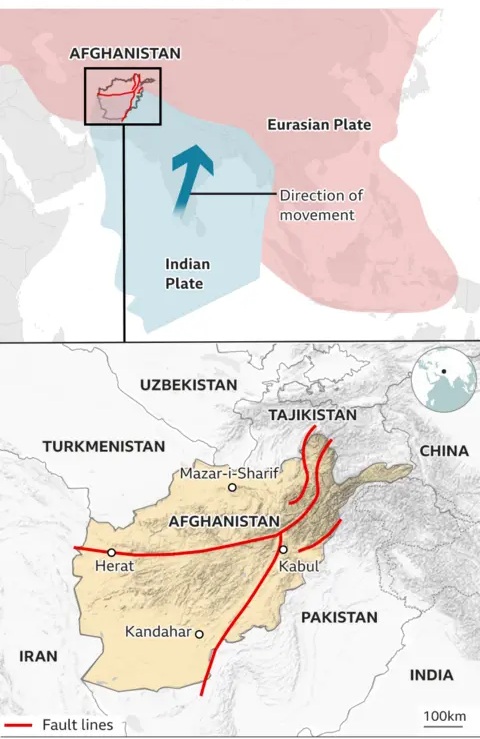
    A powerful earthquake in Afghanistan killed at least 800 people and injured thousands, highlighting the country’s extreme vulnerability to seismic hazards.

    Deadly Earthquake in Afghanistan

    Why is Afghanistan so prone to Earthquakes?

    • Geological Setting: Afghanistan lies in the Hindu Kush mountains, part of the Alpide Belt, the world’s second most seismically active belt after the Circum-Pacific.
    • Tectonic Origin: The Alpide Belt was formed by the closure of the Tethys Ocean, following the collision of the African, Arabian, and Indian Plates with the Eurasian Plate.
    • Ongoing Collision: The Indian Plate’s continued movement into the Eurasian Plate builds mountain ranges (Himalayas, Hindu Kush) and drives strong seismic activity.
    • Seismic Characteristics: Afghanistan experiences both shallow-focus earthquakes (0–70 km depth) causing major destruction and rare deep-focus quakes (up to 200 km) unique to the Hindu Kush.
    • Fault Structures: Major faults occur where the Indian and Eurasian Plates meet, making Afghanistan heavily fractured and highly vulnerable to tremors.

    Where do Afghanistan’s Earthquakes occur?

    • Hindu Kush Region (Northern Afghanistan): Produces both shallow and deep-focus quakes due to the Indian Plate’s lithosphere sinking into the mantle, making it one of the world’s most unique seismic zones.
    • Sulaiman Range (SE Afghanistan & Western Pakistan): Known for shallow, thrust fault quakes, often destructive at the surface.
    • Main Pamir Thrust Zone: Another hotspot for shallow, surface-level earthquakes that cause high damage.
    • Overall Vulnerability: These regions together make Afghanistan one of the most earthquake-prone countries, with repeated deadly events since the 1990s.
    [UPSC 2023] Consider the following statements:

    1. In a seismograph, P waves are recorded earlier than S waves.

    2. In P waves, the individual particles vibrate to and fro in the direction of waves propogation whereas in S waves, the particles vibrate up and down at right angles to the direction of wave propagation.

    Which of the statements given above is/are correct?

    Options: (a)  1 only (b) 2 only (c) Both 1 and 2 * (d) Neither 1 nor 2


  • RTE Act and Minority Educational Institutions

    Why in the News?

    The Supreme Court has referred to a larger Bench the question of whether Minority Educational Institutions (MEIs) are completely exempt from the purview of the Right to Education (RTE) Act, 2009.

    About Minority Educational Institutions (MEIs):

    • Constitutional Basis:
      • Article 30(1) grants religious and linguistic minorities the right to establish and administer educational institutions of their choice.
      • Article 29 protects their cultural and educational rights.
    • Legal Framework:
      • Defined under the National Commission for Minority Educational Institutions (NCMEI) Act, 2004.
      • The NCMEI adjudicates disputes, grants recognition, and safeguards the autonomy of such institutions.
    • Recognized Minority Communities: Muslims, Christians, Sikhs, Buddhists, Jains, and Zoroastrians (Parsis) are notified as minorities by the Government of India.
    • Judicial Principles:
      • In T.M.A. Pai Foundation vs. State of Karnataka (2002), SC held that minority status is determined state-wise, not nationally.
      • Minority institutions can reserve seats for their community and enjoy greater control over administration and recruitment.
    • Purpose and Role:
      • Preserve the cultural, linguistic, and religious heritage of minority groups.
      • Provide quality education with constitutional protection from excessive state interference.

    What is the Right to Education (RTE) Act, 2009?

    • Genesis: Stemming from Unnikrishnan vs. State of Andhra Pradesh (1993), where SC declared education as a Fundamental Right under Article 21.
      • Later given constitutional backing through the 86th Amendment Act (2002), which inserted Article 21A – free and compulsory education for children aged 6–14 years.
    • Enactment: To operationalize Article 21A, Parliament passed the Right of Children to Free and Compulsory Education Act, 2009.
    • Key Provisions:
      • Free and compulsory education for all children aged 6–14 in a neighbourhood school.
      • 25% reservation in private schools for children from disadvantaged groups and weaker sections.
      • No detention, expulsion, or board exams up to Class VIII (amended in 2019 to allow states discretion).
      • Teacher norms: TET (Teachers Eligibility Test) qualification mandatory; ban on private tuitions by teachers.
      • School Management Committees (SMCs): Parents, local authority reps, and teachers oversee school functioning.
      • Curriculum & Standards: Developed by an academic authority (often NCERT/SCERT).
    • Amendments:
      • 2012: Included children with disabilities; exempted minority/religious institutions.
      • 2019: Abolished uniform “no-detention policy,” left to states’ choice.


    [UPSC 2018] Consider the following statements:

    1. As per the Right to Education (RTE) Act, to be eligible for appointment as a teacher in a State, a person would be required to possess the minimum qualification laid down by the concerned State Council of Teacher Education.

    2. As per the RTE Act, for teaching primary classes, a candidate is required to pass a Teacher Eligibility Test conducted in accordance with the National Council of Teacher Education guidelines.

    3. In India, more than 90% of teacher education institutions are directly under the State Governments

    Which of the statements given above is/are correct?

    Options: (a) 1 and 2 (b) 2 only* (c) 1 and 3 (d) 3 only


  • Data shows seas rising faster around Maldives, Lakshadweep than believed

    Introduction

    Sea-level rise is one of the most significant consequences of global warming, threatening ecosystems, economies, and human settlements. In the Indian Ocean, recent findings based on coral microatolls suggest that sea levels began rising rapidly as early as the 1950s, decades before satellite and tide-gauge data had indicated. This challenges existing assumptions in climate change studies and raises critical questions about preparedness for vulnerable island states like Maldives, Lakshadweep, and the Chagos archipelago.

    Coral Microatolls as Natural Recorders of Sea-Level History

    • Unique natural recorders: Coral microatolls are disk-shaped colonies that stop growing upwards once constrained by the lowest tide, making their surface a natural reflection of long-term sea-level change.
    • Longevity and accuracy: They can survive for decades or centuries, providing high-resolution, continuous data.
    • Study site: Research conducted on Mahutigalaa reef, Huvadhoo Atoll (Maldives), measured a Porites microatoll covering 1930–2019.

    Acceleration and Scale of Sea-Level Rise in the Indian Ocean

    • Accelerated rise: Data showed a 0.3 metre increase over 90 years.
    • Rates of rise:
      • 1930–1959: 1–1.84 mm/year
      • 1960–1992: 2.76–4.12 mm/year
      • 1990–2019: 3.91–4.87 mm/year
    • Striking revelation: Sea-level rise began in the late 1950s, not around 1990 as earlier assumed.
    • Cumulative impact: Maldives, Lakshadweep, and Chagos have witnessed 30–40 cm rise in half a century, worsening flooding and erosion risks.

    Climate Variability and Environmental Signals Captured in Corals

    • Climate variability: Slow or interrupted coral growth coincided with El Niño and negative Indian Ocean Dipole (IOD) events.
    • Astronomical influence: The 18.6-year lunar nodal cycle was reflected in the growth bands, showing tidal and sea-level oscillations.
    • Tectonic stability: Critical factor ensuring that coral growth data reflects sea-level change rather than land movement.

    Regional Significance of Findings for the Indian Ocean Basin

    • Above-average warming: The Indian Ocean is heating faster than the global average, amplifying sea-level fluctuations.
    • Strategic gaps: Despite its ecological and geopolitical importance, the central Indian Ocean is one of the least-monitored basins.
    • Regional variations: Coastal areas saw recent acceleration, but the central basin experienced earlier, stronger rise, influenced by shifts in Southern Hemisphere westerlies, ocean heat uptake, and the Intertropical Convergence Zone.

    Vulnerabilities and Adaptation Imperatives for Island Nations

    • Existential threat: Infrastructure and communities are concentrated just above sea level in Maldives and Lakshadweep.
    • Adaptation strategies: Understanding historic timing and magnitude of sea-level rise is vital for coastal planning, disaster preparedness, and climate resilience.
    • Scientific value: Microatolls cannot replace tide gauges or satellites but offer a vital complementary tool to refine projections in data-sparse regions.

    Conclusion

    The discovery that sea-level rise in the Maldives and Lakshadweep began decades earlier than thought is a wake-up call for policymakers and communities. Coral microatolls, silent sentinels of the ocean, have revealed the urgency of accelerating adaptation and resilience measures. As the Indian Ocean warms faster than global averages, the survival of low-lying nations will depend on proactive international cooperation and evidence-based planning.


    Value Addition

    Global Reports and Scientific Frameworks

    • IPCC AR6 (2021–22): Predicts global mean sea level rise of 0.28–1.01 m by 2100, depending on emission scenarios.
    • World Meteorological Organization (WMO): State of the Global Climate 2023: Confirms Indian Ocean warming faster than the global average, intensifying regional sea-level anomalies.
    • UNFCCC & Paris Agreement: Commitments to limit warming below 2°C directly shape adaptation strategies for vulnerable island nations.

    Case Studies for Enrichment

    • Maldives: Declared intent to become a carbon-neutral nation by 2030; adaptation measures include artificial islands and elevated infrastructure.
    • Kiribati (Pacific Island): Purchased land in Fiji to relocate populations – showcases climate migration.
    • Lakshadweep Islands: Reports of shoreline erosion, freshwater lens salinity, and threat to tourism livelihoods.

    Scientific Concepts for Enrichment

    • Thermal Expansion: Ocean water expands as it warms, contributing ~50% to global sea-level rise.
    • Cryosphere–Ocean Linkages: Melting of Greenland & Antarctic ice sheets accelerates rise beyond thermal expansion.
    • Lunar Nodal Cycle (18.6 years): Natural oscillation in tides influencing local sea-level variability, as confirmed in microatoll data.

    PYQ Relevance

    [UPSC 2023] The Intergovernmental Panel on Climate Change (IPCC) has predicted a global sea level rise of about one metre by AD 2100. What would be its impact in India and the other countries in the Indian Ocean region?

    Linkage: The article’s findings on coral microatolls show that sea-level rise in the Maldives, Lakshadweep, and Chagos began as early as the 1950s, much earlier than assumed. This reinforces IPCC projections of accelerated rise, highlighting existential risks for low-lying islands. For India and the wider Indian Ocean region, the impacts include intensified coastal erosion, loss of habitats, and the need for urgent adaptation strategies.

  • NGO ‘Educate Girls’ wins Ramon Magsaysay Award 2025

    Why in the News?

    The Ramon Magsaysay Award 2025 has been awarded to Educate Girls, an Indian NGO working to promote girls’ education in rural and disadvantaged regions.

    Other winners include:

    • Shaahina Ali (Maldives): A noted environmental activist.
    • Fr. Flaviano Antonio L. Villanueva (Philippines): A human rights defender, critic of Duterte’s drug war.

    About Educate Girls:

    • Founded as: Foundation to Educate Girls Globally; CEO: Gayatri Nair Lobo.
    • Mission: Address gender inequality in education and uplift rural communities through girls’ schooling.
    • Impact:
      • Operates in India’s most rural and remote regions.
      • Employs community workers (preraks, team balikas) to mobilise enrollment and retention.
      • Creates ripple effects: education empowers girls → uplifts families → strengthens communities.
    • Significance: It is the first Indian organisation to win the award since its inception in 1958.

    About Ramon Magsaysay Award:

    • “Nobel Prize of Asia”: Awarded annually since 1958.
    • Purpose: Celebrate “greatness of spirit and transformative leadership” in Asia.
    • Recognition: Individuals/organisations showing integrity in governance, service, and idealism in democracy.
    • Origin:
      • Established April 1957 by Rockefeller Brothers Fund trustees with support of the Philippines govt.
      • Named in honour of Ramon Magsaysay, former Philippine President (1953–57), noted for administrative and military leadership.
    • Original Categories (1958–2008): Govt Service, Public Service, Community Leadership, Journalism & Arts, Peace & International Understanding, and later Emergent Leadership (2001).
    • Since 2009: Fixed categories dropped (except Emergent Leadership), award now honours diverse forms of excellence.
    • Notable Indian Recipients:
      • Vinoba Bhave (1958): Bhoodan movement.
      • Mother Teresa (1962): humanitarian service.
      • Satyajit Ray (1967): cinema.
      • M.S. Subbulakshmi (1974): music.
      • Arvind Kejriwal (2006): anti-corruption work.
      • Ravish Kumar (2019): journalism.
      • Sonam Wangchuk (2018): educational innovation.
      • Educate Girls (2025): first Indian organisation to be honoured.
    [UPSC 2004] Sandeep Pandey, the winner of Ramon Magsaysay Award, is mainly an activist in:

    Options: (a) a campaigner for urban sanitation (b) an anti-child labour activist (c) Environmental protection (d) Education and livelihood projects for Dalits*