💥Join UPSC 2027,2028 Mentorship (August Batch) + XFactor Notes & Microthemes PDF

Distribution: weekly

  • Do doctors need a Central protection Act?     

    Why in the News?

    Resident doctors across India are on strike, demanding safety laws after a young doctor was tragically raped and murdered at R.G. Kar Medical College in Kolkata on August 9.

    Why are Healthcare Workers Protesting?

    • Response to Violence: The protests were triggered by the brutal rape and murder of a young doctor at R.G. Kar Medical College and Hospital in Kolkata on August 9, 2024.
    • Demand for Safety: Healthcare workers are demanding laws and measures that ensure their safety while on duty.
    • Historical Context: Violence against healthcare workers is not a new issue in India. Previous incidents, such as the case of Aruna Shanbaug, a nurse who was sexually assaulted in 1973, underscore a long-standing pattern of violence in healthcare settings.

    Working Conditions of Junior Doctors, Interns, and Nurses

    • Poor Working Environment: Junior doctors, interns, and nurses often work in ill-lit and poorly secured hospital environments.
    • Long Shifts and Exhaustion: Many healthcare workers, including the victim of the recent incident, are subjected to excessively long shifts—in this case, a 36-hour duty shift—without adequate rest or safe spaces to recuperate.
    • Mental Health Concerns: The stressful working conditions, combined with the threat of violence, have raised significant concerns about the mental health and well-being of healthcare workers.

    Key Demands of the Protesters

    • Central Protection Act: The Indian Medical Association (IMA) is advocating for a Central protection law specifically for healthcare workers, similar to measures in other countries that classify assaults on medical staff as serious offenses.
    • Enhanced Security Measures: Protesters are calling for hospital security protocols that match those of airports, including the installation of CCTV cameras, deployment of security personnel, and improved lighting in hospital corridors and wards.
    • Safe Work Environment: There is a demand for immediate systemic reforms to improve working conditions, including better security arrangements and the establishment of healthcare facilities as safe zones.
    • Accountability and Justice: The IMA has requested a thorough investigation into incidents of violence against healthcare workers, with a focus on timely and professional handling of cases and ensuring that perpetrators face exemplary punishment.
      • Government Response: Following the protests, the Ministry of Health and Family Welfare issued an order mandating that any violence against healthcare workers must be reported and acted upon swiftly, with institutional FIRs to be filed within six hours of an incident.

    Sole responsible for the safety of Health workers:

    • State Governments: Health and law enforcement are primarily state subjects in India, meaning that state governments are primarily responsible for ensuring the safety of healthcare professionals. They are tasked with implementing laws, providing adequate security in hospitals, and ensuring a safe working environment for medical staff.
    • Central Government: The central government plays a role in formulating national policies and frameworks that support the safety of healthcare workers. 
      • Recent initiatives include the Ministry of Health and Family Welfare’s order mandating the filing of FIRs within six hours of any violence against healthcare workers, indicating a push for accountability and swift action.

    Way forward: 

    • Implement a Central Protection Law for Healthcare Workers: The government should fast-track the enactment of a Central law specifically designed to protect healthcare workers from violence.
    • Improve Working Conditions and Mental Health Support: Hospitals should prioritize creating safe and well-secured environments for healthcare workers, including reasonable shift hours, adequate rest periods, mental health support, and robust security protocols to prevent future incidents of violence.
  • Zoopharmacognosy: the study of how animals self-medicate

    Why in the News?

    Researchers highlighted the zoopharmacognosy (practice of self-medication) by a Sumatran orangutan using the plant Fibraurea tinctoria to treat a facial wound.

    What is Zoopharmacognosy?

    • Zoopharmacognosy is the study of how animals use natural substances like plants, soils, and insects to treat their own illnesses. 
    • The term was coined by ecologist D.H. Janzen from the University of Pennsylvania.
    • It shows that animals have an instinctive ability to find and use natural remedies. 

    Key Studies and Observations

    • Neanderthals: In 2012, a Nature publication found that Neanderthals in Northern Spain used plants like yarrow and chamomile to treat infections.

    Other Animal Species:

    • Primates: Chimpanzees eat bitter leaves, like Vernonia amygdalina, to get rid of intestinal worms.
      • Pregnant lemurs nibbling on tamarind leaves to aid milk production.
    • Reindeer: Reindeer eat mushrooms like Amanita muscaria, possibly to fight off parasites.
    • Birds: Starlings line their nests with antimicrobial plants to protect their young from diseases.
    • Elephants: Pregnant elephants in Kenya eat specific plants to help induce labor.
    • Dogs: Dogs chew grass and then vomit to clear their stomachs of infections.

    PYQ:

    [2019] Recently, there was a growing awareness in our country about the importance of Himalayan nettle (Girardinia diversifolia) because it is found to be a sustainable source of:

    (a) Anti-malarial drug

    (b) Biodiesel

    (c) Pulp for paper industry

    (d) Textile fibre

  • [pib] REACHOUT Scheme

    Why in the News?

    The Indian student team, supported by the REACHOUT (Research, Education, Training and Outreach) scheme, achieved remarkable success at the 17th edition of the International Earth Sciences Olympiad (IESO) held in Beijing, China.

    What is the REACHOUT Scheme?

    • It is an initiative by the Ministry of Earth Sciences (MoES) under the broader PRITHVI (PRITHvi Vigyan) program. 
    • The scheme aims to enhance the understanding and dissemination of Earth system sciences through research, education, and outreach activities.

    About the International Earth Sciences Olympiad (IESO)

    • The IESO was established in 2003 during the International Geoscience Education Organization Council Meeting in Calgary, Canada.
    • The competition focuses on promoting interest in earth system sciences, particularly in addressing climate change, environmental challenges, and natural disasters.

    India’s Participation:

    • India has participated in the IESO since 2007 and hosted the 10th edition in Mysore.
    • The Indian National Earth Science Olympiad (INESO) serves as a national-level prelude to the IESO, held across schools in India.
    • Top-performing students from INESO represent India at the IESO, with support from MoES and the Geological Society of India.

    PYQ:

    [2019] Atal Innovation Mission is set up under the

    (a) Department of Science and Technology

    (b) Ministry of Labour and Employment

    (c) NITI Aayog

    (d) Ministry of Skill Development and Entrepreneurship

  • In news: Namdhari Sect

    Why in the News?

    Recently, followers of the two rival groups within the Namdhari religious sect clashed violently in Haryana.

    About Namdhari Sect

    Details
    Founder Satguru Ram Singh in 1857 (on Baisakhi)

    Also known as Kuka Movement

    Primary Beliefs Belief in a living human Guru; Also known as Kuka/Kukaism
    – Guru Granth Sahib is considered the Supreme Gurbani
    Strict vegetarianism and teetotalism (alcohol is forbidden)
    Key Practices – Wearing white attire as a sign of mourning
    Rejection of caste distinctions
    – Promotion of widow remarriage
    Non-violent resistance Cow is the sacred animal
    Headquarters Bhaini Sahib, Ludhiana, Punjab
    Global Presence Deras across Punjab and Haryana
    – Presence in countries such as the UK, Canada, and Kenya
    Role in Independence – Early opposition to British rule
    – Adoption of non-cooperation and boycott of British goods
    – Victims of severe British reprisals
    Notable Historical Event Malerkotla Massacre (1872) – 66 Namdharis executed by the British
    Leadership Succession – After Ram Singh: His brother Satguru Hari Singh
    – Later Successors: Satguru Partap Singh, Satguru Jagjit Singh
    – Current leaders: Uday Singh and Dalip Singh (factional dispute)


    PYQ:

    [2013] Consider the following Bhakti Saints :

    1. Dadu Dayal

    2. Guru Nanak

    3. Tyagaraja

    Who among the above was/were preaching when the Lodi dynasty fell and Babur took over?

    (a) 1 and 3

    (b) 2 only

    (c) 2 and 3

    (d) 1 and 2

  • Lok Sabha Speaker constitutes 6 new Parliamentary Committees 

    Why in the News?

    Lok Sabha Speaker has constituted six new Parliamentary Committees, for a tenure of 1year:

    Origin Composition Functions
    Public Accounts Committee (PAC) Established in 1921 under the Government of India Act, 1919
    • 22 members: 15 Lok Sabha + 7 Rajya Sabha;
    • Chairman from the Opposition,
    • Appointed by the LS Speaker.
    Examines public expenditure, scrutinizes CAG reports, and ensures efficient use of public funds.
    Committee on Estimates Traces back to 1921; reconstituted in 1950 (recommended by John Mathai)
    • 30 members,
    • All from Lok Sabha;
    • Elected annually through proportional representation.
    • Minister CANNOT be a member.
    Examines budget estimates, suggests economic efficiencies, and recommends alternative policies.
    Committee on Public Undertakings Established in 1964 based on the Krishna Menon Committee
    • 22 members: 15 Lok Sabha + 7 Rajya Sabha;
    • Chairman appointed by the Speaker,
    • Chosen from Lok Sabha members
    Examines accounts and reports of PSUs, and provides recommendations without interfering in operations.
    Committee on Welfare of OBCs The committee was constituted in June 2012 It comprises 30 members, with 20 from the Lok Sabha and 10 from the Rajya Sabha Focuses on the implementation of policies for OBC welfare, evaluates reservations, and suggests improvements.
    Committee on Welfare of SC/ST N/A The committee consists of 30 members, with 20 elected from the Lok Sabha and 10 from the Rajya Sabha. Ensures implementation of safeguards for SCs and STs, reviews welfare programs, and suggests enhancements.
    Joint Committee on Office of Profit Joint Committee on Office of Profit was established by the Lok Sabha on July 23, 2019 15 members; 10 Lok + 5 from Rajya Sabha. Examines cases of MPs/MLAs holding offices of profit, determine qualification, and maintains legislative integrity.


    PYQ:

    [2018] With reference to the Parliament of India, which of the following Parliamentary Committees scrutinizes and reports to the house whether the powers to make regulations, rules, sub-rules, by-laws, etc., conferred by the Constitution or delegated by the Parliament are being properly exercised by the Executive within the scope of such delegation?

    (a) Committee on Government Assurances

    (b) Committee on Subordinate Legislation

    (c) Rules Committee

    (d) Business Advisory Committee

  • What are Deceptive Dark Patterns?

    Why in the News?

    The Advertising Standards Council of India (ASCI) has released a report highlighting the use of deceptive dark patterns in Indian apps.

    Key highlights of the ASCI Study:

    • The ASCI report aims to raise awareness among marketers and designers about the ethical implications of these deceptive patterns.
    • The study analyzed 12,000 screens across 53 leading Indian apps in 9 different industries.
    • The report identified the use of one or more of 12 deceptive patterns in most of these apps.

    What are Deceptive Dark Patterns?

    • These practices use elements of digital choice architecture, particularly in user interfaces.
    • The goal is to manipulate or impair consumer autonomy, decision-making, or choice.
    • These patterns are often subtle, directing users toward decisions that may not align with their true preferences.
    • As a result, they compromise the ability of users to make informed choices.

    Examples of Deceptive Patterns:

    Description Example
    Interface Interference Directs users to specific choices using visual tricks. Highlighting preferred options with bright colors.
    Confirm Shaming Uses guilt to push users toward certain actions. Options like “Upgrade now” vs. “I don’t want a smarter software.”
    Basket Sneaking Adds unwanted items to cart without consent. Automatically adding a donation to the shopping cart.
    Privacy Deception Tricks users into sharing more personal data. Requiring unnecessary personal info during signup.
    Drip Pricing Reveals extra fees late in the purchase process. Adding hidden charges at checkout.
    Subscription Trap Leads to unintended subscriptions without clear notice. “Free trial” that auto-renews to a paid plan.

    Importance of Ethical Design

    • Raising Awareness: Marketers are encouraged to study the guidelines issued by ASCI and the Department of Consumer Affairs to avoid unethical practices.
    • Conscious Patterns Website: Marketers can use resources like the Conscious Patterns website to test their apps and obtain a “conscious score” to ensure that their apps balance business needs with user interests.
    • Digital Responsibility: As the digital world evolves, ethical design practices are crucial for building and maintaining trust with customers.
    • Marketer and Designer Roles: Both marketers and app designers need to be vigilant about pursuing ethical design to create safe and trustworthy online environments.

    PYQ

    [2015] What are the impediments in marketing and supply chain management in developing the food processing industry in India? Can e-commerce help in overcoming this bottleneck?

  • Egg, sperm donors have no parental right on child: Bombay HC held

    Why in the News?

    On Tuesday, the Bombay High Court affirmed that sperm or egg donors cannot claim biological parenthood or legal rights over a child born using their gametes.

    About the Present Case and Rival Contentions

    • Background of the Case: The Bombay High Court ruled on a custody dispute involving twin girls born through altruistic surrogacy. The mother, a 42-year-old woman, sought visitation rights after her estranged husband took the children to live with him and her younger sister, who was the egg donor.
    Note: Altruistic surrogacy is a type of surrogacy arrangement where the surrogate mother carries a pregnancy for intended parents without receiving any monetary compensation for her services, aside from reimbursement for medical and pregnancy-related expenses.


    • Family Dynamics: The egg donor is the younger sister of the mother and had donated her eggs to help her sister and brother-in-law conceive. After the egg donation, the sister faced a tragic accident that resulted in the loss of her husband and daughter, complicating the family dynamics further.
    • Rival Claims: The mother argued that her daughters are legitimate children born within wedlock (being married), asserting her rights as the biological mother. In contrast, the estranged husband claimed that the egg donor had legitimate rights over the children, arguing that she should be recognized as a biological parent.
    Legal Framework: The case was governed by the 2005 National Guidelines on Assisted Reproductive Technologies (ART) since the surrogacy agreement was signed before the enactment of the Surrogacy (Regulation) Act, 2021. The guidelines say that both the donor and surrogate give up all rights as parents.

    Other key provisions of the Surrogacy (Regulation) Act, 2021

    • The Surrogacy (Regulation) Act, 2021 permits only altruistic surrogacy in India, where the surrogate mother cannot receive any monetary compensation beyond reimbursement for medical expenses and insurance coverage.
    • Commercial surrogacy, which involves payment beyond medical costs, is strictly prohibited.
    • Eligibility Criteria: Intended parents must be a legally married couple, with the female partner aged between 23 and 50 years and the male partner between 26 and 55 years. They must not have any biological children from previous marriages or through surrogacy. The surrogate must be married and have at least one child of her own.

    What the Bombay High Court Ruled

    • No Parental Rights for Egg Donors: The Bombay High Court ruled that an egg donor does not have legal rights as a biological parent. The court emphasised that while the egg donor may be considered a genetic mother, she cannot claim parental rights over the children born through surrogacy.
    • Recognition of Legal Parents: The court affirmed that the twin girls are the daughters of the petitioner (the mother) and her estranged husband, as they were born from their wedlock with their consent. The ruling highlighted that the couple signed the surrogacy agreement, establishing them as the intending parents.
    • Legal Precedent: The ruling clarified the legal standing of sperm and egg donors in surrogacy arrangements, reinforcing that they do not retain any parental rights or duties in relation to the child, as per the existing guidelines.

    Conclusion: The Bombay High Court confirmed that egg donors have no parental rights. The ruling reaffirmed that legal parentage lies with the intending parents as per surrogacy guidelines and existing laws.

  • [pib] Amendments to the Foreign Exchange Management (Non-debt Instruments) Rules, 2019 

    Why in the News?

    The Finance Ministry has issued a notification amending the Foreign Exchange Management (Non-debt Instruments) Rules, 2019, to simplify Foreign Direct Investment (FDI) rules.

    Key amendments made by the Finance Ministry:

    Details
    Cross-Border Share Swaps Simplifies the process for Indian companies to engage in cross-border share swaps with foreign companies.
    Clarity on Downstream Investments Provides clearer guidelines on the treatment of downstream investments by OCI-owned entities on a non-repatriation basis, aligning them with NRI-owned entities.
    FDI in White Label ATMs (WLAs) Allows FDI in White Label ATMs to increase the geographical spread of ATMs, particularly in semi-urban and rural areas.
    Standardization of ‘Control’ Definition Standardizes the definition of ‘control’ to ensure consistency with other Acts and laws.
    Harmonization of ‘Startup Company’ Definition Aligns the definition of ‘startup company’ with the Government of India’s notification G.S.R. 127 (E) dated February 19, 2019.

    About The Foreign Exchange Management (Non-debt Instruments) Rules, 2019 

    • These rules govern foreign investment in India in non-debt instruments like equity shares, mutual funds, and real estate (excluding agricultural land).
    • These rules, effective from October 17, 2019, were issued under FEMA, 1999 (Foreign Exchange Management Act).

    It covers the following key aspects:

    • FDI Regulation: Specifies guidelines for foreign direct investment (FDI) in various sectors, including sectoral caps and conditions.
    • Investment Vehicles: Allows investment through entities like Alternative Investment Funds (AIFs), Real Estate Investment Trusts (REITs), and mutual funds.
    • Repatriation: Provides a framework for repatriation of profits, dividends, and capital by foreign investors.
    • Reporting: Mandates detailed reporting for companies receiving foreign investments.
    • Sectoral Caps and Conditions: Sets sectoral limits and approval requirements for foreign investment, with some sectors requiring government approval.
    • Prohibited Sectors: Prohibits foreign investment in sectors like lottery, gambling, chit funds, and agricultural land.
    • Transfer of Shares: Outlines guidelines for share transfer between residents and non-residents, ensuring compliance with regulatory conditions.

    PYQ:

    [2020] With reference to Foreign Direct Investment in India, which one of the following is considered its major characteristic?

    (a) It is the investment through capital instruments essentially in a listed company.

    (b) It is a largely non-debt creating capital flow.

    (c) It is the investment which involves debt-servicing.

    (d) It is the investment made by foreign institutional investors in the Government securities.

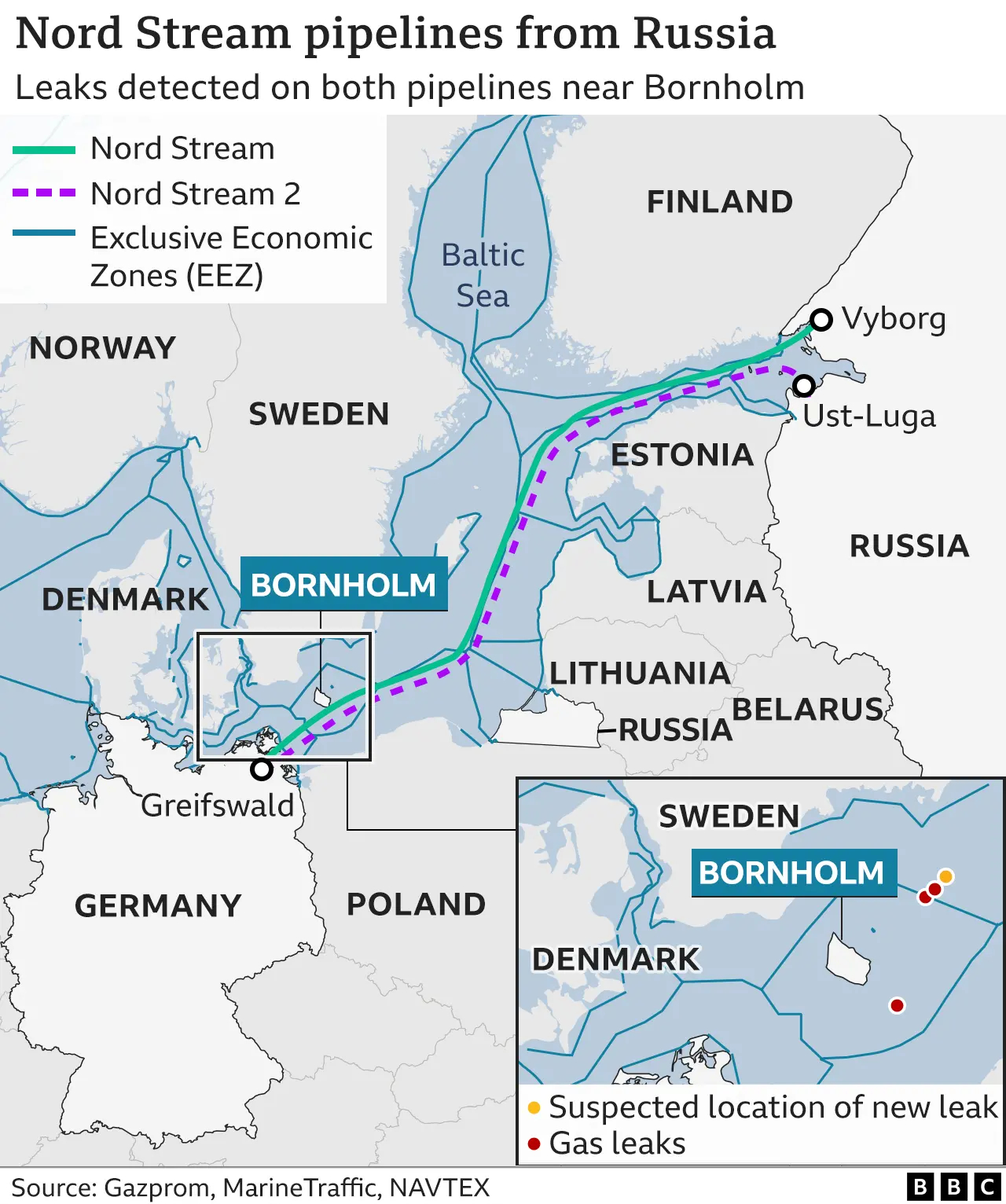
  • Nord Stream Gas Pipeline

    Why in the News?

    The Wall Street Journal has reported that a group of Ukrainian patriots carried out the sabotage of the undersea pipelines(Nord Stream pipelines) in sep,2022 that supplied gas from Russia to Europe. 

    About Nord Stream Pipeline:

    Details
    Overview
    • Natural gas pipeline under the Baltic Sea.
    • Connects Russia and Germany.
    Purpose Built to transport natural gas from Russia to Europe, bypassing traditional transit countries like Ukraine.
    Completion
    1. Nord Stream 1: Completed in 2011, 1,224 km long, running from Vyborg, Russia to Lubmin, Germany. 
    2. Nord Stream 2: Completed in 2012, running from Ust-Luga, Russia to Lubmin, Germany, with a capacity of 55 billion cubic meters per year.

    Significance of the Pipelines

    (A) For Europe:

    • Provides a steady and cost-effective supply of natural gas, essential for heating, power, and industry which ensures stable gas prices. If reduced supply from Russia could lead to price hikes and domestic unrest in europe.

    (B) For Russia:

    • Revenue: Critical for Russia, with around 40% of its budget coming from gas and oil sales.
    • Geopolitical Influence: Strengthens Russia’s influence over Europe’s energy markets by securing its position as a major gas supplier.
  • [pib] Oeko-Tex Certification for Eri Silk

    Why in the News?

    The North Eastern Handicrafts and Handlooms Development Corporation (NEHHDC), under the Ministry of Development of North Eastern Region (DoNER), has achieved the prestigious Oeko-Tex certification for its Eri Silk.  

    What is Oeko-Tex Certification?

     Details
    EstablishmentFounded in 1992 by the Oeko-Tex Association.

    Comprises 18 independent textile research and testing institutes.

    Certification SystemIndependent testing and certification for textile safety and environmental standards.
    Key StandardsSTANDARD 100: Tests textiles for harmful substances.
    MADE IN GREEN: Ensures environmentally friendly and socially responsible production.
    LEATHER STANDARD: For leather products, free from harmful chemicals.
    STeP: Certification for sustainable textile production facilities.
    ECO PASSPORT: Certifies safe chemicals used in textiles.
    DETOX TO ZERO: Supports elimination of hazardous chemicals in production.
    Testing ProcessProducts tested for harmful substances like heavy metals, formaldehyde, azo dyes, etc.
    Global RecognitionTrusted worldwide for ensuring product safety, environmental friendliness, and social responsibility.
    BenefitsConsumers: Assurance of safe, chemical-free products.
    Manufacturers: Access to global markets, improved brand reputation.
    Environment: Promotes sustainable and eco-friendly production.
    UsageFound on clothing, home textiles, bedding, footwear, and more.

    About Eri Silk 

    • Eri Silk is the world’s only vegan silk, where the moth naturally exits the cocoon, making it cruelty-free.
      • Unlike conventional silk production, where cocoons are boiled to extract the silk filament.
    • It is also known as Ahimsa Silk.
    • It is primarily produced in the North-Eastern states of India, especially Assam; also found in Meghalaya, Nagaland, Manipur, and other states.
    • Its production is deeply rooted in the traditions of tribal communities in Assam and adjacent hill areas.

    Significant Features of Eri Silk:

    • Production Process: Known as Ericulture; involves rearing silkworms on castor plants; the silk is spun rather than reeled due to the naturally pierced cocoons.
    • Eco-Friendly: Requires minimal chemicals and water; only 20 litters of water needed to convert 1 kg of raw Eri fiber into yarn.
    • Unique Properties: Isothermal (temperature-regulating), anti-fungal, washable, durable, and less shiny than other silks.

    PYQ:

    [2013] What is an FRP composite material? How are they manufactured? Discuss their application in aviation and automobile industries. (100 words)