On July 31, 1940, Indian revolutionary leader Udham Singh was executed at the Pentonville prison in London for killing Michael O’Dwyer, the former lieutenant governor of Punjab.
Singh was born in Sunam in Punjab’s Sangrur district in 1899.
Political Activism
Became associated with the Ghadar Party while in the US, which was founded by Sohan Singh Bhakna in 1913 and headquartered in California.
Purpose and Actions
In 1934, Singh travelled to London to assassinate Michael O’Dwyer, the former Lieutenant Governor of Punjab during the 1919 Jallianwala Bagh massacre.
Reason for Targeting O’Dwyer
O’Dwyer had ordered Brigadier Reginald Dyer to Amritsar before the massacre, fearing a second Indian mutiny due to Hindu-Muslim unity and demonstrations.
Assassination of O’Dwyer
On March 13, 1940, Singh shot O’Dwyer at a meeting in Caxton Hall, London.
Arrest and Execution
Arrested immediately, held in Brixton prison, sentenced to death, and hanged on July 31, 1940, at Pentonville Prison.
Legacy and Recognition
Regarded as a hero for avenging the Jallianwala Bagh massacre.
Gandhi termed it an “act of insanity”.
He symbolized Hindu-Sikh-Muslim unity by adopting the name ‘RamMohamed Singh Azad’ during his trial.
Posthumous Honors
His remains were returned to India in 1974 and cremated in his village in Sunam.
His statue was installed at Jallianwala Bagh in 2018;
Udham Singh Nagar district in Uttarakhand is named after him.
PYQ:
[2014] The Ghadr (Ghadar) was a:
(a) Revolutionary association of Indians with headquarters at San Francisco.
(b) Nationalist organization operating from Singapore
(c) Militant organization with headquarters at Berlin
(d) Communist movement for India’s freedom with head-quarters at Tashkent
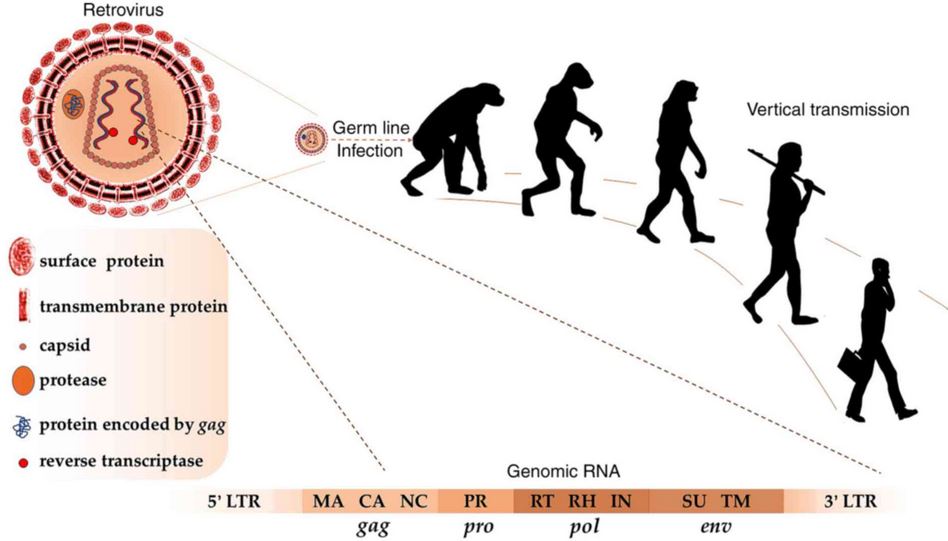
Research suggests that around 8% of the human genome is composed of Endogenous Retroviruses (ERVs) often referred to as ‘zombie’ regions.
Retroviruses and Human Genome Integration
Most viruses can’t affect the human genome, but retroviruses are an exception.
Retroviruses can integrate and reshape the genomes of their hosts.
They have an RNA genome and can reverse-transcribe it to DNA, inserting it into the host’s genome.
This process is facilitated by the enzyme reverse transcriptase.
Discovered by Howard Temin and David Baltimore in 1971, this enzyme converts the virus’s RNA into a corresponding DNA sequence.
Historical Discoveries:
Viral causes of cancer were known even before the mechanism was understood.
In 1908, Oluf Bang and Vilhelm Ellermann discovered the viral cause of chicken leukosis.
In 1957, Ludwik Gross isolated a leukaemia-causing virus in mice.
What are Endogenous Retroviruses (ERVs)?
ERVs are remnants of ancient viral infections that have integrated into the genome of the host species.
When these retroviruses infect germ cells (sperm or egg cells), their genetic material can be passed down to the next generation, becoming a permanent part of the host’s DNA.
Zombie Regions:
They refer to inactive viral sequences within the genomethat no longer produce functional viruses but remain as embedded genetic fossils.
These regions are a result of retrovirus integration that has lost its ability to replicate and produce proteins, yet they persist in the host’s DNA.
Evolutionary Significance of ERVs:
In the life cycle of a retrovirus, reverse-transcribed DNA is integrated into the host’s DNA with the help of integrase.
The viral DNA, called a provirus, hijacks human cells, turning them into virus-making factories.
Over tens of thousands of years, many retroviruses have left genomic elementsin human genome, contributing to evolutionary processes.
Example:
Syncytins are genes thought to have descended from ERVs and are crucial for placental development. These genes originally came from viruses and were acquired during mammalian evolution.
Their Contribution to Human Biology
ERVs are highly expressed in the placenta and may influence conditions like preeclampsia.
Researchers found that a particular RNA derived from an ERV is dysregulated in early-onset preeclampsia, suggesting it could be used as a biomarker for the condition.
ERVs play a role in cell-type differentiationduringembryo development.
A protein called MERVL-gag is derived from an ERV. This transition is crucial for producing pluripotent stem cells capable of forming different cell types.
Researchers also found that a human ERV element LTR10affects tumour formation in colorectal cancer.
PYQ:
[2021] Consider the following statements :
1. Adenoviruses have single-stranded DNA genomes whereas retroviruses have double-stranded DNA genomes.
2. Common cold is sometime caused by an adenovirus whereas AIDS is caused by a retrovirus.
Which of the statements given above is/are correct?
Finance Minister Nirmala Sitharaman’s decision to eliminate indexation for calculating long-term capital gains (LTCG) tax in the Union Budget has received a lukewarm response from stakeholders.
Changes in the LTCG Regime
The new LTCG regime removes the indexation benefit for property, gold, and other unlisted assets.
The LTCG tax rate is reduced from 20% to 12.5%.
For assets purchased before 2001, the fair market value as of April 1, 2001, is considered the cost of acquisition.
What is long-term capital gains (LTCG) tax?
LTCG refers to the profit realized from the sale of an asset that has been held for more than one year. This includes various types of assets such as stocks, bonds, real estate, and mutual funds.
If an asset is sold before this holding period, the gains are classified as short-term capital gains (STCG) and are taxed at different rates.
Why has the Union Finance Minister done away with indexation for computing long-term capital gains (LTCG) tax?
Simplification of Tax Computation: The Finance Minister proposed the change to “ease computation of capital gains for the taxpayer and tax administration.” The intention is to simplify the tax process.
Uniform Tax Rate: Long-term gains on all financial and non-financial assets would now be taxed at a flat rate of 12.5%, replacing the previous tiered structure.
High real estate return: The Income Tax department believes that the real estate returns (12-16% per annum) are higher than indexation for inflation (4-5%). Thus, it predicts “substantial tax savings” for a “vast majority” of taxpayers under the new system.
What is indexation?
Indexation is a mechanism used to adjust the original purchase price of an asset to account for inflation. It helps in calculating the real gains and prevents inflation from inflating the tax liability. The adjusted purchase price is called the indexed cost of acquisition.
How does Indexation help in Tax Savings?
Adjusts the purchase price for inflation: Indexation increases the original purchase price of an asset to account for inflation between the time of purchase and sale. This results in a lower taxable capital gain.
Reduces the taxable capital gains: By revising the purchase price upwards using the Cost Inflation Index, indexation reduces the difference between the sale price and purchase price. This lowers the taxable capital gains amount.
Leads to lower tax liability: With a reduced taxable capital gain, the tax payable on it also decreases. For example, on a ₹48 lakh gain from selling a house, indexation can bring down the taxable gain to ₹28.6 lakh, saving ₹4,264 in tax (assuming 20% LTCG rate).
What has been the feedback from corporates and industry regarding the move?
Concerns Over Increased Tax Liability: Many stakeholders expressed apprehension that the removal of indexation would lead to higher tax obligations for ordinary investors, particularly in the real estate sector.
There are fears that this might encourage the undervaluation of properties to reduce capital gains tax and potentially increase black money transactions in real estate.
Mixed Reactions from Realty Players: While some real estate developers and consultants indicated that the removal of indexation might not significantly impact demand and prices, especially for primary home buyers, they noted that high-end properties could see a drop in demand.
Some developers viewed the changes positively and said that the lowered tax rate (from 20% to 12.5%) could make real estate a more attractive long-term investment.
Government Justifications and Clarifications: The government has argued that the new tax regime simplifies the capital gains tax structure and is beneficial for most taxpayers.
Way forward:
Transitional Provisions: Govt. should implement transitional provisions for existing investments to ease the shift from the old system to the new one.
Strengthen the monitoring system: Need to strengthen monitoring mechanisms to prevent the undervaluation of properties and reduce black money transactions.
Mains PYQ:
Q Comment on the important changes introduced in respect of the Long-term Capital Gains Tax (LCGT) and Dividend Distribution Tax (DDT) in the Union Budget for 2018-2019. (UPSC IAS/2018)
Mains: Q1 Has digital illiteracy, particularly in rural areas, coupled with lack of Information and Communication Technology (ICT) accessibility hindered socio-economic development? Examine with justification. (UPSC IAS/2021)
Q2 What do understand by the concept “freedom of speech and expression”? Does it cover hate speech also? Why do films in India stand on a slightly different plane from other forms of expression? Discuss. (UPSC IAS/2014)
Note4Students:
Mains: Issues related to Broadcasting Regulation Bill, 2024;
Mentor comments: Could Dhruv Rathee and Ravish Kumar’s YouTube videos have swayed voter preferences in the 2024 general election? This question arises in the context of a Union government that anticipated a return to power with a larger majority but instead was re-elected as a coalition with a reduced mandate. Recognizing a threat to its authority, the government seeks to undermine digital creators through the Broadcasting Regulation Bill, 2024. Data from two CSDS-Lokniti surveys reveal that 29% of voters consume political content daily on digital platforms, suggesting a shift towards a “content election” where digital media increasingly challenges traditional television news.
Let’s learn!
__
Why in the News?
The Broadcasting Bill, 2024 exhibits clear characteristics of a digital authoritarianism initiative aimed at controlling online narratives.
Recent changes Convergence of IT and broadcasting ministries:
Ashwini Vaishnaw remains the Minister for Electronics and Information Technology (MeitY) and has also been given the Ministry of Information and Broadcasting (MIB) portfolio. This reflects a growing convergence and interest of these ministries in controlling digital content.
Key highlights of the Bill
Expanded Definition of Broadcasters: The Bill classifies individual commentators as “Digital News Broadcasters” and content creators as “OTT Broadcasters.”
This allows the Ministry of Information and Broadcasting (MIB) to set and modify thresholds for subscribers or users, mandating registration for those who meet these criteria, thus significantly broadening government oversight over digital media.
New Compliance Requirements: The Bill introduces additional compliance measures for online platforms, establishing a new safe harbor regime separate from the Information Technology Act, 2000.
It enables the MIB to enforce censorship and require platforms like YouTube to implement specific compliance measures entities.
Expanding legal powers for censorship: A formal legal basis for this censorial partnership was established through the IT Rules, 2021 which expanded MeitY’s powers, including a traceability mandate compromising end-to-end encryption.
The rules also granted the MIB new powers to require registration and block digital news media and online entertainment streaming apps. The MIB has publicly disclosed enforcement action only when it aligns with nationalistic themes fitting its political interests.
Creation of an Autocratic Weapon for Digital Censorship
Expansion of IT Rules: Following the inadequacies of the IT Rules, 2021, the Union Government expanded its powers twice in 2023, first by establishing Grievance Appellate Committees (GACs) to handle appeals regarding digital content and then by amending the IT Rules to allow the government to remove content deemed “fake, false, and misleading.“
Broadcasting Services (Regulation) Bill, 2023: The introduction of this bill is seen as a significant step towards increased government control over digital content.
If passed, it would require online creators, such as those on YouTube and Instagram, to register and operate under the Ministry of Information and Broadcasting (MIB), effectively granting the government unprecedented authority over digital expression.
Concerns Over Transparency and Accountability: Critics argue that the Broadcasting Bill, 2023, and its subsequent version, the Broadcasting Services (Regulation) Bill, 2024, would enhance government powers while reducing transparency and accountability. This could lead to an erosion of fundamental rights, particularly freedom of expression.
Secrecy and Lack of Public Access: The latest draft of the Broadcasting Bill, 2024, has not been made public, and access has been restricted to select stakeholders under stringent conditions.This secrecy contradicts the government’s own Pre-Legislative Consultation Policy, raising concerns about the democratic process and public participation in law-making.
Way forward:
The government should adhere to its own Pre-Legislative Consultation Policy and make the latest draft of the Broadcasting Services (Regulation) Bill, 2024, publicly accessible to allow for meaningful public participation and scrutiny.
Processes should be put in place to ensure transparency in the decision-making process of the Grievance Appellate Committees (GACs) and the enforcement actions taken by the Ministry of Information and Broadcasting (MIB).
Legal insights from well-structured think tanks can be crucial in clarifying the true intent of specific legislation for the government.
Scope to Review the Process of Legal Consultancy
Need for Structured Legal Inputs: The handling of legal issues by the National Democratic Alliance has been inadequate. There is a need for continuous, informed, and empirically valid legal inputs from structured think tanks to clarify legislative intents.
Proposal for a Legal Advisory Council (LAC): Establishing a LAC akin to the Economic Advisory Council could provide the Prime Minister with timely legal analysis and insights, helping to preempt legal challenges and enhance the legislative process.
Need of Think Tank:
Expert Legal and Policy Analysis: Well-structured think tanks provide informed and empirical legal analysis that can enhance the legislative process.
Facilitation of Evidence-Based Decision Making: Think tanks can contribute to evidence-based decision-making by conducting research and providing data-driven insights on complex legal and social issues.
Recent Legal Issues and the Puttaswamy Case Judgment
Electoral Bonds Scheme: The Supreme Court recently ruled the electoral bonds scheme unconstitutional for violating voters’ right to information. This decision highlights the importance of conducting proportionality tests before implementing laws to balance privacy rights with transparency.
Aadhaar Act Intervention: A similar legal examination prior to the implementation of the Aadhaar Act could have prevented the Supreme Court’s intervention in the K.S. Puttaswamy v. Union of India case, which addressed privacy concerns.
Transporter Strike: Concerns over the hit-and-run provisions in the Bharatiya Nyaya Sanhita, 2023, led to nationwide protests by transporters, indicating the need for thorough legal viability assessments before introducing potentially problematic legislation.
Anticipating Challenges
Proactive Legal Analysis: The proposed LAC would conduct legal analyses of issues referred by the government and perform suo motu research on contemporary legal matters, allowing for proactive identification of potential legal challenges.
Engagement with National Law Universities: Leveraging the expertise of national law universities can enhance the legal consultancy process, ensuring that laws are constitutionally viable and socially acceptable. Regular research inputs from these institutions can aid in formulating better legislation and addressing legal challenges before they escalate.
Way forward:
The LAC should comprise legal experts, eminent jurists, academicians, and researchers with specializations in various fields frequently legislated upon by the government, such as criminal law, trade law, international law, business laws, and taxation laws.
Establish formal mechanisms for collaboration, such as the Committee for Reforms in Criminal Laws at the National Law University Delhi set up by the Ministry of Home Affairs, to facilitate the exchange of ideas and research between the government and academia.
The NPPA monitors the prices of scheduled as well as non-scheduled medicines under Drugs (Prices Control) Order, 2013 (DPCO, 2013), informed the Union Minister of State for Chemicals and Fertilizers.
What are Scheduled and Non-Scheduled Formulations?
[A] Scheduled Formulations:
Defined as formulations listed in Schedule-I of the Drugs (Prices Control) Order, 2013 (DPCO, 2013).
Ceiling prices of these formulations are revised annually based on the Wholesale Price Index (WPI) for the preceding calendar year.
National Pharmaceutical Pricing Authority (NPPA) is responsible for revising and notifying these prices.
[B] Non-Scheduled Formulations:
Defined as formulations not included in Schedule-I of the DPCO, 2013.
Prices of these formulations can be increased by manufacturers, but the Maximum Retail Price (MRP) cannot be increased by more than 10% during the preceding 12 months.
NPPA also monitors the prices of non-scheduled formulations to ensure compliance.
Action is taken against companies selling formulations at prices higher than permissible, and overcharged amounts are recovered.
About National Pharmaceutical Pricing Authority (NPPA)
NPPA was set up as an independent regulator on August 29, 1997, for drug pricing and ensuring affordable access to medicines.
It is an attached office of the Department of Pharmaceuticals (DoP), Ministry of Chemicals & Fertilizers.
NPPA is not a Statutory or Constitutional Body.
It is responsible for implementing and enforcing the provisions of the DPCO.
Functions of NPPA:
Fixation and revision of prices of ‘Scheduled’ drugs under Drug (Price Control) Orders.
Scheduled drugs (15% of the pharma market) are allowed an increase based on WPI.
Non-scheduled drugs (85% of the pharma market) are allowed an automatic 10% increase annually.
Monitoring and enforcement of drug prices.
Ensuring availability and accessibility of all medicines and medical devices, including non-scheduled drugs.
Undertaking or sponsoringstudies on drug pricing.
Collecting and maintaining data on production, exports, imports, market share, and profitability of pharmaceutical companies.
Advising the Central Government on changes or revisions in drug policy.
Back2Basics:Drugs (Prices Control) Order (DPCO)
The DPCO is an order issued by the Government of India under Sec. 3 of Essential Commodities Act, 1955 to regulate the prices of drugs.
The Order provides the list of price controlled drugs, procedures for fixation of prices of drugs, method of implementation of prices fixed by Govt., penalties for contravention of provisions etc.
Under the provisions of DPCO 2013, only the prices of drugs that figure in the National List of Essential Medicines (NLEM) are monitored and controlled by the regulator, the National Pharmaceutical Pricing Authority.
Essential medicines are those that satisfy the priority healthcare needs of the majority of the population.
PYQ:
[2019] How is the Government of India protecting traditional knowledge of medicine from patenting by pharmaceutical companies?
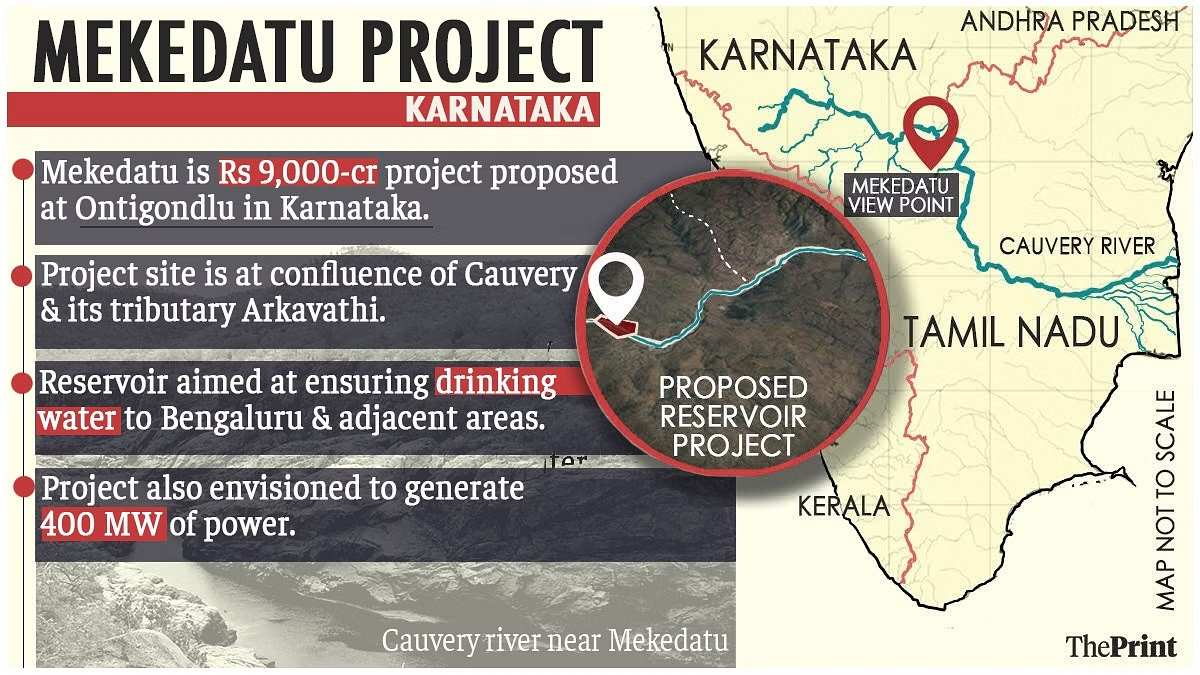
Karnataka CM has offered to discuss with Tamil Nadu, the implementation of Mekedatu Project across River Cauvery.
About Mekedatu Project
Mekedatu is a location along Kaveri in the border of Chamarajanagar and Ramanagara Districts in Karnataka.
Karnataka intends to build a reservoir across River Cauvery near Mekedatu.
The dam is proposed to have a capacity of 48 TMCfeet (thousand million cubic) and is estimated to cost Rs 6,000 crore.
It was first proposed in 2003 with an intention:
To use the water for a hydro power station (400 MW) and
Supply drinking water to Bengaluru city.
At Mekedatu, the Kaveri runs through a deep, narrow ravineof hard granite rock.
Tamil Nadu’s concerns over the Project
Tamil Nadu has all along strongly opposed the project and approached the Supreme Court as well.
Its argument is that any dam proposal by upper riparian states in the Cauvery basin would deprive the state’s delta farmers of their rightful share of water as per the top court verdict.
Tamil Nadu contends that the proposed dam violates the final award of the Cauvery Water Disputes Tribunal, which determined the water-sharing arrangements between the two states.
About Cauvery River
The Cauvery River, also spelled as ‘Kaveri’ and known as ‘Ponni’in Tamil, originates from Talakaveri in the Brahmagirirange located in Karnataka’s Kodagu district.
It spans approximately 800 km, traversing through the states of Karnataka and Tamil Nadu, until it eventually discharges in theBay of Bengal.
The river’s catchment area covers regions in Tamil Nadu, Kerala, Karnataka, and the Union Territory of Pondicherry.
Key tributaries that join the Cauvery include Harangi, Hemavati, Kabini, Suvarnavathi, and Bhavani.
Cauvery remains perennial due to its dual reliance on both advancing and retreating monsoons for rainfall.
Justifications and proposals by Karnataka
Ensuring adequate flow to TN: Karnataka argues that the construction of the Mekedatu dam will not hinder the stipulated quantum of water release to Tamil Nadu nor be utilized for irrigation purposes.
Allocation of funds and willingness to negotiate: The Karnataka government has earmarked Rs 1,000 crore for the project, indicating its commitment. It also expresses willingness to engage in discussions and negotiations with Tamil Nadu to address concerns and find a resolution.
Clearance of feasibility study: The Central Water Commission cleared a feasibility study for the Mekedatu project in 2018, providing additional support for Karnataka’s justifications and indicating the project’s viability.
PYQ:
[2016] Recently, linking of which of the following rivers was undertaken?
Many people have died, and hundreds are feared trapped after three landslides hit Kerala’s Wayanad district.
About Wayanad
Wayanad is the only plateau in Kerala, forming a continuation of the Mysore Plateau, part of the Deccan Plateau.
The Kabini River, a tributary of the Kaveri River, originates in Wayanad.
The Chaliyar River, the fourth longest river in Kerala, also originates on the Wayanad plateau.
Wayanad is home to the Wayanad Wildlife Sanctuary.
Susceptibility to Landslides:
The region predominantly has laterite soil, which is highly prone to erosion.
The steep and undulating terrain of Wayanad makes it naturally susceptible to landslides.
Wayanad receives intense and prolonged monsoon rains that cause water infiltration, leading to soil saturation and increased pore water pressure, which destabilizes slopes.
Large-scale deforestation for agriculture and settlement reduces the binding capacity of the soil and its ability to absorb water, exacerbating the risk of landslides.
What are Landslides?
A landslide is the downward and outward movement of materials including rock, earth, or debris down a slope due to gravitational force. Landslides are disasters of hydrogeological origin, resulting from the failure of materials falling down a slope due to gravity.
India is among the top five landslide-prone countries globally, with at least one death per 100 sq km reported annually due to landslides.
Regional Distribution
North-western Himalayas: 66.5% of landslides.
North-eastern Himalayas: 18.8% of landslides.
Western Ghats: 14.7% of landslides.
Key Policy Initiative: National Landslide Susceptibility Map
The National Remote Sensing Centre (NRSC) under ISRO released the Landslide Atlas of India in 2023.
This detailed guide identifies landslide hotspots across the country with a 100 sq. m resolution overview of landslide susceptibility.
The map highlights traditional high-risk areas and uncovers new regions of concern, broadening the scope of landslide monitoring.
Scientists conducted a risk assessment based on 80,000 landslides recordedbetween1998 and 2022 across 147 districts in 17 states and two Union Territories, creating a “Landslide Atlas” of the country.
Key Highlights of the Landslide Atlas:
Top States by Landslide Events:
Mizoram: 12,385 events in the past 25 years.
Uttarakhand: 11,219 events.
Other states: Kerala, Jammu and Kashmir, Nagaland, Arunachal Pradesh, and Tripura.
Districts with Maximum Landslide Exposure:
Arunachal Pradesh: 16 districts.
Kerala: 14 districts.
Uttarakhand and Jammu and Kashmir: 13 districts each.
Himachal Pradesh, Assam, and Maharashtra: 11 districts each.
Mizoram: 8 districts.
Nagaland: 7 districts.
Highest Landslide Density and Risk Exposure:
Rudraprayag and Tehri Garhwal districts in Uttarakhand.
PYQ:
[2021] Describe the various causes and the effects of landslides. Mention the important components of the National Landslide Risk Management Strategy.
Scientists from the “CSIR-Institute of Genomics and Integrative Biology” have developed an enhanced genome-editing system using FnCas9that can modify DNA more precisely and more efficiently than existing CRISPR-based technologies.
CRISPR occurs naturally in some bacteria, as a part of their immune system that limits infections by recognizing and destroying viral DNA.
What is FnCas9?
FnCas9 is a variant of the Cas9 enzyme derived from the bacterium Francisella novicida.
It is used in genome editing technologies, particularly within the CRISPR (Clustered Regularly Interspaced Short Palindromic Repeats) system, to make precise modifications to DNA sequences.
What is CRISPR-Cas9 System?
CRISPR-Cas9 is a revolutionary genome-editing tool adapted from a natural bacterial defense mechanism against viruses.
Bacteria use CRISPR sequences to store segments of viral DNA, which helps them recognize and combat viruses in subsequent infections.
The most commonly usedCas9 enzyme is derived from Streptococcus pyogenes.
Mechanism:
Guide RNA (gRNA): A specifically designed RNA molecule that matches the target DNA sequence.
Cas9 Enzyme: Acts as molecular scissors that cut DNA at a location specified by the gRNA.
Proto-spacer Adjacent Motif (PAM): A short DNA sequence adjacent to the target site that Cas9 must recognize and bind to in order to cut the DNA.
DNA Repair: Once the DNA is cut, the cell’s natural repair mechanisms either repair the break or introduce desired genetic changes.
Applications:
Agriculture: Enhancing crop yield and nutritional value.
Healthcare: Diagnosing and treating genetic disorders.
Research: Studying gene functions and interactions.
Challenges with Traditional Cas9: SpCas9 can sometimes cut DNA at unintended sites, leading to potential unintended genetic modifications.
How FnCas9 overpowers traditional Cas9 (SpCas9)?
FnCas9 is known for its higher specificityin targeting DNA sequences compared to SpCas9, resulting in fewer off-target effects.
More accurate targeting reduces unintended genetic modifications.
It ensures more reliable and safer genome editing.
Achievements by Indian Scientists
Scientists at the CSIR-IGIB in New Delhi have modified FnCas9 to enhance its efficiency without compromising specificity.
Key Modifications include:
Amino Acid Tinkering: Researchers modified amino acids in FnCas9 that interact with the PAM sequence to increase binding affinity.
Improved Binding: Enhanced binding affinity allows FnCas9 to sit more securely on the DNA, improving gene-editing effectiveness.
Flexibility: The enhanced FnCas9 can access and edit hard-to-reach regions of the genome.
Experimental Results:
Enhanced FnCas9 cuts target DNA at a higher rate than the unmodified version.
FnCas9 improved ability to detect single-nucleotide changes in the genome, broadening its diagnostic and therapeutic applications.
PYQ:
[2019] What is Cas9 protein that is often mentioned in news?
(a) A molecular scissors used in targeted gene editing
(b) A biosensor used in the accurate detection of pathogens in patients
(c) A gene that makes plants pest-resistant
(d) A herbicidal substance synthesized in genetically modified crops
[2016] In the context of the developments in Bioinformatics, the term ‘transcriptome’, sometimes seen in the news, refers to:
(a) a range of enzymes used in genome editing
(b) the full range of mRNA molecules expressed by an organism
(c) the description of the mechanism of gene expression
(d) a mechanism of genetic mutations taking place in cells
The Defence Acquisition Council (DAC) has reviewed and approved amendments to the deal for 31 MQ-9B High Altitude Long Endurance (HALE) Unmanned Aerial Vehicles (UAVs) from General Atomics of the US.
The DAC also approved a proposal for the scheduled refit of aircraft carrier INS Vikramaditya later this year.
About MQ-9B HALE UAV
The MQ-9B drone is a version of the MQ-9 “Reaper” and has two models: Sky Guardian and Sea Guardian.
It is built by the General Atomics.
This drone can fly over 40,000 feet high, making it useful for watching the Himalayan border areas.
It can stay in the air for up to 40 hours, perfect for long surveillance missions.
The MQ-9B has advanced features like automatic take-off and landing, a system to avoid other objects, secure GPS, and encrypted communications.
It can offer 80% of a manned aircraft’s capabilities at 20% of the cost per hour.
Deployment:
The MQ-9B drones are planned to be deployed at four places, including INS Rajaji near Chennai and Porbandar in Gujarat, by the Indian Navy.
The other two services will keep them jointly at two bases in Sarsawa and Gorakhpur in Uttar Pradesh at Air Force bases due to long runway requirements.
Specifications of the Procurement:
India is looking to procure 31 MQ-9B UAVs, including 15 Sea Guardians for the Indian Navy and 16 Sky Guardians (eight each for the Indian Army and Air Force).
The Indian Navy has leased two MQ-9As with the maiden flight taking place on November 21, 2020.
The estimated cost is $3.99 billion.
As part of the deal, General Atomics will establish a Global Maintenance, Repair, and Overhaul (MRO) facility in India, contributing to offset obligations.
Significance of the deal
The SeaGuardian model can help the Navy patrol large areas more economically than manned aircraft.
For the Army and Air Force, these drones will help monitor movements along the borders, especially with China.
Back2Basics: Defence Acquisition Council (DAC)
Details
Constitution
Established under the Defence Ministry for guiding defence procurement planning.
Role
Highest decision-making body in the Defence Ministry for new policies and capital acquisitions for the Army, Navy, Air Force, and Indian Coast Guard.
Formation
Created in 2001 following recommendations on reforming the National Security System after the Kargil War.
Chairman
Minister of Defence.
Members
Chief of Defence Staff (CDS), Minister of State for Defence, Three Service Chiefs (Army, Navy, Air Force), Chief of Integrated Staff Committees, Defence Secretary, Secretary Defence Research & Development.
Functions
In-principle approval of the 15 Year Long-Term Integrated Perspective Plan for Defence Forces.
Accord of Acceptance of Necessity for acquisition proposals.
Categorize acquisition proposals into ‘Buy’, ‘Buy & Make’, and ‘Make’.
Decisions on offset provisions for acquisitions above Rs. 300 crores.
Decisions regarding the transfer of technology under the ‘Buy & Make’ category.
PYQ:
[2018] What is “Terminal High Altitude Area Defense (THAAD)”, sometimes seen in the news?
(a) An Israeli radar system
(b) India’s indigenous anti-missile programme
(c) An American anti-missile system
(d) A defence collaboration between Japan and South Korea
![[31st July 2024] The Hindu Op-ed: A Licence Raj for digital content creators](https://www.civilsdaily.com/wp-content/uploads/2024/07/31-july-1568x882.jpg)