In a major breakthrough, Indian researchers have developed a new type of laser that can be placed directly onto silicon chips, a key component of modern computers.
What is Silicon Photonics?
Silicon photonics is a technology that uses light (photons) instead of electrical signals to transmit data inside computer systems.
Light can carry more data at higher speeds with less energy than electricity, making it a promising technology for future computing and data transfer.
Traditional silicon chips struggle to produce light, requiring external lasers, which were inefficient and costly.
Silicon photonics can significantly enhance data transfer speed and efficiency, benefiting industries like data centers and telecommunications.
About the Miniaturized Laser Technology
Indian researchers have successfully integrated a laser directly onto a silicon chip, eliminating the need for separate lasers.
The laser is made using gallium arsenide (where 20% of gallium atoms had been replaced with indium to achieve optimal light emission), which helps silicon emit light, a crucial step since silicon alone cannot produce light efficiently.
It uses minimal power, ideal for high-performance, energy-efficient computers.
Direct integration reduces costs, making the technology scalable for mass production.
This innovation boosts computing power, particularly in data centers where fast data transfer is critical.
Efforts are underway to enhance its durability, especially at higher temperatures, for broader industrial use.
[UPSC 2008] Which one of the following laser types is used in a laser printer?
India’s Defence Research and Development Organisation (DRDO) has successfully tested the Mk-II(A) Laser-Directed Energy Weapon (DEW) system, marking a major achievement in the country’s defense capabilities.
About Mk-II(A) Laser-Directed Energy Weapon (DEW) System
The Mk-II(A) Laser-DEW system, also known as Sahastra Shakti, is an indigenously developed Laser weapon with an operational range of 5km.
It is designed to neutralize threats like drones, missiles, and remotely piloted aircraft using a 30-kilowatt laser.
It is developed by DRDO’s Centre for High Energy Systems and Sciences (CHESS), in collaboration with other DRDO labs, academic institutions, and Indian industries.
It focuses primarily on neutralizing aerial threats such as drones and missiles, offering a cutting-edge solution against modern warfare tactics.
How does it work?
It utilizes radar and Electro-Optic (EO) systems for target detection.
The laser engages the target at the speed of light, causing structural failure or significant damage.
It delivers rapid, precise strikes with lethal impact in seconds.
The energy used for a few seconds of firing costs as little as a couple of litres of petrol, making it cost-efficient.
The 30-kilowatt laser ensures quick target neutralization with minimal collateral damage.
Significance of the Mk-II(A) Laser-DEW System
Cost-Effective: Far more affordable than traditional missile systems, providing sustainable defense options.
Reduced Ammunition Dependence: Reduces reliance on expensive ammunition, offering a long-term sustainable defence solution.
Precision & Speed: Engages targets almost instantaneously, minimizing collateral damage and ensuring high-value targets are neutralized quickly.
Strategic Advantage: Enhances India’s defence capabilities, providing an advanced method for protecting infrastructure and addressing evolving aerial threats.
[UPSC 2011] With reference to Indian defence, which one of the following statements is NOT correct?
(a) With the induction of Prithvi-II, the IAF is the only air force in the world with surface-to-surface ballistic missiles under its command.
(b) Sukhoi-30 MKI jet fighters can launch air-to-air and air-to-surface precision missiles
(c) Trishul is a supersonic surface-to-air missile with a range of 30 km
(d) The indigenously built INS Prabal can launch surface-to-surface missiles
[UPSC 2018] How would the recent phenomena of protectionism and currency manipulations in world trade affect macroeconomic stability of India?
Linkage: Trump’s administration was known for implementing protectionist trade policies, primarily through tariffs, starting around that period as discussed in the article. The question asks about the impact of “protectionism” on “macroeconomic stability,” which is directly linked to concerns about a potential recession.
Mentor’s Comment: The U.S. has been a strong supporter of free trade and a key driver of globalization since the mid-20th century. However, in a surprising shift, President Donald Trump took drastic action on April 2, calling it “Liberation Day,” by drastically changing U.S. trade policy. Until 2024, the U.S. had a low tariff rate of 2 to 3% on imports for two decades. But on April 2, Trump announced that the U.S. would now charge a minimum of 10% tariff on all imports. For imports from around 60 countries, the tariffs would be much higher, called “reciprocal” tariffs. These include a 20% tariff on the European Union (EU), 27% on India, and 46% on Vietnam.
Today’s editorial analyzes how the U.S. tariffs will affect India and the rest of the world. This topic is useful for GS Paper 2 and 3 in the UPSC Mains exam.
_
Let’s learn!
Why in the News?
On April 2, U.S. President Trump announced that the U.S. would start charging at least 10% tariffs on all imports.
What change did Trump announce on April 2 regarding U.S. tariffs?
Introduction of a Minimum 10% Tariff on All Imports: Trump declared that the U.S. would levy a minimum 10% tariff on all imported goods, ending decades of low tariff policy. Eg: A previously tariff-free $100 imported item would now cost $110 with the new 10% tariff.
“Reciprocal” Tariffs for Select Countries: Tariffs would be significantly higher for around 60 countries, based on what the U.S. perceives as unfair trade practices. Eg: Imports from India now face a 27% tariff, Vietnam 46%, and China a staggering 145%.
Highest Tariffs Targeted at China: China, the largest source of U.S. imports, was hit hardest — facing 145% tariffs, as part of an aggressive move to reduce trade deficits and pressure China economically. Eg: A $100 Chinese product would now cost $245 after the new tariff.
How did markets respond?
Stock Markets Nosedived: The announcement caused panic among investors, leading to sharp declines in stock markets around the world. Eg: The U.S. stock market dropped significantly, with major indices like the Dow Jones and S&P 500 seeing large declines as investors feared the impact of the tariffs.
Increased Economic Uncertainty: The abrupt tariff increases created a sense of economic uncertainty, particularly regarding trade relations and the global supply chain. Eg: The value of the U.S. dollar fluctuated, with the dollar weakening against several currencies as concerns about a trade war heightened.
Commodity Prices Rose: The market anticipated higher costs for goods, especially imported items, leading to a rise in the price of key commodities. Eg: Goods like electronics and consumer products became more expensive, reflecting the expected rise in tariffs and trade barriers.
What could be the chance of recession after US tariffs?
Reduced Consumer Spending Due to Higher Prices: Higher tariffs make imported goods more expensive, which can lead to inflation and reduced purchasing power among consumers. This slowdown in consumer spending—a key driver of the U.S. economy—can drag growth. Eg: A $1,000 smartphone imported from China may now cost $2,450 due to 145% tariffs, making consumers delay or avoid big purchases.
Strained Global Supply Chains and Business Uncertainty: Companies reliant on international supply chains may face higher input costs and uncertainty, leading to reduced investments, production delays, and job cuts.Eg: U.S. auto manufacturers sourcing parts from Asia may cut production or delay expansion due to rising costs and disrupted logistics.
Global Retaliation and Slowing Trade: Other countries may retaliate with their own tariffs, triggering a trade war that slows global trade and weakens demand for U.S. exports, increasing the risk of a global economic downturn. Eg: If the EU or China impose counter-tariffs on U.S. agricultural or tech exports, American farmers and companies may face losses, increasing joblessness and recession risk.
Why is China better prepared for a trade war?
Reason
Why China Is Better Prepared
Example
Diversified Export Markets
Reduced reliance on U.S. by expanding trade with Asia, Europe, and Africa.
U.S. share in China’s exports dropped from 21% (2006) to 16.2% (2022).
Lower Export Dependence on GDP
Exports now form a smaller part of China’s economy, reducing vulnerability.
Export-to-GDP fell from 35% (2012) to 19.7% (2023).
Focus on Tech & Innovation
Heavy investment in AI, EVs, and domestic tech industries to cut foreign dependence.
Made in China 2025 boosted self-reliance in high-tech sectors.
Manufacturing Shift to Neighbors
Relocating production to East Asia (e.g., Vietnam) to bypass U.S. tariffs.
Maintains supply chains while avoiding direct U.S. tariffs.
Strong Forex Reserves & Bond Holdings
Large reserves used to buy U.S. treasury bonds, ensuring financial strength.
U.S. dollar assets reduce trade/finance risks and secure China’s position.
How will higher U.S. tariffs impact India’s exports?
Reduced Export Earnings: Higher U.S. tariffs could decrease India’s export earnings as Indian goods would become more expensive for U.S. consumers, potentially leading to lower demand. Eg: Products like textiles and gems & jewelry, which are major export items to the U.S., might see a drop in sales due to increased tariffs.
Impact on Key Sectors: India’s manufacturing sectors, such as automobiles and electrical machinery, might face stiffer competition due to higher tariffs, reducing their ability to compete in the U.S. market. Eg: Indian automobile exports, especially in segments like small cars, might struggle as U.S. tariffs raise the prices and reduce competitiveness.
Diversification of Export Markets: Since the U.S. accounts for 21.8% of India’s total exports, any tariff hike could push India to explore new markets outside the U.S., reducing the impact of the tariff increase. Eg: India might increase its focus on the European Union or Southeast Asian markets, where demand for Indian goods remains strong.
Pharmaceutical and Service Exports Unaffected: Higher tariffs on goods may not impact India’s pharmaceutical and services exports as significantly, as they are major contributors to India’s trade surplus with the U.S. Eg: Generic medicines and IT services, such as software development, will likely continue to thrive in the U.S. market despite higher tariffs on other goods.
Pressure on Domestic Industry: Increased tariffs could also drive higher production costs in India, as it may face higher input costs for raw materials imported from the U.S. This could hurt the competitiveness of India’s export products. Eg: Sectors like steel and chemicals, which rely on U.S. exports for raw materials, may see a rise in production costs, potentially reducing profit margins.
When did the U.S. maintain low tariffs?
Post-World War II Period (1945–1970s): After World War II, the U.S. championed free trade and maintained low tariffs to encourage global economic recovery and integrate global markets. During this period, the U.S. was seen as the chief architect of globalization. Eg: The General Agreement on Tariffs and Trade (GATT), established in 1947, played a crucial role in reducing global tariffs, and the U.S. led many rounds of negotiations to lower its own import duties.
1980s to Early 2000s: During this period, particularly under the Clinton administration, the U.S. kept tariffs low to support global trade liberalization and its dominant position in the world economy. This made the U.S. an attractive market for exports and facilitated the growth of international trade. Eg: The North American Free Trade Agreement (NAFTA) signed in 1994 between the U.S., Canada, and Mexico aimed to eliminate tariffs and increase trade between the countries, further reinforcing the U.S.’s low-tariff approach.
Why was it seen as the chief architect of globalisation during that time?
Promotion of Free Trade Agreements: The U.S. led the establishment of various international trade agreements to reduce tariffs and promote open markets. It actively negotiated trade deals that facilitated the movement of goods, services, and capital across borders. Eg: The General Agreement on Tariffs and Trade (GATT), later replaced by the World Trade Organization (WTO) in 1995, was strongly influenced by the U.S. and aimed at creating a more liberalized global trade system.
Economic Influence and Dollar Dominance: The U.S. played a dominant role in global finance, with the dollar as the primary global reserve currency. This position helped facilitate international trade and investment, as countries around the world held U.S. dollars for foreign exchange and international transactions. Eg: Countries like China and Japan invested heavily in U.S. Treasury bonds, reinforcing the U.S.’s economic influence and fostering the expansion of global markets.
Technological and Industrial Leadership: The U.S. led technological innovation and industrial development, particularly in sectors like technology, finance, and manufacturing. This leadership helped drive global supply chains, with many countries relying on the U.S. for both innovation and as a key export market. Eg: U.S. tech giants such as Microsoft, Apple, and Google set the global stage for the digital economy, helping integrate economies worldwide into a globalized tech ecosystem.
Way forward:
Diversify Export Markets: India and other countries should explore new markets outside of the U.S., especially in emerging economies and regional trade agreements, to reduce dependency on the U.S. and mitigate the effects of tariff hikes. Eg: Strengthening ties with the European Union, Southeast Asia, and Africa could help reduce reliance on the U.S. market.
Enhance Domestic Innovation and Self-Sufficiency: Countries should focus on boosting domestic production, innovation, and technological advancements to reduce vulnerability to external trade barriers and tariffs. Eg: India could prioritize self-reliance in sectors like pharmaceuticals, electronics, and renewable energy to counter tariff pressures.
In The State of Tamil Nadu vs. The Governor of Tamil Nadu and Another, a two-judge Bench of the Supreme Court of India, led by Justice J.B. Pardiwala and Justice R. Mahadevan, reaffirmed that Governors’ powers are limited and must follow constitutional boundaries.
What constitutional issue was addressed in the Tamil Nadu vs the Governor case?
Aspect
Details
Example
Limits of Gubernatorial Discretion (Article 200)
The Governor cannot withhold assent to a Bill indefinitely or act independently of the elected State Cabinet, except in constitutionally specified situations. The role is largely ceremonial.
Governor of Tamil Nadu withheld assent to 12 Bills, including those on the appointment of Vice-Chancellors to public universities.
Constitutional Obligations of the Governor and State Executive
The Governor is bound by the advice of the State Cabinet and cannot act on personal discretion unless explicitly permitted by the Constitution. This upholds representative democracy.
Governor delayed referrals to the President without valid reasons, thereby undermining the democratic function of the State Legislature.
Judicial Review of Governor’s Actions
Article 361 gives personal immunity to the Governor but does not shield official actions from judicial review. Courts can check if actions comply with the Constitution and democratic norms.
Supreme Court held that the Governor’s inaction violated the Constitution, and invoked Article 142 to deem the Bills as assented to, resolving the legislative deadlock.
Why was the Governor’s inaction on Tamil Nadu Bills ruled unconstitutional?
Violation of Constitutional Duty under Article 200: The Governor is constitutionally bound to either assent to a Bill, withhold assent (and return it for reconsideration), or reserve it for the President. Indefinitely sitting on Bills without any action violates this mandate. Eg: The Governor kept 10 re-enacted Bills pending without any action or justification, undermining the role of the legislature.
Undermining the Principles of Representative Democracy: By not acting on duly passed Bills, the Governor disregarded the advice of the elected Council of Ministers, thereby disrupting the democratic process and the legislative will of the people. Eg: Despite the Tamil Nadu Assembly passing the Bills again in a special session, the Governor forwarded them to the President without consulting the State Cabinet, showing a lack of respect for democratic norms.
When can a Governor use discretion under Article 200?
When a Bill Affects the Powers of the High Court: The second proviso to Article 200 allows the Governor to reserve a Bill that directly affects the powers of the High Court for the President’s consideration. Eg: If a State law tries to curtail the High Court’s jurisdiction or authority, the Governor can use discretion to reserve it.
When Presidential Assent is Constitutionally Mandatory: If a Bill falls under categories where presidential assent is specifically required (such as laws under Article 31C that seek immunity from judicial review), the Governor may reserve it. Eg: A Bill claiming protection under Article 31C, linked to Directive Principles, must be reserved for the President.
When a Bill Fundamentally Undermines Constitutional Values: The Governor can act without ministerial advice if the Bill threatens the basic structure or core values of the Constitution. Eg: A Bill that violates secularism or federalism in an extreme manner could justify the Governor’s discretionary action.
How did the Supreme Court invoke Article 142 to resolve the constitutional deadlock in the Tamil Nadu Bills case?
Used Article 142 to Ensure Complete Justice: The Court exercised its special power under Article 142 to deliver complete justice by deeming the 10 re-enacted Bills as having received the Governor’s assent. Eg: Instead of waiting for further assent or action from the Governor, the Court directly validated the Bills to avoid further delays in governance.
Bypassed Unworkable Remedies Like Mandamus: Issuing a writ of mandamus (to compel the Governor to act) was seen as ineffective since the Governor is protected from personal liability under Article 361. Eg: Since the Governor cannot be punished for contempt, the Court chose Article 142 as a more enforceable solution.
Restored the Legislative Authority of the State: By invoking Article 142, the Court reinforced the principle that the Governor cannot override the will of an elected legislature through inaction Eg: This prevented indefinite delays in implementing laws passed by the Tamil Nadu Assembly, thus preserving democratic functioning.
Why was issuing a writ of mandamus deemed inadequate?
Governor is Immune Under Article 361: The Constitution grants the Governor personal immunity from legal proceedings while in office, making it difficult to enforce any court directive. Eg: Even if the Court issued a mandamus to compel assent or action, the Governor could not be held legally accountable for ignoring it.
Mandamus Cannot Be Enforced Practically: Courts cannot force a Governor to exercise discretion in a particular way, only to consider doing so—making the remedy ineffective when deliberate inaction is involved. Eg: If the Governor simply delays action without giving reasons, courts have limited tools to compel a timely decision.
Could Cause a Constitutional Standoff: Forcing the Governor through judicial direction risks undermining the separation of powers and could lead to a deadlock between constitutional authorities. Eg: If the Governor resists the court order, it could trigger a conflict between the judiciary and the executive, weakening the constitutional balance.
Way forward:
Codify Time Limit for Assent: Amend the Constitution or enact a statutory framework to prescribe a reasonable time limit (eg: 30 days) within which the Governor must act on Bills to prevent indefinite delays.
Enhance Legislative Oversight: Establish a mechanism for State Legislatures to seek judicial clarification or initiate review when the Governor delays action, reinforcing accountability and upholding democratic norms.
Mains PYQ:
[UPSC 2022] Discuss the essential conditions for exercise of the legislative powers by the Governor. Discuss the legality of re-promulgation of ordinances by the Governor without placing them before the Legislature.
Linkage: This question directly addresses the legislative powers of the Governor, a key aspect of their conduct. The second part specifically asks about the legality of re-promulgation of ordinances, which can be a contentious issue and often involves judicial scrutiny. This relates to the constitutional limits on the Governor’s powers, similar to the issues raised in the article.
N4S: A digital identity for students: convenience or control? This article unpacks the APAAR ID, its benefits, and the privacy concerns it raises. UPSC often asks about Fundamental Rights in light of recent judgments (like the Right to Privacy ruling in Puttaswamy vs. Union of India, 2017). This year, it asked about DNA testing and privacy. The pattern is clear—questions link current policies to constitutional rights. Aspirants often struggle with applying theoretical knowledge to real-life scenarios. They memorize constitutional provisions but miss how policies challenge or reinforce them. This article helps by breaking down APAAR ID—not just its goal of digitizing student records, but also the hidden risks of forced compliance, data security loopholes, and Aadhaar-like concerns. It connects textbook concepts to ongoing debates, making your understanding more dynamic and exam-ready. One standout feature? It doesn’t just explain; it questions. “If saying no has consequences, is it really a choice?” This article teaches you to critically analyze government initiatives—just like UPSC wants.
PYQ ANCHORING:
Examine the scope of Fundamental Rights in the light of the latest judgement of the Supreme Court on Right to Privacy. [GS 2, 2017]
Right to privacy is intrinsic to life and personal liberty and is inherently protect ed under Article 21 of the Constitution. Explain. In this reference discuss the law relating to D.N.A. testing of a child in the womb to establish its paternity. [GS 2,2024]
MICROTHEMES: Fundamental Rights
“We must ensure that we don’t stumble too much as the baby learns to walk.” This sentiment from policymakers reflects their cautious defense of APAAR ID, India’s ‘One Nation, One Student ID’ initiative. While the idea of a lifetime academic record seems promising, concerns over privacy, consent, and coercion are growing.
Take the case of Rahul, a Class 10 student in Karnataka—his school warned that without an APAAR ID, he might lose scholarships and mid-day meals. His anxious parents rushed to register him, even though the government insists the ID is voluntary. If refusing has consequences, is it really a choice?
As schools push for full enrolment, minority institutions face scrutiny, and parents feel pressured, key questions arise: Is APAAR truly voluntary, or is it Aadhaar 2.0 with forced compliance? What safeguards exist against misuse of students’ personal data? Have similar well-intentioned policies in the past led to concerns over privacy, surveillance, and coercion?
About APAAR ID
The Ministry of Education introduced the APAAR ID, a unique 12-digit identification number under the ‘One Nation, One Student ID’ initiative of the National Education Policy 2020.
Designed as a lifelong academic identity, it allows students to digitally store and access their educational records, including mark sheets, degrees, and certificates.
APAAR also simplifies credit recognition and transfer, enabling smoother academic progression and recognition of prior learning.
Significance of APAAR ID
A Lifetime Academic Record: APAAR creates a digital vault for students, storing all their mark sheets, degrees, and certificates in one place, ensuring easy access whenever needed.
Easy Sharing & Transfers: No more running around for transcripts! Students can seamlessly share their academic records with schools, colleges, and employers without paperwork hassles.
Part of India’s Digital Ecosystem: APAAR connects with existing education databases like UDISE+ (Unified District Information System for Education Plus), helping improve how student data is managed and used for better governance.
Smoother Scholarships & Admissions: Whether applying for a scholarship, getting into college, or proving qualifications for a job, APAAR makes the process faster, easier, and more transparent.
The Bumpy Ride of APAAR ID in Uttar Pradesh & Karnataka
The rollout of the APAAR ID in Uttar Pradesh and Karnataka was meant to streamline student records, but instead, it’s causing a fair bit of chaos. Here’s why:
Schools Under Pressure: The 100% Enrolment Race: Education authorities have set sky-high targets—every single student must be enrolled, no exceptions. Schools are being rushed to meet these deadlines, making the process feel more like a race to fill numbers rather than a well-planned initiative. In Uttar Pradesh, administrators are scrambling to comply, fearing backlash if they fall short.
Parents Cornered: “No APAAR, No Benefits” Threats: In Karnataka, some schools are telling parents that their children might lose access to government benefits or even face roadblocks in future education if they don’t register. This has left many parents worried—is this an option or an ultimatum?
Minority Institutions Feeling the Heat: Religious minority schools and their administrators are under heightened scrutiny. In Uttar Pradesh, authorities are cross-checking APAAR data with existing school records, raising concerns about bias and administrative overreach. Schools are now stuck between government mandates and the trust of their communities.
APAAR ID: A Digital Leap or a Privacy Trap?
While APAAR promises to simplify student records and integrate them into India’s digital education system, it also raises serious concerns. Without a strong legal framework, issues like data privacy, consent, and security remain unclear.
Critics argue that what seems like a step toward efficiency might actually lead to forced enrollment, exclusion risks, and increased bureaucratic control. Is it truly for students’ benefit, or does it bring more challenges than solutions?
The following table breaks down the key issues surrounding the APAAR ID :
Issue
Why It’s a Concern
Example
Accountability & Transparency
No legal oversight makes data use opaque and vulnerable to misuse. Without independent supervision, transparency is hard to ensure.
Germany regulates student data under GDPR, but India lacks similar safeguards for APAAR.
Lawful Data Processing
No dedicated data protection law means student information could be misused or leaked. Aadhaar integration raises surveillance risks.
In 2018, Aadhaar data leaks exposed millions of personal records, showing risks of weak data protection.
Adaptability to New Technologies
While APAAR integrates with digital platforms like UDISE+, it lacks safeguards against AI-driven profiling or misuse of student data.
AI-based student tracking in China raised concerns about excessive surveillance and profiling of children.
National Security vs. Individual Rights
Mandatory linking with Aadhaar may violate privacy rights, as ruled in past Supreme Court judgments.
In 2017, the Supreme Court ruled Aadhaar cannot be forced for school admissions (Puttaswamy case). APAAR risks similar legal challenges.
Consent & Control
Despite being called voluntary, schools pressure students to enroll, raising doubts about real choice.
Parents in Karnataka reported being told that without APAAR, their children might lose scholarships and mid-day meals.
Ethical Implementation
Errors in digital records can lead to exclusion from education benefits, with no clear way to fix mistakes.
A name mismatch in DigiLocker once prevented a student from applying for a government scholarship.
With growing public pushback and legal uncertainties, the APAAR ID needs stronger safeguards, clearer policies, and true voluntariness to prevent it from becoming another digital surveillance tool rather than an educational enabler.
Global Best Practices in Student Identification and Education Records
Country
System
Key Feature
European Union
ECTS (Credit System)
Enables seamless student mobility and credit transfer across EU countries, ensuring academic recognition.
United States
Student ID + SSN (optional)
Balances identification with strong education and privacy policies to safeguard students’ rights.
Estonia
National Digital Identity
Offers a fully digital education journey with a privacy-by-design model to protect student data.
India (Future?)
APAAR + DigiLocker + ABC
Requires transparent, inclusive, and secure implementation to avoid privacy and consent concerns.
Way Forward: Making APAAR Work Without Controversy
India can turn the APAAR ID from a controversial mandate into a trusted educational tool by addressing its legal, ethical, and implementation challenges. Here’s what needs to change:
Enact a Strong Legal Framework: Pass a comprehensive data protection law that clearly defines how student data will be stored, used, and safeguarded.
Student-Controlled Access – Introduce a feature where students can grant and revoke access to their records for institutions and employers, ensuring greater control over personal data.
Blockchain-Based Verification – Implement blockchain technology for secure, tamper-proof academic records, reducing fraud and ensuring transparency in credential validation.
Offline Access for Underserved Areas – Develop a system where students in remote areas can access and update their APAAR records offline, syncing data when connectivity is available.
Independent Grievance Redressal Portal – Set up an independent platform where students and parents can report data errors, privacy concerns, or coercion, ensuring accountability.
Integration with Skill-Based Certifications – Expand APAAR beyond traditional degrees by integrating verified skill certifications, internships, and vocational training records, making it more comprehensive.
APAAR ID has the potential to revolutionize academic record management, but its implementation without a robust legal framework risks privacy violations, exclusion, and governance inefficiencies. Strong data protection laws, independent oversight, and clear consent mechanisms are essential to balance efficiency with individual rights.
#BACK2BASICS: INDIA’S TRYST WITH Centralization vs. Individual Rights
Controversy
Objective of the Measure
Reason for Controversy
Outcome
Aadhaar (UIDAI)
Unique biometric-based ID for targeted delivery of subsidies and services
Privacy concerns, potential surveillance, data breaches, exclusion of marginalized communities
Supreme Court upheld Aadhaar but restricted private sector use; mandated data protection norms
DigiLocker
Digital storage for official documents to reduce paperwork and fraud
Data security concerns, limited awareness, fear of hacking
Widely adopted but security enhancements introduced
Aarogya Setu
Contact tracing and health tracking during COVID-19
Lack of transparency, concerns over mass surveillance
Government later made it open-source to address concerns
CoWIN Portal
Digital vaccination record-keeping and management
Data leaks exposing citizens’ personal information
Government denied major breach; security protocols strengthened
National Digital Health ID (NDHM)
Creating a unified digital health record system for individuals
Fear of medical data misuse, lack of clear opt-in consent
A recent study published in Geophysical Research Letters revealed changes in the amount and timing of rainfall using GSMaP Data between 2001-2010 and 2011-2020.
AboutGlobal Satellite Mapping of Precipitation (GSMaP)
GSMaP is a specialized precipitation product developed through collaboration between ISRO (Indian Space Research Organisation) and JAXA (Japan Aerospace Exploration Agency).
It provides high-resolution precipitation data with a 0.1° x 0.1° grid and one-hour temporal resolution, focusing on the Indian subcontinent since March 2000.
The data supports rainfall trend analysis, climate modelling, and water resource management.
Key Findings of the Study:
Rainfall Trends:
West-Central India: Increased daily rainfall (2 mm/day) from 2011-2020 compared to 2001-2010.
Eastern India: A decrease of ~1 mm/day in rainfall during the same period.
Regional Shifts: Northeastern and eastern India saw decreased rainfall, while the Indo-Gangetic Plain and southern India experienced increases.
Vegetation & Soil Moisture:
West-Central India saw an increase in vegetation (NDVI from 0.2 to 0.4) and soil moisture linked to increased rainfall.
Eastern India had decreased soil moisture during the same period.
Shifts in Peak Rainfall Timing:
Indo-Gangetic Plain: Peak rainfall advanced by 2-4 hours.
West-Central India: Peak rainfall delayed by 1-2 hours.
Factors responsible for this Shift:
Higher soil moisture supports rainfall, while reduced moisture, particularly in eastern India, decreases rainfall.
Higher aerosol concentrations in polluted areas like the Indo-Gangetic Plain lead to earlier rainfall peaks.
Changes in atmospheric circulation, topography, and coastal influences also affect rainfall distribution and timing.
[UPSC 2012] Consider the following statements:
1. The duration of the monsoon decreases from southern India to northern India.
2. The amount of annual rainfall in the northern plains of India decreases from east to west.
Which of the statements given above is / are correct?
(a) 1 Only (b) 2 Only (c) Both 1 and 2 (d) Neither 1 nor 2
Researchers from Thiruvananthapuram have developed a cost-effective Real-Time LAMP (rt-LAMP) Assay for early Tuberculosis (TB) diagnosis.
About the rt-LAMP Assay
The rt-LAMP assay (real-time Loop-mediated Isothermal Amplification) is a molecular diagnostic test designed to detect TB DNA with high precision.
It can detect TB DNA at concentrations as low as 10 copy numbers per microlitre, ensuring early detection even with low bacterial loads.
Developed by SCTIMST, Thiruvananthapuram, the rt-LAMP assay uses Syto 16, a fluorescent dye, to monitor DNA amplification in real time, addressing the limitations of traditional LAMP tests.
Working Principle:
It uses six primersfor DNA amplification (compared to two in RT-PCR), enhancing amplification speed.
It operates at a single temperature, unlike RT-PCR, making it simpler and more cost-effective.
It monitors the amplification process continuously, providing faster results.
Advantages Offered:
High Sensitivity and Specificity: Ensures accurate detection of TB DNA due to the use of six primers.
Cost-Effective: Uses affordable fluorescent dyes and primers, reducing diagnostic costs.
Speed: Produces results in just 10-20 minutes, faster than traditional tests.
Ease of Use: Compatible with existing RT-PCR machines, reducing the need for new infrastructure.
High Throughput: Can process 96-384 tests in one run, making it ideal for high-volume settings.
[UPSC 2007] Which of the following types is used by computed tomography employed for visualization of the internal structure of the human body?
(a) X-rays (b) Sound Waves (c) Magnetic Resonance (d) Radioisotopes
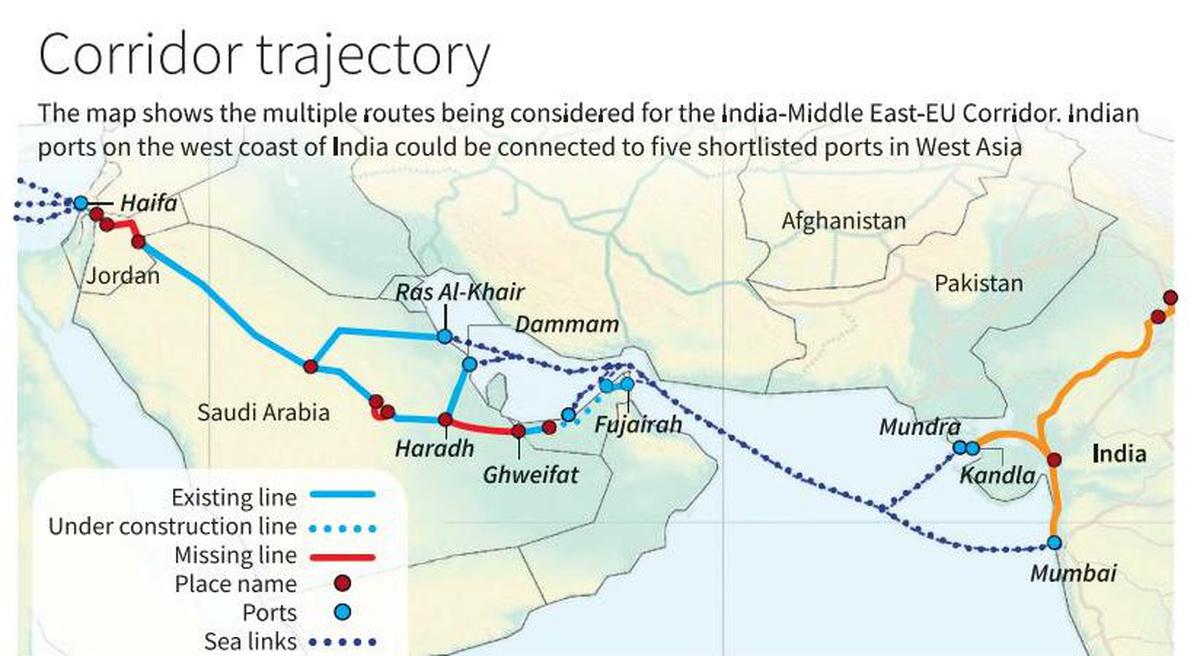
India and Italy have decided to enhance cooperation in trade, defence, clean energy, and high technology while working jointly on the India-Middle-East-Europe-Economic Corridor (IMEEC).
About IMEEC Project:
IMEEC is a key initiative under the Partnership for Global Infrastructure and Investment (PGII), aimed at infrastructure development in developing regions.
It was formally endorsed on September 10, 2023, during the 2023 G20 New Delhi summit.
Signatories include: India, United States, UAE, Saudi Arabia, France, Germany, Italy, and the European Union.
Objective: To integrate Asia, Europe, and the Middle East to boost economic cooperation, trade, and regional connectivity.
IMEEC consists of two main corridors:
East Corridor: Connecting India to the Arabian Gulf.
Northern Corridor: Connecting the Gulf region to Europe.
Key Ports to be Connected:
India: Mundra, Kandla, Jawaharlal Nehru Port Trust (Mumbai).
Middle East: Fujairah (UAE), Jebel Ali (Dubai), Dammam (Saudi Arabia).
Earlier this month, severe weather in the United States, including heavy rainfall, strong winds, and thunderstorms, was caused by an Atmospheric River.
What is an Atmospheric River?
An atmospheric river is a narrow, fast-moving band of moistureand wind that transports large amounts of water vapor across vast distances.
They form when large-scale weather patterns align, creating channels of moisture transport from tropical oceans, guided by low-level jet streams toward the coast.
They typically span 402-606 km in width and can extend over 1600 km in length.
The most powerful atmospheric rivers transport moisture equivalent to the Mississippi River’s flow.
Example: The Pineapple Express, a well-known atmospheric river, transports moisture from Hawaii to the West Coasts of the U.S. and Canada.
The intense rainfall from atmospheric rivers leads to flooding, mudslides, and infrastructure damage, with wind speeds comparable to hurricanes.
Impact and Climate Change:
Rising global temperatures cause more water to evaporate, and warmer air can hold more moisture.
For every 1°C increase, the atmosphere can hold 7% more moisture, leading to stronger storms.
Research indicates such events will likely grow longer and more intense.
[UPSC 2023] With reference to the Earth’s atmosphere, which one of the following statements is correct?
(a) The total amount of insolation received at the equator is roughly about 10 times of that received at the poles.
(b) Infrared waves are largely absorbed by carbon dioxide that is concentrated in the upper atmosphere.
(c) Infrared waves are largely absorbed by water vapour that is concentrated in the lower atmosphere.
(d) Ultraviolet rays are absorbed by the ozone layer lying in the ionosphere.
[UPSC 2019] What are the continued challenges for women in India against time and space?
Linkage: The challenges that women still face are a major concern under the Beijing Platform for Action and are likely to be reviewed in the Beijing India Report. Pointing out these ongoing issues shows how much more needs to be done to reach the goals of the Beijing Declaration.
Mentor’s Comment: It’s been 30 years since the Beijing Declaration set a global plan for gender equality across areas like education, health, and politics. In India, it led to key laws like the Domestic Violence Act and the POSH Act, and encouraged women’s economic empowerment. However, poor implementation still creates a gap between legal rights and the real experiences of women.
Today’s editorial discusses how gender inequality and climate change are interconnected. This topic is relevant for GS Paper 1 (Women’s Issues), GS Paper 2 (Policy Making), and GS Paper 3 (Impact of Climate Change). It highlights the challenges women face due to climate change and the need for better policies to address these issues.
_
Let’s learn!
Why in the News?
The report lacks a strong link between climate and gender, and this needs to be fixed through policy improvements and changes at the grassroots level.
Why does this report lack a strong link between climate and gender?
Limited Focus on Gender-Specific Impacts: The report fails to adequately highlight how climate change specifically affects women, especially in rural areas. Eg: It doesn’t emphasize the extra burden women face in collecting water or gathering fuel during droughts, which worsens due to climate change.
Insufficient Data on Gendered Vulnerabilities: The report lacks comprehensive data on the gendered impacts of climate change, leaving out how women are disproportionately affected by disasters and resource scarcity. Eg: It overlooks how climate-induced migration increases women’s vulnerability to gender-based violence.
Absence of Gender-Responsive Climate Policies: The report doesn’t propose clear actions for integrating gender into climate policies, limiting women’s participation in climate adaptation and decision-making. Eg: There are no specific recommendations for promoting women’s leadership in local climate action plans or agricultural adaptation strategies.
What challenges do rural women face due to gender inequality and climate change?
Challenge
Impact on Rural Women
Example/Evidence
Education Disruption
Climate-induced migration and household burdens force girls to drop out of school.
In Dhanelikanhar village, Chhattisgarh, girls are leaving school due to displacement caused by climate stress and migration.
Unpaid Care Work
Resource scarcity increases women’s burden of water, fuel collection, and caregiving, limiting their economic opportunities.
Arsht-Rock report: Rural Indian women work over 8 hours daily, with 71% of their labor unpaid, deepening gender inequality.
Health Vulnerability
Malnutrition, anaemia, and reproductive health issues rise due to food insecurity and lack of healthcare access.
Over 50% of pregnant women in India are anaemic; food-insecure women are 1.6x more likely to suffer from anaemia.
Livelihood Loss
Extreme weather reduces agricultural output and affects non-farm livelihoods where women are largely employed.
Climate change causes up to 33% income loss in rural areas, with women in non-farm sectors most affected.
Exposure to Violence and Safety Risks
Climate stress and resource conflicts heighten risks of intimate partner violence and general insecurity.
A study shows every 1°C rise in temperature leads to 8% more physical violence and 7.3% more sexual violence against women in India.
Why is a gender-climate lens vital for India’s sustainable future, as per the Beijing India Report 2024?
Inclusive Policy Design: A gender-climate lens ensures that women’s specific vulnerabilities are addressed in climate policies. Eg: Only 6% of climate policies globally mention women, leading to gender-blind strategies in India’s rural development.
Strengthening Resilience: Recognizing women’s roles in natural resource management and agriculture strengthens community resilience to climate shocks. Eg: Rural and tribal women preserve climate-resilient seeds, essential for adaptive farming during droughts and floods.
Reducing Inequality: Targeted climate budgeting and gender audits help close gaps in access to resources, services, and decision-making power. Eg: Women’s unpaid work, like water and fuel collection, could rise to 8.3 hours/day by 2050 without gender-responsive policies.
Boosting Food Security: Closing the gender gap in agricultural resources increases productivity and national food security. Eg: Empowering women farmers can raise farm yields by 20%-30%, feeding up to 150 million more people.
Empowering Local Leadership: Women-led climate initiatives promote local innovation, disaster preparedness, and sustainability. Eg: Women’s self-help groups in climate-vulnerable areas act as first responders during disasters and promote eco-friendly practices.
What are the steps taken by the Indian government?
Inclusion in National Climate Frameworks: The government has integrated gender concerns into major climate policies like the National Action Plan on Climate Change (NAPCC) and State Action Plans (SAPCCs). Eg: Some SAPCCs include women’s role in sustainable agriculture and water management initiatives.
Legislative and Policy Support for Women’s Empowerment: Laws like the Protection of Women from Domestic Violence Act and POSH Act strengthen the overall gender rights framework, which intersects with climate resilience. Eg: These laws provide safety nets that support women’s participation in community and environmental activities.
Promotion of Women-Led Livelihoods in Rural Missions: Schemes like the National Rural Livelihoods Mission (NRLM) support women’s Self-Help Groups (SHGs) to engage in sustainable practices. Eg: Women SHGs in Odisha and Chhattisgarh are trained in climate-resilient farming and forest produce collection.
Where should policies and budgets focus to support gender-responsive climate action? (Way forward)
Gender-Responsive Climate Budgeting: Policies must ensure budgets address the specific climate vulnerabilities of women and prevent greenwashing. Eg: Creating separate budget lines for women’s disaster relief and climate-resilient livelihood schemes in rural areas.
Climate Education and Skill Building: Invest in capacity building for women to participate in climate action and green jobs. Eg: Training rural women in solar panel installation or eco-friendly farming techniques.
Support Hubs and Safety Services: Establish community hubs that offer healthcare, disaster relief, and protection from gender-based violence. Eg: Setting up women-centric climate support centers in flood-prone regions of Assam.
Non-Farm Livelihood Diversification: Promote alternative income sources for women affected by climate-related agricultural losses. Eg: Funding mushroom farming or tailoring units for women in drought-hit Bundelkhand.
Inclusion in Local Governance and Decision-Making: Ensure women’s representation in local climate planning and governance bodies. Eg: Mandating women’s participation in State and District Climate Action Committees in Madhya Pradesh.