India needs a clear Free Trade Agreement policy, especially in dealing with International Trade and Foreign Investment Laws.
About Free Trade Agreement:
A Free Trade Agreement between two or more countries aims to reduce or eliminate barriers to trade, such as tariffs, quotas, and other restrictions, to facilitate the flow of goods and services across borders.
Its significance for India: It can increase market access for Indian goods and services, boost exports, attract foreign investment, stimulate economic growth, create employment opportunities, and enhance competitiveness through exposure to international markets and technologies.
Present status of India’s Involvement in FTA:
India is involved in various free trade arrangements, including the South Asian Free Trade Area (SAFTA), the Association of Southeast Asian Nations (ASEAN) Free Trade Area, the India-Japan Comprehensive Economic Partnership Agreement (CEPA), and negotiations with the European Union for a free trade agreement, among others.
Negotiations for India’s FTAs with countries like the United Kingdom and the European Union (EU) appear to have stalled amidst the current parliamentary elections in India.
Why does India need to rebuild its Free Trade Agreement policy?
For Comprehensive Economic Treaties: Combining trade and investment negotiations provides India with clear negotiating leverage to strike beneficial deals.
It allows India to leverage concessions in trade for advancements in investment, and vice versa. This approach enhances India’s bargaining power in FTA negotiations.
For Scope Expansion: India should expand the scope of investment issues by incorporating provisions for protecting foreign investors under international law, ensuring their confidence in investing in India.
It will help India to establish an efficacious dispute settlement mechanism under international law to resolve investment disputes effectively.
Providing enforceable legal protection to foreign investors is crucial for boosting their confidence, especially amidst declining foreign direct investment levels in India.
For addressing the drop in FDI Levels: The policy should address the decline in foreign direct investment levels in India by instilling confidence among foreign investors through robust legal protection and dispute resolution mechanisms.
Investment lessons from the India-EFTA Trade deal:
The India-EFTA FTA includes a comprehensive investment chapter, which is missing in recent Indian FTAs with countries like Australia, UAE, and Mauritius.
The agreement includes provisions wherein EFTA countries commit to making honest endeavors to increase FDI to India and facilitate job generation, codifying an obligation of conduct rather than an obligation of result.
Economic theory highlights the close linkage between trade and investment. While earlier Indian FTAs included both binding trade rules and investment protection, recent ones decoupled international trade law from international investment law.
The India-EFTA FTA, emphasizes combining trade and investment negotiations in one comprehensive economic treaty, that is ‘FTA 3.0 Approach’, which represents a departure from the decoupling approach seen in recent FTAs.
Way Forward:
Capacity Building: Enhance the capacity of Indian negotiators and policymakers to understand complex trade and investment issues, including legal frameworks, dispute resolution mechanisms, and international best practices.
Integrated Negotiation Approach: Adopt an integrated approach to FTA negotiations, wherein trade and investment aspects are negotiated together within a single agreement, ensuring coherence and synergy between the two.
Mains PYQ:
Q Quadrilateral Security Dialogue (Quad) is transforming itself into a trade bloc from a military alliance, in present times Discuss.
Q Analyse the salience of ‘sect’ in Indian society vis-a-vis caste, region, and religion.(UPSC IAS/2022) Q Discuss the main objectives of Population Education and point out the measures to achieve them in India in detail. (UPSC IAS/2021) Q “Empowering women is the key to controlling the population growth.” Discuss. (UPSC IAS/2019)
Prelims: India is regarded as a country With a “Demographic Dividend” This is due to (UPSC IAS/2011) (a) Its high population in the age group below 15 years (b) Its high population in the age group of 15-64 years (c) Its high population in the age group above 65 years (d) Its high total population
Note4Students:
Prelims: Population Trends; Minorities;
Mains: Society; Minorities; Religious demography; Effects of Policies and Programs on Demographics;
Mentor comment: The recent report ‘Share of Religious Minorities: A Cross-Country Analysis (1950-2015)’ conducted by the Economic Advisory Council analyzes the demographic changes in the religious composition of Indian Society as well as across 167 countries from 1950 to 2015. It focuses on the shifting shares of majority and minority religious groups, highlighting trends such as the decline in the Hindu population and the growth of the Muslim population in India. The study emphasizes the importance of understanding these changes as indicators of relative well-being within a country. We need to study this analysis as it is based on the premise that any change in minority populations is influenced by policies related to defining and treating minorities in our country.
Let’s learn
_
Why in the News?
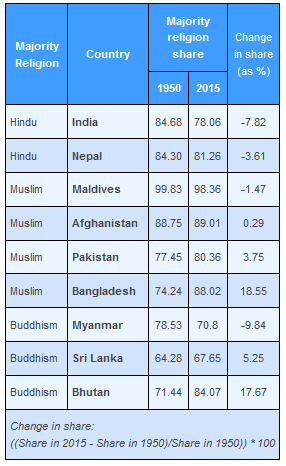
The recent working paper titled ‘Share of Religious Minorities: A Cross-Country Analysis (1950-2015)’ by the Economic Advisory Council to the Prime Minister (EAC-PM), has major observations on Indian religious demographics.
Key highlights made by EAC-PM Report:
The paper is based on the baseline year as 1950, because this was the time around when the International Human Rights Framework was introduced under the aegis of the newly created United Nations. Considering the global trends of declining majority, India too has witnessed a reduction in the share of the majority religious denomination by 7.82%. According to the Report, the Hindu population decreased by 7.82% (1950-2015), while that of Muslims increased by 43.15%, suggesting a conducive environment in the country to foster diversity. The share of the Christian population rose from 2.24% to 2.36% — an increase of 5.38% between 1950 and 2015. While the share of the Sikh population increased from 1.24% in 1950 to 1.85% in 2015 — a 6.58% rise in their share, the share of the Parsi population in India witnessed a stark 85% decline, reducing from 0.03% share in 1950 to 0.004% in 2015.
South Asian Trends:
Within the neighborhood, the share of the majority religious denomination has increased and minority populations have shrunk alarmingly across countries like Bangladesh, Pakistan, Sri Lanka, Bhutan, and Afghanistan. Minority populations from across the neighborhood come to India during times of duress.
The present controversy over the EAC-PM Report:
The PM-EAC report on religious minorities in India has sparked debate due to its timing, outdated data, and selective focus.
For example, firstly, it does not highlight the nearly 1,520% increase in share in the total population of Buddhists, for every one Muslim, five Hindus were born during this period.
Secondly, the Hindu population has tripled, and the Total Fertility Rate (TFR) of Muslim women saw a drop of 2.05 against Hindu women’s TFR by 1.36, making it controversial.
Despite concerns raised by some, the demographers do not see that the Hindus are losing their majority status, given the historical context and current demographic patterns.
For example, when Hindus could retain their majority status during the 800 years of so-called Mughal rule, they cannot be in danger today.
Present rhetoric and challenges:
Need to have a broader outlook: Focusing solely on Total Fertility Rates to assess a group’s status overlooks broader factors like education and socioeconomic conditions.
Need to survey Public Participation: The representation of a particular religious group in the state’s power structure is a crucial indicator of its well-being.
The Finance Minister recently highlighted the growth of the Muslim population as a positive sign, emphasizing that Indian Muslims enjoy more rights compared to minorities in some Muslim-majority countries.
India is set to become the country with the largest Hindu and Muslim populations by 2050, showcasing the diversity and coexistence within the nation.
What does the Population Data say?
Stabilizing of the Minorities: The data on the decline in Muslim women’s fertility rates, as seen in Census data, indicates a positive trend toward stabilization. (according to the United Nations Population Fund)
Demographers predict that by the end of the century, Muslims may constitute around 18.8% of India’s population, with Hindus maintaining a significant majority at 74.7%.
Regional Variations: Various states have already achieved fertility rates below replacement levels, signaling a broader trend of population stabilization.
Whilethe Population Regulation Bill in 2019or the Population (Control) Bill in 2021has been introduced, some demographers generally emphasize the importance of addressing population dynamics through education, healthcare, and socioeconomic development.
Lack of Data-evidences: Claims of alarming Muslim population growth in certain regions like Assam lack substantial evidence, with data showing different growth patterns across states.
Illegal Muslim infiltration from Bangladesh is generally said to be responsible for the demographic change since the 1970s in Assam.
Are Coercive Methods Counter-productive?
International Norms and the Indian Government stance: Being a signatory to international covenants such as the International Covenant on Civil and Political Rights (ICCPR), India has to abide by the international norms on population control.
The United Nations Human Rights Committee has categorically mandated that state parties to ICCPR cannot adopt policies that are compulsory, coercive, or discriminatory.
Even the National Population Policy, of 2000 focused on more relevant socio-cultural factors such as age at marriage, age at birth, girl education, maternal and child health, and voluntary and informed consent over coercive methods.
Conclusion: To address concerns about population growth, efforts should concentrate on improving education and economic opportunities for all communities, including Muslims, rather than resorting to coercive measures.
Blue magpie species are frequently observed from Kashmir to Myanmar.
About Himalayan Magpies
Magpies belong to the Corvidae family, which also includes crows, jays, and ravens.
These birds are typically noisy and inquisitive, often featured as omens in folklore around the world.
Species Distribution and Habitat:
Gold-billed Magpie (Urocissa flavirostris): Also known as the yellow-billed blue magpie, this species inhabits high altitudes between 2,000 and 3,000 meters above sea level, thriving in the high-altitude zones of the Himalayas from Kashmir to Myanmar.
Red-billed Magpie: Found at slightly lower altitudes than the gold-billed magpie.
Blue Magpie: Occupies lower altitudes and is more likely to be found near human settlements. It builds nests in rhododendron trees.
IUCN Status: ‘Least Concerned’
Observations:
The best sightings of yellow and red-billed magpies are along a trekking corridor in Western Sikkim, which spans from tropical forests at lower altitudes to Alpine landscapes.
Over 250 species of birds have been documented in this region, with significant bird activity around 2,500 meters.
PYQ:
[2014] If you walk through countryside, you are likely to see some birds stalking alongside the cattle to seize the insects, disturbed by their movement through grasses.
Which of the following is/are such bird/birds?
Painted Stork
Common Myna
Black-necked Crane
Select the correct answer using the code given below.
The Indian Space Research Organisation (ISRO) successfully tested a liquid rocket engine made with the help of additive manufacturing technology — commonly known as 3D printing.
The engine, PS4, which is used as the engine for the fourth stage of the Polar Satellite Launch Vehicle (PSLV), was redesigned by ISRO for production using 3D printing.
3D Printed PS4 Engine
The technology helped ISRO bring down the number of parts in the engine from 14 to a single piece.
ISRO was able to eliminate 19 weld joints and saved 97% of raw material.
It also reduced the overall production time by 60%.
What is 3D printing?
3D printing is a process that uses computer-created design to make three-dimensional objects layer by layer.
It is an additive process, in which layers of a material like plastic, composites or bio-materials are built up to construct objects that range in shape, size, rigidity, and colour.
Common 3D Printing materials include Acrylonitrile Butadiene Styrene (ABS), Carbon Fiber Filaments, Conductive Filaments, Metal Filaments etc.
How is 3D printing done?
To carry out 3D printing, one needs a personal computer connected to a 3D printer.
All they need to do is design a 3D model of the required object on computer-aid design (CAD) software and press ‘print’.
The 3D printer does the rest of the job.
3D printers construct the desired object by using a layering method, which is the complete opposite of the subtractive manufacturing processes.
Benefits offered:
3D printing offers several key advantages over traditional manufacturing, including:
Complexity without Extra Cost: Allows for intricate designs without increasing production costs.
Rapid Prototyping: Speeds up the development process by quickly producing prototypes from digital designs.
Customization: Ideal for producing customized or bespoke items in small quantities.
Reduced Waste: Generates minimal waste compared to traditional subtractive methods, making it more sustainable.
Cost-Effective for Low Volumes: Avoids the need for expensive tooling and molds, beneficial for small production runs.
PYQ:
[2018] “3D printing” has applications in which of the following?
Preparation of confectionery items
Manufacture of bionic ears
Automotive industry
Reconstructive surgeries
Data processing technologies
Select the correct answer using the code given below:
Researchers at Princeton University found that Caenorhabditis elegans can inherit the ‘knowledge’ to avoid a disease-causing bacterium, Pseudomonas vranovensis, across several generations after initially consuming it.
C. Elegans: Breakthrough made in Scientific Research
C. elegans can inherit the ‘knowledge’ to avoid a disease-causing bacterium, Pseudomonas vranovensis, across several generations after by consuming it.
The study revealed that the worms ingested small RNA (sRNA) molecules from P. vranovensis, which then altered their feeding behaviour to avoid the bacteria.
This sRNA interacts with the worm’s gene maco-1, affecting its neurological functions.
These sRNAs are passed down to at least four subsequent generations, demonstrating a form of transgenerational epigenetic inheritance.
About C. Elegans Worm
C. elegans, or Caenorhabditis elegans, is a small, transparent nematode (roundworm) widely used in scientific research.
It is about 1 mm in length, making it easy to study under a microscope.
It has a simple body plan, which simplifies many types of biological research.
C. elegans was the first multicellular organism to have its entire genome sequenced in 1998.
Key Features ofC. Elegans Worm
Short lifespan and quick regeneration: It has a short lifespan of about 2-3 weeks and develops from an egg to an adult in just 3-5 days. This allows for quick generation turnover and facilitates studies on genetics and developmental biology.
Transparency: It allows researchers to easily observe its internal structures and developmental processes in real time.
Genetic information: This has provided a wealth of genetic information and made it a powerful tool for genetic studies.
Consistent Somatic Cell Count: Adult C. elegans have exactly 959 somatic cells, and their lineage has been fully mapped, providing a consistent model for studying cell development and death.
PYQ:
[2021] Consider the following:
1. Bacteria
2. Fungi
3. Virus
Which of the above can be cultured in artificial/synthetic medium?
In a rare event, the night sky over Hanle village in Ladakh was illuminated by the northern lights or aurora borealis.
Concurrently, the southern lights, or aurora australis, were observed in New Zealand and Australia.
What are Auroras?
Auroras are natural light displays that appear as bright, swirling curtains in the night sky.
They are typically seen near the Poles but can occasionally be observed at lower latitudes.
These lights can display a range of colors, including blue, red, yellow, green, and orange, due to the interaction of solar particles with different gases in the Earth’s atmosphere.
The phenomenon is known as:
Aurora borealis in Northern Hemisphere and
Aurora australis in Southern Hemisphere
What causes Auroras?
Interaction with Earth’s Magnetic Field: As the solar wind approaches Earth, it interacts with the planet’s magnetic field, causing some charged particles to enter the atmosphere near the poles.
Interaction with Gases: These particles interact with gases in the upper atmosphere, producing colourful flashes of light. Collision with oxygen produces green light, while interaction with nitrogen results in shades of blue and purple.
Reasons for Aurora in Ladakh:
Intense Solar Activity: Auroras can extend to lower latitudes during periods of intense solar activity, such as solar flares and coronal mass ejections (CMEs).
The CMEs are from the AR13664 region of the sun that has produced several high-energy solar flares
Localized magnetic anomalies: Variations in Earth’s magnetic field could potentially influence the occurrence of auroras in specific areas, including regions at lower latitudes.
Impact on Tech Infrastructure
Auroras can pose challenges to space-dependent technologies and operations.
Disruptions in Global Positioning Systems (GPS), radio communications, flight operations, power grids, and space exploration endeavors may occur during such events.
PYQ:
[2022] If a major solar storm (solar flare) reaches the Earth, which of the following are the possible effects on the Earth?
GPS and navigation systems could fail.
Tsunamis could occur at equatorial regions.
Power grids could be damaged.
Intense auroras could occur over much of the Earth.
Forest fires could take place over much of the planet.
Orbits of the satellites could be disturbed.
Shortwave radio communication of the aircraft flying over Polar Regions could be interrupted.
Select the correct answer using the code given below:
(a) 1, 2, 4 and 5 only
(b) 2, 3, 5, 6 and 7 only
(c) 1, 3, 4, 6 and 7 only
(d) 1, 2, 3, 4, 5, 6 and 7
Mains: Q India is well endowed with fresh water resources. Critically examine why it still suffers from water scarcity. (UPSC IAS/2015)
Q What are the maritime security challenges in India? Discuss the organizational, technical, and procedural initiatives taken to improve maritime security. (UPSC IAS/2022)
Q ‘Climate change’ is a global problem. How India will be affected by climate change? How Himalayan and coastal states of India will be affected by climate change? (UPSC IAS/2017)
Note4Students:
Prelims: Non-renewable sources;
Mains: Non-renewable sources in India; Non-controversial legislative;
Mentor comment: Healthy freshwater environments supply water for drinking, growing crops, manufacturing, energy, and transport. They also help to prevent erosion, dispose of waste, and provide natural protection from flooding. But we’ve been careless with this vital resource. In addition, 10% of the world’s animal species live exclusively in freshwater habitats, many of which are currently threatened with extinction. Now in this Climate changing world, can you imagine that huge volumes of freshwater exist under the saline ocean? And what if this Saline Ocean becomes an opportunity as the ‘largest freshwater resource’?
Let’s learn
_
Why in the News?
A team of scientists from Vietnam and other countries have discovered underwater sources of Fresh water in the Oceanic body, previously, a river under the sea was discovered at the bottom of the Black Sea.
Context:
In the 1960s, the U.S. Geological Survey drilled boreholes off the New Jersey coast and unexpectedly struck freshwater.
According to the present researchers, this river appears to be 100 feet deep and has a flow rate of about 4 miles per hour; about 22,000 cubic meters of water passes through this channel.
It would count as one of the largest rivers in the world when compared to land-based rivers.
Freshwater is a depleting resource and countries will begin exploring for and exploiting freshwater from above or under their ocean bed, within their maritime zones. Eventually, they will try to expand their Exclusive Economic Zones (EEZ) as given in Part XI of UNCLOS.
India can take the lead in shaping Non-controversial Legislative text that addresses the gaps in the laws of the sea, especially in exploratory activities that concern freshwater extraction
About UNCLOS (United Nations Convention on the Law of the Sea):
It is an international treaty adopted in 1982 (in force since 1994) that sets out the legal framework for all marine and maritime activities. While UNCLOS is a comprehensive text governing oceans, customary international law remains significant in shaping maritime law. As of 2024, 168 parties have ratified the treaty. •Exploration and Exploitation of the “Area”: UNCLOS governs the exploration and exploitation of mineral resources in the Area, which includes solid, liquid, or gaseous mineral resources beneath the seabed. The International Seabed Authority regulates activities in this regard. •“Minerals”: While UNCLOS defines “resources” as including solid, liquid, or gaseous mineral resources, it’s unclear if this includes freshwater. •International Seabed Authority (ISA): The ISA administers and controls activities in the “Area” under UNCLOS, ensuring compliance with regulations and procedures. However, it does not have jurisdiction over states’ parties to the Geneva Conventions.
About Geneva Conventions on the Law of the Sea, 1958:
These conventions cover many issues addressed by UNCLOS and are often based on customary international law. •Article 311 of UNCLOS states that UNCLOS prevails over the Geneva Conventions, among state parties. This means that UNCLOS applies to signatory states over the Geneva Conventions. • The United States is a signatory to the Geneva Conventions but not UNCLOS, creating complexities in its adherence to maritime law. •Non-signatory states are not bound by UNCLOS and may not recognize concepts like the Exclusive Economic Zone (EEZ) or the “Area” beyond 200 nautical miles. • There is ambiguity regarding the regulation of state parties to the Geneva Conventions, especially concerning mining and exploratory activities in the “Area.”
Challenges for India in the “Zone of Exploration”:
Water Scarcity and Conflict: Anticipation that future wars may be fought over water due to its increasing scarcity and value, highlighting the importance of freshwater resources.
The potential of the “Area” for Freshwater: With freshwater becoming scarce and expensive, the “Area” could qualify as a potential zone for freshwater exploration and extraction, similar to oil exploration.
Lack of Legislation: Currently, there is a lack of specific legislation and terminologies governing the exploration and extraction of resources beyond national jurisdiction, particularly freshwater.
Complexities in Governance: The governance of activities beyond national jurisdiction, such as freshwater exploration, is complicated by multiple legislations governing the law of the sea.
Silver Lining for India:
Opportunity for Legislative Development: There is a need for the international community to develop laws of the sea, particularly concerning exploratory activities related to freshwater from the “Area.”
Sustainable Development Goals: The effort aligns with the global agenda of SDG 14, emphasizing the importance of sustainable resource management beyond national jurisdictions.
Potential Role for India: India is suggested to take a lead role in addressing these legislative challenges and advancing exploration activities in the “Area,” which could benefit mankind significantly.
Human Priorities Over Space Exploration: It advocates for prioritizing efforts to secure freshwater resources on Earth over investing in space exploration, highlighting the immediate and pressing need for water security.
The way for India to shape the “Non-controversial” Legislative text:
(The Non-controversial legislative text means the laws that are passed without an actual voice or recorded vote but by unanimous consent.)
Diplomatic Leadership: India can leverage its diplomatic influence and engagement with other nations to initiate discussions and negotiations on developing new legislative frameworks for freshwater extraction in areas beyond national jurisdiction.
International Partnerships: India can forge partnerships with like-minded countries, international organizations, and stakeholders to collaboratively draft and promote legislative proposals addressing gaps in the laws of the sea related to freshwater extraction.
Expertise and Research: India can contribute its expertise in marine science, technology, and legal studies to inform the development of non-controversial legislative text. Investing in research and studies on freshwater resources can provide valuable insights for legislative discussions.
Conclusion: India needs to work towards involvement in amending existing conventions like UNCLOS or drafting new agreements tailored to address the unique challenges of freshwater resource management.
Nepal’s Cabinet last week decided to put a map on its Rs 100 currency note showing certain areas administered by India in Uttarakhand as part of its territory.
India’s External Affairs Ministry said that such “unilateral measures” by Kathmandu would not change the reality on the ground.
Genesis of the issue:
Territorial dispute: The territorial dispute is about a 372-sq-km area that includes Limpiadhura, Lipulekh, and Kalapani at the India-Nepal-China trijunction in Uttarakhand’s Pithoragarh district. Nepal has claimed for long that these areas belong to it both historically and evidently.
Treaty of Sugauli (1815-16): This treaty marked the end of the Anglo-Nepalese War and resulted in Nepal ceding significant territories to the British East India Company, including lands east of the Kali River. Article 5 of the treaty delineated the boundary along the river, thereby affecting Nepal’s jurisdiction over the area.
Historical division: Maps issued by the British Surveyor General of India in the 19th and early 20th centuries depicted the Kali River as originating from Limpiadhura. These maps served as crucial references for defining territorial boundaries between Nepal and British India.
Depiction of Kali River: Maps from different periods showed variations in the depiction of the Kali River, with some using the name “Kuti Yangti” and others referring to it as the Kali River. Additionally, discrepancies emerged regarding the river’s exact origin point, with some maps showing different sources.
Map issued by Britisher (1947): The last map issued by the British before they left India in 1947 reverted to showing the initial position of the Kali River originating in Limpiadhura, indicating a reaffirmation of the historical boundary according to British cartographic records.
Argument given by Nepal to claim land:
According to Shrestha, villages in this area — Gunji, Nabhi, Kuti, and Kalapani, also known as Tulsi Nyurang and Nabhidang — were covered by the Nepal government census until 1962, and the people paid land revenue to the government in Kathmandu.
However, the situation changed after the war between India and China in 1962.
Nepal also says that then Indian PM Jawaharlal Nehru approached King Mahendra of Nepal asking for permission to use Kalapani, which was strategically located close to the trijunction, as a base for the Indian Army.
Prominent personalities representing Nepal in bilateral talks have claimed that India has made assurances regarding the resolution of border disputes if Nepal could provide evidence for its claims.
Despite assurances and agreements to expedite the resolution process, progress has been slow or stalled.
Frictions in Bilateral Ties:
From 2005-2014: The period from 2005 to 2014 saw India mediating Nepal’s transition from a Hindu Kingdom to a secular federal republic.
However, tensions arose in 2015 when Nepal’s Maoist Party rejected India’s suggestion to delay the adoption of a new constitution until the concerns of the Terai parties were addressed.
The subsequent 134-day blockade by India in September 2015 exacerbated distrust and led Nepal to seek alternative trade routes, including agreements with China.
During 2020: Nepal’s inclusion of disputed territories, such as the 372 square kilometres in Uttarakhand, in its new map in 2020 escalated tensions with India. While Nepal aimed to assert sovereignty over these areas, India condemned the move as “cartographic aggression.”
Despite India’s stance that the issue should be resolved diplomatically based on evidence, no concrete steps have been taken to address the dispute.
During 2024: The decision by Nepal’s cabinet to include the new map on its currency notes in 2024 has reignited tensions between the two countries.
India-Nepal Border Dispute
Way Forward:
Need for Dialogue: While both India and Nepal agree on the need to resolve territorial disputes through dialogue and evidence-based discussions, there has been no concrete progress in scheduling meetings or setting a timeframe for resolution.
Need for Dispute settlement: Nepal has successfully resolved boundary issues with China in the past through bilateral meetings of the boundary commission. However, the unresolved disputes with India highlight the importance of timely and effective diplomatic engagement to prevent future complications and ensure peaceful coexistence between the two neighbours.
Joint Border Commission: Establishing a joint border commission comprising representatives from both countries can facilitate a systematic review of historical documents, maps, and evidence related to territorial claims.
Mains PYQ:
Q Border management is a complex task due to difficult terrain and hostile relations with some countries. Elucidate the challenges and strategies for effective border management.
Recently, during the 19th Session (10th May 2024) of the United Nations Forum on Forests (UNFF19) in New York, a significant report titled “International Forest Governance” was published.
About International Forest Governance:
The report “Critical Review of Trends, Drawbacks, and New Approaches” authored by the Science-Policy Programme (SciPol) of the International Union of Forest Research Organizations (IUFRO) was released.
It marked the first global synthesis on international forest governance in 14 years.
The report exposes the rising trend of ‘Climatization’ of forests:
AboutClimatization of forests:
Shift in Emphasis: The trend involves a notable shift in focus towards valuing forests primarily as carbon sinks, rather than recognizing their essential ecological and social functions.
Carbon Sequestration Priority: Political and financial orientations have increasingly prioritized carbon sequestration in forests as a means to address climate change issues. This emphasis often leads to the overshadowing of other aspects of forest management.
Neglect of Long-Term Sustainability: The emphasis on carbon sequestration may result in neglecting the long-term sustainability of forests. Forest management strategies that prioritize carbon storage may not necessarily align with broader ecological and social sustainability goals.
Risks and their impacts:
Ongoing Crises: Despite efforts to reduce deforestation, significant challenges persist, including climate change, biodiversity loss, and socio-economic inequalities. These crises pose substantial threats to global sustainability and well-being.
Commodification Risks: The commodification of forests for carbon capture introduces risks that may exacerbate existing inequalities and hinder effective forest management practices.
Market-based Versus Non-market Approaches:
Market-Based Solutions: There has been significant traction in market-based solutions such as forest carbon trading and zero-deforestation supply chains. These approaches aim to incentivize sustainable forest management practices through economic mechanisms.
Exacerbation of Inequities: Despite their popularity, market-based solutions may exacerbate existing inequities within forest governance systems. Certain stakeholders or regions may benefit disproportionately, while others may be marginalized or disadvantaged.
Non-market mechanisms: As an alternative, non-market mechanisms, including state regulation and community-led initiatives, are suggested to offer more just and effective pathways for forest governance.
Policy recommendations as per the Report:
Holistic Valuation of Forests: Policymakers should reevaluate forests beyond their role as carbon sinks, recognizing their multifaceted ecological, social, and economic values.
Equitable Governance: Policymakers should prioritize inclusive decision-making processes that ensure the voices of marginalized groups, such as indigenous and local communities, are heard and respected.
Protection of Rights and Livelihoods: Policies should prioritize the protection of the rights and livelihoods of resource-dependent communities.
Way Forward:
Integrated Forest Management: Governments and international organizations should adopt integrated approaches to forest management that recognize and balance the ecological, social, and economic values of forests.
Strengthening Governance Structures: Policymakers should work to strengthen governance structures at local, national, and international levels to ensure more equitable decision-making processes.
Mains PYQ:
Q Examine the status of forest resources of India and its resultant impact on climate change. (UPSC 2020)
India has voted in favour of a UN General Assembly resolution recommending Palestine’s admissionas a full member of the United Nations.
Arab push for Palestine’s Membership
The emergency special session was convened by the Arab Group, with the UAE presenting the resolution in support of Palestine’s full membership.
The resolution calls for the Security Council to “reconsider” Palestine’s membership favourably, based on its determination that Palestine is qualified for UN membership.
The resolution received overwhelming support, with 143 votes in favour, including India’s, nine against, and 25 abstentions.
As an observer state, Palestine currently lacks voting rights in the General Assembly and cannot nominate candidates to UN organs.
India’s Stanceon Palestine:
In 1988, India recognized the State of Palestine.
In 1996, India opened its Representative Office to the Palestine Authority in Gaza, later relocating it to Ramallah in 2003.
About United Nations
Details
Background
Resulted from the devastation of World War I and II
Highlighted the need for a more effective international body to maintain peace and prevent future conflicts.
Predecessor
The League of Nations, created in 1919 after World War I, aimed at peacekeeping but failed during World War II.
The Atlantic Charter
Issued in August 1941 by President Franklin D. Roosevelt (USA) and Prime Minister Winston Churchill (UK), this document outlined principles for a post-war world and set the stage for the UN’s creation.
Naming
The term “United Nations” was coined by President Roosevelt in 1941 to describe the allied nations opposed to the Axis powers.
Declaration by United Nations
On January 1, 1942, representatives from 26 Allied nations, including India under British colonial rule, signed this declaration in Washington DC, formalizing their alliance and war objectives.
Official Formation
UN was officially established on October 24, 1945, when its Charter was ratified by 51 member countries
It included 5 permanent Security Council members: France, Republic of China, Soviet Union, UK, and US.
First General Assembly
The inaugural meeting of the UN General Assembly took place on January 10, 1946.
Core Goals
To maintain international peace and security.
To foster friendly relations among nations.
To cooperate in solving international problems and in promoting respect for human rights.
To be a centre for harmonizing the actions of nations in attaining these common ends.
India’s Role
India was a founding member of the United Nations, having signed the initial Declaration alongside 25 other Allied nations during World War II.
Rights and Privileges:
The rights and privileges of member states in the United Nations are designed to ensure that all members can effectively participate in the organization’s activities and benefit from its resources.
PYQ:
[2022] With reference to the “United Nations Credentials Committee”, consider the following statements:
It is a committee set up by the UN Security Council and works under its supervision.
It traditionally meets in March, June and September every year
It assesses the credentials of all UN members before submitting a report to the General Assembly for approval.
Which of the statements given above is/are correct?