💥Join UPSC 2027,2028 Mentorship (July Batch) + XFactor Notes & Microthemes PDF

Distribution: yearly

  • Subansiri Lower Hydroelectric Project (SLHEP)

    subansiri

    Central Idea

    • Trial runs for the Subansiri Lower Hydroelectric Project (SLHEP): NHPC Limited, a government of India enterprise, will begin trial runs for the Project in July.
    • India’s largest: After a delay of 20 years, India is finally approaching the launch of India’s largest hydropower project which is crucial for the region’s energy transition.
    • About NHPC Ltd: NHPC Limited, formerly known as National Hydroelectric Power Corporation Ltd, is the largest hydropower development organization in India.

    About Subansiri Lower Hydroelectric Project (SLHEP)

    • Gravity dam: It is a concrete gravity dam 116 m high from river bed level on the Subansiri River.
    • Location: The dam is located approximately 2.3 km upstream of the Subansiri River in Arunachal Pradesh, India.
    • Accessibility: The project is located near North Lakhimpur on the border of Arunachal Pradesh and Assam. The nearest railhead is Nagaon, and the nearest airport is Lilabari/Dibrugarh.
    • Run-of-the-river project: NHPC Limited, the project developer, describes the SLHEP as a run-of-the-river project, indicating its design aims to maintain the natural flow of the river.
    • Power generation capacity: Once completed, the SLHEP is expected to have a power generation capacity of 2,000 MW, making it one of the largest hydroelectric projects in India.

    Construction challenges

    • Natural obstacles: The project has faced several challenges during its construction, including issues related to landslides, the need for redesigning certain aspects, and opposition from various stakeholders.
    • Delayed completion: Originally scheduled for completion in 2018, the project has experienced delays, contributing to its ongoing construction status.
    • Clearance from NGT: The SLHEP received clearance from the National Green Tribunal (NGT) on July 31, 2019, allowing for the resumption of main dam construction activities on October 15, 2019.
    • Construction progress: As of early 2019, work on the SLHEP and other major dam projects in the Assam region, such as the Dibang Dam, had faced challenges and were not progressing as expected.

    Benefits offered

    • Cascade development and flood moderation: It is expected to moderate floods in the Subansiri River and bring overall development to the area, benefiting the local economy.
    • Hydropower boost: Hydropower plays a crucial role in balancing the electricity grid, especially as solar and wind power generation rise.

    Strategic Location

    • Its strategic significance is heightened by its proximity to the India-China border.
    • Located in Arunachal Pradesh, which shares a border with China, the project holds geopolitical importance.

     

  • Hiroshima Process for AI Governance

    hiroshima

    Central Idea

    • G7 Summit in Hiroshima, Japan: Annual meeting of the Group of Seven (G7) countries was held in Hiroshima, Japan in May 2023.
    • Communique initiated Hiroshima AI Process (HAP): Official statement from the G7 leaders that established the Hiroshima AI Process (HAP) to regulate artificial intelligence (AI).

    What is the Hiroshima AI Process (HAP)?

    • Inclusive AI governance: The HAP’s objective is to promote inclusive governance of artificial intelligence.
    • Upholding democratic values: The HAP seeks to achieve the development and implementation of AI systems that align with democratic values and are considered trustworthy.
    • Focuses Areas: The HAP prioritizes discussions and actions related to generative AI, governance frameworks, intellectual property rights, transparency measures, and responsible utilization of AI technologies.
    • Commencement: The HAP is anticipated to conclude its activities and produce outcomes by December 2023. The process officially commenced with its first meeting on May 30.

    Notable Aspects of the Process

    • Liberal Process in AI development: The HAP places significant emphasis on ensuring that AI development upholds principles of freedom, democracy, and human rights.
    • High principles for responsible AI: The HAP acknowledges the importance of fairness, accountability, transparency, and safety as fundamental principles that should guide the responsible development and use of AI technologies.
    • Ambiguity with keywords: The specific interpretation and application of terms such as “openness” and “fair processes” in the context of AI development are not clearly defined within the HAP.

    Entailing the Process

    For now, there are three ways in which the HAP can play out:

    1. It enables the G7 countries to move towards a divergent regulation based on shared norms, principles and guiding values;
    2. It becomes overwhelmed by divergent views among the G7 countries and fails to deliver any meaningful solution; or
    3. It delivers a mixed outcome with some convergence on finding solutions to some issues but is unable to find common ground on many others.

    Example of the Process’s Potential

    • Intellectual property rights (IPR) as an example of HAP’s impact: Through the HAP, guidelines and principles regarding the relationship between AI and intellectual property rights can be developed to mitigate conflicts and provide clarity.
    • Addresses use of copyrighted materials: The HAP can contribute to shaping global discussions and practices concerning the fair use of copyrighted materials in datasets used for machine learning (ML) and AI applications.

    Setting the Stage

    • Varying visions of trustworthy AI: The G7 recognizes that different member countries may have distinct perspectives and goals regarding what constitutes trustworthy AI.
    • Emphasizes working with others: The HAP underscores the importance of collaboration with external entities, including countries within the OECD, to establish interoperable frameworks for AI governance.

    Conclusion

    • The establishment of the HAP signifies that AI governance is a global issue that involves various stakeholders and may encounter differing viewpoints and debates.


  • India’s Middle Class: Estimation, Expansion and Economic Impact

    middle class

    Central Idea

    • Estimating India’s middle class: This article delves into the estimation of India’s middle class, a crucial indicator of household consumption and the economy’s health.

    Key points of discussions

    • Lack of clarity in defining the middle class: The absence of a clear definition results in diverse estimations, based on subjective judgments or income ranges and consumption benchmarks.
    • Importance of expanding the middle class: Despite the impact of the existing middle class, the focus is shifting towards significant expansion to unleash India’s economic potential.

    Understanding a Genuine Middle Class

    • Characteristics of a genuine middle class: It entails stable and resilient consumption patterns, enabling them to weather economic downturns without significantly reducing consumption.
    • Implications for investors and the economy: A stable and resilient middle-class demand instills investor confidence, leading to job creation and reinforcing the middle class. Surplus income contributes to overall savings.
    • Continuous income improvement: A strong foundation for continuous income growth within the middle class drives higher-quality consumption and stimulates diverse and high-quality supply responses.

    Features of the Indian Middle Class

    • Stable income
    • Higher levels of education and skills
    • Limited disposable income for discretionary spending
    • Homeownership aspirations
    • Access to credit and financing
    • Affordability of consumer durables and comforts
    • Prioritization of healthcare and insurance
    • Emphasis on savings and investments
    • Associated with upward social mobility
    • Value placed on education and success
    • Active civic engagement

    Estimating India’s Genuine Middle Class

    middle class

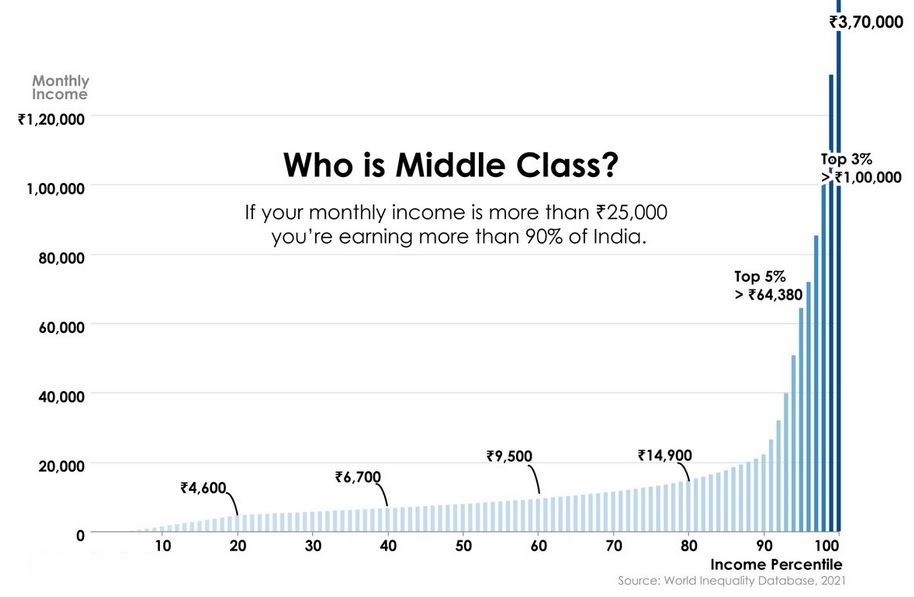
    • Discrepancy in popular estimates: Popular estimates tend to overstate the middle class’s size, obscuring the actual extent.
    • Concentration within the richest deciles: India’s genuine middle class is primarily concentrated within the richest 10 to 20 percent of households rather than uniformly distributed.
    • Concerns about occupation profiles: Instability characterizes the occupation profiles of the richest deciles, with a reliance on small agricultural land and informal non-agricultural occupations.
    • Limited upward mobility: Chief wage earners in the richest deciles demonstrate limited potential for upward mobility into higher-skilled occupations.

    Issues faced by the Indian Middle Class

    • Income Stagnation: Many middle-class individuals in India struggle with stagnant income levels, with limited opportunities for significant wage growth or promotions.
    • Rising Cost of Living: The increasing cost of essential goods and services, including housing, education, healthcare, and transportation, often outpaces income growth, putting financial strain on the middle class.
    • Inflationary Pressures: Inflation rates impact the purchasing power of the middle class, making it challenging to maintain their standard of living and meet their financial obligations.
    • Job Insecurity: Middle-class individuals face concerns about job security, as economic uncertainties and technological advancements lead to changes in job markets and potential layoffs.
    • Healthcare Expenses: Rising healthcare costs and limited access to quality healthcare put a significant burden on the middle class, impacting their financial well-being and ability to seek necessary medical care.

    Consequences of Limited Middle-Class Expansion

    middle class

    • Economic implications: The limited expansion of the middle class hinders the economy from reaching its fullest potential in terms of consumption, investments, and job creation.
    • Inequality concerns: A small middle class contributes to income inequality, as a significant portion of the population remains deprived of upward mobility and economic opportunities.
    • Overreliance on the affluent: The concentration of economic power and consumption within the richest deciles may result in skewed market dynamics and limited inclusivity.

    Strategies for Expanding the Middle Class

    • Enhancing education and skill development: Investing in education and skill-building initiatives to equip individuals with the qualifications needed for higher-skilled occupations.
    • Promoting entrepreneurship and small businesses: Creating an enabling environment for entrepreneurial growth, which can generate jobs and foster economic resilience within the middle class.
    • Strengthening social safety nets: Developing robust social safety nets to provide support during economic downturns and help individuals bounce back without significant setbacks.
    • Addressing informal employment: Implementing policies that promote formalization of employment, providing stability and better benefits for workers.

    Way forward

    • Strengthen financial literacy: Implement comprehensive programs, accessible resources, and collaborations to improve understanding of personal finance.
    • Promote entrepreneurship and innovation: Foster an ecosystem with resources, mentorship, and support for middle-class individuals starting businesses.
    • Build social safety nets: Establish comprehensive programs for unemployment benefits, healthcare coverage, and retraining support during economic shocks.
    • Foster social dialogue: Create platforms for inclusive discussions, partnerships, and collaborations between policymakers, businesses, and the middle class.
    • Prioritize work-life balance: Advocate for family-friendly policies, flexible work arrangements, and support for well-being and productivity.
    • Support family-friendly policies: Implement policies for affordable childcare, parental leave, and flexible work arrangements to support work-life balance.


    Get an IAS/IPS ranker as your 1: 1 personal mentor for UPSC 2024

  • Betelgeuse: The Red Giant Star on the Brink of Supernova

    Betelgeuse

    Central Idea: Recent research has shed light on the Betelgeuse’s current stage and its potential fate as it approaches the end of its lifecycle.

    Betelgeuse: The Bright Red Star in Orion

    • Easily visible in the constellation Orion, Betelgeuse is a bright red star known as “Thiruvathirai” or “Ardra” in Indian astronomy.
    • It is a massive star that undergoes the carbon-burning stage, leading to its eventual collapse into a supernova.

    How is it dying?

    • Massive stars like Betelgeuse exhaust their hydrogen fuel and transition to using helium to create carbon.
    • The energy released during helium fusion is lower than that of hydrogen, requiring the star to burn more helium to maintain stability.
    • Eventually, the helium is depleted, leading to the star’s progression through various burning stages, including carbon and silicon burning.

    Pulsation and Betelgeuse’s Death Throes

    • Researchers studying Betelgeuse have observed its pulsation, indicating its stage of evolution.
    • The observed pulsation aligns with theoretical estimates of the late carbon-burning stage, suggesting that Betelgeuse is in its death throes.
    • Astronomers detect the expansion and contraction of Betelgeuse by analyzing its pulsation and corresponding brightness variations.
    • Previous studies disagreed on which pulsation period is fundamental, with one team considering 417 days and another team proposing 2,190 days.
    • Researchers conclude that it is in the final stage of burning carbon, considering the 2,190-day pulse as fundamental.


    Get an IAS/IPS ranker as your 1: 1 personal mentor for UPSC 2024

  • Global Slavery Index: Controversies with modern Metric

    global slavery
    PC: Indian Express

    Central Idea

    • Report published: Published last week, the global slavery index provides an overview of modern slavery.
    • 50 million people in modern slavery: The report reveals that approximately 50 million individuals were living in “modern slavery” on any given day in 2021.
    • Existing slavery: Out of the 50 million affected, 28 million suffer from forced labor, while 22 million experience forced marriages. Shockingly, 12 million of those impacted are children.

    Definition of Modern Slavery

    • Exploitation and inability to refuse or leave: “Modern slavery” encompasses situations where individuals are exploited and cannot decline or escape due to threats, violence, coercion, deception, or abuses of power.
    • Broad range of abuses: Modern slavery is an umbrella term that covers various forms of exploitation, including forced labor, forced marriage, debt bondage, sexual exploitation, human trafficking, slavery-like practices, forced or servile marriage, and the sale and exploitation of children.

    What is Global Slavery Index?

    • Constructed by Walk Free: The Index is created by Walk Free, a human rights organization.
    • Based on Global Estimates of Modern Slavery: The index relies on data provided by the Global Estimates of Modern Slavery, which is produced by the International Labour Organization (ILO), Walk Free, and the International Organization for Migration (IOM).
    • Fifth edition: The recently published Global Slavery Index is the fifth edition and is based on the estimates from 2022.
    • Country-wise estimates: While initial estimates are regional, the index employs representative surveys to determine country-specific estimates.
    • Metrics: The index examines the prevalence of modern slavery by calculating the incidence per 1000 population.

    Country-wise Findings

    • Highest prevalence of modern slavery: The following ten countries have the highest prevalence: North Korea, Eritrea, Mauritania, Saudi Arabia, Turkey, Tajikistan, United Arab Emirates, Russia, Afghanistan, and Kuwait.
    • Countries with lowest prevalence: Switzerland, Norway, Germany, Netherlands, Sweden, Denmark, Belgium, Ireland, Japan, and Finland have the lowest prevalence of modern slavery.
    • Countries hosting the most people in modern slavery: The top ten countries are India, China, North Korea, Pakistan, Russia, Indonesia, Nigeria, Turkey, Bangladesh, and the United States.

    Criticisms of the Index

    • Lack of internationally agreed definition: One criticism is the absence of a universally accepted definition for modern slavery, unlike trafficking in persons which has an agreed-upon definition.
    • Calculation based on “risk score”: Factors determining the risk often align with those used to classify countries as developed or developing, potentially leading to biased conclusions.
    • Discrepancies in statistics: For instance, the index highlights the UK as having the “strongest government response to modern slavery,” but later mentions a decline in the UK’s overall response and potential violation of international law.

    Challenges faced by developing countries

    • Workers in countries like India: Countries such as India face significant challenges concerning modern slavery, as evidenced by the hardships experienced by workers during the COVID lockdown and subsequent reverse migration.
    • Status of women: Women, particularly in terms of economic freedoms, face significant disparities, contributing to issues related to modern slavery.

    Addressing the Issues

    • Importance of addressing worker precarity: It is crucial to address the precarious situations faced by workers, particularly in the post-pandemic era and during G20 presidencies.
    • Responsibilities of countries: Countries, especially G20 nations, bear the responsibility to combat issues like trafficking and modern slavery, rather than stigmatizing poorer nations and absolving richer nations of their obligations.

    India’s measures against on modern slavery

    • India has passed laws like the Bonded Labour Abolition Act of 1976 to address modern slavery.
    • However, implementation challenges, corruption, legal loopholes, and lack of political hinder effective enforcement of these laws.
    • Moreover, there are lacunas in the proper identification and enumeration of people trapped in modern slavery conditions.

    Way forward

    • Strengthen Measures and Legislation: Enact stronger laws to prevent the sourcing of goods and services associated with modern slavery.
    • Embed Anti-Slavery Measures in Climate Change Plans: Integrate anti-slavery efforts into sustainability plans, acknowledging the link between climate change and vulnerability to modern slavery.
    • Enhance Education and Tighten Regulations: Provide accessible education while tightening regulations on forced labor, child marriage, and exploitative practices.
    • Prioritize Rehabilitation and Support: Prioritize comprehensive support systems for the rehabilitation of bonded laborers, including financial aid, education, job security, and fair compensation.
    • Hold G20 Nations Accountable and Foster Cooperation: Ensure accountability among G20 nations and promote collaborative efforts to eliminate modern slavery.


    Get an IAS/IPS ranker as your 1: 1 personal mentor for UPSC 2024

  • Global Nuclear Arsenal Expansion Race

    nuclear arms stockpile

    Central Idea

    • China’s nuclear arsenal: China increased its nuclear arsenal from 350 warheads in January 2022 to 410 warheads in January 2023, according to SIPRI.
    • Potential ICBM parity: SIPRI suggests that depending on how China structures its forces, it could have a comparable number of intercontinental ballistic missiles (ICBMs) to the U.S. or Russia by the end of the decade.
    • Concerns over stated aim: SIPRI’s Weapons of Mass Destruction Programme questions the alignment between China’s expanding nuclear arsenal and its declared goal of maintaining minimum nuclear forces for national security.

    India and Pakistan’s Nuclear Arsenal Growth

    • India’s nuclear arsenal: SIPRI estimates indicate that India’s nuclear arsenal grew from 160 warheads in 2022 to 164 warheads in 2023.
    • Pakistan’s nuclear arsenal: SIPRI estimates that Pakistan’s nuclear arsenal increased from 165 warheads in 2022 to 170 warheads in 2023.
    • Emphasis on longer-range weapons: India seems to be placing growing importance on longer-range weapons capable of reaching targets across China, while Pakistan remains the primary focus of India’s nuclear deterrent.

    Global Nuclear Weapons Inventory

    • Total global inventory: As of January 2023, the global inventory of warheads reached 12,512.
    • Warheads in military stockpiles: Approximately 9,576 warheads were held in military stockpiles for potential use, representing an increase of 86 warheads compared to January 2022.
    • Dominance of Russia and the U.S.: Russia and the U.S. collectively possess nearly 90% of all nuclear weapons.
    • Stability in nuclear arsenals: The size of Russia’s and the U.S.’ nuclear arsenals remained relatively stable in 2022, although transparency regarding nuclear forces declined due to the Ukraine conflict, as noted by SIPRI.

    Reasons for increased stockpile

    • Shifting power dynamics: China’s significant expansion of its nuclear arsenal has implications for global power dynamics, potentially challenging the traditional dominance of the U.S. and Russia in the nuclear arena.
    • Regional security concerns: China’s increased nuclear capabilities raise concerns among neighboring countries, particularly those involved in territorial disputes or security rivalries in the Asia-Pacific region.
    • Global arms race: China’s nuclear arsenal growth may fuel an arms race in the region, leading to increased tensions and instability.

    Nuclear Dynamics in South Asia

    • Strategic rivalry between India and Pakistan: The nuclear arsenals of India and Pakistan continue to expand, reflecting the ongoing strategic competition and deterrence dynamics between the two countries.
    • Escalation risks: The increase in nuclear capabilities in South Asia raises the potential for miscalculation and escalation, heightening the risk of a nuclear conflict in the region.
    • Implications for regional stability: The growth of nuclear arsenals in India and Pakistan has wider implications for regional stability and the effectiveness of non-proliferation efforts.

    Challenges to the Global Disarmament ideals

    • Declining transparency: The decline in transparency regarding nuclear forces in Russia and the U.S., coupled with the overall increase in global warhead stockpiles, poses challenges to nuclear arms control and disarmament efforts.
    • Erosion of trust: The lack of transparency and increased stockpiles undermine trust between nuclear-armed states, making it more difficult to achieve meaningful progress in disarmament negotiations.
    • Need for renewed dialogue: The growing nuclear arsenals underscore the importance of revitalizing international dialogue on disarmament and strengthening existing arms control agreements.

    Legacy issues

    • Notion of Nuclear ‘Haves’ and ‘Have-Nots’: The proponents of disarmaments are themselves nuclear armed countries thus creating a nuclear monopoly.
    • Concept of Peaceful Nuclear Explosion (PNE): conducted for non-military purposes such as mining.

    India’s commitment for de-nuclearization

    • Universal commitment and non-discriminatory framework: India advocates for nuclear disarmament based on principles of equality, non-discrimination, and global security.
    • Working paper on Nuclear Disarmament: India submitted a working paper on Nuclear Disarmament to the UN General Assembly in 2006, presenting its perspectives and proposals for achieving global disarmament.
    • Participation in Nuclear Security Initiatives: India actively engages in the Nuclear Security Summit process and supports efforts to enhance global nuclear security through participation in international conferences organized by the IAEA.
    • Membership in the Nuclear Security Contact Group: India is a member of the Nuclear Security Contact Group, contributing to discussions and initiatives aimed at strengthening international cooperation on nuclear security.
    • Support for Fissile Material Cut-off Treaty (FMCT): India expresses readiness to support negotiations on a Fissile Material Cut-off Treaty, considering it an important step towards disarmament by banning the production of fissile material for nuclear weapons.
    • Concerns regarding the Comprehensive Nuclear-Test-Ban Treaty (CTBT): India has not joined the CTBT due to several concerns, but it remains open to addressing these concerns and exploring possibilities for future accession to the treaty.
    • Leadership in Preventing Weapons of Mass Destruction (WMD) Proliferation: India actively leads efforts to prevent terrorists from acquiring WMDs, piloting an annual UNGA Resolution on “Measures to Prevent Terrorists from Acquiring Weapons of Mass Destruction” since 2002, which receives consensus adoption.

    Way forward

    • Strengthening non-proliferation efforts: The expansion of nuclear arsenals highlights the need for robust non-proliferation mechanisms and adherence to international agreements such as the Treaty on the Non-Proliferation of Nuclear Weapons (NPT).
    • Managing nuclear risks: As the number of nuclear-armed states increases, effective risk management and confidence-building measures become crucial to prevent accidental or intentional use of nuclear weapons.
    • Balancing deterrence and disarmament: The international community faces the challenge of striking a balance between maintaining credible deterrence and pursuing disarmament goals to ensure global security.


    Get an IAS/IPS ranker as your 1: 1 personal mentor for UPSC 2024

  • CoWIN Vaccination Data Breached

    cowin

    Central Idea

    • Data breach reports: The Health Ministry, on Monday, refuted claims of a data breach of COVID vaccination beneficiaries, stating that such reports were baseless and mischievous in nature.
    • Investigation by CERT-In: The Indian Computer Emergency Response Team (CERT-In) has been asked to investigate the alleged data breach issue and submit a report to ascertain the facts.
    • Assurance of data safety: The Ministry maintains that the CoWIN (Covid Vaccine Intelligence Network) portal is completely safe, equipped with adequate safeguards to protect data privacy.

    About CoWIN

    • Development: CoWIN was developed and is owned and managed by the Ministry of Health.
    • Policy decisions: The Empowered Group on Vaccine Administration (EGVAC), chaired by the former CEO of the National Health Authority, oversees this. It includes members from the Health Ministry and MeitY (Ministry of Electronics and Information Technology).

    Evaluation of Alleged Breach

    • CERT-In review results: The review conducted by CERT-In concludes that there was no direct breach of the CoWIN app or database.
    • Data source of Telegram bot: The data accessed by the Telegram bot was sourced from a separate threat actor database, which contained previously breached or stolen data.
    • No direct breach of CoWIN: The Ministry states that it does not appear that the CoWIN app or database itself was directly breached.

    Clarification on CoWIN Data Access

    • Three methods of data access: The Ministry outlines the three ways in which data can be accessed on the CoWIN portal: user access, vaccinator access, and authorized third-party applications.
    • Data sharing with Telegram bot: The Ministry clarifies that data cannot be shared with the Telegram bot without undergoing the one-time password (OTP) authentication process.
    • Limited data collection: CoWIN only collects the year of birth and does not capture a person’s address.

    Unanswered Questions and API Access

    • Uncertainty regarding recent breaches: The Ministry has not explicitly clarified whether the CoWIN database was breached recently or in the past.
    • Lack of insights on bot accuracy: The Ministry’s statement does not offer insight into the accuracy of the Telegram bot’s retrieval of citizens’ data from the CoWIN database.
    • API access without OTP: The Ministry admits the existence of an API that allows data sharing without OTP, but emphasizes that requests are accepted only from trusted whitelisted APIs.

    Concerns and Aadhaar Data

    • Accuracy of Aadhaar details: The accuracy of displaying Aadhaar numbers corresponding to mobile numbers raises concerns, as the government has never publicly acknowledged any breaches of Aadhaar data.
    • Need for clarity: The Ministry’s statement does not provide clarity on how the Telegram bot accurately displayed Aadhaar numbers.
    • Addressing security concerns: The Ministry should address concerns regarding the security of Aadhaar data and provide transparency on its safety measures.

    Future Steps and Data Governance Policy

    • Empowering CERT-In: The Health Ministry has requested a final report from CERT-In to investigate the alleged data breach incident thoroughly.
    • National Data Governance policy: The Ministry highlights the finalization of the National Data Governance policy, which aims to establish a common framework for data storage, access, and security standards across the government.
    • Awaited response from CERT-In: The Ministry is awaiting a response from CERT-In regarding the issue, which will provide further insights into the nature of the breach.

    Assurance and Previous Leaks

    • Assurances of secure infrastructure: Health authorities maintain that CoWIN has state-of-the-art secure infrastructure and has never experienced a security breach.
    • Dismissal of previous claims: Previous claims of data leaks, such as the ‘Dark Leak Market’ incident, were dismissed by health authorities, emphasizing the safety of citizen data.
    • Security measures in place: CoWIN has implemented security measures such as web application firewall, regular vulnerability assessments, and OTP authentication to ensure the protection of data.

    Implications of this data leak

    • Identity theft risks: The leaked data exposes individuals to the risk of identity theft, as sensitive information can be misused for fraudulent activities.
    • Targeted scams and phishing attacks: With access to personal details, scammers may attempt targeted scams and phishing attacks, leading to financial loss and potential harm to individuals.
    • Loss of trust in government systems: The data breach undermines public trust in the government’s ability to safeguard sensitive information, affecting confidence in the vaccination program and other government initiatives.
    • Reputational damage: The incident could tarnish the reputation of the CoWIN platform and associated government agencies, affecting their credibility in managing sensitive data.
    • Impact on future vaccination drive: Concerns about data security may deter individuals from participating in the vaccination program, slowing down efforts to control the spread of COVID-19.
    • Calls for accountability: The data leak prompts demands for accountability from the responsible government agencies and the implementation of stricter measures to protect citizen data.

    Conclusion

    • The data leak incident related to the CoWIN portal raises serious concerns about the privacy and security of individuals’ personal information.
    • While the Ministry of Health maintains that the CoWIN app and database were not directly breached, the access to sensitive data through a Telegram bot raises questions about the integrity of the system.


    Get an IAS/IPS ranker as your 1: 1 personal mentor for UPSC 2024

  • IIT-M generates Hydrogen from Seawater

    hydrogen

    Central Idea

    • Researchers from IIT-Madras have developed components for a cost-effective method of electrolyzing seawater to produce green hydrogen.
    • The current alkaline water electrolyzer technology is energy-intensive, requires an expensive oxide-polymer separator, and uses fresh water.

    Generating Green Hydrogen

    • Instead of using fresh water, the researchers developed an electrolyzer that utilizes alkaline seawater.
    • Carbon-based support material was used for the electrodes to minimize corrosion.
    • Transition metal-based catalysts were designed to catalyze both oxygen and hydrogen evolution reactions, improving the production of hydrogen and oxygen.
    • A cellulose-based separator was developed to allow hydroxide ions to pass through while preventing crossover of oxygen and hydrogen.

    How does Electrolysis take place?

    • The alkaline water electrolyzer involves two half-reactions at the anode and cathode.
    • At the cathode, water dissociates into H+ and hydroxide ions, with H+ ions converting into hydrogen.
    • Hydroxide ions produced at the cathode pass through the separator, and oxygen is generated at the anode.
    • When seawater is used, hypochlorite formation occurs at the anode, causing corrosion and reducing oxygen production. Impurities also affect the hydrogen evolution reaction at the cathode.

    How were the Catalyst and Electrode designed?

    • The carbon-based support material was used for both anode and cathode electrodes to prevent corrosion.
    • The catalyst coating on the support material enhances hydrogen production at the cathode and oxygen production at the anode.
    • Transition bimetals in the catalyst are selective toward oxygen evolution reaction, overcoming the challenge of hypochlorite formation.
    • Despite impurities adsorbed on the cathode, the catalyst promotes hydrogen evolution, increasing hydrogen production.

    What made this device novel?

    • The team developed a cellulose-based separator to separate the anode and cathode.
    • The separator allows hydroxide ions to pass through but minimizes the crossover of hydrogen and oxygen.
    • The separator shows high resistance to degradation in seawater.

    Experimental Results and Performance

    • The assembled electrolyzer achieved a seawater splitting voltage of 1.73 V at 10 mA/sq.cm and 26 degrees C.
    • The optimized parameters enable the electrolyzer to directly use photovoltaic-derived voltage for green hydrogen production.
    • Two prototypes of different dimensions were developed, producing hydrogen at rates of 250 ml/hour and 1 liter/hour.
    • A stack of three cells produced hydrogen at a rate of about 4 liters/hour.

    Back2Basics: Hydrogen Categories

    Production Method Carbon Emissions
    Gray Hydrogen Steam Methane Reforming (SMR) from fossil fuels High emissions
    Blue Hydrogen Steam Methane Reforming (SMR) from fossil fuels with carbon capture and storage (CCS) or carbon capture utilization and storage (CCUS) Reduced emissions compared to gray hydrogen
    Green Hydrogen Electrolysis using renewable energy sources (solar, wind, hydro) No carbon emissions
    Turquoise Hydrogen Methane pyrolysis from fossil fuels with carbon capture and storage (CCS) or carbon capture utilization and storage (CCUS) Reduced emissions compared to gray hydrogen
  • Project Akashteer: Indian’s Air Defence Upgrade

    akashteer akash

    Central Idea

    • Reorientation of focus: Indian Army shifts focus from western to northern borders following 2020 standoff with China.
    • Lessons from Ukraine conflict: Insights from ongoing war in Ukraine are influencing transformation of Army Air Defence (AAD).
    • Induction of new systems: New systems are being inducted to enhance air defence capabilities.

    What is Project Akashteer?

    • Networking and automation: Project Akashteer aims to establish networking and automation capabilities similar to Indian Air Force’s system.
    • Comprehensive air defence picture: Project Akashteer focuses on building a comprehensive air defence picture for monitoring, tracking, and engaging air defence assets.
    • Implementation target: The project aims to complete implementation by March 2024 for integration of radars, control centres, and weapons.

    Shifting Focus and New Technology

    • Shift in focus: Indian Army shifts focus from western border to northern borders.
    • Mountainous air defence requirements: The need for lightweight radars and mobile weapon systems to cater to requirements in mountainous regions.
    • Consideration of new threats: Insights from Ukraine conflict prompt consideration of new threats such as UAVs, loitering munitions, swarm drones, and cruise missiles.

    Induction of New Systems

    • Improved Akash surface-to-air missile systems: Contract signed for two regiments of improved Akash systems to enhance air defence capabilities.
    • Collaboration with Israel: Collaboration with Israel for the induction of medium-range surface-to-air missile project.
    • Development of quick reaction systems: Indigenously developing quick reaction surface-to-air missile (QRSAM) to meet critical air defence needs.
    • Exploration of air defence guns: Ongoing efforts to procure air defence guns to strengthen air defence capabilities.

    Challenges and Indigenization

    • Component shortage: Global shortage of components and hardware due to the Ukraine conflict affecting the pace of inductions.
    • Emphasis on indigenization: Focus on promoting indigenization and reducing dependence on imports for air defence systems.
    • Revitalization of modernization: Revival of Army Air Defence modernization with emphasis on indigenous development and procurement.

    Significance of the project

    • Strengthened air defence capabilities: Focus on enhancing air defence capabilities for robust border security.
    • Improved monitoring and coordination: Integration and automation initiatives enhance monitoring, coordination, and situational awareness.
    • Enhanced border preparedness: Contribution to enhanced border preparedness and response capabilities.

    Way forward

    • Continued research and development: Focus on continuous research and development to stay ahead of evolving threats and challenges.
    • International collaboration: Collaboration with international partners to incorporate advanced air defence systems and technologies.
    • Integration of advanced technologies: Integration of technologies like AI and machine learning to enhance air defence operations and effectiveness.
    • Innovation and efficiency: Focus on innovation, efficiency, and effectiveness in future air defence strategies.
  • Fruit Flies: Unveiling their Contributions to Science and Medicine

    fruit

    Central Idea

    • Flies’ negative perception: Fruit flies often considered annoying pests, but their significance in biological and medical science is immense.
    • Economic and environmental importance: Flies, including fruit flies, play crucial roles as pollinators for plants and contribute to decomposition processes.

    Fruit Flies (Drosophila melanogaster)

    • Overview: Fruit or vinegar fly species known for its nuisance during summer.
    • Scientific significance: Drosophila melanogaster is a well-understood animal organism globally and has contributed to numerous Nobel Prize-winning discoveries in physiology and medicine.

    Partnership between Science and Flies

    • Early collaborations with flies: Biologist Thomas Hunt Morgan’s experiments with fruit flies revolutionized evolutionary and genetic research.
    • Discoveries in genetics: Fruit flies provided insights into genetic mutations, inheritance patterns, and the mapping of genes on chromosomes.
    • Understanding biological processes: Studies in fruit flies helped unravel mechanisms of development, gene regulation, and protein synthesis.

    Insights from Drosophila Research

    • Embryo studies: Microscopic examination of Drosophila embryos aided in understanding genetic defects and gene networks that control development.
    • Contribution to genetic medicine: Research on fruit flies helped decipher the genetic code, map DNA structure, and investigate inherited disorders.
    • Remarkable genetic similarity: Fruit flies and humans share striking biological similarities, allowing for the study of human biology and disease in flies.

    Versatility and Applications of Drosophila Research

    • Efficient and cost-effective research: Fruit flies offer a fast and versatile model organism for studying various aspects of human biology and disease.
    • Neuroscience and behavioral research: Fruit flies provide insights into learning, memory, sleep, aggression, addiction, and neural disorders.
    • Broad range of applications: Fruit flies are used to study cancer, aging, development, gut microbiome, stem cells, muscles, and the heart.

    Bridging Knowledge Gaps

    • Complementary to human studies: Fruit flies serve as a bridge to understanding complex human diseases and physiological processes.
    • Insights into neurodegenerative diseases: Although flies cannot fully mimic personality loss in Alzheimer’s disease, they contribute to studying neuronal death and related mechanisms.

    Paradigm for Scientific Discoveries

    • Accelerating research in complex organisms: Knowledge gained from fruit flies can be applied to more complex organisms, expediting scientific progress.
    • Global research community: Over 10,000 researchers worldwide utilize fruit flies for diverse areas of study, enriching our understanding of human biology and disease.

    Shifting Perspectives

    • Appreciating the significance: Fruit flies, despite their annoyance, play a vital role in advancing scientific knowledge and medical breakthroughs.
    • Rethinking flies’ presence: Viewing fruit flies in a different light, recognizing their value in research and their contributions to understanding the world around us.