Mains Ready By December. Smash Mains & Smash PYQ Admissions Open

GS Paper: GS2-18.Bilateral, regional and global groupings and agreements involving India and/or affecting India’s interests.

  • What is India’s current policy of multi alignment? Advantages and challenges

    Multi alignmentContext

    • Forthcoming Shanghai Cooperation Organization (SCO) summit in Samarkand, Uzbekistan is leading India to multi alignment.

    Background

    • India’s journey of foreign policy from being the founder of non-alignment to the multi-alignment. In his book The India Way, External Affairs Minister S. Jaishankar offers a critique of India’s traditional policy of “non-alignment”, where he distinguishes between the “optimistic  non- alignment ” of the past, which he feels has failed, that must give way to more realistic “multiple engagements of the future”.

    Shanghai Co-operation Organization (SCO)

    • SCO is a Eurasian political, economic and security organization.
    • It is the world’s largest regional organization,
    • 40% of the world population
    • More than 30% of global GDP.
    • Members: 8-China, Kazakhstan, Kyrgyzstan, Russia and Tajikistan, Uzbekistan, India and Pakistan.

    Multi alignmentSCO SUMIIT, 2022

    • Host- Uzbekistan,
    • Uzbekistan will host a full house: 15 leaders including eight member states from four Central Asian States, China, India, Pakistan and Russia,
    • The observer states: Belarus, Mongolia and Iran (which will become member this year) —
    • Afghanistan is not invited
    • Leaders of guest countries -Armenia, Azerbaijan, Turkey and Turkmenistan

    What is non- alignment?

    • It’s a policy, a brainchild of Nehru. Non-alignment movement emerged after second world war.
    • Non-alignment means not having an alliance with any of superpower, either USSR or USA.  Decolonized nations of Asia and Africa was largely a part of this group.

    Multi alignmentIndia’s policy of non-alignment

    • At bandung conference in 1955 non-alignment movement started with India as one of the founding member.
    • With policy of non-alignment India refused to gravitate towards USA or USSR.
    • India was the leader of non-alignment.

    What is India’s current policy of multi- alignment? Advantages and challenges.

    • Since the start of his tenure from 2014, Prime Minister Narendra Modi have not attended any conference of non-alignment.
    • External Affairs Minister Dr. S. Jaishankar in his book, The Indian way have criticized the non-alignment.
    • In the words of Former Foreign Secretary Vijay Gokhale India is no longer the non-align nation.

    How it is a Multi alignment policy?

    • India to truly multi aligned or all aligned by being a part of every major grouping.
    • India is a part of BRICS and Prime Minister Modi is attending the SCO SUMMIT in Samarkand.
    • On parallel to rival groups India is also the part of Quad and Indo pacific economic framework.
    • India is buying the discounted Russian oil and reusing to buckle under pressure from west and USA.
    • S-400 purchase is happening and India have dodged the bullet of sanctions from USA.
    • India is choosing the bilateral Free trade agreement like with Australia and UAE and withdrew from groupings like RCEP and Most recently IPEF. This policy are is said to be in the economic interest of India.

    Advantages of Multi alignment

    • India no longer wants to repeat the mistake of missing out of P5 Security council (“Permanent membership in the Security Council was granted to five states based on their importance in the aftermath of World War II).
    • If any group work against your interest it is better to be part of group rather than remain outside and do nothing
    • With retreating USA and its collapsing hegemony world is moving towards multiple polar world order.

    Disadvantages

    • Major disadvantage of non-alignment is you no longer have influence over adverse policy of friendly country.
    • For example. Russia sells S-400 to India but it also sold the same weapon to china.
    • USA and India are strategically getting closer day by day but USA recently approved the sale of $450 million F-16 fighter jets to Pakistan.

    Conclusion

    • Multi alignment will serve India its best national interest.
    • So far India has managed the rival parties at world stage to secure its foreign policy objectives but with Russian aggression and Chinese assertion and divided world will pose a significant challenge to India’s multi alignment policy.


    Mains question

    Q. What do you understand by non-alignment and multi-alignment? Analyze the shift In India’s foreign policy from non-alignment to multi-alignment.

    UPSC 2023 countdown has begun! Get your personal guidance plan now! (Click here)

  • G4 countries call for UNSC reforms

    g4

    The G4 nations have said that the Intergovernmental Negotiations on UN Security Council reform are constrained by a lack of openness and transparency.

    Who are the G4 Countries?

    • The G4 nations, comprising Brazil, Germany, India, and Japan are four countries which support each other’s bids for permanent seats on the United Nations Security Council.
    • Their primary aim is the permanent member seats on the Security Council.
    • Each of these four countries have figured among the elected non-permanent members of the council since the UN’s establishment.
    • Their economic and political influence has grown significantly in the last decades, reaching a scope comparable to the permanent members (P5).

    Deterrent in their cause

    • The UK and France have backed the G4’s bid for permanent seats.
    • All the permanent members of P5 have supported India’s bids for permanent seat.
    • However, China has previously implied that it is only ready to support India if it does not associate its bid with Japan.
    • The US has sent strong indications to Brazil that it is willing to support its membership; albeit, without a veto.

    What holds them back?

    • There has been discontent among the present permanent members regarding the inclusion of controversial nations or countries not supported by them.
    • For instance, Japan’s bid is heavily opposed by China, North Korea, Russia and South Korea who think that Japan needs to make sincere reparations for war crimes committed during World War II.
    • Under the leadership of Italy, countries that strongly oppose the G4 countries’ bids have formed the Uniting for Consensus movement, also called as Coffee Club.
    • In Asia, Pakistan opposes India’s bid.

    Why India deserves a permanent seat?

    • India has been part of UN since inception.
    • It has the world’s second-largest population and is the world’s largest democracy suited to represent South Asia.
    • It has contributed maximum peacekeepers to UN so far.

    Why reform UNSC?

    • Non-representative nature: UNSC in current form is not representative of developing world and global needs, with primacy of policy being political tool in hands of P5, is well recognised globally.
    • Contention over Veto and Technical Holds: Veto power with P5 enables any one of them to prevent the adoption of any “substantive” draft Council resolution, regardless of its level of international support.
    • Divided institution: UNSC has become an organisation, which can pass strong resolutions against weak countries, weak resolutions against strong countries and no resolution against P5 countries.

    Conclusion

    • There is a possibility that if UN doesn’t reform itself, it may lose relevance and alternate global and regional groupings may assume greater importance.
    • More global pressure from middle powers like G4 may force an expansion of UNSC as a possibility, but abolition of veto power in current set up is unlikely

    Back2Basics: United Nations Security Council (UNSC)

    • The UNSC is one of the six principal organs of the United Nations and is charged with the maintenance of international peace and security.
    • Its powers include the establishment of peacekeeping operations, the establishment of international sanctions, and the authorization of military action through Security Council resolutions.
    • It is the only UN body with the authority to issue binding resolutions to member states.
    • The Security Council consists of fifteen members. Russia, the United Kingdom, France, China, and the United States—serve as the body’s five permanent members.
    • These permanent members can veto any substantive Security Council resolution, including those on the admission of new member states or candidates for Secretary-General.
    • The Security Council also has 10 non-permanent members, elected on a regional basis to serve two-year terms. The body’s presidency rotates monthly among its members.


    UPSC 2023 countdown has begun! Get your personal guidance plan now! (Click here)

  • What is the Plant Treaty?


    The ninth session of the governing body of the International Treaty on Plant Genetic Resources for Food and Agriculture (ITPGRFA) has recently begun in New Delhi.

    Theme of this years event

    • The theme of the meeting is ‘Celebrating the Guardians of Crop Diversity: Towards an Inclusive Post-2020 Global Biodiversity Framework’.

    What is the Plant Treaty?

    • The International Treaty on Plant Genetic Resources for Food and Agriculture (ITPGRFA) was adopted by the Food and Agriculture Organization of the United Nations November 3, 2001.
    • It was signed in 2001 in Madrid, and entered into force on 29 June 2004.
    • It is the first legally-binding international instrument to formally acknowledge the enormous contribution of indigenous people and small-holder farmers as traditional custodians of the world’s food crops.
    • It also calls on nations to protect and promote their rights to save and use the seeds they have taken care of for millennia.
    • The parties to this treaty have come together after nearly three years to discuss governance of agricultural biodiversity and global food security.

    Objectives of the treaty

    The treaty aims at:

    1. Guaranteeing food security through the conservation
    2. Exchange and sustainable use of the world’s plant genetic resources for food and agriculture (PGRFA)
    3. Fair and equitable benefit sharing arising from its use, as well as
    4. Recognition of farmers’ rights.

    Key feature: Annex 1 Crops

    • The treaty has implemented a Multilateral System (MLS) of access and benefit sharing, among those countries that ratify the treaty, for a list of 64 of some of the most important food and forage crops essential for food security and interdependence.
    • The genera and species are listed in Annex 1 to the treaty. The treaty facilitates the continued open exchange of food crops and their genetic materials.
    • The list of plant genetic material included in the Multilateral System of the Treaty is made of major food crops and forages.
    • The Forages are also divided in legume forages and grass forages.
    • They were selected taking into account the criteria of food security and country interdependence


    UPSC 2023 countdown has begun! Get your personal guidance plan now! (Click here)

  • Eastern Economic Forum (EEF)

    eef

    Russia hosted the seventh Eastern Economic Forum- EEF Vladivostok from September 5 to 8. The four-day forum is a platform for entrepreneurs to expand their businesses into Russia’s Far East (RFE).

    What is the Eastern Economic Forum-EEF?

    • The EEF was established in 2015 aiming to encourage foreign investments in the RFE to display:
    1. Economic potential
    2. Suitable business conditions and
    3. Investment opportunities in the region
    • Focus areas: The agreements focus on infrastructure, transportation projects, mineral excavations, construction, industry and agriculture.
    • With EEF, Russia is trying to attract the Asian economies in investing and developing the Far East.
    • This year, the Forum aimed at connecting the Far East with the Asia-Pacific

    What does the EEF aim for?

    eef

    • FDI inflows: The primary objective of the EEF is to increase the Foreign Direct Investments in the RFE.
    • Natural resource exploitation: The region encompasses one-third of Russia’s territory and is rich with natural resources such as fish, oil, natural gas, wood, diamonds and other minerals.
    • Demographic revamp: The sparse population living in the region is another factor for encouraging people to move and work in the Far East.
    • Unleashing economic potential: The region’s riches and resources contribute to five percent of Russia’s GDP.

    Success of EEF

    • Agreements signed at the EEF increased from 217 in 2017 to 380 agreements in 2021, worth 3.6 trillion roubles.
    • As of 2022, almost 2,729 investment projects are being planned in the region.
    Who are the major actors in the EEF?
    • China is the biggest investor in the region as it sees potential in promoting the Chinese Belt and Road Initiative and the Polar Sea Route in the RFE.
    • China’s investments in the region account for 90% of the total investments.
    • South Korea has invested in shipbuilding projects, manufacturing of electrical equipment, gas-liquefying plants, agricultural production and fisheries.
    • Japan is another key trading partner. In 2017, its investments through 21 projects amounted to $16 billion.

    How does Russia see Chinese investment in EEF?

    • Russia has been welcoming Chinese investments since 2015; more now than ever due to the economic pressures caused by the war in Ukraine.
    • The Trans-Siberian Railway has further helped Russia and China in advancing trade ties.
    • The countries share a 4000-km-long border, which enables them to tap into each other’s resources with some infrastructural assistance.
    • China is also looking to develop its Heilongjiang Province which connects with the RFE.
    • Both nations have invested in a fund to develop connectivity between the cities of Blagoveshchensk and Heihe.

    India and Russia’s Far East

    • India seeks to expand its influence in the RFE.
    • In 2019, India also offered a $1 billion line of credit to develop infrastructure in the region.
    • During the forum, PM Modi expressed the country’s readiness in expanding trade, connectivity and investments in Russia.
    • India is keen to deepen its cooperation in energy, pharmaceuticals, maritime connectivity, healthcare, tourism, the diamond industry and the Arctic.

    Strategic significance of EEF for Russia

    • Gateway to Asia: The RFE is geographically placed at a strategic location; acting as a gateway into Asia.
    • Negating the Ukrainian war impact: The Ukraine war is a worrying issue as it affects the economic growth of the country.
    • Surviving sanctions: Although, the EEF is an annual gathering, the forum comes at an opportune time for Russia who is dealing with the impact of the sanctions.
    • Supply chain resilience: The IPEF will also play a key role in building resilient supply chains.

    Will India be able to strike a balance between the EEF and IPEF?

    • Both are incomparable: The US-led Indo-Pacific Economic Framework for Prosperity (IPEF) and the EEF are incomparable based on its geographic coverage and the partnership with the host-countries.
    • India values both: India has not shied away from investing in the Russia-initiated EEF despite the current international conditions.
    • India is firm for its purpose: At the same time, India has given its confirmation and acceptance to three of the four pillars in the IPEF.

    Conclusion

    • India understands the benefits of being involved in the development in the RFE but it also perceives the IPEF as a vital platform to strengthen its presence in the Indo-Pacific region.
    • India’s participation in the forum will help in disengaging from supply chains that are dependent on China and will also make it a part of the global supply chain network.


    Also read:

    [Sansad TV] Perspective: Russia’s Far East- Opportunities for India


    UPSC 2023 countdown has begun! Get your personal guidance plan now! (Click here)

  • G20 summit will open pandora of opportunities

    G20 summitContext

    • India is going to be at the centre stage of geopolitical spectrum as India will be hosting G20 summit presidency from December 2022. As Harsh V. Shringla, India’s chief G20 coordinator and former Foreign Secretary, (Amitabh kant is G20 Sherpa of India) recently said, “Our G20 Presidency would place India on the global stage, and provide an opportunity for India to place its priorities and narratives on the global agenda.”

    What is G20 (Group of Twenty)?

    • Composed of most of the world’s largest economies: 19 countries plus European Union, including both industrialized and developing nations. Together, its members represent more than 80% of the world’s GDP, 75% of international trade and 60% of the world’s population.
    • Role: To address major issues related to the global economy such as international financial stability, climate change mitigation, and sustainable development.
    • It is an Intergovernmental forum.
    • Strategic role: The G20 holds a strategic role in securing global economic growth and prosperity.

    G20 summitIndia and the presidency of G20 summit

    • In November this year, the 17th G20 Heads of State and Government Summit will take place in Bali.
    • After Indonesia, India will assume the presidency of the G20 from December 1, 2022 to November 30, 2023.
    • By hosting the summit of the G20, India will have the opportunity to assume centre stage in proposing and setting the global agenda and discourse.
    • India can assert its political, economic and intellectual leadership while hosting the G20 presidency.
    • Further it Provides India an opportunity to also champion the causes of developing and least developed countries.
    • India could invite and engage countries from Africa and South America to ensure better and more balanced representation at the G20.

    G20 summitChallenges before India:

             Global

    • World affected by the pandemic: Uneven vaccine availability has been flagged by many countries. Vaccine issue upset some countries.
    • Ukraine conflict: According to external affairs ministers Dr.S.Jaishankar due to Ukraine  conflict world is divided and this poses the challenge for India to bring rival camp on same stage
    • Climate change: Divergent view of developed and developing countries on climate change can be the bone of contention between west and the rest.
    • The rise of an assertive China: To maintain the delicate balance between NATO, G7 on the on hand while Russia and china on the other (as India is part of both QUAD and SCO).

         Domestic

    • Economic challenges: Such as stagflation, unemployment, exchange rate, declining prospects for exports and rising trade deficit.
    • Terrorism: Cross border terrorism emanating from Pakistan.

    Indonesia has focused on three key pillars in its presidency of G20 presidency:

    • Global health architecture: president of Indonesia Joko Widodo talked about a global contingency fund for medical supplies, building capacity in developing countries to manufacture vaccines and the creation of global health protocols and standards.
    • Sustainable energy transition: as part of its roadmap to reach net zero by 2060, Indonesia had slashed the coverage area of forest fires sevenfold. The country has restored peatlands and rehabilitated 50,000 hectares of mangrove forests.
    • Digital transformation

    What India can address?

    • Issues of global concern: Terrorism, climate change, stagflation etc.
    • Domestic and regional: economic recovery, trade and investment, unemployment, patent waivers on diagnostics, therapeutics, vaccines etc.
    • Greater co-operation and co-ordination: free trade agreements, supply chain resilience mechanism, stressing on green and digital transformations in the economy and its impact on societal well-being.
    • Other important Areas :such as technology transfer, assistance towards green economy, greater access to trade for developing countries, addressing debt distress of countries by offering sustainable aid and loan programmes, tackling food and energy prices/security for vulnerable economies etc.

    Why G20 summit presidency is an opportunity for India?

    • India exchange the G20 presidency with Indonesia and chose 2023 instead of 2022 to host the G20 countries.
    • India wanted to showcase its prowess in its 75th year of independence as cornerstone of new emerging world order. As India is part of Quad and SCO BRICS -the warring factions at world stage, it’s an opportunity in crisis to become the bridge of the divided world.
    • India is hosting the summit in Kashmir. World media will be in the Kashmir. In the direct message to world India will again assert that Kashmir is an integral part of India.

    Way ahead

    • As India will be hosting G20 and SCO summits, India will be central in outlining key priority areas. India can assert its political, economic and intellectual leadership which will have to address issues that help in cement the Fault-line in the world order.
    • India’s leadership could define the coming years and decades of global discourse and avenues of cooperation.

    Other related Information

    SCO (Shanghai Co-operation Organization):

    • The Shanghai Cooperation Organization (SCO) is a Eurasian political, economic and security organization. It is the world’s largest regional organization, 40% of the world population, and more than 30% of global GDP.
    • Members: The Shanghai Five group was created on 26 April 1996; China, Kazakhstan, Kyrgyzstan, Russia and Tajikistan, Uzbekistan, India and Pakistan.

    QUAD:

    • Known as the ‘Quadrilateral Security Dialogue’ (QSD), the Quad is an informal strategic forum comprising four nations, namely – United States of America (USA), India, Australia and Japan.
    • One of the primary objectives of the Quad is to work for a free, open, prosperous and inclusive Indo-Pacific region.

    G7:

    • The Group of Seven (G7) is an inter-governmental political forum consisting of Canada, France Germany, Italy, Japan, the United Kingdom and the United States. In addition, the European Union is a ‘non-enumerated member.

    Mains Question

    Q. India can take advantage of G20 for its economic growth and security architecture. Discuss.

    UPSC 2023 countdown has begun! Get your personal guidance plan now! (Click here)

  • India stays out of ‘Trade Pillar’ of IPEF

    India stayed out of the joint declaration on the trade pillar of the US-led Indo-Pacific Economic Framework (IPEF) ministerial meet in Los Angeles, with Union Commerce Minister citing concerns over possible discrimination against developing economies.

    Why did India opt out of the trade pillar?

    • One of the reasons for staying out of the trade pillar was that the contours of the framework had not emerged yet.
    • This is particularly about the kind of commitment each country would have to make on “environment, labour, digital trade and public procurement”.
    • India’s decision also mirrors the decision to walk out after seven years of negotiations from the Regional Comprehensive Economic Partnership (RCEP).

    What is IPEF?

    • It is a US-led framework for participating countries to solidify their relationships and engage in crucial economic and trade matters that concern the region, such as building resilient supply chains battered by the pandemic.
    • It is not a free trade agreement. No market access or tariff reductions have been outlined, although experts say it can pave the way to trade deals.

    Members of IPEF

    • The member nations include Australia, Brunei, India, Indonesia, Japan, South Korea, Malaysia, New Zealand, the Philippines, Singapore, Thailand and Vietnam.
    • It includes seven out of 10 members of the Association of South East Asian Nations (ASEAN), all four Quad countries, and New Zealand.
    • Together, these countries account for 40 per cent of the global GDP.

    Four pillars of IPEF

    1. Trade that will include digital economy and emerging technology, labor commitments, the environment, trade facilitation, transparency and good regulatory practices, and corporate accountability, standards on cross-border data flow and data localisations;
    2. Supply chain resilience to develop “a first-of-its-kind supply chain agreement” that would anticipate and prevent disruptions;
    3. Clean energy and decarbonization that will include agreements on “high-ambition commitments” such as renewable energy targets, carbon removal purchasing commitments, energy efficiency standards, and new measures to combat methane emissions; and
    4. Tax and anti-corruption, with commitments to enact and enforce “effective tax, anti-money laundering, anti-bribery schemes in line with [American] values”.

    How do members participate?  

    • Countries are free to join (or not join) initiatives under any of the stipulated pillars but are expected to adhere to all commitments once they enrol.
    • Negotiations are meant to determine and list the provisions under each pillar and open the floor for countries to choose their ‘commitments’.
    • The framework would be open to other countries willing to join in the future provided they are willing to adhere to the stipulated goals and other necessary obligations.

    Reasons for the creation of IPEF

    • US regaining lost credibility: IPEF is also seen as a means by which the US is trying to regain credibility in the region after Trump pulled out of the Trans Pacific Partnership TPP).
    • Rising Chinese influence: Since then, there has been concern over the absence of a credible US economic and trade strategy to counter China’s economic influence in the region.
    • Competing RCEP: It is also in the 14-member Regional Comprehensive Economic Partnership, of which the US is not a member (India withdrew from RCEP).
    • “Pivot to Asia” strategy: US has intensified its engagement with the wider Asia-Pacific region to advance its economic and geopolitical interests.

    India’s perception of IPEF

    • PM Modi described the grouping as born from a collective desire to make the Indo-Pacific region an engine of global economic growth.
    • India has called for common and creative solutions to tackle economic challenges in the Indo-Pacific region.

    What does it have to do with China?  

    • The US strategists believe the US lacks an economic and trade strategy to counter China’s increasing economic influence in the region since 2017.
    • US companies are looking to move away from manufacturing in China.
    • IPEF would therefore offer an advantage to participating countries, allowing them to bring those businesses into their territory.
    • However, it officially excluded Taiwan despite its willingness and economic merit to join.
    • This exhibits Washington’s geopolitical caution.

    Reactions from the opponents

    • Chinese Foreign Minister Wang Yi criticized the initiative as an attempt to further economic decoupling from China.
    • He argued that the initiative, and the US Indo-Pacific strategy as a whole, created divisions and incited confrontation. It is destined to be ultimately be a failure.
    • Taiwan was excluded in order to appease key “fence-sitter” countries such as Indonesia whose governments feared angering China.

    Issues with IPEF framework

    • IPEF would neither constitute a ‘free trade agreement,’ nor a forum to discuss tariff reductions or increasing market access.
    • Unlike a traditional trade agreement, the US administration will not need congressional approval to act under the IPEF. Hence its legal status is questionable.
    • This also raises doubts among potential participants about their reluctance to offer significant concessions under the agreement.
    • The volatility of US domestic politics has raised concerns about IPEF’s durability.
    • Unlike traditional FTAs, the IPEF does not subscribe to the single undertaking principle, where all items on the agenda are negotiated simultaneously.

    Given the divisive nature of American politics, it is unclear whether the IPEF will survive past the Biden administration.

    Way forward

    • The IPEF’s launch in Tokyo was symbolic in nature; bringing the IPEF to fruition will involve significant domestic and international challenges.
    • Without ratification by Congress, the IPEF’s fortunes will remain in limbo.
    • Going forward, the US and the founding partners need to develop the process and criteria by which other countries from the region will be invited to join the negotiations on the IPEF.


    UPSC 2023 countdown has begun! Get your personal guidance plan now! (Click here)

  • PM Modi to attend SCO meet

    sco

    PM Modi will travel to Samarkand in Uzbekistan to attend the first in-person summit of the SCO (Shanghai Cooperation Organisation) countries since the COVID-19 pandemic.

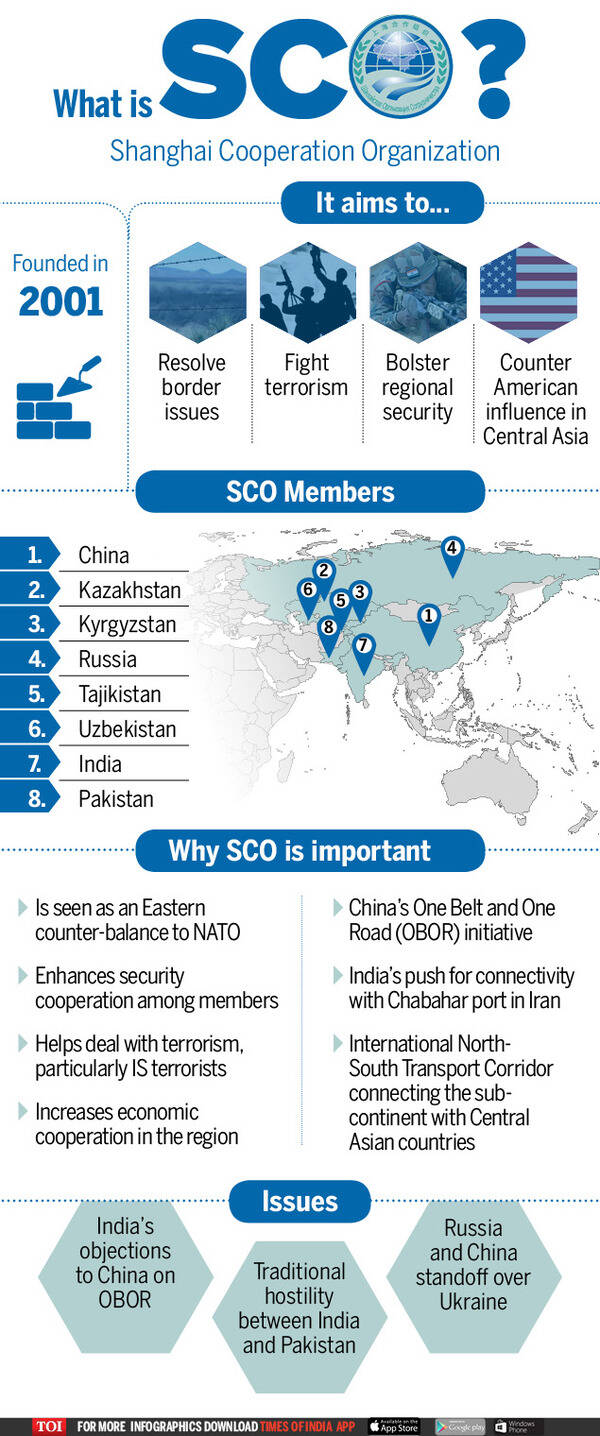
    What is SCO?

    • After the collapse of the Soviet Union in 1991, the then security and economic architecture in the Eurasian region dissolved and new structures had to come up.
    • The original Shanghai Five were China, Kazakhstan, Kyrgyzstan, Russia and Tajikistan.
    • The SCO was formed in 2001, with Uzbekistan included. It expanded in 2017 to include India and Pakistan.
    • Since its formation, the SCO has focused on regional non-traditional security, with counter-terrorism as a priority.
    • The fight against the “three evils” of terrorism, separatism and extremism has become its mantra. Today, areas of cooperation include themes such as economics and culture.

    India’s entry to the SCO

    • India and Pakistan both were observer countries.
    • While Central Asian countries and China were not in favor of expansion initially, the main supporter — of India’s entry in particular — was Russia.
    • A widely held view is that Russia’s growing unease about an increasingly powerful China prompted it to push for its expansion.
    • From 2009 onwards, Russia officially supported India’s ambition to join the SCO in 2017.
    • China then asked for its all-weather friend Pakistan’s entry.

    Changing the narrative of SCO

    Infographic: Shanghai Cooperation Organisation: An Explainer - Times of India

    • There has been discussion in the international arena that the trend of non-alignment is back.
    • NATO is based on Cold War thinking.
    • The logic of NATO is creating new enemies to sustain its own existence.
    • However, SCO is a cooperative organisation based on non-alignment and not targeting a third party.

    India and SCO: Present status

    • India will host the SCO summit next year, and Varanasi has been selected as the SCO region’s first “Tourism and Cultural Capital”.
    • India will also be chairing the summit.


    UPSC 2023 countdown has begun! Get your personal guidance plan now! (Click here)

  • India Bangladesh Relations

    bangladeshContext

    • Bangladesh PM Sheikh Hasina’s four-day visit to India to boost bilateral ties.

    India-Bangladesh ties background

    • India’s links with Bangladesh are civilization, cultural, social and economic.
    • There is much that unites the two countries – a shared history and common heritage, linguistic and cultural ties, passion for music, literature and the arts.
    • India was one of the first countries, along with Bhutan, to recognise Bangladesh as a sovereign state on 6 December 1971.
    • It is also worth recalling that India shares its longest border of 4,096.7 kilometres with Bangladesh, which is also the fifth-longest border in the contemporary world.

    bangladeshTrade between two

    • CEPA: Trade will be a focal point during Ms. Hasina’s visit as the two countries gear up to sign a Comprehensive Economic Partnership Agreement.
    • Bangladesh dependency: Bangladesh imports critical industrial raw material from India on which its exports are reliant.
    • Leveraging Indian support: Bangladesh also could improve several manufacturing industries by leveraging Indian expertise in service sectors.

    bangladeshConnectivity

    • IMT highway: Bangladesh has expressed its interest in joining the India-Myanmar-Thailand highway project.
    • Waterway: India-Bangladesh bilateral waterway trade will get boosted as India can now use the Mongla and Chittagong ports.
    • Logistics: India’s Northeast and Bangladesh is important for bilateral cooperation. Currently, three express trains and international bus services operate between Indian and Bangladesh.

    Key data to remember

    Bangladesh is India’s sixth largest trade partner with bilateral trade rising from $2.4 billion in 2009 to $10.8 billion in 2020-21.

    Regional geopolitics

    • Chinese influence: Chinese inroads into the neighbourhood have been a cause of worry for India. China has been actively pursuing bilateral ties with Bangladesh. Bangladesh had successfully approached China for a mega project to enhance Teesta river water flow.
    • Strategic location: From the perspective of India’s Northeast, Bangladesh is India’s most strategic neighbour, whom New Delhi cannot ever afford to ignore.
    • Cooperation needed: India’s dream of ‘Act East Policy’ can only be materialized with the helping hands of Dhaka.
    • Gateway to northeast: The bridge ‘Maitri Setu’ has been built over the Feni River which flows between the Indian boundary in Tripura State and Bangladesh. It is set to become the ‘Gateway of North East’ with access to Chittagong Port of Bangladesh, which is just 80 kms from Sabroom.

    Way forward

    • The future will present itself with an abundance of opportunities to help the two countries to reach a new plane of bilateral relations higher than ever before.
    • Both nations should play their diplomatic cards with more maturity and pragmatism, keeping the regional aspirations and nuances of both countries in mind.
    • A judicious aggregation of regional expectations on both sides of the border will help in achieving their mutual national objectives.
    • To make the recent gains irreversible, both countries need to continue working on the three Cs — cooperation, collaboration, and consolidation.

    Conclusion

    • For India it will take more than cosy relations with one particular government to have long-term stable relations with its most trusted friend in the neighbourhood.

    Mains question

    Q. Do you think Bangladesh is most trusted friend in the neighbourhood? Discuss bilateral relations between two in terms of trade, connectivity and geopolitics.

    UPSC 2023 countdown has begun! Get your personal guidance plan now! (Click here)

  • QUAD

    New Delhi will host an official-level meeting of the Quad grouping with the US, Japan and Australia next week, the first such “senior officers meeting” (SOM) to be held since the recent escalation of tensions over the Taiwan Strait.

    Quadrilateral Security Dialogue: A Backgrounder

    Quadrilateral Security Dialogue or the Quad is an informal strategic forum between the United States, Japan, India and Australia that is maintained by semi-regular summits, information exchanges and military drills between member countries.

    • The US, Japan, India and Australia came together in the aftermath of the 2004 Indian Ocean tsunami to assist the devastated countries.
    • Later, officials of the four countries met in 2007 “to look at issues of common interest.” During an India visit, then Japanese PM Shinzo Abe unveiled the idea of “the Confluence of the Two Seas” that gave birth to the concept of the Indo-Pacific.
    • A decade later officials of the four countries met in the Philippines in 2017 to talk about an aggressively rising China.
    • In 2019, the foreign ministers of the Quad countries met in Washington for the first time.
    • In November, the Quad nations came together to participate in a two-phase joint military exercise, Malabar 2020, in the Bay of Bengal and in the Arabian Sea.

    Now it is increasingly viewed as ‘Asian NATO’.

    Focus on Indo-Pacific: For the China-wary world

    • The latest meeting of Quad comes at a time when all four countries have either trade or security disputes with China.
    • Despite not explicitly mentioning China, Quad has been openly supporting a “free and fair” Indo-Pacific which is seen as a clear message to Beijing that it needs to curb its assertive behaviour.
    • The optics were hard to miss when India, the US, Japan and Australia joined their navies for the mega Malabar military exercise late last year, an activity which raised alarm in Beijing.
    • This posturing by the Quad nations sent a strong signal to China.

    (1) US vs China

    • USA had followed a policy to contain China’s increasing influence in East Asia. Therefore, USA sees the coalition as an opportunity to regain its influence in the Indo-Pacific region.
    • The US has described China, along with Russia, as a strategic rival in its National Security Strategy, National Defence Strategy and the Pentagon’s report on Indo-Pacific Strategy.
    • Both are navigating intense disagreements over trade and human rights in Tibet, Hong Kong and the western Xinjiang region, as well as the coronavirus pandemic and increasing Chinese assertiveness in the South China Sea.

    (2) Australia vs China

    • Australia is concerned about China’s growing interest in its land, infrastructure and politics, and influence on its universities.
    • Ties have been on a downward spiral since 2018 when Australia, accusing China of meddling in its domestic affairs, passed a new law against foreign interference and espionage.
    • It also barred Huawei from building the country’s 5G mobile network, among the first countries to do so, citing national security.
    •  The atmosphere worsened when  PM Scott Morrison’s government called for an international inquiry into the origins of the coronavirus that causes Covid-19.

    (3) Japan vs. China

    • Tensions between Japan and China over the Senkaku/Diaoyu Islands dispute have recently increased.
    • China has relentlessly continued attempts to unilaterally change the status quo by coercion in the sea area around the Senkaku Islands.
    • The more salient indicator is the number of Chinese patrols inside the territorial sea of the islands, which Japan sees as an explicit violation of its territorial sovereignty.

    (4) India vs. Quad

    • India’s strained relations with China needs no explanation. The year long border dispute is the testimony.
    • The Quad summit is taking place in the backdrop of an ongoing military disengagement between India and China following their months-long border standoff in eastern Ladakh.
    • China is increasing its footprint in our neighborhood through its Belt and Road policy and political coercion following the debt trap are some of the increasing concerns other than economic imbalance.

    Opportunities unveiled for India

    India’s engagement with the Quad goes back to China’s expanding footprint in South Asia and the Indian Ocean Region over the last few years. India can reap some benefits as discussed below:

     (1) Checkmating the Chinese

    • The maritime sphere is wide open to India to undertake coalition building, rule sets, and other forms of strategic exploration than compared to land borders.
    • The maritime space is more important to China than engaging in land grab attempts in the Himalayas. A huge chunk of Chinese trade happens via the Indian oceanic routes that pass through maritime chokepoints.

    (2) Channelizing geo-politics

    • There is a growing great power interest in the maritime sphere, especially with the arrival of the concept of ‘Indo-Pacific’. For instance, many European countries have recently released their Indo-Pacific strategies.
    • The most recent was for France to send its warship in the international waters of the South China Sea.

    (3) Maritime domain for India

    • Above is the backdrop against which one must see the progressive evolution of Exercise “Malabar”,
    • In the beginning, it was a bilateral event involving just the Indian and US navies. It became tri-lateral with the inclusion of Japan in 2015.
    • And now it has transformed into a four-cornered naval drill that will also include Australia.

    (4) Check on China’s India Ocean Ambitions

    • The Quad has a valuable role to play as a check on China’s Indian Ocean ambitions.
    • India must develop ingrained habits of interoperable cooperation with its Quad partners.
    • This interoperable cooperation could pre-emptively dissuade China from mounting a naval challenge in its backyard.

    (5) Eccentricity in South Asia

    • With India, located right at the centre of the Indo-Pacific geopolitical imagination can realize the vision of a ‘broader Asia’ that can extend its influence away from geographical boundaries.
    • Further, India with Quad countries can check the imperialist policies of China in the Indian Ocean region and ensure Security and growth for all in the region.

    Issues with Quad

    (1) Structural problems

    • The Quad has a core structural problem as its objective pivots around the U.S.
    • The Quad riles China as a hostile grouping, but hardly serves the security interests of its members.
    • Despite rhetoric relating to the promotion of a ‘rules-based’ world order, the Quad neither shares a strategic vision nor is it animated by a shared agenda.

     (2) Nature of alliance

    • Alliances involve written commitments to come to the defence of the other against a third party.
    • Despite the potential for cooperation, the Quad remains a mechanism without a defined strategic mission.

    (3) Economic alliance not feasible

    • Quad is neither a military alliance nor an economic partnership.
    • Its intention to counter China in the rare-earth sector is logical given the dominant role the country plays in supplying more than half of the world’s such key materials.
    • But, for a country like India, the lack of relevant technologies and talent pool could obstruct its progress in building up a supply chain from scratch.

     (4) Overt emphasis on Maritime domain

    • The entire focus on the Indo-Pacific makes the Quad a maritime, rather than a land-based grouping, raising questions whether the cooperation extends to the Asia-Pacific and Eurasian regions.
    • India’s core concerns with China are primarily undemarcated borders and trade deficit.

     (5) Lack of existence of Indo-Pacific system

    • There has never been Indo-Pacific system ever since the rise of the port-based kingdoms of Indochina in the first half of the second millennium.
    • There were two Asian systems — an Indian Ocean system and an East Asian system — with intricate sub-regional balances.
    • The effort by a U.S. to artificially manufacture to combine the Indo and the Pacific into a unitary system is unlikely to succeed.

    (6) Indian borders can go more vulnerable

    • A lesson for India is China’s long-held and strategic interest in parts of Jammu and Kashmir.
    • It is wrongly argued that it is Pakistan that is the issue in J&K.
    • China undoubtedly is as big an issue but has quietly hidden behind Pakistan’s cover.

    Challenges: China will retaliate

    (1) China’s assertiveness

    • China claims that it has historical ownership over nearly the entire region of South China Sea, which gives it the right to manufacture islands.
    • However, the International Court of Arbitration rejected the claim in 2016.
    • Since then, the incidences of Chinese transgression has only increased making China more assertive for its interest.

    (2) Preying small nations

    • The ASEAN countries have a well-knit relationship with China. So are other SAARC countries have fallen prey to Chinese debt traps.
    • The Regional Cooperation Economic Partnership (RCEP) is a recent example of China’s increasing influence over ASEAN nations to which Australia is even a forerunner.

    (3) Chinese monopoly

    • Considering the economic might of China and the dependence of Quad nations like Japan and Australia on China, the Quad nations cannot afford to have strained relations with it in the long run.
    • India too, is still very heavily dependent on Chinese exports.

    Way Forward

    • Need for a clearer vision: It is important for members of the Quad not to be reactive. It is also important to exhibit openness, and ensure that all talk of a ‘Free and Open Indo-Pacific’ is more than just a mere slogan.
    • Consensus for a common objective: The Quad nations need to better explain the Indo-Pacific Vision in an overarching framework with the objective of advancing everyone’s economic and security interests.
    • Setting an agenda: This will reassure the littoral States that the Quad will be a factor for regional benefit, and a far cry from Chinese allegations that it is some sort of a military alliance. Future meetings can be an opportunity to define the idea and chart a future path.
    • Expanding Quad: India has many other partners in the Indo-Pacific; therefore India should pitch for countries like Indonesia, Singapore to be invited to join in the future. There is also a vital need to economically expand the Quad.


    UPSC 2023 countdown has begun! Get your personal guidance plan now! (Click here)

  • Nord Stream Pipeline to remain shut

    Russian has said that it can‘t resume the supply of natural gas through a key pipeline to Germany for now because of what it said was a need for urgent maintenance work.

    Why in news?

    • There are growing concerns in European countries that Russia would shut down its gas supplies in retaliation against the current sanctions against Moscow.

    What is Nord Stream 1?

    • It is a system of offshore natural gas pipelines running under the Baltic Sea from Russia to Germany.
    • Nord Stream 1 is a 1,224 km underwater gas pipeline that runs from Vyborg in northwest Russia to Lubmin in northeastern Germany via the Baltic Sea.
    • Two further pipelines under construction running from Ust-Luga to Lubmin termed Nord Stream 2.
    • Majority owned by the Russian energy giant Gazprom, the pipeline is the primary route through which its gas enters Germany.

    Worry for Europe

    • There have been growing concerns that there could be further restrictions to European gas supplies.
    • European countries rely on Russian energy for their cold winters.
    • But now they believe that Russia could weaponized their dependency as a response to their sanction due to the conflict in Ukraine.

    What are Europe’s alternative sources of energy?

    • As an alternative source for energy, European countries have increasingly turned towards the US, from whom they purchase liquified natural gas (LNG) that comes via ships.
    • Since ship-delivered gas ends up being far more expensive, there are also attempts to get non-Russian pipeline gas from Norway and Azerbaijan.
    • While EU countries were earlier seeking to phase out fossil fuels and emphasize renewable forms of energy, many are now returning to coal to deal with the energy crisis.


    UPSC 2023 countdown has begun! Get your personal guidance plan now! (Click here)