Mains Ready By December. Smash Mains & Smash PYQ Admissions Open

GS Paper: GS2-18.Bilateral, regional and global groupings and agreements involving India and/or affecting India’s interests.

  • What is EDISON Alliance?

    The World Economic Forum (WEF) has announced the launch of an Essential Digital Infrastructure and Services Network (EDISON) Alliance.

    The peculiarity of name ‘EDISON Alliance’ creates a hotspot here for prelims.  UPSC may either crate confusion over purpose or parent organization. The alliance is yet to take shape completely; hence there is an ambiguity over its members.

    EDISON Alliance

    • Geneva-based World Economic Forum (WEF), which describes itself as an international organization for public-private partnership, will serve as the secretariat and platform for the EDISON Alliance.
    • A wider group of ‘Champions Leaders’ will advise and support the Alliance, the WEF said while announcing the launch.
    • Alliance aims to work towards ensuring global and equitable access to the digital economy.
    • Its prime goal is to ensure an unprecedented level of cross-sectoral collaboration between the technology industry and other critical sectors of the economy, according to the WEF.

    Why need such an alliance?

    • Access to digital technologies has enabled many to work, learn and live during the COVID-19 pandemic.
    • However, the pandemic has exposed and exacerbated existing gaps and inequalities in almost half of the global population.
    • Some 3.6 billion people, remain offline and broadband services are too expensive for 50 percent of the population in developed countries, the WEF said.
    • This hampers access to health, education, and economic inclusion.
  • Pursuing national interests, at the UN high table

    The article highlights India’s challenges at the UNSC in its 2 year stint.

    India’s agenda at the UNSC

    • India’s two-year non-permanent stint at the UNSC should be viewed as a once-in-a-decade opportunity to clearly identify and pursue its national interests regionally and globally.
    • India’s entry into the UNSC coincides with the emergence of a new world order.
    • Under new world order, there is systemic uncertainty, little care for global commons, absence of global leadership, the steady division of the world into rival blocs, pursuit of narrow national interests.
    • Efforts by Biden administration in the United States may go on to ameliorate some of the harsh impact of this global order.
    • The UNSC has also reached a point wherein its very relevance is in serious doubt.
    • India too is no longer an ardent believer in the fantastical claims about a perfect world at harmony with itself, nor is it a timid observer in global geopolitics.
    • India’s pursuit of its interests at the UNSC should, therefore, reflect its material and geopolitical limitations, and its energies should be focused on a clearly identified agenda.

    Factors determining India’s agenda at the UNSC

    1) Rivalry with China

    • India’s tenure at the UNSC comes in the wake of its growing military rivalry with China.
    • China’s opposition to having India chair the Counter-Terrorism Committee (CTC) in 2022 was a precursor to the things to come ahead.
    • The next two years will be key to ensure checking further Chinese incursions along the Line of Actual Control and building up enough infrastructure and mobilising sufficient forces in the forward areas.

    2) Relations with Russia

    • Greater Indian alignment with the West at the UNSC, an unavoidable outcome, could, however, widen the growing gulf between Russia and India.
    • It might not be possible for India to sit on the fence anymore.
    • Fence sitting would bring more harm than goodwill in an international system where battlelines are sharpening by the day.

    3) Terrorism issue

    • Terror is likely to be a major focus for India at the UNSC.
    • External Affairs Minister’s statement at the UNSC Ministerial Meeting on the 20th Anniversary of Security Council Resolution 1373 and the establishment of the Counter Terrorism Committee has set the stage for New Delhi’s approach on the issue.
    • India recently assumed the chair of the Taliban sanctions committee which assumes significance given the fast-moving developments in Afghanistan.
    • India must formulate its policy towards terrorism with far more diplomatic finesse and political nuance especially given that it is chairing the Taliban sanctions committee while courting the very same Taliban.

    4) Coalition of like-minded states and setting the agenda for next decade

    • India should use the forum and its engagement there to build coalitions among like-minded states and set out its priorities for the next decade — from climate change to non-proliferation.
    • India should use its bargaining power at the UNSC to pursue its national interests in other forums and domains as well.
    • India’s UNSC strategy should involve shaping the narrative and global policy engagement vis-à-vis — the Indo-Pacific.
    • Given India’s centrality in the Indo-Pacific region and the growing global interest in the concept, New Delhi would do well to take it upon itself to shape the narrative around it.
    • In doing so, it should, through the UNSC and other means, court Moscow once again and assuage its concerns about the Indo-Pacific.

    Way forward

    • India’s pursuit of its national interest at UNSC must also be tempered by the sobering fact that the UNSC is unlikely to admit new members any time soon, if ever at all.
    • A glance at the recent debates on UNSC reforms and the state of the international system today should tell us that bending over backwards to please the big five to gain entry into the UNSC will not make a difference.

    Consider the question “What agenda should India pursue at the UNSC in its two year non-permanent stint? What are the challenges in pursuing such agenda?”

    Conclusion

    India must focus its energies on what it can achieve during the short period that it would be in the UNSC rather than what it wishes happened.

  • Intergovernmental Negotiations (IGN) at UNSC

    Seeking urgent reform of the United Nations Security Council (UNSC), India has highlighted the failure of the Intergovernmental Negotiations (IGN) since 13 years of its establishment.

    Note various countries in the various groups.

    What is the news?

    • India, along with Brazil, Japan and Germany are pressing for urgent reform of the UNSC and for a permanent seat in the reformed 15-member top organ of the world body.
    • India has said that the UNSC is finding itself unable to act effectively to address increasingly complex issues of international peace and security.
    • The UNSC lacks inclusivity of those who need to be members of the powerful organ of the world body.

    What is IGN?

    • The Intergovernmental Negotiations framework or IGN is a group of nation-states working within the United Nations to further reform of the UNSC.
    • The IGN is composed of several different international organizations, namely:
    1. African Union (55 member states)
    2. G4 nations (Brazil, Germany, India and Japan)
    3. Uniting for Consensus Group (UfC), also known as the “Coffee Club” (it aims to counter the bids for permanent seats proposed by G4 nations, includes Pakistan, Turkey, Canada, Spain and Italy)
    4. L69 Group of Developing Countries ( it includes developing countries from Africa, Latin America and the Caribbean, Asia and the Pacific)
    5. Arab League (six members: Egypt, Iraq, Jordan, Lebanon, Saudi Arabia, and Syria) and
    6. Caribbean Community ( a group of 15 member countries called CARICOM)
  • Ratle Hydroelectric Project

    The Centre has decided to go ahead with the long-pending 850-megawatt Ratle hydroelectric power project on the river Chenab in J&K Kishtwar district, despite objections raised by the Pakistan government over the same.

    Tap to read more about Indus River System

    Ratle Hydel Plant

    • It is a run-of-the-river hydroelectric power station currently under construction on the Chenab River, downstream of the village near Drabshalla in Kishtwar district of the Indian UT of Jammu and Kashmir.
    • The project includes a 133 m (436 ft) tall gravity dam and two power stations adjacent to one another.
    • The installed capacity of both power stations will be 850 MW.
    • In June 2013, then PM Manmohan Singh laid the foundation stone for the dam.
    • Pakistan has frequently alleged that it violates the Indus Water Treaty.

    What is the Indus Water Treaty?

    • The Indus Waters Treaty is a water-distribution treaty between India and Pakistan, brokered by the World Bank signed in Karachi in 1960.
    • According to this agreement, control over the water flowing in three “eastern” rivers of India — the Beas, the Ravi, and the Sutlej was given to India.
    • The control over the water flowing in three “western” rivers of India — the Indus, the Chenab, and the Jhelum was given to Pakistan
    • The treaty allowed India to use western rivers water for limited irrigation use and unrestricted use for power generation, domestic, industrial, and non-consumptive uses such as navigation, floating of property, fish culture, etc. while laying down precise regulations for India to build projects
    • India has also been given the right to generate hydroelectricity through the run of the river (RoR) projects on the Western Rivers which, subject to specific criteria for design and operation is unrestricted.
  • India-Nepal relations in a new transition

    India-Nepal Joint Commission meeting took place at a time when Nepal in going through a political turmoil. The article examines the issues discussed in the meeting and how its implications for the bilateral relations between the two countries.

    India-Nepal joint commission meeting amid political chaos in Nepal

    • Recently, the Minister for Foreign Affairs of Nepal visited New Delhi for the sixth meeting of the India-Nepal Joint Commission.
    • Nepal’s Prime Minister dissolved the House of Representatives in late December 2020, the move was termed ‘unconstitutional’ by the experts and the country’s Supreme Court is hearing writ petitions against the move.
    • As a unique characteristic, Nepal’s internal political fundamentals continue to shape its foreign policy choices. 
    • In such a scenario, any inbound or outbound delegation is seen from a different prism.

    Issues discussed in the meeting

    1) Progress on the development partnership front

    • On the development partnership front, the expansion of the Motihari-Amlekhganj petroleum products pipelines to Chitwan and the establishment of a new pipeline on the eastern side connecting Siliguri to Jhapa in Nepal formed a part of the discussions.
    • The operating procedures for commencement of train services of the first passenger railway line between India and Nepal from Jaynagar to Kurtha via Janakpurhave have been discussed.
    • Other cross-border rail connectivity projects, including a possible Raxaul-Kathmandu broad gauge railway line, were also discussed.
    • The joint hydropower projects, including the proposed Pancheshwar Multipurpose Project, should get positive momentum following this round of meetings.

    2) Facilitating the cross-border movement of people

    • The recently inaugurated Integrated Check Posts (ICPs) at Birgunj and Biratnagar have helped in the seamless movement of people and trade between the two countries.
    • The construction of a third integrated check post at Nepalgunj has already commenced, while the new integrated check post at Bhairahwa would begin shortly.
    • Since Nepal relies on India’s seaports in a big way for trading, and goods are transported by road, the integrated check posts are expected to ease trade and transit.

    3) Border issue

    • Nepali side’s demand to include the boundary in the Joint Commission Meeting.
    • However, India made it clear to find a fresh mechanism to resolve any such crucial long-pending issue.

    4) New direction to bilateral ties

    • India’s support for two more cultural heritage projects in Nepal, namely, the Pashupatinath Riverfront Development and the Bhandarkhal Garden Restoration in Patan Durbar is significant.
    • Nepal expressed support for India’s permanent membership of an expanded UN Security Council (UNSC) to reflect the changed balance of power.
    • The next meeting of the Joint Commission in Nepal should be crucial in giving a new direction to the bilateral ties, keeping a balance between change and continuity.

    India’s deepening engagement with all sections

    • There is growing disenchantment among the Nepali masses over the increased centralization of power, failure of the Provincial System in addressing the developmental issues, misuse of Presidential authority, and unprecedented corruption.
    • While the unusual developments are taking place in Nepal, there are many who still think that India is comfortable with some changes as its Nepal policy is heading very clearly towards a deeper engagement with all sections.

    Consider the question “How India-Nepal ties are affected by the internal political fundamentals in Nepal? What approach should be adopted by India in dealing with Nepal?” 

    Conclusion

    Nepal cannot afford to enter into another round of political instability, and those who have commanding authority to spearhead India-Nepal bilateral relations must give a humane consideration to it. At the crossroads, Nepal needs action and to come to terms with realities.

  • UK invites India to attend G7 Summit

    The United Kingdom has invited PM Modi to attend the G7 summit that is scheduled to be held in June.

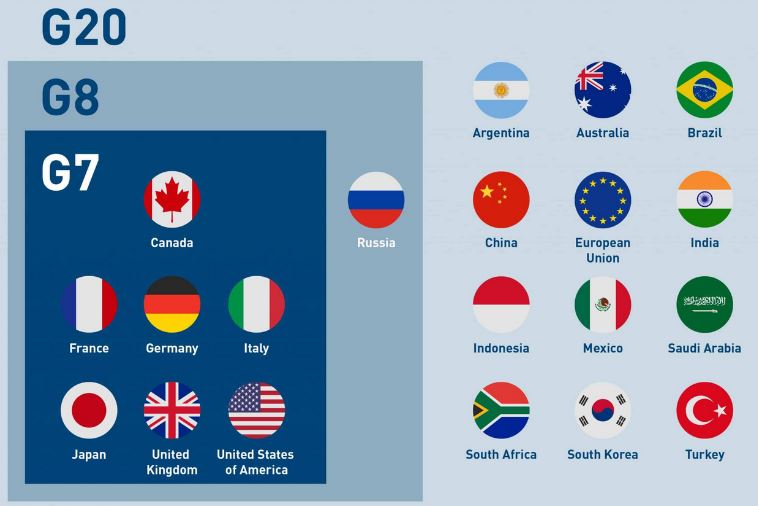
    Note the members of G7 and G20. UPSC may puzzle you asking which G20 nation isn’t a member of G7.

    G7 Countries

    • The G-7 or ‘Group of Seven’ includes Canada, France, Germany, Italy, Japan, the United Kingdom, and the United States.
    • It is an intergovernmental organisation that was formed in 1975 by the top economies of the time as an informal forum to discuss pressing world issues.
    • Initially, it was formed as an effort by the US and its allies to discuss economic issues.
    • The G-7 forum now discusses several challenges such as oil prices and many pressing issues such as financial crises, terrorism, arms control, and drug trafficking.
    • It does not have a formal constitution or a fixed headquarters. The decisions taken by leaders during annual summits are non-binding.
    • Canada joined the group in 1976, and the European Union began attending in 1977.

    Evolution of the G-7

    • When it started in 1975—with six members, Canada joining a year later—it represented about 70% of the world economy.
    • And it was a cozy club for tackling issues such as the response to oil shocks.
    • Now it accounts for about 40% of global GDP.
    • Since the global financial crisis of 2007-09, it has sometimes been overshadowed by the broader g20.
    • The G-7 became the G-8 in 1997 when Russia was invited to join.
    • In 2014, Russia was debarred after it took over Crimea.

    Significance of G7 for India

    • India will get more voice, more influence, and more power by entering the G7.
    • After the UN Security Council (UNSC), this is the most influential grouping.
    • If the group is expanded it will collectively address the humongous issues created by the Wuhan virus,
    • Diplomatically, a seat at the high table could help India further its security and foreign policy interests, especially at the nuclear club and UN Security Council reform as well as protecting its interests in the Indian Ocean.

    Back2Basics: The G-20

    • The G-20 is a larger group of countries, which also includes G7 members.
    • The G-20 was formed in 1999, in response to a felt need to bring more countries on board to address global economic concerns.
    • Apart from the G-7 countries, the G-20 comprises Argentina, Australia, Brazil, China, India, Indonesia, Mexico, Russia, Saudi Arabia, South Africa, South Korea, and Turkey.
    • Together, the G-20 countries make up around 80% of the world’s economy.
    • As opposed to the G-7, which discusses a broad range of issues, deliberations at the G-20 are confined to those concerning the global economy and financial markets.
    • India is slated to host a G-20 summit in 2022.
  • Russia withdraws from Open Skies Treaty

    Russia has announced that it was pulling out of the Open Skies Treaty, saying that the pact had been seriously compromised by the withdrawal of the United States.

    The New START, INF and now the OST …. Be clear about the differences of these treaties. For example- to check if their inception was during cold war era etc.

    Open Skies Treaty (OST)

    • OST is an agreement that allows countries to monitor signatories’ arms development by conducting surveillance flights over each other’s territories.
    • The idea behind the OST was first proposed in the early years of the Cold War by former U.S. President Dwight Eisenhower.
    • It came to existence decades later and was signed in 1992, during the George H.W. Bush presidency and after the Soviet Union had collapsed.
    • The OST came into effect in 2002 under the George W. Bush administration and it allows its 34 signatories to conduct unarmed reconnaissance flights over the territory of treaty countries.

    Issues with the OST

    • The U.S. has used the treaty more intensively than Russia.
    • Between 2002 and 2016, the U.S. flew 196 flights over Russia (in addition to having imagery from other countries) compared to the 71 flights flown by Russia.
  • Nepal once again raises Kalapani Boundary Issue

    Nepal has raised the Kalapani boundary dispute with India during the Joint Commission meeting of the Foreign Ministers.

    Q.The India-Nepal bilateral relations these days are increasingly seen through the lens of China factor. Examine.

    Kalapani Boundary Issue

    • Mapped within Uttarakhand is a 372-sq km area called Kalapani, bordering far-west Nepal and Tibet.
    • A treaty signed between Nepal and British India in 1816 determined the Makhali river, that runs through Kalapani, as the boundary between the two neighbours.
    • The Treaty of Sugauli concluded between British India and the Kingdom of Nepal in the year 1816, maps the Makhali River as the western boundary with India.
    • But different British maps showed the source of the tributary at different places which were mainly due to underdeveloped and less-defined surveying techniques used at that time.
    • However, the river has many tributaries that meet at Kalapani. For this reason, India claims that the river begins at Kalapani but Nepal says that it begins from Lipu Lekh pass, which is the source of most of its tributaries.
    • While the Nepal government and political parties have protested, India has said the new map does not revise the existing boundary with Nepal.
    • India claims that the river begins at Kalapani but Nepal says that it begins from Lipu Lekh pass, which is the source of most of its tributaries.

    Legal Dimension of Issue

    According to International Laws, the principles of avulsion and accretion are applicable in determining the borders when a boundary river changes course.

    • Avulsion: It is the pushing back of the shoreline by sudden, violent action of the elements, perceptible while in progress. Also, it can be defined as the sudden and perceptible change in the land brought about by water, which may result in the addition or removal of land from a bank or shoreline.
    • Accretion: It is the process of growth or enlargement by a gradual buildup. It is the natural, slow and gradual deposit of soil by the water.

    If the change of the river course is rapid – by avulsion – the boundary does not change. But if the river changes course gradually – that is, by accretion – the boundary changes accordingly.

    Since, the Gandak change, of course, has been gradual, India claimed Susta as part of their territory as per international laws.

    • On several occasions, India has tried to resolve the issue through friendly and peaceful negotiations, but the Nepali leadership has always shown hesitation in resolving the issue.
    • In Nepal, the issue has become a tool for arousing strong public sentiment against India. Therefore, resolving the issue may not be in the best interest of Nepal’s domestic politics.

    Significance for India

    • The Lipu Lekh pass serves strategic importance for India as a key point to monitor Chinese troop movement.
    • The link road via Lipulekh Himalayan Pass is also considered one of the shortest and most feasible trade routes between India and China.
    • The Nepalese reaction would probably have triggered in response to Chinese assertion.

    An undefined boundary claimed by Nepal

    • Nepal’s western boundary with India was marked out in the Treaty of Sugauli between the East India Company and Nepal in 1816.
    • Nepali authorities claim that people living in the low-density area were included in the Census of Nepal until 58 years ago.
    • Five years ago, Nepali Foreign Minister had claimed that the late King Mahendra “handed over the territory to India”.
    • By some accounts in Nepal, this allegedly took place in the wake of India-China War of 1962.

    Must read:

    [Burning Issue] India-Nepal Border Row

  • Reclaiming SAARC

    The article examines the issues are making it difficult to function and suggests its revival.

    Dysfunctional SAARC and its implications

    • The year 2020 marked the sixth year since the leaders of the eight nations that make up SAARC were able to meet.
    • India-Pakistan issues have impacted other meetings of SAARC as well.
    • Inactive SAARC is making it easier for member countries, as well as international agencies, to deal with South Asia as a fragmented group.
    • India’s refusal to allow Pakistan to host the SAARC summit is akin to giving Pakistan a ‘veto’ over the entire SAARC process.
    • The events of 2020, particularly the novel coronavirus pandemic and China’s aggressions at the Line of Actual Control (LAC) shone a new spotlight on this mechanism.
    • This should make the government review its position and reverse that trend.

    Reasons India should review its position on SAARC

    1) India attend other forums with Pakistan

    • India continued to attend Shanghai Cooperation Organisation (SCO) meetings along with their Pakistani counterparts.
    • While China’s incursions in Ladakh constituted the larger concern in the year, India did not decline to attend meetings with the Chinese leadership at the SCO, the Russia-India-China trilateral, the G-20 and others.
    • No concerns over territorial claims stopped the government from engaging with Nepal either.

    2) Pandemic caused challenges

    • Reviving SAARC is crucial to countering the common challenges brought about by the pandemic.
    • Studies have shown that South Asia’s experience of the pandemic has been unique from other regions of the world.
    • This experience needs to be studied further in a comprehensive manner in order to counter future pandemics.
    • Such an approach is also necessary for the distribution and further trials needed for vaccines, as well as developing cold storage chains for the vast market that South Asia represents.

    3) Impact of the pandemic on economies of South Asia

    • Apart from the overall GDP slowdown, global job cuts which will lead to an estimated 22% fall in revenue for migrant labour and expatriates from South Asian countries.
    • World Bank have suggested that South Asian countries work as a collective to set standards for labour from the region, and also to promoting a more intra-regional, transnational approach towards tourism, citing successful examples including the ‘East Africa Single Joint Visa’ system.
    • In the longer term, there will be a shift in priorities towards health security, food security, and job security, that will also benefit from an “all-of” South Asia approach.
    • While it will be impossible for countries to cut themselves off from the global market entirely, regional initiatives will become the “Goldilocks option”.

    4) Dealing with the China challenge

    • In dealing with the challenge from China too, both at India’s borders and in its neighbourhood, a unified South Asian platform remains India’s most potent countermeasure.
    • At the border, tensions with Pakistan and Nepal amplify the threat perception from China, while other SAARC members (minus Bhutan), all of whom are Belt and Road Initiative (BRI) partners of China will be hard placed to help individually.
    • Significantly, from 2005-14, China actually wanted to join SAARC.
    • Despite the rebuff, China has continued to push its way into South Asia.

    Conclusion

    Seen through Beijing’s prism, India’s SAARC neighbourhood may be a means to contain India, with the People’s Liberation Army strategies against India over the LAC at present, or in conjunction with Pakistan or Nepal at other disputed fronts in the future. New Delhi must find its own prism with which to view its South Asian neighbourhood as it should be: a unit that has a common future, and as a force-multiplier for India’s ambitions on the global stage.

  • Reframing India’s foreign policy priorities

    The article highlights the challenges facing the India’s foreign policy and factors responsible for these challenging circumstances.

    Stronger China in 2021 and Impact on India

    • China is about the only major country which had a positive rate of growth at the end of 2020, and its economy is poised to grow even faster in 2021.
    • Europe has recently revived its China links by ‘concluding in principle the negotiations for an EU-China Comprehensive Agreement on Investment’.
    •  The China-EU Investment Treaty which is an indication that Europe values its economy more than its politics.
    • In one swift move, Europe has thus shattered all hope that China would remain ostracised in 2021.
    • India which has greatly curtailed its relations with China in the wake of Chinese aggression in Eastern Ladakh, will find itself in difficult position.

    Major changes in West Asia and implications for India

    • In West Asia, the Abraham Accords have sharpened the division between the Saudi Bloc and Iran-Turkey.
    • Despite the hype surrounding the Abraham Accords the risk of a confrontation between Iran and Israel remains high.
    • This does pose problems for India, since both have relations with it.
    • Meanwhile, China demonstrates a willingness to play a much larger role in the region, including contemplating a 25-year strategic cooperation agreement with Iran.

    Foreing policy challenges for India in 2021

    • No breakthrough in Sino-Indian relations has, or is likely to occur.
    • India-Iran relations today lack warmth.
    • In Afghanistan, India has been marginalised as far as the peace process is concerned.
    • While India’s charges against Pakistan of sponsoring terror have had some impact globally, it has further aggravated tensions between the two neighbours and pushed Pakistan closer to China.
    • Hostility between India and Nepal appears to have reduced lately, relations continue to be strained.
    • Through a series of diplomatic visits, India has made efforts to improve relations with some of its neighbours such as Bangladesh, Myanmar and Sri Lanka, but as of now worthwhile results are not evident.
    • One key takeaway is that as India-China relations deteriorate, India’s neighbours are not averse to taking sides, increasing India’s isolation.
    • India will serve as the president of the powerful UN Security Council for the month of August, 2021, but if it is to make a real impact, it must be seen to possess substantial weight to shape policies, more so in its traditional areas of influence.

    Factors responsible for India’s foreing policy issues

    • There is a perception that India’s closeness to the U.S. has resulted in the weakening of its links with traditional friends such as Russia and Iran.
    • Perhaps the most relevant explanation could be the shifting balance of power in the region in which India is situated, notably the rise of China.
    • The enlarging conflict between the two biggest powers in Asia is compelling many nations to pick sides in the conflict.
    • Othe important factor is that India’s foreign policy suffers from an ideational vacuum.
    • India remains isolated from two important supranational bodies of which it used to be a founding member, viz., the Non-Aligned Movement (NAM) and the South Asian Association for Regional Cooperation (SAARC).

    Conclusion

    As part of the ideational restructuring of India’s foreign policy, what is urgently required, apart from competent statecraft, is the adoption of prudent policies, pursuit of realistically achievable objectives, and, above all, a demonstration of continuity of policy, irrespective of changes in the nature of the Administration.