💥Mains Ready By December. Smash Mains & Smash PYQ Admissions Open

GS Paper: GS3-05.Different types of irrigation and irrigation systems

  • Inside Jharkhand & Bihar’s 25-year Sone river dispute

    Inside Jharkhand & Bihar’s 25-year Sone river dispute

    Why in the News

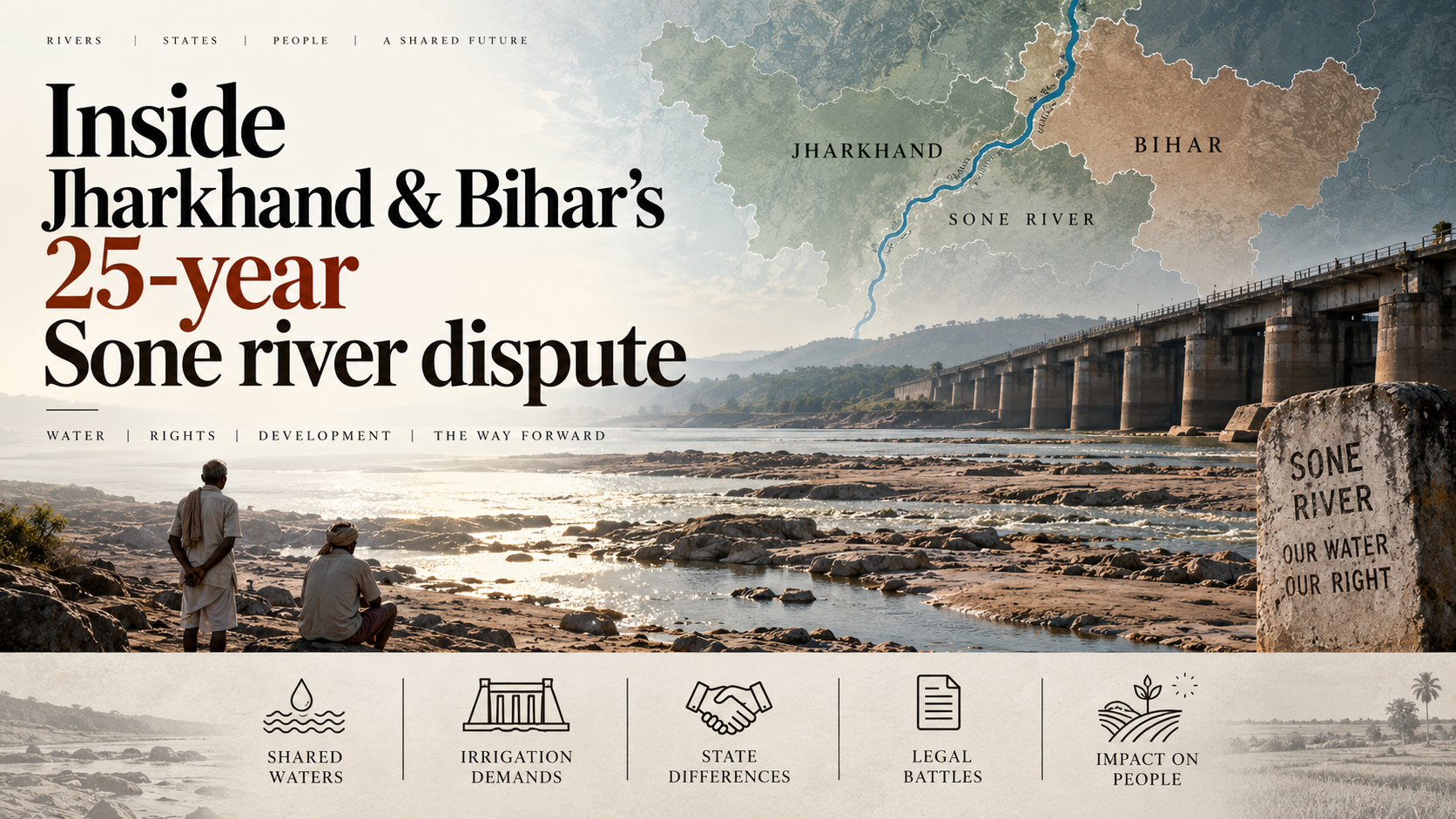
    Bihar and Jharkhand have signed an inter State memorandum of understanding dividing Sone river water, with 5.75 million acre feet (MAF, the volume that would cover a million acres to a depth of one foot) going to Bihar and 2 MAF to Jharkhand.

    Why did a 1973 allocation stop working after 2000?

    1. The river’s course: The Sone flows generally northward from its upper catchments in Madhya Pradesh, passes through Uttar Pradesh, runs along the Jharkhand Bihar boundary and joins the Ganga in Bihar.
    2. The original entitlement: The Bansagar Agreement of 1973, a tripartite agreement involving Madhya Pradesh and Uttar Pradesh, allocated 7.75 MAF of Sone water to undivided Bihar out of the total basin yield.
    3. Bifurcation split the basin unevenly: Jharkhand inherited the major upper catchment areas and the tributaries, and the lower riparian agricultural hubs stayed with Bihar.
    4. No formula followed the division: After the State was divided, no binding formula existed to apportion that allocation between the two successor States.
    5. Two decades of stalled mediation: Committees attempted mediation over the last two decades, and talks repeatedly broke down over reservoir height, land submergence and volumetric splits.

    What does the new agreement actually settle?

    1. Jharkhand’s concession: Jharkhand agreed to specified reservoir water levels to minimise land submergence, backed by clear rehabilitation provisions.
    2. Bihar’s gain: Bihar receives additional water from the Indrapuri Barrage to irrigate farmland in its existing command.
    3. Jharkhand’s return: The pact enables new canal networks in the drought prone Palamu and Garhwa districts.
    4. What it unblocks: Long delayed irrigation, reservoir and river linking projects in the drought prone regions of both States are expected to move forward.

    What does the pact unlock on the ground?

    1. The diversion structure: The Indrapuri Barrage across the Sone in Rohtas district, built in the late 1960s, is the primary structure diverting water into the canal system.
    2. The canal command: The Sone canal network irrigates the Shahabad agricultural belt of Rohtas, Bhojpur, Buxar and Kaimur districts.
    3. The southern belt: The agreement guarantees critical irrigation supplies to the Magadh belt of south Bihar, including Aurangabad.
    4. The constraint was legal, not physical: The barrage and its canals already existed, so what was holding back their full use was the missing share rather than any limit of the structure.

    Why did the dispute stay politically live?

    1. No formal confrontation: The two States never reached a major State level confrontation over the water.
    2. An election season issue in Bihar: Leaders across party lines in the Shahabad and Magadh belts targeted the State government over water shortages in the Sone canal system during the summer sowing season.
    3. A displacement issue in Jharkhand: Leaders from Palamu and Garhwa raised the fear that raising the Indrapuri Dam’s height would submerge agricultural land and displace thousands without fair compensation.

    Challenges to the Sone water sharing arrangement

    1. A memorandum is not an award: The States have signed an administrative understanding rather than obtained a tribunal award under the Inter-State River Water Disputes Act, 1956, so no adjudicated instrument stands behind it. Eg. The Punjab Termination of Agreements Act, 2004 showed that a State legislature can move to repudiate water sharing agreements it had signed.
      The Fix: Constitute a joint control board with gauged and publicly reported releases at the barrage, so compliance is a matter of record rather than of assertion.
    2. A fixed volumetric split against a variable yield: The shares are stated in absolute volume even though the Sone is rain fed and its annual yield swings with the monsoon. Eg. The parent entitlement was itself fixed on basin yield estimates made in the early 1970s.
      The Fix: Convert the split into proportional shares of the actual annual yield, with a stated rule for how a deficit year is shared.
    3. Canal efficiency decides who receives water: An allocation at the barrage does not survive conveyance losses, so tail end farmers get less than the head reach whatever the agreement says. Eg. The Sone canal system dates from the 1870s and still delivers through long unlined earthen channels.
      The Fix: Line and modernise the main and distributary canals and meter deliveries at outlet level before the new water is credited to the command area.
    4. Rehabilitation commitments outrun delivery: Submergence limits rest on rehabilitation provisions whose record in Indian reservoir projects is poor. Eg. Families displaced by the Sardar Sarovar project on the Narmada were still contesting resettlement decades after the dam was cleared.
      The Fix: Publish a dated rehabilitation schedule with land for land entitlements settled before reservoir levels are raised.
    5. Groundwater has filled the gap: Farmers in the command have substituted diesel pumped groundwater for unreliable canal supply, and the pact says nothing about that substitution. Eg. Water tables across south Bihar fall sharply in the summer months when canal supply is weakest.
      The Fix: Sequence canal restoration with conjunctive use planning so surface deliveries replace pumping instead of adding to it.

    Conclusion

    An administrative understanding has closed a gap that two decades of mediation could not, and it has done so without creating any body able to enforce it. Compliance now rests on the continued willingness of two State governments, which is the same condition under which the previous arrangement failed. The marker to watch is whether releases are gauged and published, since an unmeasured share is what allows a settled formula to unravel quietly.

    Back2Basics: Sone river

    1. Source and course: The Sone rises on the Amarkantak plateau in Madhya Pradesh, close to the source of the Narmada, and flows north east to meet the Ganga.
    2. Its rank: It is the second largest of the Ganga’s southern tributaries after the Yamuna.
    3. Its regime: The river is rain fed, so it carries heavy monsoon flow and shrinks sharply through the dry season.
    4. Its tributaries: The North Koel, the Rihand and the Kanhar are among its principal tributaries.

    [2024, GS3, 15 marks] What are the major challenges faced by Indian irrigation system in recent times? State the measures taken by the government for efficient irrigation management.
  • River-linking is not the solution

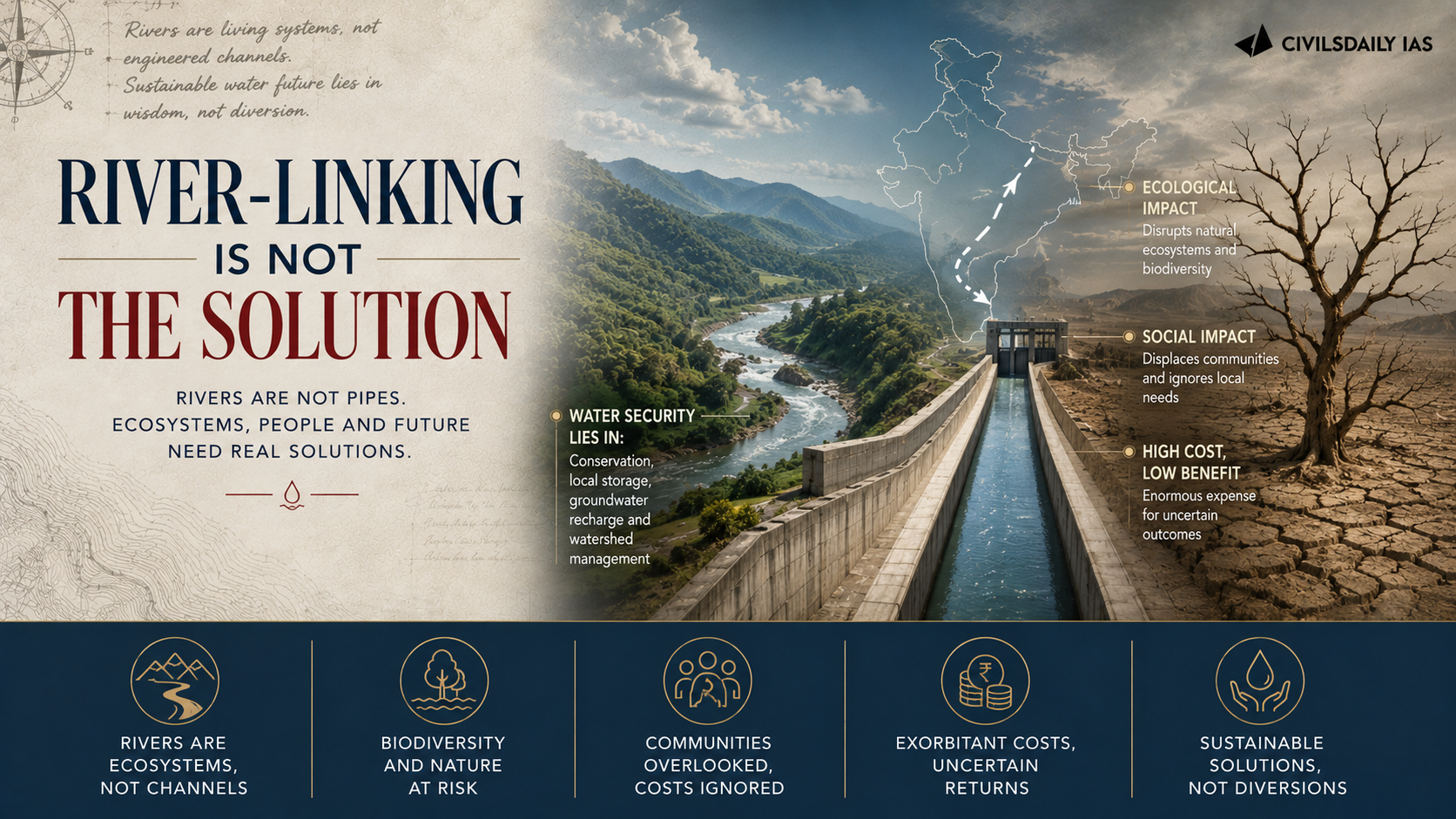
    River-linking is not the solution

    Why in the News

    The Union Home Minister used the Southern Zonal Council meeting at Mamallapuram to press for early resolution of water sharing disputes in the southern region, and to propose linking major rivers from the Brahmaputra to the Godavari and the Cauvery.

    Why does the Pennaiyar case undercut the promise of early resolution?

    1. The grievance: Tamil Nadu is aggrieved over what it terms a violation of the 1892 inter State agreement by Karnataka.
    2. The request and the parallel litigation: Tamil Nadu asked the Centre in November 2019 to establish a tribunal. It also moved the Supreme Court with the same demand.
    3. Negotiation without settlement: Two negotiation committees have been formed since then and 11 meetings have been held.
    4. A court direction, then an extension: The Supreme Court in February directed the Centre to form the tribunal within a month, and later extended the deadline by six months. The adjudicatory body is still not in place.
    5. The referral suggestion: The Centre asked the court whether the Pennaiyar dispute could be referred to the Mahadayi Water Disputes Tribunal instead of constituting a new one, although there is nothing in common between the two disputes.
    6. The statute does not allow it: The Interstate River Water Disputes Act, 1956 does not permit such a referral.
    7. A second unanswered demand: The Central government has not replied to Tamil Nadu’s demand, made in March this year, for a tribunal on the Mekedatu dam project proposed by Karnataka.

    What are the objections to inter-linking?

    1. The proponents’ claim: Supporters of river linking, Tamil Nadu among them, hold that the intent is not to disturb the natural flow of any river but to divert a portion of surplus water.
    2. The claim on surplus is disputed: Many experts are not convinced, and expect that once linking is allowed, benefiting regions will demand water even in times of distress.
    3. The original beneficiary loses: That escalation would eventually deprive the original beneficiaries of their quota, which converts a transfer of surplus into a redistribution of entitlement.
    4. The ecological objection: Kerala has stoutly opposed the Pamba-Achankovil-Vaippar link proposal, on the ground that it will affect the Vembanad wetland system, into which the Pamba and Achankovil rivers drain.
    5. The agency’s answer: The National Water Development Agency, the central body that prepares feasibility studies for inter-basin transfer links, says it has accounted for improving the flow of rivers in lean periods.

    What is the record of inter-basin transfer in India?

    1. A thin record over 130 years: In the last 130 odd years the country has seen only a handful of inter-basin transfer projects, most of them in south India.
    2. The projects treated as successes: The Mullaperiyar dam, the Parambikulam-Aliyar project, the Krishna Water Supply Project and the Indira Gandhi Canal Project are regarded as successful examples of inter-basin transfer.
    3. An institution without output: A Special Committee for Interlinking of Rivers was formed after 2014 and has held over two dozen meetings, without much headway.
    4. The one project that moved: The foundation stone for the ₹44,000 crore Ken-Betwa Link Project was laid in 2024.
    5. Its social cost surfaced immediately: That project has led to agitations by tribal populations in Chhatarpur.

    Why is supply side expansion reaching its limit?

    1. Land is the binding constraint: Land is becoming scarcely available for projects of this size.
    2. Acquisition faces organised resistance: Resistance among people is growing when it comes to land acquisition.
    3. The consequence for project design: The days of implementing mega irrigation projects are almost over, which removes the delivery route the linking proposal depends on.

    What does demand side management require?

    1. A shift in the object of policy: Governments at the Centre and in the States, and civil society, need to focus on demand side management instead of perpetually seeking supply side interventions.
    2. Conservation as the priority: The priority has to be conserving what is available and using it judiciously.
    3. A programme aimed at the farmer: A massive programme of sensitising and incentivising farmers on the optimal use of water has to be launched.
    4. The subsidy that drives extraction: Indiscriminate extraction of groundwater, facilitated by free electricity for agriculture in many States, is paving the way for ecological disaster and has to be curbed immediately.

    Challenges to inter-basin water transfer proposals

    1. Surplus is asserted rather than measured: A basin is declared surplus on hydrological series that predate current withdrawal and cropping intensity, so the transferable volume is an estimate that has never been revalidated. Eg. Peninsular link proposals rest on assessments framed decades before present groundwater draft in the same basins.
      The Fix: Publish a revalidated basin water budget, with the assessment year stated, before any link component is taken up for investment approval.
    2. Himalayan links depend on flows that originate outside India: A transfer scheme drawing on the Brahmaputra is exposed to upstream storage decisions India has no treaty right to see. Eg. The Brahmaputra enters India as the Yarlung Tsangpo after a long course through Tibet.
      The Fix: Make a binding upstream flow data arrangement a stated precondition before any Himalayan component of a national grid is sanctioned.
    3. Transferred water carries a permanent energy bill: Peninsular links must lift water across watersheds, so the delivered cost includes pumping power for the life of the project. Eg. Moving water across the Eastern Ghats requires sustained lift rather than gravity flow.
      The Fix: Price transferred water at its delivered cost including pumping energy, so the recipient command area faces the real cost of the supply.
    4. Alignments run through forest and protected areas: Canal alignment and submergence take the least contested land, which in practice is forest and reserve land rather than settled farmland. Eg. The Ken-Betwa link submerges part of the Panna Tiger Reserve.
      The Fix: Require a no alternative alignment finding, tested against a published route comparison, before submergence inside a protected area is cleared.
    5. New supply changes cropping and returns the shortage: A command area that receives assured water shifts to water intensive crops, so demand rises to meet the new supply within a decade. Eg. Long canal commands in western India moved to paddy and sugarcane and developed waterlogging and salinity.
      The Fix: Tie the release of transferred water to a notified crop plan and volumetric delivery through water user associations rather than to area based supply.

    Conclusion

    India is being offered more supply while the reason for the shortage stays untouched. A grid that moves water between basins does not change how the water is used once it arrives. The immediate decision point is the Pennaiyar tribunal, still unconstituted after a court set deadline and an extension of it. Free farm power, and the groundwater extraction it underwrites, is the variable that will decide whether any new transfer capacity is absorbed or simply exhausted.

    Water Resources Management in India

    1. About: Water resources management covers the planning, development and management of water quantity and quality across every use, along with the institutions, infrastructure, incentives and information systems that guide it.
    2. The hydrological imbalance: India has an effective rainfall period of 28 to 29 days in a year, so most annual flow arrives in a short window and has to be stored or lost.
    3. Agriculture dominates demand: Agriculture accounts for around 89 per cent of groundwater extraction.
    4. The institutional home: The Ministry of Jal Shakti was formed in 2019 by integrating two earlier water related ministries.

    Constitutional Framework Governing Water Resources Management

    1. Entry 17, State List: Places water supply, irrigation, canals, drainage, embankments and storage with the States, subject to Entry 56.
    2. Entry 56, Union List: Allows Parliament to regulate inter State rivers and river valleys where it declares such regulation to be in the public interest.
    3. Article 262: Empowers Parliament to provide for adjudication of inter State river water disputes, and to bar the jurisdiction of the courts including the Supreme Court over them.

    Laws and Rules Governing Water Resources Management

    1. Interstate River Water Disputes Act, 1956: Provides for the constitution of a tribunal when a State’s request for adjudication cannot be settled by negotiation.
    2. The 2002 amendment: Fixed a one year limit for constituting a tribunal and a three year limit for the award.
    3. River Boards Act, 1956: Enables the Centre to set up river boards to advise on the regulation and development of an inter State river. No board has been constituted under it.
    4. Dam Safety Act, 2021: Establishes national and State level authorities for the surveillance, inspection and maintenance of specified dams.

    Government Initiatives for Water Resources Management

    1. Atal Bhujal Yojana: Launched in 2019 to improve groundwater management in selected States through community participation.
    2. Pradhan Mantri Krishi Sinchayee Yojana: Expands assured irrigation coverage and promotes micro irrigation under the Per Drop More Crop component.
    3. National Water Mission: Targets integrated water resource management and a 20 per cent improvement in water use efficiency, with the Bureau of Water Use Efficiency set up under it in 2022.

    Challenges in Water Resources Management

    1. Groundwater is extracted faster than it recharges: Assessment blocks in the north west and the south are classified as over exploited, which means annual draft exceeds annual recharge. Eg. Central Ground Water Board assessments place large parts of Punjab, Haryana and Rajasthan in that category.
      The Fix: Extend community level water budgeting with metered abstraction, so a village sees its own draft against its own recharge each season.
    2. Cropping patterns ignore local water availability: Crop choice follows assured procurement and price, not the water the region actually has. Eg. Sugarcane in Marathwada consumes a disproportionate share of a chronically drought affected region’s irrigation water.
      The Fix: Link procurement or price support for water intensive crops to verified micro irrigation adoption on the same holding.
    3. Irrigation charges recover a fraction of the cost: Water charged below the cost of delivering it removes any incentive to use less of it. Eg. Canal water rates in most States do not cover the operation and maintenance cost of the system supplying it.
      The Fix: Move to volumetric supply at the outlet, billed through water user associations rather than assessed on irrigated area.
    4. Basin data is incomplete and not shared: Allocation disputes are argued over rival estimates because no agreed real time record of flows exists. Eg. Rival State claims in southern river disputes rest on differing assessments of the same basin’s yield.
      The Fix: Make real time gauge and groundwater data on one national platform the sole admissible basis for allocation claims.

    Matching Previous Year Question

    “[2017, GS3, 10 marks] Not many years ago, river linking was a concept but it is becoming reality in the country. Discuss the advantages of river linking and its possible impact on the environment.”

  • Per Drop More Crop expands water efficient micro irrigation

    Why in the News

    PIB detailed the reach of the Per Drop More Crop (PDMC) component of national irrigation policy. Revised guidelines widen the water management activities that states can fund.

    Core facts

    1. What it is: Per Drop More Crop promotes drip and sprinkler irrigation. The aim is higher water use efficiency at the farm.
    2. Coverage record: About 83.06 lakh hectares were brought under micro irrigation from 2015-16 to 2023-24. About 30.55 lakh hectares of that were added in the last three years.
    3. Central assistance: About Rs 18,714.69 crore was released to states since inception.
    4. Subsidy pattern: Assistance is 55 percent for small and marginal farmers and 45 percent for other farmers. Northeastern and Himalayan states get 25 percent higher unit cost support.
    5. Revised guidelines: States can now plan micro level water management works such as diggi construction and water harvesting under the scheme.
    6. Figure caveat: Some current media figures cite about 115 lakh hectares and 12.30 lakh farmers. Those could not be verified on a fetchable PIB detail page, so the PIB verified figure of 83.06 lakh hectares is used above.

    Static Context

    1. Parent scheme history: PDMC ran under the Pradhan Mantri Krishi Sinchayee Yojana (PMKSY) from 2015-16 to 2021-22. Since 2022-23 it runs under the Rashtriya Krishi Vikas Yojana (RKVY).
    2. Micro Irrigation Fund: The Micro Irrigation Fund (MIF) was created with the National Bank for Agriculture and Rural Development (NABARD). Its initial corpus was Rs 5,000 crore.
    3. Interest support: The Fund gives states a 3 percent interest subvention on loans for micro irrigation expansion.
    4. PMKSY mandate: PMKSY, launched in 2015, follows the goal of Har Khet Ko Paani and improved on farm water use.

    Prelims angle

    1. Umbrella hook: PDMC now sits under RKVY, earlier under PMKSY.
    2. Fund hook: The Micro Irrigation Fund is with NABARD, corpus Rs 5,000 crore.
    3. Concept hook: Micro irrigation cuts fertiliser and nutrient loss and can check groundwater depletion. It is not the only means of dryland irrigation.

    Mains angle

    GS3 (types of irrigation and irrigation systems). A question can ask how micro irrigation addresses India’s water stress and how coverage can be widened.

    Matching Previous Year Question

    “[2021, GS3, 10 marks] How and to what extent would micro-irrigation help in solving India’s water crisis? [2016, GS3, 12.5 marks] What is water-use efficiency? Describe the role of micro-irrigation in increasing the water-use efficiency. [2011] With reference to micro-irrigation, which of the following statements is/are correct? 1. Fertilizer/nutrient loss can be reduced. 2. It is the only means of irrigation in dry land farming. 3. In some areas of farming, receding of the groundwater table can be checked. (a) 1 only (b) 2 and 3 only (c) 1 and 3 only (d) 1, 2 and 3 Answer: (c)”

  • A dry spell along the Cauvery river

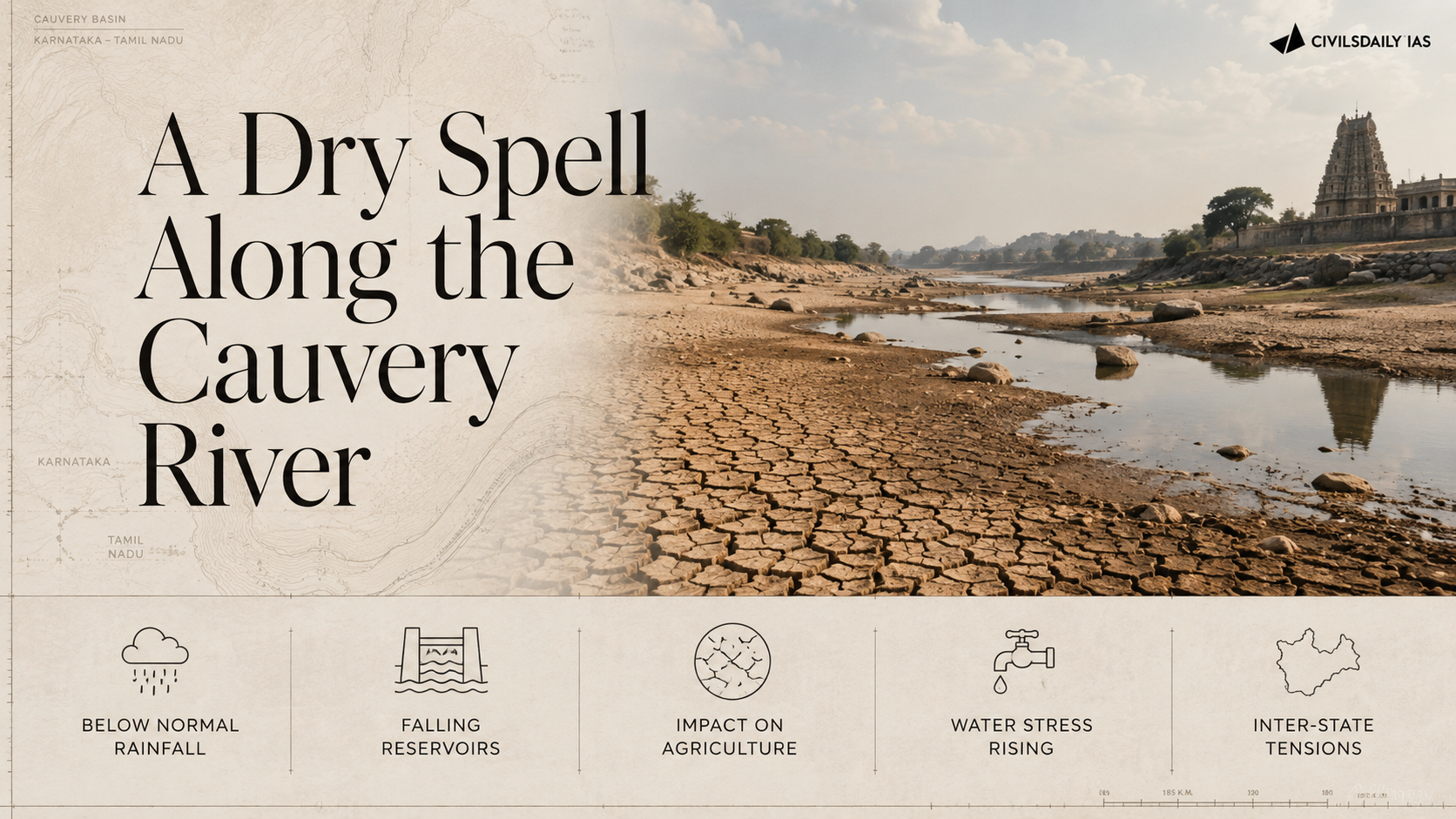
    A dry spell along the Cauvery river

    Why in the News

    Karnataka appealed to the Cauvery Water Management Authority (CWMA) on 11 August to cut its daily release to Tamil Nadu from 12,000 cusecs to 10,000 cusecs. It warned of a severe drinking water shortage if more water were released for crops in the Cauvery basin. Tamil Nadu had already chosen not to open the Mettur dam for irrigation on the customary date of 12 June, given a poor south-west monsoon forecast attributed to a super El Nino. Large tracts of the Cauvery delta consequently remain barren in a season that normally carries two crops. The dispute is no longer only between an upper and a lower riparian State, because Karnataka is simultaneously rationing its own canal irrigation and committing reservoir water to Bengaluru’s drinking supply.

    What is the Cauvery water-sharing arrangement?

    1. The dispute predates the States: The sharing of the Cauvery is a vexed issue going back more than 130 years, to agreements between the Mysore Kingdom and the Madras Presidency that were drawn without regard to any future State boundary.
    2. The award fixes an annual quota and a monsoon share: The Cauvery Water Disputes Tribunal and the Supreme Court provided for Karnataka to release 123.14 thousand million cubic feet of the 177.25 thousand million cubic feet annual quota during the south-west monsoon. That share is mostly meant to support paddy cultivation in the Samba season.
    3. A central authority administers the sharing: The CWMA was set up in June 2018 by the Union government to handle water-sharing from the Cauvery among Karnataka, Tamil Nadu, Kerala and Puducherry.
    4. A technical committee advises it: The Cauvery Water Regulation Committee (CWRC) assesses storage and crop requirement and recommends releases to the CWMA, and both bodies sit under the Supreme Court’s continuing supervision.

    What is a cusec?

    1. A cusec measures flow, not volume: A cusec is one cubic foot per second, so a release order of 12,000 cusecs fixes the rate at which water must cross the inter-State point rather than a total quantity.

    What is a TMC?

    1. A TMC measures volume: A thousand million cubic feet (TMC) is a stock of water, roughly 28.3 million cubic metres. Reservoir capacity and annual quotas are stated in TMC rather than in the cusecs used for daily obligations.

    Why does the delta’s cropping calendar depend on a single dam opening date?

    1. One release date sets the whole season: Water released from the Mettur dam, built in Salem district across the Cauvery, on 12 June for irrigation ordinarily reaches Tiruvarur about 300 km downstream by 23 or 24 June. This year nothing reached it.
    2. Two seasons run off that release: Paddy is ordinarily cultivated across 5.3 lakh acres in the delta during the short-term Kuruvai season, followed by 12.9 lakh acres during the longer Samba-Thaladi season.
    3. Samba is the season that matters: Samba transplantation begins in late July or early August and the harvest ends in mid-January, and the crop is both a food security crop and the mainstay of the delta’s rural economy.
    4. Kuruvai is the higher-yield gamble: The shorter-duration Kuruvai crop can offer higher yields and is largely dependent on groundwater drawn through energised pumpsets rather than on canal water.
    5. The acreage has already collapsed: Tamil Nadu government data put the area under paddy cultivation this year at 4.5 lakh acres, against the 5.3 lakh acres the Kuruvai season alone normally covers.

    How is Karnataka rationing its own irrigation?

    1. Farmers sowed against official advice: Farmers across Karnataka’s Cauvery basin defied advice against sowing water-intensive crops such as paddy and sugarcane this season, amid a predicted deficient monsoon and inadequate inflows into the basin’s reservoirs.
    2. A brief August revival encouraged them: The Krishna Raja Sagara (KRS) reservoir has a full level of 124.8 feet. It rose from 93 to 94 feet to over 100 feet within days in the first week of August before stagnating at 109 feet.
    3. The canal system runs off that reservoir: The Visvesvaraya canal system draws water from the KRS reservoir, located across the Cauvery near Mysuru, and serves the Mandya belt.
    4. Releases were cut to four rotational cycles: The Cauvery Irrigation Advisory Committee, a regional body chaired by the Karnataka Water Resources Minister, met in Bengaluru on 19 August and decided to release canal water in only four rotational cycles during the crop season instead of continuously.
    5. The stated purpose is storage, not irrigation: The decision was taken to conserve reservoir storage and ensure water availability for other needs, including drinking water.
    6. Rotation does not sustain a standing crop: A pattern of about 15 days of release followed by 15 days without will not provide enough water for paddy and sugarcane, and leaves farmers able to grow only dry crops.

    What are farmers at the canal’s tail end facing?

    1. The tail end gets water last or not at all: A farmer in Kuntanahalli village of Maddur taluk in Mandya district has raised a paddy nursery on a two-acre plot lying at the tail end of the Visvesvaraya canal system.
    2. The window is measured in days: Without water in the next 7 to 10 days he loses both the sowing season and the Rs 8,000 already spent on raising the nursery.
    3. Switching crops is not a safe alternative: Semi-dry crops such as ragi, pulses and oilseeds are the fallback, and heavy rain arriving late can damage a ragi crop just as its absence damages paddy.
    4. Position on the canal decides outcomes: Paddy transplantation is nearly complete in Karekura and Hosahalli, close to the KRS reservoir, and even there farmers who normally take two crops a year doubt the second.
    5. Losing a crop means becoming a labourer: Most agricultural labourers in the region earn Rs 400 to Rs 500 for a day’s work from 7 a.m. to noon, which is the fallback income for a farmer whose second crop fails.
    6. Sugarcane is exposed for longer: A standing sugarcane crop in Pandavapura taluk needs another nine months before harvest, and without timely rain may not even be fit for use as cattle fodder.
    7. Debt is the binding constraint: Farmers have taken interest-free short-term loans from primary agricultural cooperative credit societies and high-interest loans from microfinance companies, and are seeking a waiver and restraint on aggressive recovery agents.

    Does Bengaluru’s drinking water come at the cost of the Cauvery’s irrigators?

    1. A new drinking water stage is already sanctioned: The Cauvery Stage VI drinking water project is a Rs 6,939 crore initiative approved by the Karnataka government this February.
    2. It adds a fixed annual claim on the river: The project requires an additional 6 thousand million cubic feet of Cauvery water every year, which is a permanent first charge rather than a seasonal allocation.
    3. The service area extends beyond the city: It will supply 500 million litres per day to roughly 30 lakh residents in Bengaluru and the adjoining towns of Bidadi, Hoskote, Anekal, Devanahalli and Nelamangala.
    4. The diversion is from the same reservoir: Farmers in Maddur taluk are bracing for confrontation with the State government over the proposed diversion of KRS water. Their canal draws from the same reservoir.
    5. The competing claim is now internal: The canal rationing decision was justified by the need to protect drinking water, so the same argument that limits releases to Tamil Nadu also limits releases to Karnataka’s own irrigators.

    Why has farmer protest stayed muted this year?

    1. Mobilisation has fallen flat: Protests over poor rainfall and releases to Tamil Nadu have remained muted compared with previous years, and a Karnataka bandh called by a Kannada activist on 13 August drew a lukewarm response outside parts of Maddur taluk.
    2. Farm bodies cannot bring out their own members: The organising secretary of the Mandya District Raithara Hitharakashana Samithi, a farmers’ welfare committee, records that farmers who are the main stakeholders are not responding to calls for struggle.
    3. Ruling party leaders are discouraging the streets: Cultivators say ruling party leaders are warning them against joining what they call an “Opposition trap”, and against the police stations and court appearances that follow a protest.
    4. The Chief Minister has publicly discouraged it: The Karnataka Chief Minister has chastised activists for staging Cauvery protests “for the sake of publicity”, and warned against wading into the river after the Water Resources Department issued a flood alert over releases from the near-brimming Kabini reservoir.
    5. The State’s own position is two-sided: The Chief Minister has acknowledged that Karnataka’s dams are not yet full and vowed to protect farmers’ interests. The same statement emphasised compliance with directions on releasing water to Tamil Nadu.
    6. Farmers question the State’s legal effort: The president of the State Sugarcane Farmers’ Association questions whether the government and its legal team have made a strong enough case before the CWRC, the CWMA and the Supreme Court about the water crisis inside Karnataka.

    What positions have the two States taken?

    1. Tamil Nadu blames storage and shortfall in releases: Low storage at the Mettur dam and Karnataka’s failure to release a sufficient share of the water it received in June and July are the two grounds Tamil Nadu cites for the barren delta.
    2. The reservoir is far below the release threshold: The Mettur dam level is now about 85 feet against a full capacity of 120 feet, and farmer bodies argue that no water should be released until the level reaches at least 100 feet.
    3. The opening date is still unannounced: The Tamil Nadu government has not announced when the Mettur dam will be opened, and it continues its legal battle with Karnataka to secure the State’s share.
    4. It is contesting the reduction in court: Tamil Nadu has strongly opposed Karnataka’s push to reduce releases and is pressing the Supreme Court to ensure strict adherence to the mandated 12,000 cusecs daily flow.
    5. The position is framed as a rights claim: The Tamil Nadu Chief Minister has said the legitimate rights of lower riparian States and the livelihoods dependent on assured river flows must be fully protected.

    What does the delta contribute and what is it losing?

    1. The delta is the State’s rice bowl: Located along the eastern coast and spanning Thanjavur, Tiruvarur, Mayiladuthurai and Nagapattinam, it is characterised by fertile alluvial soil and a tropical climate carried by the Cauvery’s flow.
    2. It supplies most of the State’s procured paddy: During the 2025-26 procurement year, from 1 September 2025 to 31 July 2026, the region contributed 39.5 lakh tonnes of paddy out of a Statewide procurement of 57.5 lakh tonnes.
    3. The failure is visible across districts: A drive of over 200 km from Tiruchi through Thanjavur, Thiruvaiyaru, Tiruvarur and Mannargudi shows largely barren paddy fields where the previous year showed continuous green.
    4. The official acreage may overstate the crop: Some agriculturists dispute the reported figure, citing stunted growth and crops showing signs of withering, which make an area-sown count unreliable as a measure of what will be harvested.
    5. The loss spreads beyond the fields: Economic activity in the region is crippled by the erosion of livelihood opportunities, and shops and other businesses in Mannargudi now down their shutters by 7 p.m.
    6. The poorest bear it first: Much of the zone remains economically backward with a majority dependent on agriculture, and Scheduled Castes, who live there in large numbers, constitute the dominant segment of landless agricultural labourers.

    Why is groundwater not a fallback for the delta?

    1. The water table is falling even between two rivers: In Peramur, about 10 km from Thiruvaiyaru and located between the Cauvery and its branch the Coleroon, the water level is going down.
    2. Extraction technology has migrated to the delta: Submersible pumpsets, once more common in the dry districts of Coimbatore and Dharmapuri, have become commonplace in the delta.
    3. Over-extraction has damaged the resource permanently: Excess withdrawal has led to salinity ingress in many areas, which removes land from cultivation rather than merely reducing a season’s yield.
    4. The Kuruvai fallback is therefore closing: The shorter crop that depends on pumped groundwater is becoming harder to raise in the very years when canal water fails, so the two sources fail together rather than covering for each other.

    What do farmers want, and what will they get?

    1. Compensation demands have begun: Several farmers’ groups have started demanding compensation for crop losses across the delta.
    2. The announced waiver is considered inadequate: Farmers are unhappy with the crop loan waiver scheme announced by the Tamil Nadu Chief Minister and are seeking a full, unconditional waiver of up to Rs 1 lakh for every farmer who has taken a crop loan.
    3. Relief is conditional on a disaster classification: Any compensation will be subject to the Union and State governments’ norms for natural disasters and to a survey by the departments concerned.
    4. Officials are still counting on the monsoon: With about a month left in the season, officials continue to hope for a revival that would allow at least a partial Samba crop.

    Challenges to Cauvery water sharing

    1. The award has no distress-year formula: The allocation assumes a normal monsoon and offers no proportionate sharing rule for a deficit year, so every shortfall becomes a fresh contest. Eg. Karnataka’s request to cut releases from 12,000 to 10,000 cusecs has to be argued case by case rather than settled by a rule. Fix. Notify a pro-rata distress sharing schedule tied to measured basin inflow, so releases fall automatically and equally in a deficit year.
    2. Drinking water and irrigation are not ranked: The award prioritises drinking water in principle without capping how much a growing city may draw, so urban demand expands against a fixed river. Eg. Delhi’s drinking water share of the Yamuna has been litigated against upstream States in the Supreme Court for over two decades. Fix. Fix an audited ceiling on urban drawal from the basin, conditional on the city reusing a notified share of its treated wastewater.
    3. The Article 262 bar is routinely circumvented: Article 262 lets Parliament exclude the courts from water disputes, and States nonetheless reach the Supreme Court through special leave petitions under Article 136. Eg. The Cauvery allocation has been litigated in the Supreme Court repeatedly after the Tribunal’s award. Fix. Amend the Inter-State River Water Disputes Act, 1956 to make a tribunal award final on quantum, leaving only implementation questions justiciable.
    4. Tribunals take decades to decide: Article 262 sets no time limit, so an award arrives after the cropping economy it was meant to govern has already changed. Eg. The Cauvery Water Disputes Tribunal took 17 years to deliver its decision. Fix. Enact the pending Inter-State River Water Disputes (Amendment) Bill and apply its timelines to disputes already before a tribunal.
    5. Flow data is contested rather than shared: Each State measures inflow and utilisation on its own gauges, so the basic facts of a deficit year are disputed before the sharing question is reached. Eg. Karnataka and Tamil Nadu differ on how much of the June and July inflow was actually released downstream. Fix. Operate a single telemetered gauge network under the CWMA with readings published in real time and binding on both States.
    6. The dispute pays politically: Regional parties gain from an unresolved conflict, so neither an implementation habit nor a negotiated settlement is rewarded at the ballot. Eg. A bandh call and a protest ban were both issued in the same fortnight in Karnataka this month. Fix. Route inter-State negotiation through the Inter-State Council under Article 263, where a recorded agreement carries a political cost to abandon.

    Conclusion

    A deficient monsoon has converted the Cauvery allocation from a sharing arrangement into a distress-year contest that the award was never designed to settle. Karnataka is rationing its own canal command to four rotational cycles and committing an additional annual volume to Bengaluru’s drinking supply. Tamil Nadu’s delta has lost a season because the Mettur dam was never opened. The immediate decisions rest with the Cauvery Water Management Authority on the daily release rate and with the Tamil Nadu government on the dam opening date. Neither will be settled this season without a rule for sharing a shortfall, which is exactly what the existing award does not contain.

    “[2024, GS3, 15 marks] What are the major challenges faced by Indian irrigation system in recent times? State the measures taken by the government for efficient irrigation management.”

  • Groundwater risk from solar irrigation is a property of the model, not of solar power

    Why in the News

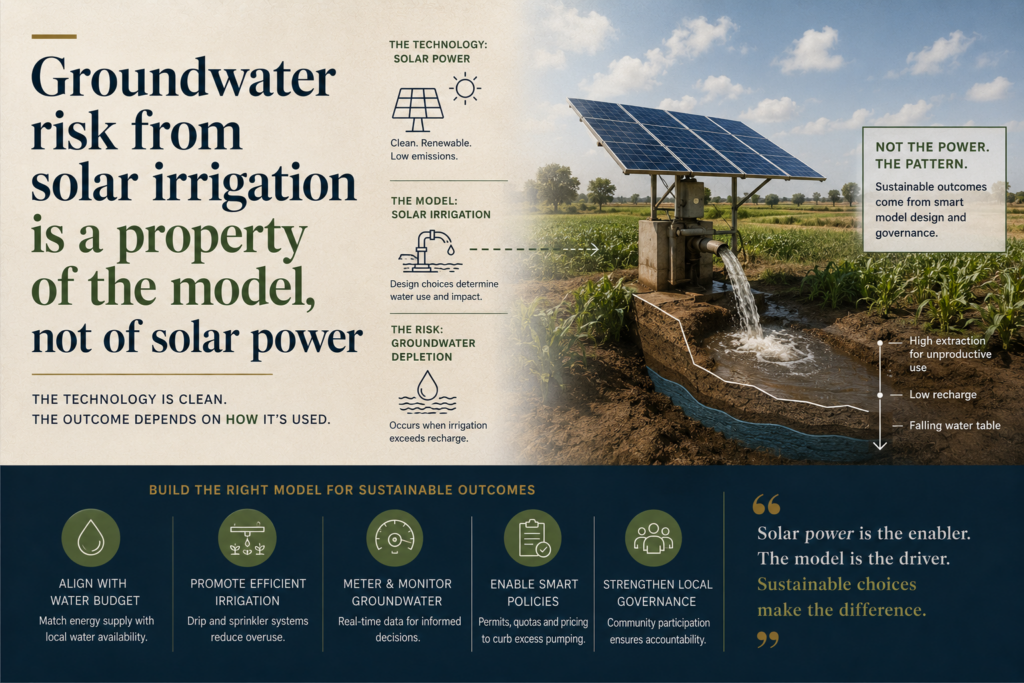
    India’s agricultural solar programme has installed over 2.5 million solar pumps in five years, and the government is now preparing PM-KUSUM 2.0. The standard objection is that free solar power removes every incentive to limit pumping and will therefore deepen the groundwater crisis. That objection treats solar irrigation as a single model, when the groundwater outcome is determined by ownership structure, pricing incentive and local hydrogeology.

    What is PM-KUSUM?

    1. About: The Pradhan Mantri Kisan Urja Suraksha evam Utthan Mahabhiyan (PM-KUSUM) is India’s agricultural solar programme, administered by the Ministry of New and Renewable Energy.
    2. Delivery so far: It has installed over 2.5 million solar pumps over the past five years, made affordable for smallholder farmers through subsidies.
    3. Three routes: It supports decentralised grid connected solar plants on barren land, standalone off grid solar pumps, and the solarisation of existing grid connected agricultural pumps.
    4. Next stage: The government is preparing PM-KUSUM 2.0, whose design challenge is to advance the clean energy transition without worsening an already over exploited groundwater base.

    What is a feed in tariff?

    1. About: A feed in tariff is a guaranteed per unit price at which a distribution utility buys electricity that a small generator exports to the grid.
    2. Why it matters here: A high enough tariff converts every unit of electricity not used for pumping into cash income, so saving water becomes profitable rather than merely virtuous.

    Why is the standard objection to solar irrigation incomplete?

    1. The objection itself: Heavily subsidised or free electricity has driven unsustainable groundwater abstraction, falling water tables, depleting aquifers and growing fiscal burdens on energy utilities, and solar is assumed to extend that pattern.
    2. First gap, the single model assumption: The debate treats solar irrigation as one model, typically a farmer running a standalone pump with no incentive to conserve water, when models differ by design, ownership structure and pricing incentive.
    3. Second gap, energy as the only variable: The debate discounts local hydrogeology, cropping patterns, marginal returns to irrigation and soil type, all of which shape irrigation behaviour independently of the energy source.
    4. Third gap, evaluation in a silo: Solar irrigation is judged as either a water intervention or an energy intervention, when its consequences span water, energy and food together.
    5. The reframed question: The question is not whether solar irrigation is inherently good or bad for groundwater, but what kind of model is deployed, where, and with what incentives.

    How do ownership and pricing change the groundwater outcome?

    1. Grid connected models create a price for restraint: Models that let farmers sell surplus solar electricity back to the grid give a direct financial reward for using less water.
    2. Gujarat’s Suryashakti Kisan Yojana: Around 100 agricultural feeders were transitioned to solar energy under the scheme.
    3. Measured behaviour change: Solar farmers showed significantly slower growth in energy consumption and in irrigation application than non solar farmers, indicating more sustainable water use.
    4. The tariff that produced it: The scheme offered around Rs 7 per unit as a feed in tariff, a meaningful incentive to conserve electricity and export energy.
    5. Income effect: By exporting energy, farmers earned an average of roughly Rs 21,900 annually, converting them from energy consumers into energy producers.
    6. Standalone pumps vary too: Even for standalone off grid pumps under PM-KUSUM, utilisation and the extent to which the pump replaces diesel rather than grid electricity vary widely with installed capacity, the depth of the water table and years of operating experience.

    What does the Bangladesh model show about pricing solar water?

    1. The dominant model there: Bangladesh’s most common arrangement is the fee for service centralised solar model, in which a pump owner supplies water to multiple farmers within a fixed command area.
    2. The revenue logic: The owner earns from selling water, so the pump is operated as a business rather than as a private convenience.
    3. The measured result: Farmers using solar irrigation did not apply more water than farmers using diesel, even though solar irrigation was 20 to 30 percent cheaper.
    4. The mechanism behind it: Excessive irrigation by one farmer reduces the operator’s ability to serve others, so efficient and equitable groundwater use becomes a condition of the business remaining financially sustainable.
    5. What the case demonstrates: A cheaper energy source did not raise water use once the water itself carried a price and a rationing constraint.

    Why does the same pump produce different outcomes across regions?

    1. Hard rock aquifer regions: Where storage capacity is limited and cropping is rainfed, each additional unit of irrigation water yields high marginal benefit, and water use changed little between solar and non solar users regardless of the energy source.
    2. Punjab and Haryana: Irrigation is already widespread and dominated by water intensive rice and wheat, leaving little scope to expand irrigated area, so solar is unlikely to drive further over exploitation.
    3. The real question in those States: Whether solar can make water, energy and food systems more sustainable by replacing subsidised fossil fuel electricity with grid connected solar, cutting subsidy costs and emissions together.
    4. Eastern India: Irrigation expansion has been constrained by access to energy rather than to water, with large rainfed areas, high diesel costs and unreliable power.
    5. Policy consequence: Solar irrigation policy must follow a differentiated regional approach with context specific model choice, paired with stronger groundwater monitoring and adaptive management to catch emerging stress early.

    What does solar irrigation change beyond groundwater?

    1. Emissions from pumping: Groundwater irrigation in India is estimated to generate between 45 and 62 million tonnes of carbon dioxide a year.
    2. Fiscal burden: Agricultural electricity subsidies across States amount to over Rs 1 lakh crore a year.
    3. Per farmer mitigation: Estimates from Gujarat suggest each grid connected solar farmer offsets approximately 12.3 tonnes of carbon dioxide annually through on farm solar use and electricity exported to the grid.
    4. Payback on public money: Subsidies covered nearly one fourth of government investments within the first two years.
    5. Scale of the opportunity: Applied across India’s more than 25 million agricultural pumps, the mitigation and fiscal implications are substantial.

    Should policy prioritise saving water or expanding access?

    1. The case for saving water: In water stressed regions, grid connected solar can be expanded through individual pumps or by taking entire agricultural feeders solar, with both models rewarding farmers for saving water.
    2. The case for expanding access: Where farmers still lack reliable irrigation, the priority is expanding access rather than saving water.
    3. The instrument each case needs: Standalone solar pumps remain the preferred option in areas with limited irrigation, poor grid access and low groundwater risk.
    4. The distributional point: Emphasis should shift from individual ownership to scaling through water user associations, water selling entrepreneurs and farmer cooperatives in India’s most irrigation deprived regions.
    5. Why the tension is real: A single national design cannot simultaneously suppress pumping in Punjab and expand it in Bihar, so the same programme must carry two opposite incentive structures.

    Why has the current design of both models underperformed?

    1. Weak uptake of surplus sale: The approach of paying farmers to save water by selling surplus electricity to the grid has seen limited uptake.
    2. Feeder transitions do not change behaviour: Feeder level transitions to solar have performed better on delivery, but in their current form do little to change pumping behaviour.
    3. What individual pumps need: Simpler grid connection procedures and attractive buyback prices that reflect the local value of water and crops.
    4. What distribution companies need: Distribution companies (DISCOMs), which buy and supply the power, must themselves be incentivised to support the individual pump model.
    5. What feeder solarisation needs: Pairing with water saving incentives such as support for micro irrigation and direct cash payments for reduced pumping, on the model of Punjab’s Pani Bachao Paisa Kamao and Haryana’s Mera Pani Meri Virasat schemes, so the gain is not confined to the distribution company.

    Challenges to PM-KUSUM

    1. Farmer contribution barrier: Even after central and State subsidy, the residual farmer share blocks the poorest applicants. e.g. smallholders in Bihar and Jharkhand, where the same pump costs a larger share of annual income than in Gujarat.
    2. Slow solarisation of existing pumps: Retrofitting grid connected pumps depends on a distribution company agreeing to buy the surplus at a workable price. e.g. the limited uptake of the surplus sale route recorded in the current programme.
    3. Feeder solarisation without behavioural conditions: Solarising a feeder cuts the utility’s power purchase cost without altering how much a farmer pumps. e.g. feeder transitions that improved supply economics while leaving abstraction unchanged.
    4. Unmetered farm supply: Without metering, neither pumping nor saving can be measured, so a water saving payment has no basis. e.g. Punjab, where agricultural supply is largely flat rate and unmetered.
    5. Land availability for decentralised plants: Barren and fallow land near substations is scarce in densely cultivated districts. e.g. canal command areas of western Uttar Pradesh with almost no uncultivated parcels.
    6. After sales service: A solar pump with no local technician becomes a stranded asset. e.g. standalone pumps idling in remote blocks for want of repair and spare parts.
    7. Equity of ownership: Individual ownership concentrates the benefit in farmers who already own a borewell and a landholding. e.g. tenant cultivators and landless water buyers, who gain nothing from a pump subsidy tied to land title.

    Conclusion

    The groundwater question about solar irrigation has been asked at the wrong level, because the outcome is set by ownership structure, pricing incentive and local hydrogeology rather than by the energy source. Gujarat’s feed in tariff and Bangladesh’s fee for service model both show that water use falls once restraint carries a price, while standalone pumps in energy constrained Eastern India are correctly an access instrument rather than a conservation one. PM-KUSUM 2.0 therefore has to carry two opposite incentive structures within one programme, tightened in water stressed States and loosened where irrigation is scarce. The unresolved condition is measurement, since no water saving payment can operate on a farm supply that is neither metered nor monitored.

    “[2025, GS3, 15 marks] Examine the factors responsible for depleting groundwater in India. What are the steps taken by the government to mitigate such depletion of groundwater?”

  • Punjab’s groundwater collapse demands the diversification its farm politics keeps deferring

    Why in the News

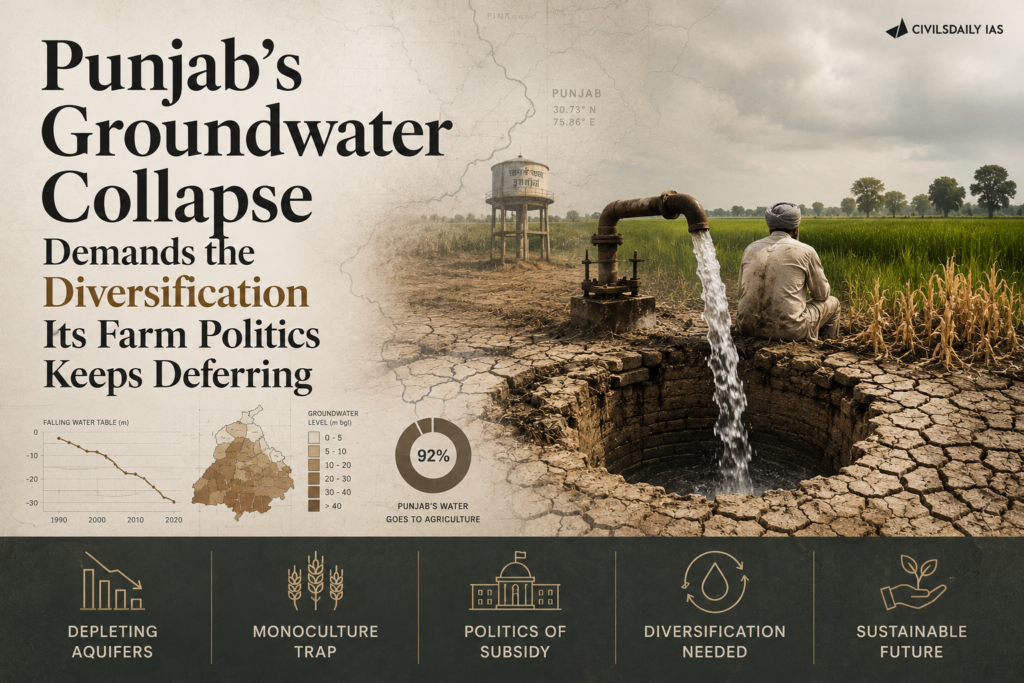
    The acreage under water intensive paddy in Punjab touched a record high this year, even as the water table continues to fall and experts warn of impending desertification. The State that built its agrarian success on assured irrigation is now consuming the resource that made it possible, while governments across party lines keep supplying free water and power rather than executing the diversification plans already drafted.

    What is crop diversification?

    1. About: Crop diversification is the shift of cropped area away from one or two dominant crops toward a wider mix of crops within the same season or rotation.
    2. How it works: A cultivator replaces part of the area under a water intensive or soil depleting crop with pulses, oilseeds, maize, cotton or horticulture.
    3. Rationale: It reduces the drawdown on a single natural resource and spreads market and weather risk across several crops.
    4. The precondition: It requires an assured market or procurement for the replacement crop, since the displaced crop already has one.

    Who was Ajit Singh?

    1. About: Ajit Singh was a peasant leader of colonial Punjab and the uncle of Bhagat Singh, and one of the main architects of the Pagdi Sambhal Jatta agitation against British agricultural laws.
    2. Exile and return: Hounded by the British, he spent nearly four decades abroad, engaging with revolutionaries including Lala Har Dayal and Subhas Chandra Bose, and was imprisoned in Germany after the Second World War before Jawaharlal Nehru secured his release in early 1947.
    3. Death: He died at Dalhousie at about 3.30 am on 15 August 1947, aged 66, his last words recorded as “Jai Hind”.

    What were the canal colonies of western Punjab?

    1. About: The canal colonies, known locally as the Baar, were settlements created in western Punjab after the British built an extensive canal network in the late nineteenth and early twentieth centuries.
    2. Why they were created: Large parts of western Punjab had remained uncultivated for centuries for want of irrigation, and the canals made cultivation possible for the first time.

    What is a murabba?

    1. About: A murabba is a square land allotment of 25 acres, the standard unit granted to settlers in the canal colonies.
    2. Who received them: Cultivators from what is now Indian Punjab, including retired soldiers, were moved into the colonies and allotted murabbas.

    What is abiana?

    1. About: Abiana is the water charge levied on cultivators for the use of canal irrigation.
    2. Why it mattered: A hike in abiana was one of the three grievances that triggered the 1907 Pagdi Sambhal Jatta agitation.

    What was the Pagdi Sambhal Jatta movement?

    1. About: Pagdi Sambhal Jatta was a peasant agitation of 1907 in colonial Punjab against three British laws that threatened farmers’ rights over their land and raised the water charge.
    2. How it got its name: Lala Banke Dayal’s poem of that title was recited at a rally in Lyallpur in March 1907, giving the movement its name and its anthem.

    What is desertification?

    1. About: Desertification is the degradation of land in dry, semi dry and dry sub humid areas, driven by climatic variation and human activity, until it loses its biological productivity.
    2. How it applies to Punjab: Sustained groundwater extraction beyond the recharge rate turns irrigated land progressively unproductive, which is the process experts have warned of in Punjab.

    What is Vibhajan Vibhishika Smriti Diwas?

    1. About: Vibhajan Vibhishika Smriti Diwas, or Partition Horrors Remembrance Day, is observed on 14 August each year since 2021.
    2. Purpose: It commemorates the displacement and loss suffered during the Partition of 1947.

    How did canal irrigation create Punjab’s agrarian identity?

    1. Arid land before irrigation: Large parts of western Punjab stayed uncultivated for centuries for want of irrigation.
    2. The canal network was the first input: The British built an extensive canal system across the region in the late nineteenth and early twentieth centuries.
    3. Settlers were the second input: Water alone was not enough, so cultivators from what is now Indian Punjab, including retired soldiers, were moved into the new tracts.
    4. Land allotted as murabbas: Each settler household received a murabba of 25 acres in the colonies.
    5. Settlements numbered, not named: New colonies were given administrative numbers such as Chak 8, Chak 20 and Chak 503, often carrying the name of the migrants’ original village, as in Chak 503 Narangwal.
    6. Reclamation took years: The land was arid and took years of sustained work before it turned fertile, which is why its loss at Partition was felt as the loss of built capital.

    What does Punjab’s tradition of agrarian resistance consist of?

    1. The 1907 movement: Ajit Singh led the Pagdi Sambhal Jatta agitation alongside Lala Lajpat Rai against three British laws that threatened farmers’ rights and hiked the water charge or abiana.
    2. Scale of mobilisation: Ajit Singh addressed 19 of the 33 meetings recorded by British intelligence.
    3. The anthem: Lala Banke Dayal’s poem was recited at a rally in Lyallpur in March 1907 and gave the movement its name.
    4. The outcome: The British withdrew the farm laws, and both leaders were imprisoned in Mandalay, Burma.
    5. Recognition: Bal Gangadhar Tilak hailed Ajit Singh as the “king of Punjab peasantry” on his return.
    6. The tradition carried forward: The same slogan was raised during the 2020-21 farmers’ agitation against the since repealed central farm laws.

    Why has the adversary shifted from colonial law to resource depletion?

    1. The threat is now internal: The challenge today is not colonial rule but the depletion of the resource that made Punjab’s agrarian success possible.
    2. Warnings are long standing: Experts have warned of impending desertification in Punjab for years.
    3. The trend is worsening, not stabilising: Acreage under water intensive paddy cultivation touched a record high this year.
    4. The water table keeps falling: The aquifer continues to drop even as extraction expands with every additional paddy season.
    5. The cost is deferred, not avoided: Groundwater does not recharge at the rate at which it is being pumped, so each season transfers the shortfall to a later one.

    Why has a known diagnosis not produced action?

    1. The solutions are already documented: Economist S S Johl outlined diversification measures during the tenure of the previous Congress government in the State.
    2. Later plans exist as well: The current State government has also prepared plans on the water issue.
    3. Implementation is the gap: Execution of both sets of plans remains negligible.
    4. The problem is not knowledge: Punjab knows precisely what has to be done and consistently fails to do it, which makes this an execution failure rather than a policy vacuum.

    Why do free water and assured paddy procurement keep expanding the crop that is emptying the aquifer?

    1. The case for the free provision: Free water and free power for tubewells lower the cash cost of cultivation for a farm sector carrying heavy debt.
    2. The political arithmetic: State governments cutting across party lines have continued the free provision for political reasons, since withdrawing it carries an immediate electoral cost.
    3. Assured procurement completes the lock in: Paddy and wheat carry guaranteed purchase at a minimum support price, and no alternative crop offers comparable certainty.
    4. The other side of the ledger: Free power removes the price signal on extraction, so pumping continues well past the rate at which the aquifer can recharge.
    5. Two legitimate claims in conflict: Farm income security and aquifer survival both carry a genuine claim, and current policy settles the question entirely in favour of the first.
    6. The cost appears nowhere: The support shows up as a power subsidy line in the State budget, while the depletion appears in no account until wells begin to fail.

    Why have farmer unions’ priorities not tracked the water crisis?

    1. Attention directed at trade: Farmer unions have mobilised strongly against free trade agreements.
    2. The nearer threat is unaddressed: The same unions have overlooked aquifer depletion as a looming calamity of comparable scale.
    3. Individual adaptation is happening: Some individual farmers have adopted alternatives to paddy on their own initiative.
    4. Collective adaptation is not: Most cultivators remain caught within an unsustainable farming model that no organised body is challenging.

    What does the stated way forward require?

    1. Reduce paddy dependence: Cut the area under water intensive paddy cultivation.
    2. Guarantee markets for the substitutes: Ensure assured markets for diversified crops so that the switch is not a loss of income.
    3. Invest in micro irrigation: Move field irrigation from flood delivery to drip and sprinkler systems.
    4. Build food processing capacity: Create processing demand that gives non paddy crops a committed buyer.
    5. Align policy with ecology: Set agricultural policy against ecological limits rather than electoral compulsions.

    Challenges to crop diversification in Punjab

    1. Absence of assured procurement for alternative crops: Only paddy and wheat carry guaranteed purchase, so any switch transfers price risk to the farmer. e.g. maize in Punjab routinely selling below its minimum support price for want of a procurement agency.
    2. Free power removes the cost of extraction: Zero marginal cost pumping eliminates any incentive to economise on water. e.g. blocks in Sangrur, Barnala and Moga classified as over exploited by the Central Ground Water Board while tubewell use continues unchecked.
    3. Sunk investment in the paddy and wheat rotation: Farm assets are built around a single cycle and cannot be repurposed. e.g. combine harvesters, paddy transplanters and laser levelled fields configured for that rotation alone.
    4. Labour and machinery calendar locked to paddy: The seasonal labour supply arrives for a specific operation window. e.g. migrant labour arriving in June for transplanting, a cycle no substitute crop matches.
    5. Groundwater regulation limited to sowing dates: Existing law delays transplanting without reducing total irrigated area. e.g. the Punjab Preservation of Subsoil Water Act, 2009, which shifted the transplanting date later but left acreage untouched.
    6. Weak processing and cold chain for horticulture: Perishable substitutes fail without storage and processing capacity nearby. e.g. kinnow growers in Abohar and Fazilka facing distress sales in glut years.
    7. Residue burning tied to the compressed paddy to wheat window: The delayed transplanting date leaves too little time between harvest and the next sowing. e.g. the October and November stubble fires across Sangrur, Bathinda and Patiala every year.

    Conclusion

    Punjab’s crisis is not the absence of a diversification plan but the presence of a policy structure that pays cultivators to keep growing paddy. Free water and power remove the cost of extraction while assured procurement removes the risk of continuing, so a record paddy acreage now coexists with a falling water table and warnings of desertification. Diversification will begin only when an alternative crop carries the same market certainty that paddy already has. Until then the tradition of agrarian resistance will keep facing outward while the aquifer empties.

    Groundwater Irrigation in India

    1. About: Groundwater irrigation is the extraction of water from aquifers through wells and tubewells for crop cultivation, as distinct from surface canal irrigation.
    2. India’s standing: India is the largest user of groundwater in the world, extracting more than the United States and China combined.
    3. Share of irrigation: Groundwater accounts for roughly 60 per cent of irrigated area and about 85 per cent of rural drinking water supply.
    4. The assessment system: The Central Ground Water Board and State agencies jointly assess blocks annually and classify them as safe, semi critical, critical or over exploited.
    5. Regional concentration of stress: Punjab, Haryana, Rajasthan, western Uttar Pradesh and parts of Tamil Nadu carry the highest proportion of over exploited units.
    6. The energy link: Subsidised or free electricity for agricultural pumping is the single largest driver of extraction, since it removes the marginal cost of drawing water.

    Constitutional Framework Governing Water in India

    1. Entry 17, State List, Seventh Schedule: Places water supply, irrigation, canals, drainage, embankments and water storage under State legislative competence.
    2. Entry 56, Union List, Seventh Schedule: Empowers Parliament to regulate inter State rivers and river valleys where it declares such regulation expedient in the public interest.
    3. Article 262: Allows Parliament to provide for adjudication of inter State river water disputes and to bar the jurisdiction of courts in such disputes.
    4. Article 21: Interpreted by the Supreme Court to include the right to clean and adequate water as part of the right to life.
    5. Article 48A: Directs the State to protect and improve the environment, which courts have read as covering groundwater conservation.
    6. Article 243G and the Eleventh Schedule: Assign minor irrigation, water management and watershed development to panchayats.

    Laws and Rules Governing Groundwater Use

    1. Indian Easements Act, 1882: Treats groundwater as attached to land ownership, which is the legal root of unrestricted extraction by landowners.
    2. Environment (Protection) Act, 1986: Provides the authority under which the Central Ground Water Authority was constituted to regulate and control groundwater development.
    3. Water (Prevention and Control of Pollution) Act, 1974: Governs the quality dimension of water resources through the pollution control boards.
    4. Punjab Preservation of Subsoil Water Act, 2009: Bars paddy nursery sowing and transplanting before notified dates, in order to shift the crop’s peak water demand closer to the monsoon.
    5. Model Bill for Conservation, Protection and Regulation of Groundwater, 2016: Circulated to States to establish groundwater as a public trust and to create local level groundwater security plans.
    6. Electricity Act, 2003: Governs agricultural power tariffs and the State subsidy mechanism that determines the cost of pumping.
    7. Guidelines for groundwater extraction, 2020: Prescribe the no objection certificate regime for industrial, infrastructure and mining users of groundwater.

    Back2Basics: Central Ground Water Board

    1. What it is: The Central Ground Water Board (CGWB) is the national apex agency for groundwater assessment, exploration, monitoring and management.
    2. Year established: Constituted in 1970, on the reorganisation of the Exploratory Tubewells Organisation.
    3. Parent ministry: It functions under the Department of Water Resources, River Development and Ganga Rejuvenation, Ministry of Jal Shakti.
    4. Headquarters: Faridabad, Haryana, with regional offices across the country.
    5. Mandate: It develops and disseminates technologies and monitors and implements national policies for the scientific and sustainable development of groundwater.
    6. Key outputs: It publishes the annual Dynamic Ground Water Resource Assessment and the groundwater year book, and it categorises assessment units by stage of extraction.
    7. Regulatory arm: The Central Ground Water Authority, constituted under Section 3(3) of the Environment (Protection) Act, 1986, exercises the regulatory powers over extraction.

    Government Initiatives for Groundwater and Crop Diversification

    1. Atal Bhujal Yojana: A community led groundwater management scheme in water stressed blocks across seven States, with incentives linked to measured improvement in the water table.
    2. Pradhan Mantri Krishi Sinchayee Yojana, Per Drop More Crop: Funds drip and sprinkler micro irrigation to raise water use efficiency at the farm level.
    3. Crop Diversification Programme: Operates in the original Green Revolution States of Punjab, Haryana and western Uttar Pradesh to shift area from paddy to alternative crops.
    4. Pani Bachao Paisa Kamao: A Punjab scheme paying farmers for electricity saved against a benchmark, converting free power into a metered incentive to pump less.
    5. Direct Seeded Rice incentive: A per acre payment in Punjab for sowing paddy directly rather than transplanting into puddled fields, cutting water use substantially.
    6. Jal Shakti Abhiyan, Catch the Rain: A national campaign for rainwater harvesting and recharge structure creation in water stressed districts.
    7. National Food Security Mission and the National Mission on Edible Oils: Support pulses and oilseeds as area substitutes for paddy through seed, input and market interventions.

    Key Facts about Groundwater and Punjab Agriculture

    1. Extraction stage: Punjab has the highest stage of groundwater extraction among Indian States, exceeding the annual recharge by a wide margin.
    2. Over exploited units: A large majority of Punjab’s assessment blocks are classified as over exploited by the Central Ground Water Board.
    3. Tubewell density: Punjab operates well over a million agricultural tubewells, nearly all running on subsidised or free power.
    4. Paddy water requirement: Transplanted paddy consumes several thousand litres of water per kilogram of grain, the highest among Punjab’s field crops.
    5. Procurement share: Punjab and Haryana together account for a dominant share of central wheat procurement and a large share of rice procurement.
    6. Green Revolution origin: Punjab was the first State where high yielding wheat varieties were introduced in the mid 1960s, establishing the wheat and paddy rotation.
    7. The 2009 legal shift: The Punjab Preservation of Subsoil Water Act, 2009 pushed paddy transplanting to mid June to align it with the monsoon onset.

    Challenges in Groundwater Management in India

    1. Legal treatment of groundwater as private property: Ownership attached to land under the Indian Easements Act, 1882 makes extraction limits hard to enforce. e.g. the absence of any cap on the number of tubewells a landowner may sink in most States.
    2. Free or heavily subsidised farm power: Zero marginal cost pumping removes the economic brake on extraction. e.g. Punjab, Haryana and Tamil Nadu supplying agricultural power free or at a nominal flat rate.
    3. Minimum support price incentives skewed to water intensive crops: Assured procurement concentrates in paddy and wheat and pulls area toward them. e.g. paddy area in Punjab reaching a record high in 2026 despite falling water tables.
    4. Weak metering and monitoring of extraction: Without volumetric measurement, regulation cannot be calibrated. e.g. the very small share of agricultural connections in the northern States that carry functioning energy meters.
    5. Aquifer contamination alongside depletion: Falling water tables concentrate geogenic contaminants and draw in poor quality water. e.g. arsenic in the Gangetic plains and fluoride in parts of Rajasthan and Telangana.
    6. Fragmented institutional responsibility: Water is a State subject while the regulatory authority is central, producing overlapping mandates. e.g. Central Ground Water Authority notifications applying to industry while agricultural extraction stays outside their reach.
    7. Poor uptake of micro irrigation: Capital cost and small holding size limit the spread of drip and sprinkler systems. e.g. micro irrigation covering only a small fraction of Punjab’s net sown area despite years of subsidy.

    Way Forward

    1. Extend assured procurement to substitute crops: Guarantee purchase of maize, pulses and oilseeds in Punjab at announced prices so the switch out of paddy carries no income penalty.
    2. Convert free power into a measured entitlement: Scale the Pani Bachao Paisa Kamao model, paying farmers for unused power rather than withdrawing the subsidy outright.
    3. Meter agricultural extraction: Install energy or volumetric meters on tubewells to make regulation and incentive design possible.
    4. Fund micro irrigation at scale: Raise the subsidy and credit support for drip and sprinkler systems to cover small holdings.
    5. Build processing and cold chain capacity: Locate processing units for maize, kinnow, potato and dairy in Punjab to create local demand for diversified output.
    6. Enact a groundwater law based on public trust: Adopt the Model Bill for Conservation, Protection and Regulation of Groundwater so extraction rights derive from a shared resource rather than land title.
    7. Link central assistance to measured water table outcomes: Extend the Atal Bhujal Yojana incentive design, so State transfers respond to verified improvement in the aquifer.

    “[2021, GS3, 15 marks] What are the present challenges before crop diversification? How do emerging technologies provide an opportunity for crop diversification?”

  • Elaborate the impact of National Watershed Project in increasing agricultural production from water-stressed areas.

    The NWP is a World Bank-assisted initiative that supports the watershed development component of India’s Pradhan Mantri Krishi Sinchayi Yojana (PMKSY).

    Project Objectives

    Strengthen Institutions – for better planning, implementation, and monitoring

    Use Technology for Efficiency – using scientific tools like GIS, remote sensing etc

    Improve Water & Soil Management

    Support Rural Livelihoods

    Positive Impact on Agricultural Production in Water-Stressed Areas

    Improved Water Availability – Groundwater levels increased by 0.5-1.2 metres on average in treated watersheds (CWC evaluation).

    Increase in Cropping Intensity

    by 35-60% in many watershed districts (ICAR-NAAS study).

    Higher Crop Yields – Yield increased by 25-40% in millets, 30-60% in pulses, 20-35% in oilseeds (NRSC 2021).

    Diversification to High-Value Crops due to reliable water.

    Reduced Soil Erosion by 40-60% – enhancing long-term soil productivity.

    Growth in Livestock Productivity – Fodder production increased 3-5 times, boosting dairy income in dryland regions.

    Improved Household Income by 27-45%, poverty reduced 12-20% in watershed villages. (World Bank)

    Climate Resilience Strengthened – Enhanced capacity to withstand dry spells, delayed rainfall, and drought cycles.

    Limitations

    Uneven Implementation Across States

    Delays in Planning & Fund Release

    Weak Community Participation

    Poor Post-Project Maintenance

    Limited Integration With Micro-Irrigation

    Fragmented Convergence With Schemes like MGNREGA, PMKSY

    To scale its impact nationally, watershed programmes must be linked with micro-irrigation, FPOs, and market access.

  • What are the salient features of the Jal Shakti Abhiyan launched by the Government of India for water conservation and water security?

    Jal Shakti Abhiyan is a time-bound, mission-mode campaign launched in 2019 to promote water conservation, recharge, and water security in stressed districts.

    Salient Features of the Jal Shakti Abhiyan (JSA)

    Targets blocks with critical or over-exploited groundwater across India, prioritising arid and semi-arid regions.

    Five Key Intervention Areas

    Water Conservation & Rainwater Harvesting

    Renovation of Traditional & Existing Water Bodies

    Reuse & Recharge of Borewells/Watershed Structures

    Watershed Development

    Intensive Afforestation

    Convergence of Multiple Departments – Brings together Rural Development, Water Resources, Agriculture, Forest, Urban Development, Panchayati Raj under a unified water conservation plan.

    Block-Level Water Conservation Plans and a scientific water budget for area-specific interventions.

    Central nodal officers monitor implementation through field visits and performance reviews.

    Jan Andolan – Engages panchayats, SHGs, NGOs, youth groups, schools, and citizens for mass awareness and behavioural change.

    Integration With MGNREGA & PMKSY for creation of check-dams, percolation tanks, ponds, trenches, recharge pits etc.

    Urban Water Conservation Measures (JSA – 2021 onwards)

    Ensuring mandatory Rainwater Harvesting (RWH) as per Model Building By-Law (MBBL) 2016.

    reuse of treated wastewater,

    Setting Up RWH Cells in Urban Local Bodies

    “Catch the Rain – Where it Falls, When it Falls” campaign

    Its integrated approach has strengthened water conservation practices and laid the groundwork for long-term water security.

  • Suggest measures to improve water storage and irrigation system to make its judicious use under depleting scenario.

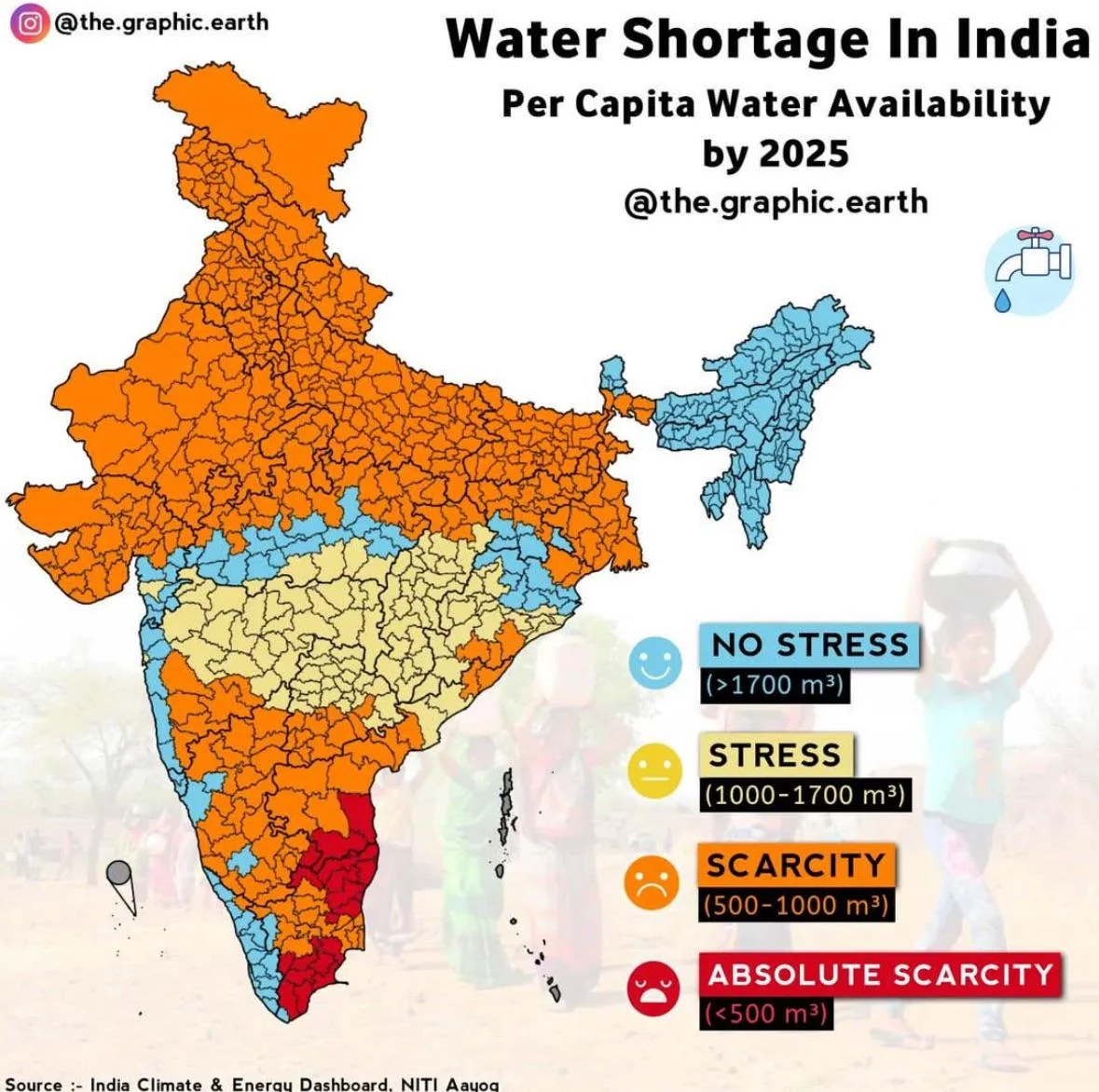
    India has 18% of the world’s population but only 4% of the freshwater resources. As per NITI Aayog “Composite Water Management Index”, 60 Cr people are experiencing high to extreme water stress.

    ~85% of India’s freshwater is used in agriculture (FAO).

    Groundwater depletion:

    1,006 blocks are over-exploited or critical (CGWB, 2023).

    Punjab and Haryana – ~1 metre annual groundwater decline.

    Per capita water availability fell from 1,820 m³ (2001)1,486 m³ (2025).

    “Day Zero” in cities like Chennai, Bengaluru, and Shimla

    By 2030, water demand could outstrip supply by twofold. (NITI Aayog)

    21 cities could exhaust groundwater by 2030. (NITI Aayog)

    The World Resources Institute ranks India 13th among the 17 most water-stressed nations globally

    2024 Annual Groundwater Quality Report – that 70% of India’s water sources are contaminated

    World Bank projects that climate-induced water scarcity could reduce India’s GDP by up to 12% by 2050

    Measures to improve water management

    Enhancing Water Storage Infrastructure

    Renovation Traditional Water Bodies – Example: Mission Kakatiya (Telangana) and Kudimaramath (Tamil Nadu).

    Farm-Level Storage – Promote farm ponds, percolation tanks, check dams, and contour bunds through MGNREGA. Eg- jalyukta Shivar of Maharashtra

    Rainwater Harvesting – Mandatory rooftop harvesting in water-stressed cities. Eg- Chennai Model

    Interlinking of Rivers – Eg- Projects like Ken-Betwa Link can ease water shortages in Bundelkhand.

    Use recharge wells to replenish aquifers through Atal Bhujal Yojana

    Dam Modernisation to enhance water storage capacity

    Improving Irrigation Efficiency

    Micro-Irrigation Expansion through PMKSY-PDMC. Eg- Drip saves 30-50% water; sprinkler saves 25-35%.

    Canal Modernisation- Improves efficiency from .

    Precision Farming – Use of sensors, fertigation, controlled irrigation for sustainable agriculture and optimal water use.

    Remote Sensing & GIS for Water Accounting – Monitor aquifers, rainfall-runoff, and canal leakages.

    Increase Capital Investment in Irrigation Systems and Fast-track AIBP projects

    Strengthening Community-Led Measures – Eg- Pani Panchayats in Odisha.

    Demand-Side Management

    Crop Diversification – Shift from water-intensive crops (paddy, sugarcane) to millets, pulses, oilseeds, horticulture. Example: Haryana’s Mera Pani Meri Virasat.

    Water Budgeting at Village Level through Gram Sabhas. Eg- Pani Foundation villages in Maharashtra.

    Water Pricing – Rational, volumetric pricing to reduce wastage.

    Water Users Associations (WUAs) – Participatory Irrigation Management for equitable distribution and canal maintenance.

    Incentivise Water Saving – Eg- Punjab’s Pani Bachao Paise Kamao for reducing groundwater usage.

    Implementing Mihir Shah Committee recommendations of One Water Approach by merging CGWB and CWC into a National Water Commission (NWC) is essential to achieve a water-secure economy.