💥Join UPSC 2027,2028 Mentorship (July Batch) + XFactor Notes & Microthemes PDF

GS Paper: GS1-02.Modern Indian History- Mid-18th century – Present (significant events, personalities, issues);

  • Back in news: Visva-Bharati University

    The stalemate continues in Visva-Bharati University as students demand the reopening of hostels and conducting of online examinations.

    Visva-Bharati

    • Visva-Bharati is a central research university and an Institution of National Importance located in Shantiniketan, West Bengal, India.
    • It was founded by Rabindranath Tagore who called it Visva-Bharati, which means the communion of the world with India.
    • Until independence, it was a college.
    • Soon after independence, the institution was given the status of a central university in 1951 by an act of the Parliament.

    Its establishment

    • The origins of the institution date back to 1863 when Debendranath Tagore was given a tract of land by the zamindar of Raipur, zamindar of Kirnahar.
    • He set up an ashram at the spot that has now come to be called chatim tala at the heart of the town.
    • The ashram was initially called Brahmacharya Ashram, which was later renamed Brahmacharya Vidyalaya.
    • It was established with a view to encouraging people from all walks of life to come to the spot and meditate.
    • In 1901 his youngest son Rabindranath Tagore established a co-educational school inside the premises of the ashram.
    • From 1901 onwards, Tagore used the ashram to organize the Hindu Mela, which soon became a center of nationalist activity.

    Try this PYQ from CSP 2021:

    Q. With reference to Madanapalle of Andhra Pradesh, which one of the following statements is correct?

    (a) Pingali Venkayya designed the tricolour Indian National Flag here.

    (b) Pattabhi Sitaramaiah led the Quit India Movement of Andhra region from here.

    (c) Rabindranath Tagore translated the National Anthem from Bengali to English here.

    (d) Madame Blavatsky and Colonel Olcott set up headquarters of Theosophical Society fi rst here.


    [wpdiscuz-feedback id=”2igxgiemsy” question=”Please leave a feedback on this” opened=”1″]Post your answers here.[/wpdiscuz-feedback]


    UPSC 2022 countdown has begun! Get your personal guidance plan now! (Click here)

  • In news: Tarapur Massacre of 1932

    Bihar CM has announced that February 15 would be celebrated as “Shahid Diwas” in memory of the 34 freedom fighters who were killed by police in Tarapur town of Bihar’s Munger district 90 years ago.

    Why such move?

    • The Tarapur massacre was the biggest carried out by the British police after the one in Jallianwala Bagh in Amritsar in 1919.
    • The freedom fighters had never got their due, the CM said.
    • PM Modi too had referred to the Tarapur massacre in his Mann ki Baat radio address of January 2021.

    Tarapur Massacre: Course of events

    • On February 15, 1932, a group of young freedom fighters planned to hoist an Indian national flag at Thana Bhavan in Tarapur.
    • Police were aware of the plan, and several officers were present at the spot. Around 2 pm, even as the police carried out a brutal lathicharge, Gopal Singh succeeded in raising the flag at Thana Bhavan.
    • A 4,000-strong crowd pelted the police with stones, injuring an officer of the civil administration.
    • The police responded by opening indiscriminate fire on the crowd.
    • After about 75 rounds were fired, 34 bodies were found at the spot, even though there were claims of an even larger number of deaths.

    Trigger for protest

    • The hanging of Bhagat Singh, Sukhdev, and Rajguru in Lahore on March 23, 1931, sent a wave of grief and anger around the country.
    • Following the collapse of the Gandhi-Irwin Pact, the Mahatma was arrested in early 1932.
    • The Congress was declared an illegal organization, and Nehru, Patel, and Rajendra Prasad were also thrown in jail.
    • In Munger, freedom fighters Srikrishna Singh, Nemdhari Singh, Nirapad Mukherjee, Pandit Dasrath Jha, Basukinath Rai, Dinanath Sahay, and Jaymangal Shastri were arrested.
    • A call given by the Congress leader Sardar Shardul Singh Kavishwar to raise the tricolour over government buildings resonated in Tarapur.


    Back2Basics:

    https://www.civilsdaily.com/news/explained-jallianwala-bagh-massacre/


    UPSC 2022 countdown has begun! Get your personal guidance plan now! (Click here)

  • Who was Tilka Manjhi?

    The Nation is remembering revolutionary freedom fighter and tribal leader Tilka Manjhi on his 272nd birth anniversary.

    Tilka Manjhi (1750-1785)

    • He organized Adivasis into an army and led the famous Santhal Hool in 1784 against the exploitative British.
    • In 1770, there was a severe famine in the Santhal region and people were dying of hunger.
    • Tilka Manjhi looted the treasury of the East India Company and distributed it among the poor and needy.
    • Inspired by this noble act of Tilka, many other tribals also joined the rebellion.
    • With this began his Santhal Hool, the revolt of the Santhals.
    • He continued to attack the British and their sycophantic allies.
    • From 1771 to 1784, Tilka Manjhi never surrendered.

    Offensive with the colonists

    • Tilka Majhi attacked Augustus Cleveland, an East India Company administrator and fatally wounded him.
    • The British surrounded the Tilapore forest from which he operated but he and his men held them at bay for several weeks.
    • When he was finally caught in 1784, he was tied to the tail of a horse and dragged all the way to the Collector’s residence at Bhagalpur, Bihar, India.
    • There, his deeply wounded body was hung from a Banyan tree.

    Try this question from CSP 2018:

    Q.After the Santhal uprising subsided, what was/ were the measure/measures taken by the colonial government?

    1. The territories called ‘Santhal Paraganas’ were created.
    2. It became illegal for a Santhal to transfer land to a non Santhal.

    Select the correct answer using the code given below:

    (a) 1 only

    (b) 2 only

    (c) Both 1 and 2

    (d) Neither 1 nor 2


    [wpdiscuz-feedback id=”21kicbmy07″ question=”Please leave a feedback on this” opened=”1″]Post your answers here.[/wpdiscuz-feedback]


    UPSC 2022 countdown has begun! Get your personal guidance plan now! (Click here)

  • Places in news: Chandernagore

    The Registry Building, a two-storey structure at Chandernagore built in 1875 and a symbol of French settlement of the colonial town, has been awaiting restoration for a long time.

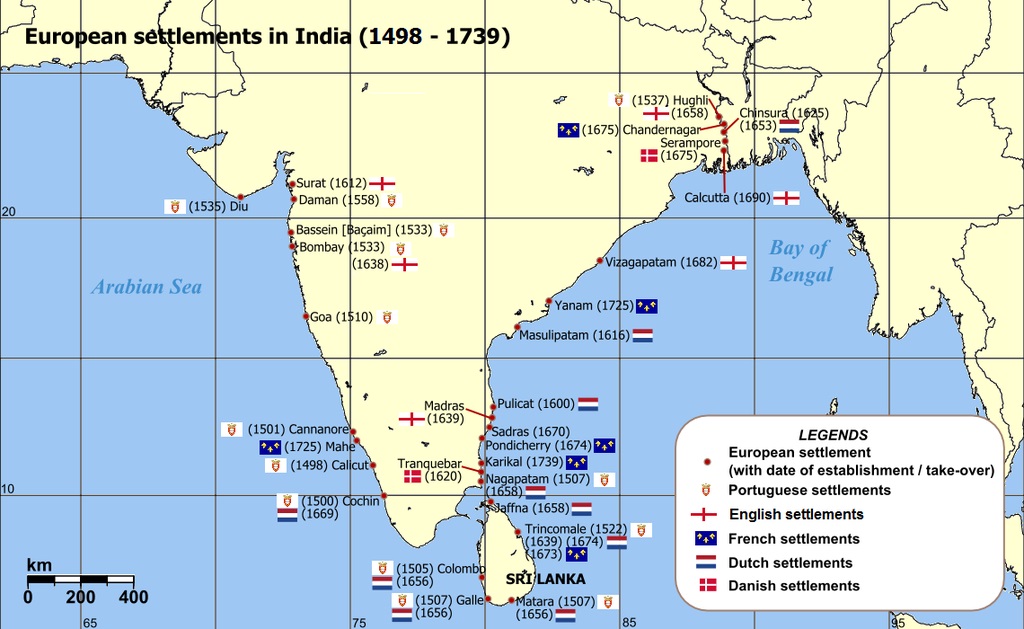
    French in India

    • France was the last of the major European maritime powers of the 17th century to enter the East India trade.
    • The French settlement in India began in 1673 with the purchase of land at Chandernagore from the Mughal Governor of Bengal.
    • The next year they acquired Pondicherry from the Sultan of Bijapur. Both became the centers of maritime commercial activities of the French in India.
    • Joseph Francois Dupleix who was initially appointed as Intendent of Chandernagore in 1731, sowed the seeds of colonization.
    • The village, which hitherto was engaged in maritime commerce along with Pondicherry, got fortified by him.

    Significance of Chandernagore

    • Chandernagore, though a part of French colonies in India, was unique in many ways.
    • It was very active in spearheading the freedom movement against the British. Due to its close proximity to Calcutta, it became a safe haven for freedom fighters of all hues.
    • Even Aurobindo Ghosh who was one of the accused in the Alipore Bomb case of 1909, was acquitted unconditionally and after a short stay at Chandernagore moved to Pondicherry.
    • Since the partition of Bengal in 1905, Chandernagore was in the thick of activities of freedom fighters against the British and produced several martyrs including Kanailal Dutt.

    Merger into India

    • As the British decided to hand over powers to the people of India by August 15, 1947, the people living under French rule in Pondicherry, Chandernagore, Karaikal, Mahe and Yanam were eager to join their homeland.
    • But the French were yet to learn their lessons. They tried all the tricks in the book to avert this.
    • Facing the onslaught from the people under their rule and the British and Indian rulers, the French declared Chandernagore as free city in 1947.
    • In June 1948, they conducted a referendum in which an overwhelming majority of 97 per cent people opted for a merger with India.
    • After so many legal hurdles, it became a part of India on October 2, 1955.

    Back2Basics: European Colonies in India


    UPSC 2022 countdown has begun! Get your personal guidance plan now! (Click here)

  • Netaji’s relationship with Nehru, Gandhi and the Congress

    In public discourse, the popular imagination of Netaji Subhash Chandra Bose is increasing all across the length and breadth of our country these days.

    Back in 2016, when there was ruckus over de-classification of some files associated with Netaji, a question too appeared in UPSC CSE Mains:


    Q. Highlight the differences in the approach of Subhash Chandra Bose and Mahatma Gandhi in the struggle for freedom.


    We can expect a repetition again considering the scale of ongoing debate around Netaji and the vitality of his INA leading to immediate withdrawal of British rulers from India.

    Also read:

    Celebration of Parakram Diwas

    Context

    The Bose-Gandhi rivalry is frequently understood as the biggest dichotomy of the Indian nationalist movement.

    Bose: A complex character of freedom movement

    • Bose was a complex character. His complexity comes alive when one realizes his disagreement with the Congress leadership, when Bose took over the Indian National Army (INA).
    • He constituted four regiments, three of which were named after Gandhi, Nehru and Maulana Azad.
    • He had profound respect for his colleagues.
    • In 1943, while Gandhi was in jail, Bose on the former’s birthday gave a moving address over the Azad Hind Radio where he referred to Gandhi as ‘father of the nation’.
    • This was probably the first time this epithet was used for Gandhi, and soon it became ubiquitous.

    Bose and his association with INC

    • Bose was a key member and a frontline leader of the Indian National Congress.
    • He plunged into the anti-colonial movement under Gandhi’s leadership in 1921 and rose to be the president of the Congress in 1938 and 39.
    • There were certain differences of opinion with the Gandhian high command in 1939, but he remained true to the Congress ideal of freedom.

    Joining the Indian National Congress

    • On July 16, 1921, Bose had returned to Bombay from London where he had gone on his father’s insistence to prepare for the Indian Civil Services examination.
    • Despite qualifying for the services he had refused to take up the opportunity.
    • Such was Bose’s zeal to join the freedom struggle that on the very afternoon he arrived in India he went to meet Gandhi at Mani Bhawan.

    Relations with the mainstream leaders

    (A) Bose vs. Gandhi

    • Bose wanted to know how the different aspects of the movement were going to culminate in the non-payment of taxes, the last stage of the campaign.
    • Secondly, he wanted to know how the non-payment of taxes would eventually force the British to leave and thirdly how Gandhi could promise Swaraj in one year.
    • On Gandhi’s advice Bose moved to Calcutta, where he worked closely with the lawyer and Congress leader C R Das.
    • As president of the Congress, his first disagreement with Gandhi happened in December 1938 when Bose was eager to form a coalition government in Bengal along with the Krishak Praja Party.
    • The following year, Bose was hopeful for re-election as Congress president. A second term was very rare and Gandhi was pretty much against the idea of re-electing Bose.
    • Bose found support from the younger and left leaning members of the Congress and also from the literary giant Rabindranath Tagore.
    • Tagore had personally written to Gandhi requesting a second term for Bose. However, Bose was aggrieved to know that Gandhi saw this as a ‘personal defeat’.

    (B) Bose vs. Nehru

    • Both leaders were of same age, similar political leanings and often finding themselves frustrated by Gandhi’s commitment to non-violence.
    • However, while Nehru was starry-eyed in his reverence for Gandhi, Bose though immensely respectful of Gandhi, found his political strategies to be ambiguous.
    • Bose and Nehru had been in prison at that time and both expressed disappointment and anger over unilateral withdrawal of non-cooperation movement over Chauri Chaura incident.
    • Both were left-leaning radical men, unswerving in their commitment to ‘purna swaraj’ and to the forming of a socialist state in independent India.
    • When Bose sought the support of the Nazi government in Germany, he found himself ideologically at the farthest end to Nehru’s views.

    (C) Bose vs. Patel

    • In response to Bose’s re-election, several members of the Congress Working Committee resigned including Vallabhbhai Patel and Rajendra Prasad.
    • Patel had an old rivalry with Bose, which was both personal and political.
    • Their relationship had deteriorated rapidly with the death of Patel’s elder brother Vithalbhai in 1933.
    • Bose had been very close to Vithalbhai and had nursed him during his last days.
    • In his will, Vithalbhai had left a substantial portion of his property to Bose.
    • Vallabhbhai had cast aspersions on the authenticity of the will and a long legal battle had followed culminating in the victory of Patel.

    As Congress president

    • In February 1938 Bose had taken over as president of the Congress and the next two years would be defining in creating his political profile as a Congressman and in drawing the rift with Gandhi and Nehru.
    • At the Haripura session of the Congress, Bose made his presidential address, which is known to be the lengthiest and most important speech he ever made to the party.
    • He made it clear that he stood for unqualified Swaraj.
    • However, it needs to be noted that nowhere in the speech did Bose suggest any criticism or deviation from Gandhi’s methods.

    Resignation from INC

    • On April 29, 1939 Bose resigned from his post as president of the Congress Party.
    • In a statement to the press, he mentioned the efforts he had made to find a common ground with Gandhi.
    • These having failed, he felt his presidency may be a sort of obstacle or handicap in the path of the Congress as it sought to reconcile its two wings.

    Life after leaving Congress

    (A) World War II

    • In September 1939 German tanks invaded Poland, marking the beginning of the Second World War.
    • The war was to have a most significant impact in the history of modern India.
    • Bose was a special invitee in the three-day meeting of the Congress Working Committee from September 9 to decide India’s position on the war.
    • For Bose, the war served as a golden opportunity for India to launch a civil disobedience movement in order to win independence.
    • For Bose the stance taken by the resolution to support British was completely unacceptable.
    • Nehru had nothing but hatred towards Fascism and Nazism and sought for some concessions from the British government to fight Mussolini and Hitler.

    (B) Escape to Germany

    • Bose organized mass protests in Calcutta for the removal of the Holwell monument that stood in Dalhousie Square as a memorial to those who died in the Black Hole of Calcutta.
    • He was arrested by the British government for the protests, but was released soon after he went into a seven-day hunger strike.
    • Bose’s arrest and the subsequent release set the scene for him to escape to Germany via Afghanistan and the Soviet Union.

    After Netaji’s demise ( rather disappearance)

    • It is also worth noting that at the end of the Second World War, Nehru put on his barrister’s gown and joined the defense team for the INA prisoners at the time of the Red Fort trials.
    • In the several speeches of Nehru after Bose’s death, the former referred to Netaji in the most affectionate way.
    • In August 1947, in his first speech from the ramparts of the Red Fort, Nehru mentioned only two people by name and were Gandhi and Bose. It was quite a warm reference.


    UPSC 2022 countdown has begun! Get your personal guidance plan now! (Click here)
  • Who was Rani Velu Nachiyar?

    The Prime Minister has paid tributes to Rani Velu Nachiyar on her birth anniversary.

    Velu Nachiyar (1730-1796)

    • Rani Velu Nachiyar was a queen of Sivaganga estate from c. 1780–1790.
    • She was the first Indian queen to wage war with the East India Company in India.
    • She is widely known as Veeramangai (“brave woman”).

    Her legend

    [A] Early life

    • Velu Nachiyar was the princess of Ramanathapuram and the only child of King Chellamuthu Vijayaragunatha Sethupathy and Queen Sakandhimuthathal of the Ramnad kingdom.
    • Nachiyar was trained in many methods of combat, including war match weapons usage, martial arts like Valari, Silambam, horse riding, and archery.
    • She was a scholar in many languages and was proficient in languages like French, English and Urdu.

    [B] Battles fought

    • During this period, she formed an army and sought an alliance with Hyder Ali with the aim of launching a campaign against the East India Company in 1780.
    • When her husband, Muthu Vaduganatha Periyavudaya Thevar was killed in a battle with EIC soldiers, she was drawn into the conflict.
    • When Velu Nachiyar found the place where the EIC stored some of their ammunition, she arranged a suicide attack on the location, blowing it up.


    UPSC 2022 countdown has begun! Get your personal guidance plan now! (Click here)

  • In news: Tai Khamti Rebellion

    The Arunachal Pradesh Deputy CM urged the Centre to recognize the Tai Khamti-British war as India’s first for independence.

    Tai Khamti Rebellion

    • The Tai Khamti Rebellion is the first such war took place in 1839 between the Tai Khamti people and the British.
    • The theatre of this war was some 2,400 km east of Meerut in Uttar Pradesh where the mutiny began.
    • Tai Khamtis resisted colonization by the British. Some 80 British soldiers, including Col. Adam White, were killed in the resultant conflict.

    Who are the Tai Khamti people?

    • The Tai Khamti people, who follow Theravada Buddhism, number a little more than 1,00,000 today and live in areas straddling Arunachal Pradesh and Assam.

    Other revolts in Arunachal

    • Arunachal Deputy CM also batted for recognition of battles between other communities of Arunachal Pradesh and the British.
    • They include a series of Anglo-Abor wars from 1858 to 1911 and the Wancho-British war in Tirap district’s Ninu in 1875.
    • The Abors, now called Adis, inhabit central Arunachal Pradesh, while the Wanchos live in the southern part of the State.


    UPSC 2022 countdown has begun! Get your personal guidance plan now! (Click here)

  • Who was P.N. Panicker?

    The President of India has recently unveiled the statue of Shri P.N. Panicker at Poojappura, Thiruvananthapuram.

    P.N. Panicker (1909-1995)

    • Puthuvayil Narayana Panicker is known as the Father of the Library Movement of Kerala.
    • June 19, his death anniversary, has been observed in Kerala as Vayanadinam (Reading Day) since 1996.
    • In 2017, PM has declared June 19, Kerala’s Reading Day, as National Reading Day in India.
    • The following month is also observed as National Reading Month in India

    Contributions

    • Panicker led the formation of Thiruvithaamkoor Granthasala Sangham (Travancore Library Association) in 1945 with 47 rural libraries.
    • The slogan of the organization was ‘Read and Grow’.
    • Later on, with the formation of Kerala State in 1956, it became Kerala Granthasala Sangham (KGS).
    • He traveled to the villages of Kerala proclaiming the value of reading.
    • Grandhasala Sangham won the ‘Krupsakaya Award’ from UNESCO in 1975.
    • It became the Kerala State Library Council, with an in-built democratic structure and funding.


    UPSC 2022 countdown has begun! Get your personal guidance plan now! (Click here)

  • 60th Goa Liberation Day

    Goa hosts PM for the celebration of its 60th liberation day.

    Goan Liberation

    • An important port for trade and military operations, Goa was ruled by the Portuguese for more than 450 years.
    • Historically, revolts against Portuguese rulers and their policies were recorded in the 18th and 19th century too.
    • On June 18, 1946, the movement of Goa’s liberation gathered momentum after socialist leader Dr Ram Manohar Lohia plunged himself into the freedom movement with many young Goans.
    • The day is now observed as Goa Revolution Day.

    Freeing from Portuguese Rule

    • Even as India became independent on August 15, 1947, Goa continued to be under Portuguese rule 14 years after that.
    • After independence, the calls for Goa’s Liberation again gathered steam.
    • After multiple agitations by freedom fighters, India made peaceful attempts for Goa’s liberation through diplomatic channels.
    • However, as a last resort, the Indian government then led by PM Nehru, sent in its armed forces to the coastal state after which the Portuguese surrendered and Goa was liberated on December 19, 1961.
    • This moment also marked the exit of the Portuguese (the first-comers), the last of the European colonizers to leave India.

    Contribution of T.B. Cunha

    • Cunha (1891-1958) was a prominent Indian nationalist and anti-colonial activist from Goa.
    • He is popularly known as the “Father of Goan nationalism”, and was the organiser of the first movement to end Portuguese rule in Goa

    What was ‘Operation Vijay’?

    • Perhaps the first tri-service operation of the Indian armed forces, Operation Vijay was about the liberation of the Portuguese territories of Goa, Daman and Diu.
    • It was a 36-hour military operation that started on December 18, 1961 and concluded on December 19, 1961.
    • While the army advanced into Goa from the North and the East, the Indian Air Force bombed the Portuguese airbase at Dabolim.
    • The Indian Navy was tasked with preventing hostile action by Portuguese warships, securing access to the Mormugao harbour, and securing the Anjadip island off Karwar.
    • By the evening of December 19, 1961, Portuguese Governor General Vassalo De Silva had signed the document of surrender after Indian armed forces.

    What happened after the liberation of Goa?

    • Goa was annexed into the Indian Union and was the Union Territory of Goa, Daman and Diu.
    • In 1967, however, the question of whether the state should merge with Maharashtra or not was answered through a plebiscite in which the majority of the Goan people voted against a merger.
    • It continued to remain a Union Territory until 1987 when it was accorded statehood.
    • Goa became India’s 25th state even as Daman and Diu continue to be UTs.


    UPSC 2022 countdown has begun! Get your personal guidance plan now! (Click here)

  • Historical episodes that PM spoke about in Kashi

    In his speech at Kashi, PM has referred to several historical episodes including the battle between Salar Masud and Raja Suhaldev and the conflict between Governor-general Warren Hastings and Raja Chait Singh.

    He also mentioned the contributions of historical figures like Rani Bhabani from Bengal.

    Note: UPSC is known to ask contemporaries.

    [1] Salar Masud and Raja Suhaldev

    • The story of Salar Masud, also known as Ghazi Mian, and Suhaldev is a mix of history and myth.
    • Ghazi Mian is believed to have acquired popularity as a warrior in the 12th century.
    • He was the nephew of the 11th-century Turkik invader, Mahmud of Ghazni, whose invasion of India is known as the moment when Islam entered large parts of the subcontinent.
    • Interestingly, his tomb at Bahraich in Uttar Pradesh stands as a place of pilgrimage for a large number of Muslims as well as Hindus.
    • The most comprehensive source of information about Ghazi Mian is the Mirat-e-Masaud (Mirror of Masaud), a 17th-century Persian hagiography written by Abdur Rahman Chisti, a Sufi saint.
    • He asserted that Masud was the disciple of Sheikh Moinuddin Chisti, the founder of the Chistiya order of Sunni mysticism.

    His conquest and Suheldev

    • Masud arrived in Multan as a 17-year old head of the Afghan army and after having subjugated it made for Delhi where he spent almost half a year.
    • Advancing his aggressive campaigns, Masud on the way destroyed several temples and converted many to Islam.
    • It was at Bahraich, where in the course of a battle in 1034 CE between Masud and a local king by the name Suhaldev that the former was wounded by an arrow and succumbed.
    • Suheldev is believed to have been the eldest son of the king of the Bhar community, from which emerged the Pasi community, a Dalit caste group of the region.

    [2] Warren Hastings and Maharaja Chait Singh

    • Another historical episode cited by Modi in his Kashi speech was about the first governor-general of Bengal Warren Hastings fleeing the city in 1781.
    • By the late 18th century, Benaras had declared independence from the Nawab of Awadh.
    • In 1771, Maharaja Chait Singh succeeded to the throne of Banaras with the help of British authorities.
    • Two years later, the Maharaja transferred the domain to the East India Company under the control of Hastings.

    Issues over Mysore war

    • When faced with the need for resources to fight the Mysore War against Hyder Ali, Hastings pressed Maharaja Chait Singh to make additional revenue payments and supply troops in 1778 and 1779.
    • When Singh failed to comply, Hastings marched to Benaras with his troops to confront the king.
    • A skirmish erupted between the British troops on the one hand and the Raja’s forces and his large number of supporters on the other.
    • As they fought, the Raja managed to escape from the fort through a window facing the Ganges.

    An embarrassing defeat for Hastings

    • Several of Hastings’ men were killed in the conflict and, left with no other option, the governor-general was forced to retreat.
    • Popular narrative goes that he left hurriedly at night for the nearby Chunar Fort riding an elephant.
    • The incident is believed to have given rise to the popular saying in Banaras: “Ghode par haudah, hathi par jeen, Kashi se bhaga Warren Hastings”.

    [3] Rani Bhabani

    • Bhabani was married to Raja Ramkanta Ray, the zamindar of the Natore estate in Rajshahi (present day Bangladesh).
    • After the death of her husband in 1748, the zamindari passed on to the hands of Bhabani, making her one among the very few women zamindars of the time.
    • For the next four decades, Bhabani is said to have managed the estate of Natore with utmost efficiency.
    • Bhabani is remembered most for her philanthropic efforts. She is known to have built several schools across Rajshahi district and offered a number of scholarships.
    • She is also known to have built the Durga Kund Mandir in Varanasi.
    • She also desired to build a Kashi in Bengal and, consequently in 1755 a complex consisting of a dozen temples was built in Baronagar in Murshidabad by her.


    UPSC 2022 countdown has begun! Get your personal guidance plan now! (Click here)