💥Join UPSC 2027,2028 Mentorship (July Batch) + XFactor Notes & Microthemes PDF

GS Paper: GS1-02.Modern Indian History- Mid-18th century – Present (significant events, personalities, issues);

  • Dictionary of Martyrs of India’s Freedom Struggle (1857-1947)

    Four martyrs of Communist movement of Kerala will be added to the ‘Dictionary of Martyrs India’s Freedom Struggle (1857-1947)’, if an earlier review report to the Indian Council for Historical Research (ICHR) is accepted.

    Communist revolutionaries of Kerala

    • The four who may make it to the list include Aboobacker and Chirukandan of Kayyur, “who walked to the gallows shouting Inquilab Zindabad and Communist Party Zindabad” and “died as brave communists,” as mentioned in the fifth volume of the dictionary.
    • Abu of Mambram, a Communist and active partner in the nationalist and anti-imperialist movements, and Chattukutty, an active Communist cadre involved in the agitations for price control, wage hike, and relief to peasants, who were killed in the Tellichery police firing on September 15, 1940, would also qualify.
    • The report had suggested the deletion of the martyrs of Punnapra-Vayalar, Karivelloor, and Kavumbayi agitations as they were rioters against the interim government headed by Jawaharlal Nehru.

    Back2Basics: “Dictionary of Martyrs” Project

    • The project for the compilation of “Dictionary of Martyrs” of India’s Freedom Struggle was commissioned by the Ministry of Culture, to the Indian Council of Historical Research (ICHR) to commemorate the 150th anniversary of the uprising of 1857.
    • In this dictionary, a martyr has been defined as a person who died or who was killed in action or in detention, or was awarded capital punishment while participating in the national movement for the emancipation of India.
    • It includes ex-INA or ex-military personnel who died fighting the British.
    • Information of about 13,500 martyrs has been recorded in these volumes.

    Who are included?

    • It includes the martyrs of 1857 Uprising, Jallianwala Bagh Massacre (1919), Non-Cooperation Movement (1920-22), Civil Disobedience Movement (1930-34), Quit India Movement (1942-44), Revolutionary Movements (1915-34), Kissan Movements, Tribal Movements, Agitation for Responsible Government in the Princely States (Prajamandal), Indian National Army (INA, 1943-45), Royal Indian Navy Upsurge (RIN, 1946), etc.

    Five Volumes

    • Volume 1: In this volume, more than 4400 martyrs of Delhi, Haryana, Punjab and Himachal Pradesh have been listed.
    • Volume 2: In this volume, more than 3500 martyrs of Uttar Pradesh, Uttarakhand, Madhya Pradesh, Chhattisgarh, Rajasthan and Jammu & Kashmir have been listed.
    • Volume 3: The number of martyrs covered in this volume is more than 1400. This volume covers the martyrs of Maharashtra, Gujarat and Sind.
    • Volume 4: The numbers of martyrs covered in this volume is more than 3300. This volume covers the martyrs of Bengal, Bihar, Jharkhand, Odisha, Assam, Arunachal Pradesh, Manipur, Meghalaya, Nagaland and Tripura.
    • Volume 5: The number of martyrs covered in this volume is more than 1450. This volume covers the martyrs of Andhra Pradesh, Telangana, Karnataka, Tamil Nadu and Kerala.
  • Centenary of Aligarh Muslim University

    In its centenary year, Aligarh Muslim University is planning to bury a time capsule, containing its history and achievements for posterity.

    Try this PYQ:

    Q.Consider the following:

    1. Calcutta Unitarian Committee
    2. Tabernacle of New Dispensation
    3. Indian Reforms Association

    Keshab Chandra Sen is associated with the establishment of which of the above?

    (a) 1 and 3 only

    (b) 2 and 3 only

    (c) 3 only

    (d) 1, 2 and 3

    Aligarh Muslim University

    • AMU is a public central university in Aligarh, India, which was originally established by Sir Syed Ahmad Khan as the Muhammadan Anglo-Oriental College in 1875.
    • Muhammadan Anglo-Oriental College became Aligarh Muslim University in 1920, following the Aligarh Muslim University Act.
    • It has three off-campus centres in Malappuram (Kerala), AMU Murshidabad centre (West Bengal), and Kishanganj Centre (Bihar).

    Its establishment

    • The university was established as the Muhammadan Anglo-Oriental (MAO) College in 1875 by Sir Syed Ahmad Khan, starting functioning on 24 May 1875.
    • The movement associated with Syed Ahmad Khan and the college came to be known as the Aligarh Movement, which pushed to realize the need for establishing a modern education system for the Indian Muslim populace.
    • He considered competence in English and Western sciences necessary skills for maintaining Muslims’ political influence.
    • Khan’s vision for the college was based on his visit to Oxford University and Cambridge University, and he wanted to establish an education system similar to the British model.

    About Syed Ahmad Khan

    • He was an Islamic pragmatist, reformer, and philosopher of nineteenth-century British India.
    • Born into a family with strong debts to the Mughal court, Ahmed studied the Quran and Sciences within the court.
    • He was awarded an honorary LLD from the University of Edinburgh in 1889.
    • In 1838, Syed Ahmed entered the service of East India Company and went on to become a judge at a Small Causes Court in 1867, retiring from 1876.
    • During the Indian Rebellion of 1857, he remained loyal to the British Raj and was noted for his actions in saving European lives.
    • In 1878, he was nominated to the Viceroy’s Legislative Council.
    • He supported the efforts of Indian political leaders Surendranath Banerjee and Dadabhai Naoroji to obtain representation for Indians in the government and civil services.
  • In news: Malabar Rebellion

    A report submitted to the Indian Council of Historical Research (ICHR) in 2016 has termed the Malabar Rebellion leaders as ‘rioters’.

    Try this question from CSP 2015:

    Q. Which amongst the following provided a common factor for a tribal insurrection in India in the 19th century?

    (a) Introduction of a new system of land revenue and taxation- of tribal products

    (b) Influence of foreign religious missionaries in tribal areas

    (c) Rise of a large number of money lenders, traders and revenue farmers as middlemen in tribal areas

    (d) The complete disruption of the old agrarian order of the tribal communities

    What is the Malabar Rebellion?

    • The Malabar Rebellion in 1921 started as resistance against the British colonial rule and the feudal system in southern Malabar but ended in communal violence between Hindus and Muslims.
    • There were a series of clashes between Mappila peasantry and their landlords, supported by the British, throughout the 19th and early 20th centuries.
    • It began as a reaction against a heavy-handed crackdown on the Khilafat Movement, a campaign in defence of the Ottoman Caliphate by the British authorities in the Eranad and Valluvanad taluks of Malabar.
    • The Mappilas attacked and took control of police stations, British government offices, courts and government treasuries.

    Why is it contentious?

    • It largely took the shape of guerrilla-type attacks on janmis (feudal landlords, who were mostly upper-caste Hindus) and the police and troops.
    • Mappilas had been among the victims of oppressive agrarian relations protected by the British.
    • But the political mobilization in the region in the aftermath of the Khilafat agitation and Gandhi’s non-cooperation struggle served as an opportunity for an extremist section to invoke a religious idiom to express their suffering.
    • There were excesses on both sides — rebels and government troops. Incidents of murder, looting and forced conversion led many to discredit the uprising as a manifestation of religious bigotry.
    • Moderate Khilafat leaders lamented that the rebellion had alienated the Hindu sympathy.
  • Person in news: Noor Inayat Khan

    World War II spy Noor Inayat Khan is now the first woman of Indian origin to be commemorated by the distinct blue London plaque.

    Try this PYQ:

    Q.A recent movie titled “The Man Who Knew Infinity” is based on the biography of-

    (a) S. Ramanujan
    (b) S. Chandrasekhar
    (c) S. N. Bose
    (d) C. V. Raman

    Noor Inayat Khan

    • A descendant of Tipu Sultan, Noor Inayat Khan became a secret agent during the Second World War.
    • She was the first woman radio operator to be infiltrated into occupied France in 1943 and worked under the code name ‘Madeleine’.
    • Renowned for her service in the Special Operations Executive, an independent British secret service set up by Winston Churchill in 1940.
    • Noor was Britain’s first Indian Muslim war heroine in Europe and the first female radio operator sent into Nazi-occupied France.
    • She was killed at the Dachau concentration camp in 1944 and was posthumously awarded the George Cross in 1949.

    What are Blue Plaques?

    • The idea of placing commemorative plaques on historically significant buildings was first mooted in 1863.
    • The idea was to honour important people and organisations that have lived or worked in London buildings.
    • Currently, the blue plaque scheme is being run by the charity organisation, English Heritage that takes care of historic sites and buildings in England.
    • While Khan is the first woman of Indian origin to be honoured with a blue plaque, it has been erected on houses and venues associated with several Indian men including Mahatma Gandhi, Raja Ram Mohun Roy, B R Ambedkar, Sardar Patel and Swami Vivekananda among others.
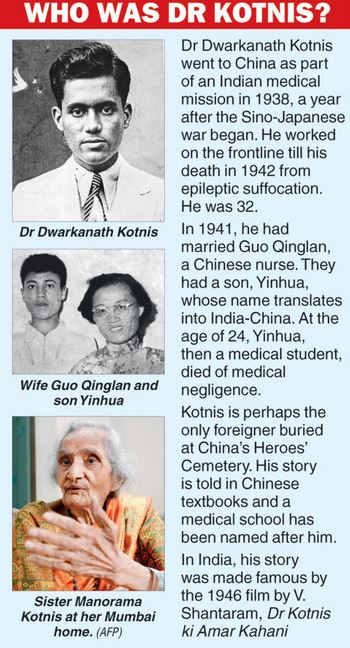
  • Who was Dr. Dwarkanath Kotnis?

    A bronze statue of Indian doctor Dwarkanath Kotnis is set to be unveiled in China.

    Try this PYQ:

    Q.A recent movie titled The Man Who Knew Infinity is based on the biography of

    (a) S. Ramanujan
    (b) S. Chandrasekhar
    (c) S. N. Bose
    (d) C. V. Raman

    Dr. Dwarkanath Kotnis

    • He is revered in China for his contributions during the Chinese revolution headed by its founder Mao Zedong and World War II.
    • He hailed from Sholapur in Maharashtra came to China in 1938 as part of a five-member team of doctors sent by the Indian National Congress to help the Chinese during World War II.
    • He joined the Communist Party of China (CPC) in 1942 and died the same year at the age of 32.
    • Kotnis’ medical assistance during the difficult days of the Chinese revolution was praised by Chinese leader Mao Zedong.
    • His statues and memorials were also set in some of the Chinese cities in recognition of his services.

    A revered personality in China

    • Late Chinese leader Mao Zedong was deeply affected by his death.
    • Mao wrote in his eulogy that “the army has lost a helping hand; the nation has lost a friend. Let us always bear in mind his internationalist spirit”.
    • Kotnis is remembered not only as a symbol inspiring medical students to work hard, but also an eternal bond between the people of China and India.
  • Story of our National Flag

    The final design of the Indian National Flag, hoisted by PM Nehru on August 16, 1947, at Red Fort, had a history of several decades preceding independence.

    Note various personalities involved in the development of our National flag. It may be no wonder to accept a personality-based question on such topics.

    Story of our National Flag: A timeline

    (1) Public display for first time

    • Arguably the first national flag of India is said to have been hoisted on August 7, 1906, in Kolkata at the Parsee Bagan Square (Green Park).
    • It comprised three horizontal stripes of red, yellow and green, with Vande Mataram written in the middle.
    • Believed to have been designed by freedom activists Sachindra Prasad Bose and Hemchandra Kanungo, the red stripe on the flag had symbols of the sun and a crescent moon, and the green strip had eight half-open lotuses.

    (2) In Germany

    • In 1907, Madame Cama and her group of exiled revolutionaries hoisted an Indian flag in Germany in 1907 — this was the first Indian flag to be hoisted in a foreign land.

    (3) During the Home Rule Movement

    • In 1917, Dr Annie Besant and Lokmanya Tilak adopted a new flag as part of the Home Rule Movement.
    • It had five alternate red and four green horizontal stripes, and seven stars in the saptarishi configuration.
    • A white crescent and star occupied one top corner, and the other had Union Jack.

    (4) Final version by Pingali Venkayya

    • The design of the present-day Indian tricolour is largely attributed to Pingali Venkayya, an Indian freedom fighter.
    • He reportedly first met Mahatma Gandhi in South Africa during the second Anglo-Boer War (1899-1902), when he was posted there as part of the British Indian Army.
    • Years of research went into designing the national flag. In 1916, he even published a book with possible designs of Indian flags.
    • At the All India Congress Committee in Bezwada in 1921, Venkayya again met Gandhi and proposed a basic design of the flag, consisting of two red and green bands to symbolise the two major communities, Hindus and Muslims.

    (5) During Constituent Assembly

    • On July 22, 1947, when members of the Constituent Assembly of India, the first item on the agenda was reportedly a motion by Pandit Nehru, about adopting a national flag for free India.
    • It was proposed that “the National Flag of India shall be horizontal tricolour of deep saffron (Kesari), white and dark green in equal proportion.”
    • The white band was to have a wheel in navy blue (the charkha being replaced by the chakra), which appears on the abacus of the Sarnath Lion Capital of Ashoka.
  • How Quit India movement gave a new direction to India’s freedom struggle?

    On August 8, 78 years ago, Mahatma Gandhi gave the call for British colonizers to “Quit India” and for the Indians to “do or die” to make this happen.

    Try this PYQ:

    Q.With reference to the Indian freedom struggle, consider the following events:

    1. Mutiny in Royal Indian Navy
    2. Quit India Movement launched
    3. Second Round Table Conference

    What is the correct chronological sequence of the above events?(CSP 2017)

    (a) 1-2-3

    (b) 2-1-3

    (c) 3-2-1

    (d) 3-1-2

    What led to the events of August 1942?

    • While factors leading to such a movement had been building up, matters came to a head with the failure of the Cripps Mission.
    • World War II was raging, and a beleaguered British needed the cooperation of their colonial subjects in India.
    • To this end, in March 1942, a mission led by Sir Stafford Cripps arrived in India to meet leaders of the Congress and the Muslim League.
    • The idea was to secure India’s whole-hearted support in the war, in return for self-governance.
    • However, despite the promise of “the earliest possible realization of self-government in India”, the offer Cripps made was of dominion status, and not freedom.

    A final blow

    • The failures of the Cripps Mission made Mahatma Gandhi realize that freedom would be had only by fighting tooth and nail for it.
    • Though initially reluctant to launch a movement that could hamper Britain’s efforts to defeat Fascist forces in the World War, Congress eventually decided to launch a mass civil disobedience.
    • At the Working Committee meeting in Wardha in July 1942, it was decided the time had come for the movement to move into an active phase.

    The Gowalia Tank address and Gandhiji’s arrest

    • On August 8, Gandhiji addressed the people from Mumbai’s Gowalia Tank maidan with the ‘Do or Die’ mantra.
    • By August 9, Gandhi and all other senior Congress leaders had been jailed.
    • He was kept at the Aga Khan Palace in Pune, and later in the Yerawada jail.
    • It was during this time that Kasturba Gandhi died at the Aga Khan Palace.

    The slogan ‘Quit India’

    • While Gandhi gave the clarion call of Quit India, the slogan was coined by Yusuf Meherally, a socialist and trade unionist who also served as Mayor of Mumbai.
    • A few years ago, in 1928, it was Meherally who had coined the slogan “Simon Go Back”.

    Outcome: A people’s movement

    • The arrest of the leaders, however, failed to deter the masses. With no one to give directions, people took the movement into their own hands.
    • In Bombay, Poona and Ahmedabad, lakhs of people clashed with the police on August 9. On August 10, protests erupted in Delhi, UP and Bihar.
    • There were strikes, demonstrations and people’s marches in defiance of prohibitory orders in Kanpur, Patna, Varanasi, and Allahabad.
    • The protests spread rapidly into smaller towns and villages.
    • Till mid-September, police stations, courts, post offices and other symbols of government authority were attacked.
    • Railway tracks were blocked, students went on strike in schools and colleges across India, and distributed illegal nationalist literature.
    • Mill and factory workers in Bombay, Ahmedabad, Poona, Ahmednagar, and Jamshedpur stayed away for weeks.
    • In some places, the protests were violent, with bridges blown up, telegraph wires cut, and railway lines taken apart.

    Outcome

    • The Quit India movement was violently suppressed by the British – people were shot, lathi-charged, villages burnt and enormous fines imposed.
    • In the five months up to December 1942, an estimated 60,000 people had been thrown in jail.

    Significance

    • Soon after, Gandhi and almost the entire top Congress leadership was arrested and thus began a truly people-led movement in our freedom struggle.
    • Eventually dispersed violently by the British, it left behind a clear message that the British would have to leave India, and no other solution would be acceptable to its masses.
  • Why August 7th is called National Handloom Day?

    Yesterday, August 7th was celebrated as the National Handloom Day. It was in 2015, the first National Handloom Day was celebrated.

    Try this PYQ:

    What was the immediate cause for the launch of the Swadeshi movement? (CSP 2010)

    (a) The partition of Bengal done by Lord Curzon.

    (b) A sentence of 18 months rigorous imprisonment imposed on Lokmanya Tilak.

    (c) The arrest and deportation of Lala Lajpat Rai and Ajit Singh; and passing of the Punjab Colonization Bill.

    (d) Death sentence pronounced on the Chapekar brothers.

    Why 7th August?

    • With the partition of Bengal, the Swadeshi Movement gained strength.
    • It was on August 7, 1905, that a formal proclamation was made at the Calcutta Town Hall to boycott foreign goods and rely on Indian-made products.

    What is handloom?

    • While different definitions for the word have evolved since the Handloom (Reservation and Articles for Production) Act, 1985, where ‘handloom’ meant “any loom other than power loom”, in recent years it has become more elaborate.
    • In 2012, a new definition was proposed: “Handloom means any loom other than power loom, and includes any hybrid loom on which at least one process of weaving requires manual intervention or human energy for production.”

    Back2Basics: Swadeshi Movement

    • Credit to starting the Swadeshi movement goes to Baba Ram Singh Kuka of the Sikh Namdhari sect, whose revolutionary movements which heightened around 1871 and 1872.
    • It gained momentum with the partition of Bengal by the Viceroy of India, Lord Curzon in 1905 and continued up to 1911.
    • It was the most successful of the pre-Gandhian movements.
    • Its chief architects were Aurobindo Ghosh, Lokmanya Bal Gangadhar Tilak, Bipin Chandra Pal and Lala Lajpat Rai, V. O. Chidambaram Pillai, Babu Genu.
    • Swadeshi, as a strategy, was a key focus of Mahatma Gandhi, who described it as the soul of Swaraj (self-rule). It was strongest in Bengal and was also called the Vandemataram movement in India.

    Important phases of the Movement

    • 1850 to 1904: developed by leaders like Dadabhai Naoroji, Gokhale, Ranade, Tilak, G. V. Joshi and Bhaswat K. Nigoni. This was also known as the First Swadeshi Movement.
    • 1905 to 1917: Began in 1905, because of the partition of Bengal ordered by Lord Curzon.
    • 1918 to 1947: Swadeshi thought shaped by Gandhi.
  • What is the Gandhi-King Initiative?

    A Bill to promote Mahatma Gandhi and Martin Luther King Jr’s legacies has been passed in American Senate.

    Practice question for mains:

    Q. Discuss how the civil rights movement in America is paralleled by India’s freedom struggle under Mahatma Gandhi.

    Gandhi-King Initiative

    • The initiative is an exchange program between India and the U.S. to study the work and legacies of Gandhiji and civil rights leader Martin Luther King Jr.
    • It will establish annual scholar and student exchange programs for Indians and Americans to study the leaders’ legacies and visit historic sites in India and the U.S.
    • The visits will be relevant to India’s freedom struggle and the U.S.’s civil rights movement.

    Gandhi-King Global Academy

    • The bill also seeks to establish the Gandhi-King Global Academy, a conflict resolution initiative based on the principles of nonviolence.
    • It proposes the establishment of the United States-India Gandhi-King Development Foundation set up by the U.S. Agency for International Development (USAID) and the GoI, organized under Indian law.
    • The Foundation, which has a proposed budget authorized of up to $ 30 million per year for five years through 2025.
    • It is tasked with administering grants to NGOs that work in health, pollution and climate change, education and empowerment of women.
  • In news: Santhal Rebellion

    Covid-19 pandemic has led to the cancellation of annual public observance of Hul in Jharkhand.

    Try this question from CSP 2018:

    Q.After the Santhal uprising subsided, what was/ were the measure/measures taken by the colonial government?

    1. The territories called ‘Santhal Paraganas’ were created.
    2. It became illegal for a Santhal to transfer land to a non Santhal.

    Select the correct answer using the code given below:

    (a) 1 only

    (b) 2 only

    (c) Both 1 and 2

    (d) Neither 1 nor 2

    Hul Divas

    • Hul Divas is observed annually on June 30 in memory of tribals — Sidho and Kanhu Murmu — who led the Santhal Hul (rebellion) on June 30, 1855, at Bhognadih in Sahebganj district.

    About Santhal Rebellion

    • The Santhals of Rajmahal Hills resented the oppression by revenue officials, police, money-lenders, and landlords—in general, by the “outsiders’ (whom they called diku).
    • The Santhals under Sido and Kanhu rose up against their oppressors, declared the end of the Company’s rule and asserted themselves independent in 1854.
    • It was only in 1856 after extensive military operations that the situation was brought under control. Sido died in 1855, while Kanhu was arrested in 1866.
    • A separate district of Santhal Parganas was created by the Government to pacify the Santhals.

    Must read:

    Tribal Issues | Part 2 | Pre Independence Tribal Revolts