💥Join UPSC 2027,2028 Mentorship (July Batch) + XFactor Notes & Microthemes PDF

GS Paper: GS1-02.Modern Indian History- Mid-18th century – Present (significant events, personalities, issues);

  • Birsa Munda and the Evolution of Adivasi Identity and Rights

    Why in the news?

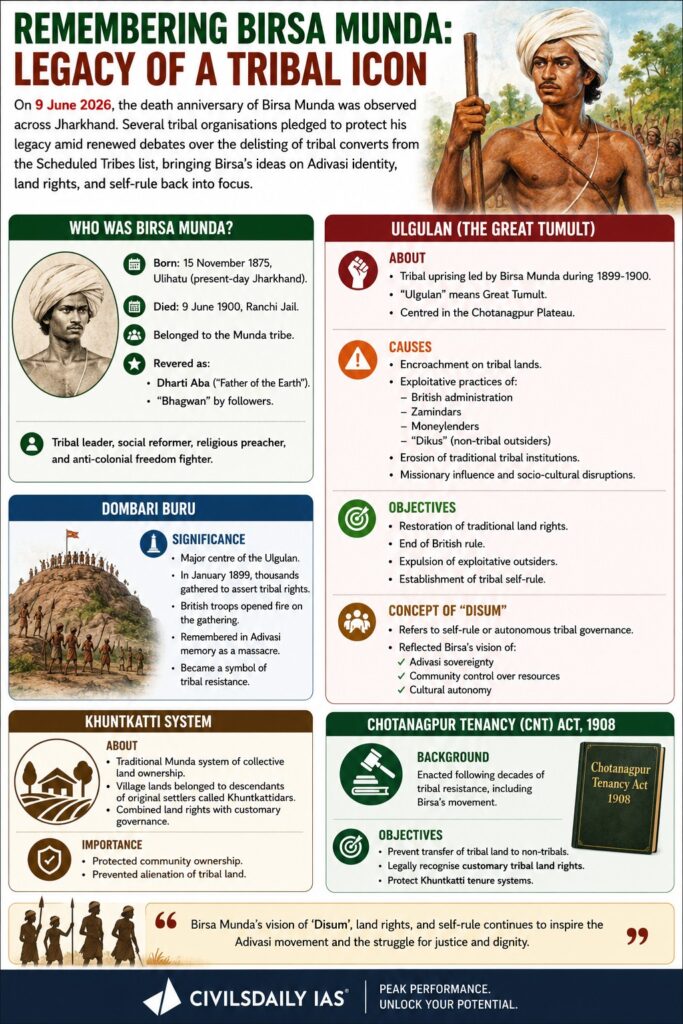
    On 9 June 2026, the death anniversary of Birsa Munda was observed across Jharkhand. Several tribal organisations pledged to protect his legacy amid renewed debates over the delisting of tribal converts from the Scheduled Tribes list, bringing Birsa’s ideas on Adivasi identity, land rights, and self-rule back into focus.

    Who was Birsa Munda?

    • Born: 15 November 1875, Ulihatu (present-day Jharkhand).
    • Died: 9 June 1900, Ranchi Jail.
    • Belonged to the Munda tribe.
    • Revered as: Dharti Aba (“Father of the Earth”) and “Bhagwan” by followers.
    • Tribal leader, social reformer, religious preacher, and anti-colonial freedom fighter.

    Ulgulan (The Great Tumult)

    • Tribal uprising led by Birsa Munda during 1899-1900.
    • “Ulgulan” means Great Tumult.
    • Centred in the Chotanagpur Plateau.

    Causes

    • Encroachment on tribal lands.
    • Exploitative practices of:
      • British administration,
      • Zamindars,
      • Moneylenders,
      • “Dikus” (non-tribal outsiders).
    • Erosion of traditional tribal institutions.
    • Missionary influence and socio-cultural disruptions.

    Objectives

    • Restoration of traditional land rights.
    • End of British rule.
    • Expulsion of exploitative outsiders.
    • Establishment of tribal self-rule.

    Concept of “Disum”

    • Refers to self-rule or autonomous tribal governance.
    • Reflected Birsa’s vision of Adivasi sovereignty, Community control over resources, and Cultural autonomy.

    Dombari Buru

    • Major centre of the Ulgulan.
    • In January 1899, thousands gathered to assert tribal rights.
    • British troops opened fire on the gathering.
    • Remembered in Adivasi memory as a massacre.
    • Became a symbol of tribal resistance.

    Khuntkatti System

    • Traditional Munda system of collective land ownership.
    • Village lands belonged to descendants of original settlers called Khuntkattidars.
    • Combined land rights with customary governance.

    Chotanagpur Tenancy (CNT) Act, 1908

    Background

    • Enacted following decades of tribal resistance, including Birsa’s movement.

    Objectives

    • Prevent transfer of tribal land to non-tribals.
    • Legally recognise customary tribal land rights.
    • Protect Khuntkatti tenure systems.

    [2020] With reference to the history of India, “Ulgulan” or the Great Trumult is the description of which of the following events?

    (a) The Revolt of 1857
    (b) The Mappila Rebellion of 1921
    (c) The Indigo Revolt of 1859-60
    (d) Birsa Munda’s Revolt of 1899-1900

  • Mountbatten Plan at 79: How it redrew the subcontinent

    Why in the News?

    The year 2026 marks the 79th anniversary of the June 3 Declaration. The Mountbatten plan formally accepted the Partition of British India after decades of constitutional negotiations aimed at preserving unity. It is significant as it represented a dramatic departure from earlier British efforts such as the Cabinet Mission Plan, which sought a united federal India.

    How Did British India Reach the Stage of Partition by 1947?

    1. Communal Polarisation: Intensified after the Muslim League’s demand for Pakistan and growing Hindu-Muslim political divergence.
    2. Direct Action Day (1946): Triggered widespread communal violence, particularly in Calcutta.
    3. Escalating Riots: Violence spread to Noakhali, Bihar, Bombay, Punjab, and other regions.
    4. Failure of Constitutional Negotiations: The Cabinet Mission Plan failed to secure agreement between Congress and the Muslim League.
    5. British Urgency: Post-World War II Britain lacked the resources and political will to govern India indefinitely.

    Why Did Lord Mountbatten Conclude That Partition Had Become Inevitable?

    1. Administrative Breakdown: Increasing communal violence threatened governance and public order.
    2. Political Deadlock: Congress and the Muslim League remained divided on power-sharing arrangements.
    3. Pakistan Demand: Muslim League leadership under Muhammad Ali Jinnah remained committed to a separate state.
    4. Time Constraints: Britain sought a rapid and orderly withdrawal from India.
    5. Security Concerns: Continued instability threatened a larger civil conflict across the subcontinent.
    6. The “Plan Balkan” Rejection: Before the June 3rd Plan, Mountbatten drafted the “Dickie Bird Plan” (Plan Balkan), which suggested letting individual provinces declare themselves independent successor states. Jawaharlal Nehru fiercely opposed it, arguing it would lead to total balkanization and chaos, prompting Mountbatten to scrap.

    Key Provisions of the June 3rd Plan 

    1. Creation of Two Dominions: British India was divided into the sovereign dominions of India and Pakistan, both holding the temporary right to retain British Commonwealth status.
    2. Partition of Bengal and Punjab: The Legislative Assemblies of Punjab and Bengal met in separate sections (Muslim-majority vs. non-Muslim majority areas) to vote on partition. Simple majorities in favor meant both provinces were split.
    3. Border Demarcation: A Boundary Commission, chaired by Sir Cyril Radcliffe, was established to draw the exact international borders for Punjab and Bengal.
    4. Regional Referendums: The North-West Frontier Province (NWFP) and the Sylhet district of Assam held popular referendums to determine whether they would join India or Pakistan. Both ultimately voted to join Pakistan.
    5. Status of Princely States: The 565 autonomous princely states were stripped of British paramountcy. They were given the choice to join either India or Pakistan based on geographical contiguity, while independent status was explicitly denied by the British administration.
    6. Sovereign Constituent Assemblies: Each dominion established its own sovereign assembly to design its independent constitution.
    7. Accelerated Timeline: Advanced from June 1948 to August 15, 1947.

    Why did Congress Accept the Partition Plan?

    1. Violence Containment: Sought to prevent further communal bloodshed.
    2. Governability: Preferred a smaller but politically cohesive India.
    3. Strong Central Authority: Feared prolonged instability in a weak federal arrangement.
    4. Administrative Practicality: Viewed Partition as the quickest route to independence.

    Key Leaders Involved

    1. Jawaharlal Nehru: Accepted Partition as a political necessity.
    2. Sardar Patel: Favoured a pragmatic settlement to avoid prolonged conflict.

    Why Did the Muslim League Support the June 3 Plan?

    1. Pakistan Objective: Fulfilled the League’s principal political demand.
    2. Political Representation: Addressed fears of marginalisation in a Hindu-majority state.
    3. Self-Determination Argument: Presented Pakistan as a means of safeguarding Muslim political interests.
    4. Recognition of Separate Nationhood: Reinforced the League’s Two-Nation Theory.

    What Objections Were Raised Against the Plan?

    Muslim League Concerns

    1. Punjab Partition: Opposed division of Punjab.
    2. Bengal Partition: Opposed division of Bengal.

    Sikh Concerns

    1. Boundary Security: Demanded stronger safeguards in Punjab.
    2. Population Distribution: Feared division of Sikh religious and economic centres.

    Congress Concerns

    1. National Unity: Regarded Partition as a tragic compromise.
    2. Future Instability: Feared long-term geopolitical tensions.

    NWFP Leadership Concerns

    1. Independence Option: Argued that the province should have been offered independence rather than a binary choice.

    How Did Boundary Decisions Become the Most Controversial Aspect of Partition?

    1. Delayed Disclosure: Radcliffe boundaries were announced after Independence.
    2. Lack of Ground Preparation: Populations were uncertain about future citizenship.
    3. Administrative Confusion: District-level ambiguities created insecurity.
    4. Communal Mobilisation: Uncertainty intensified migration and violence.
    5. Territorial Disputes: Several boundary disputes emerged after Partition.

    What Were the Immediate Consequences of the Mountbatten Plan?

    Political Consequences

    1. Creation of Two Dominions: India and Pakistan emerged as independent states.
    2. Constitution-Making: Separate Constituent Assemblies began functioning.

    Humanitarian Consequences

    1. Mass Migration: One of the largest forced migrations in modern history.
    2. Communal Violence: Widespread killings, abductions, and displacement.
    3. Refugee Crisis: Millions crossed borders seeking safety.

    Geopolitical Consequences

    1. India-Pakistan Rivalry: Emerged as a defining feature of South Asian politics.
    2. Kashmir Dispute: Became a major unresolved issue after Partition.

    Did the Mountbatten Plan Solve or Deepen Existing Problems?

    Major Successes

    1. Rapid Transfer of Power: Ensured formal British withdrawal.
    2. Constitutional Transition: Enabled establishment of sovereign governments.
    3. Administrative Closure: Resolved immediate constitutional deadlock.

    Major Failures

    1. Inadequate Preparation: Insufficient planning for migration and security.
    2. Boundary Ambiguities: Created confusion and unrest.
    3. Humanitarian Disaster: Failed to anticipate the scale of violence and displacement.
    4. Long-Term Conflict: Left unresolved territorial and identity disputes.

    Conclusion

    The Mountbatten Plan remains one of the most consequential political decisions in modern South Asian history. While it facilitated the end of colonial rule and enabled the emergence of independent states, it also exposed the limitations of hurried decolonisation. The legacy of Partition continues to influence India-Pakistan relations, debates on identity and federalism, and discussions on managing diversity within democratic nation-states.

    PYQ Relevance

    [UPSC 2019] Assess the impact of British imperial power in complicating the process of transfer of power during the 1940s.

    Linkage: The question examines the British role in shaping the final phase of India’s independence and Partition. The Mountbatten Plan was the decisive framework through which Britain managed the transfer of power, accelerated Partition, and redrew the political map of the Indian subcontinent.

  • How the charkha came to embody Gandhi and Tagore’ deepest disagreements

    Why in the News?

    Rabindranath Tagore’s 165th birth anniversary has renewed focus on his intellectual disagreements with Mahatma Gandhi, particularly over the symbolism of the charkha during the freedom movement. The debate remains highly relevant because contemporary politics across the world increasingly invokes civilisational nationalism, cultural identity, and economic self-reliance in ways similar to early 20th-century anti-colonial movements. 

    Why did the Gandhi-Tagore relationship evolve into an ideological conflict?

    1. Nationalism Debate: Gandhi prioritised mass mobilisation against colonialism, while Tagore feared aggressive nationalism could suppress universal humanism.
    2. Different Intellectual Foundations: Gandhi drew from ethical politics, rural reconstruction, and civil resistance; Tagore emphasised cosmopolitanism, creativity, and intellectual freedom.
    3. Post-Jallianwala Context: The divide widened after the 1919 Jallianwala Bagh massacre and the launch of the Non-Cooperation Movement.
    4. Renunciation of Knighthood: Tagore renounced his British knighthood after the massacre, signalling moral opposition to colonialism while still differing with Gandhi’s methods.
    5. Mass Politics vs Individual Freedom: Gandhi viewed collective discipline as necessary for anti-colonial struggle; Tagore warned against suppression of independent thought.

    How did the charkha become the centre of their disagreement?

    1. Political Symbolism: Gandhi transformed the charkha into a symbol of swadeshi, self-reliance, and resistance to British industrial goods.
    2. Congress Institutionalisation: In 1924, Gandhi proposed compulsory spinning for Congress workers and required members to wear khadi.
    3. Economic Resistance: Hand-spinning challenged British textile imports and revived rural employment.
    4. Moral Discipline: Gandhi linked spinning with simplicity, dignity of labour, and ethical citizenship.
    5. Tagore’s Critique: Tagore argued that excessive emphasis on spinning reduced creativity and narrowed the broader goals of freedom.

    Why did Tagore oppose the centrality of the charkha?

    1. Intellectual Freedom: Tagore rejected the idea that one activity should define patriotism or national participation.
    2. Critique of Mechanical Uniformity: He argued that compulsory spinning encouraged conformity over creativity.
    3. Essay ‘The Cult of the Charkha’: Tagore criticised the elevation of spinning into a quasi-religious national ritual.
    4. Fear of Isolationism: Tagore warned that rejection of modern industrial civilisation could isolate India economically and intellectually.
    5. Universal Humanism: He believed nationalism should not undermine openness to global knowledge and cultural exchange.

    How did Gandhi defend the charkha against Tagore’s criticism?

    1. Mass Employment: Gandhi argued that spinning addressed rural unemployment and poverty.
    2. Symbol of Equality: The charkha enabled participation across caste, class, and gender lines.
    3. Ethical Economics: Gandhi viewed decentralised production as morally superior to exploitative industrial capitalism.
    4. Response through ‘The Poet and the Charkha’ (1925): Gandhi replied that Tagore misunderstood the suffering of India’s villages.
    5. Constructive Programme: Gandhi linked spinning with village upliftment, self-respect, and national discipline.

    What larger philosophical differences emerged from the debate?

    1. View of Modernity: Gandhi criticised industrial modernity for creating inequality and exploitation; Tagore accepted modern science and international engagement.
    2. Role of the Individual: Tagore prioritised artistic freedom and diversity of thought; Gandhi emphasised collective sacrifice.
    3. Economic Vision: Gandhi advocated village-centred decentralised economies; Tagore supported balanced engagement with modern industry.
    4. Approach to Nationalism: Gandhi used nationalism as a mobilising force; Tagore warned against chauvinism and cultural rigidity.
    5. Educational Philosophy: Tagore’s Visva-Bharati model promoted global learning and creativity, contrasting with Gandhi’s emphasis on craft-centred education.

    Why does the Gandhi-Tagore debate remain relevant today?

    1. Civilisational Politics: Contemporary debates on cultural nationalism mirror earlier tensions between identity and universalism.
    2. Self-Reliance Discourse: Policies centred on economic nationalism revive questions raised during the swadeshi movement.
    3. Democratic Dissent: Their respectful disagreements demonstrate the importance of intellectual pluralism in democracy.
    4. Development Debate: The tension between industrial growth and decentralised sustainability remains unresolved.
    5. Ethics of Nationalism: The debate highlights the need to balance patriotism with openness, diversity, and constitutional values.

    Conclusion

    The Gandhi-Tagore debate transcended the immediate question of the charkha and evolved into a larger conversation on the meaning of freedom, nationalism, and human progress. Gandhi sought moral regeneration through collective discipline and self-reliance, while Tagore defended intellectual freedom and universal humanism. Their disagreement demonstrated that democratic nation-building requires both ethical conviction and openness to dissent.

    PYQ Relevance

    [UPSC 2023] What was the difference between Mahatma Gandhi and Rabindranath Tagore in their approach towards education and nationalism?

    Linkage: The PYQ directly overlaps with the Gandhi-Tagore debate on charkha, nationalism, modernity, and individual freedom discussed in the article. It helps in understanding ideological diversity within the freedom struggle, a recurring UPSC theme under Gandhian thought and nationalist discourse.

  • Komagata Maru Incident (1914) 

    Why in the News

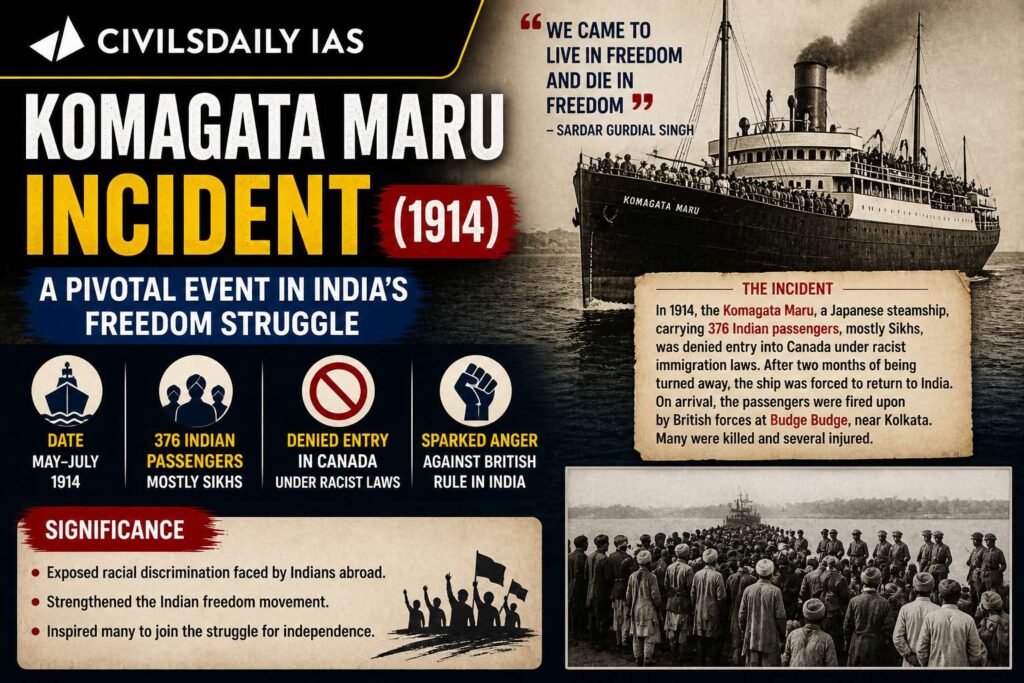
    The Komagata Maru incident (1914) has resurfaced in public discourse after references in global media, highlighting racist immigration policies under colonial rule and its role in India’s freedom movement.

    About Komagata Maru

    • Ship: Komagata Maru (also called Guru Nanak Jahaz)
    • Chartered by: Gurdit Singh
    • Origin: Hong Kong
    • Destination: Vancouver, Canada
    • Passengers: 376 Indians
      • Majority Sikhs, along with Muslims and Hindus

    Timeline of Events

    • April 1914: Ship leaves Hong Kong
    • May 1914: Arrives at Vancouver
    • Only 24 passengers allowed entry
    • Remaining passengers denied entry and kept on ship for 2 months
    • July 1914: Ship forced to return to India

    Reason for Denial of Entry

    • Canadian law: Continuous Journey Regulation (1908)
      • Required migrants to travel directly without stops from their country
    • Aimed to restrict Asian immigration
    • Influenced by racist groups like the Asiatic Exclusion League

    Events on Return to India

    • Ship reached Budge Budge (near Kolkata)
    • British authorities tried to send passengers to Punjab
    • Passengers resisted
    • Police opened fire
      • 20 people killed
      • Many injured
    [2014] The Ghadr (Ghadar) was a: 
    (a) revolutionary association of Indians with headquarters at San Francisco. 
    (b) nationalist organization operating from Singapore. 
    (c) militant organisation with headquarters at Berlin. 
    (d) Communist movement for India’s freedom with headquarters at Tashkent.
  • St Francis Xavier and Goa

    Why in the News

    Francis Xavier, the patron saint of Goa, is in the news following a controversy involving alleged derogatory remarks by a YouTuber, which led to protests and raised concerns about communal harmony in Goa.

    Key Facts About St Francis Xavier

    • Born in Spain in 1506
    • One of the founding members of the Society of Jesus (Jesuit Order)
    • Arrived in Goa in 1542 during Portuguese rule
    • Mission: Spread and restore Christianity among settlers

    Death and Relics

    • Died in 1552 on Shangchuan Island (off China)
    • Body brought to Goa in 1554
    • Mortal remains preserved in the Basilica of Bom Jesus since 1624
    • Considered “incorruptible” as it showed minimal decay

    Religious and Cultural Significance

    • Revered as “Goencho Saib” (Lord of Goa)
    • Central figure in Goan Catholic identity
    • Associated with pilgrimage tourism and heritage

    Exposition of St Francis Xavier

    • Held once every 10 years
    • Relics are displayed for public veneration
    • Duration: Around 45 days
    • Relics moved to Se Cathedral

    Historical Context

    • Goa was a Portuguese colony during his arrival
    • Linked to spread of Christianity in India
    • His role is sometimes debated in relation to the Goa Inquisition
    [2021] Consider the following statements: 
    1 St. Francis Xavier was one of the founding members of the Jesuit Order. 
    2 St. Francis Xavier died in Goa and a church is dedicated to him there. 
    3 The Feast of St. Francis Xavier is celebrated in Goa each year. 
    Which of the statements given above are correct? 
    (a) 1 and 2 only (b) 2 and 3 only (c) 1 and 3 only (d) 1, 2 and 3

  • Subhash Chandra Bose: the paradox of a revolutionary theory and praxis

    Why in the News?

    Subhas Chandra Bose’s ideological framework has regained relevance amid contemporary debates on strong leadership, state-led development, and the balance between democracy and efficiency. His synthesis of Vedantic values with socialist policies and centralized governance offers an alternative model of nation-building, contrasting with the Gandhian approach.

    How did Bose reconcile Indian spirituality with Western philosophical frameworks?

    1. Vedantic Foundation: Rooted early thought in Advaita Vedanta; believed reality is spiritual and unified. Example: Influence of Swami Vivekananda
    2. Doctrine of Maya: Viewed world as illusion but not escapist. This facilitated revolutionary engagement
    3. Hegelian Dialectics: Adopted conflict as driver of progress. (Thesis-Antithesis-Synthesis framework)
    4. Synthesis Approach: Combined Eastern spirituality with Western rationalism. This was a unique ideological blend
    5. Moral Evolution: Considered conflict as moral and necessary and this shaped his revolutionary outlook.

    Why did Bose shift from idealism to pragmatic socialism?

    1. Rejection of Absolutism: Moved away from pure idealism and adopted pragmatic politics.
    2. Historical Materialism Influence: Recognized role of material conditions in shaping society.
    3. Critique of Gandhian Methods: Found non-violence inadequate for rapid transformation.
    4. Industrial Imperative: Identified industrialization as key to poverty eradication
    5. Global Influences: Inspired by Soviet planning and European models. Example: Exposure to Germany and USSR

    What was Bose’s concept of ‘harmonious equality’?

    Subhas Chandra Bose’s concept of “harmonious equality” was rooted in his ideology of Samyavada (Samya: concord/harmony; vada: doctrine), a doctrine of synthesis designed to blend the best elements of foreign ideologies with India’s spiritual traditions, rather than blindly copying them. It was a vision for a “thoroughly modern and Socialist State” that achieved total liberation from both colonial rule and internal socio-economic inequalities

    1. Samyavada Doctrine: Advocated synthesis of socialism and nationalism
    2. Rejection of Extremes: Opposed both capitalism and orthodox communism. Equality Principle: Emphasized social and economic equality
    3. Dialectical Balance: Viewed ideologies as evolving through conflict and not static. He did not see Fascism or communism as finalities but as stages in the dialectical process. In the Indian Struggle (1934), he argued that India’s role was to work out a synthesis. 
    4. Indian Contextualization: Adapted socialism to Indian conditions and avoided blind imitation.

    How did Bose envision political freedom beyond independence?

    1. Comprehensive Freedom: Extended beyond colonial rule and it included social and economic justice.
    2. Redistribution of Wealth: Ensured equitable distribution across classes.
    3. Anti-Caste Measures: Focused on removal of caste inequalities
    4. Gender Equality: Advocated equal rights for women
    5. Communal Harmony: Emphasized elimination of religious divisions

    Why did Bose advocate authoritarian governance during reconstruction?

    1. Strong State Requirement: Supported centralized authority for nation-building
    2. Temporary Authoritarianism: Suggested limited period of dictatorship
    3. Administrative Efficiency: Ensured rapid decision-making and implementation
    4. Planned Economy: Favored state control over production and distribution
    5. Forward Bloc Vision: Proposed disciplined, centralized political organization.

    What are the contradictions in Bose’s political philosophy?

    1. Democracy vs Authority: Advocated freedom but supported authoritarianism
    2. Spiritualism vs Materialism: Combined metaphysical beliefs with socialist economics
    3. Nationalism vs Internationalism: Inspired by global ideologies but rooted in Indian nationalism.
    4. Revolution vs Stability: Promoted radical change yet sought structured governance
    5. Ethical Conflict: Justified conflict as moral necessity and raises ethical concerns.
    6. Bose Vs Gandhi: Subhas Chandra Bose failed to win the confidence of Mahatma Gandhi mainly because of deep differences in ideology, methods, and political strategy within the Indian national movement.

    Conclusion

    Bose’s philosophy reflects a complex synthesis of spirituality, socialism, and authoritarian governance. It offers an alternative framework for nation-building but raises critical concerns regarding democratic values and ethical limits of power.

    PYQ Relevance

    [UPSC 2016] Highlight the differences in the approach of Subhas Chandra Bose and Mahatma Gandhi in the struggle for freedom.

    Linkage: UPSC often frames questions on contrasting ideological approaches within the freedom struggle, making comparisons like Subhas Chandra Bose and Mahatma Gandhi highly relevant for Mains. This theme links to broader areas such as ideological diversity, methods of resistance, and models of nation-building, which are frequently tested directly or indirectly.

  • Babu Jagjivan Ram: 119th Birth Anniversary

    Why in News

    India paid tributes to Babu Jagjivan Ram on his 119th birth anniversary (5 April 2026) at Samta Sthal, New Delhi.

    About Babu Jagjivan Ram

    • Born: 5 April 1908, Chandwa, Bihar
    • Popularly known as: Babuji
    • Freedom fighter and social justice leader
    • Longest serving Union Cabinet Minister (35 years)
    • Served as Deputy Prime Minister (1979)

    Freedom Movement Contributions

    • Founded All India Depressed Classes League (1935)
    • Participated in Quit India Movement (1942)
    • Imprisoned by British
    • Youngest Minister in 1946 Interim Government
    • Held Labour portfolio

    Post Independence Contributions

    Green Revolution

    • Minister for Food & Agriculture (1967–70)
    • Helped India achieve food self sufficiency

    1971 War

    • Defence Minister during India Pakistan War 1971
    • Role in creation of Bangladesh

    Labour Reforms

    • Promoted:
      • Minimum wages
      • Workers welfare
      • Social security

    Political Career

    • Left Congress in 1977
    • Formed Congress for Democracy
    • Joined Janata Party
    • Deputy Prime Minister: 1979

    Death

    • Died: 6 July 1986
    • Memorial: Samta Sthal, New Delhi
    [2024] Consider the following pairs: Party : Its Leader 1 Bharatiya Jana Sangh : Dr. Shyama Prasad Mukherjee 2 Socialist Party : C. Rajagopalachari 3 Congress for Democracy : Jagjivan Ram 4 Swatantra Party : Acharya Narendra Dev How many of the above are correctly matched? (a) Only one (b) Only two (c) Only three (d) All four
  • Shyamji Krishna Varma

    Why in News?

    The Prime Minister of India paid homage to Shyamji Krishna Varma on his death anniversary, recalling his role in promoting Indian nationalism abroad.

    About Shyamji Krishna Varma

    • Born 4 October 1857 in Mandvi, Kachchh district, Gujarat
    Freedom fighter, lawyer and journalist
    • First President of Bombay Arya Samaj
    • Strongly influenced by Swami Dayanand Saraswati
    • Played a key role in revolutionary nationalism outside India

    Major Contributions

    Indian Home Rule Society (1905)

    • Founded in London
    • Supported by Bhikaji Cama, Dadabhai Naoroji, S.R. Rana
    • Aim: Promote self rule for India

    India House

    • Established in London in 1905
    • Residence for Indian students in Britain
    • Became hub of revolutionary nationalism

    Indian Sociologist

    • Monthly journal started in London
    • Spread nationalist ideas
    • Criticised British colonial rule

    Importance

    • Promoted freedom struggle internationally
    • Inspired revolutionary leaders
    • Strengthened Indian independence movement abroad

    [2018] Which among the following events happened earliest? (a) Swami Dayanand established Arya Samaj. (b) Dinabandhu Mitra wrote Neeldarpan. (c) Bankim Chandra Chattopadhyay wrote Anandmath. (d) Satyendranath Tagore became the first Indian to succeed in the ICS.
  • Before salt, there was water: why Mahad Satyagraha deserves its centenary

    Why in the News?

    The Mahad Satyagraha is in the news due to its upcoming centenary in 2027, prompting reflection on its legacy. It is significant as it marked an organised Dalit assertion of civil rights, while also highlighting the continuing gap between constitutional equality and social reality.

    What was the Mahad Satyagraha?

    The Mahad Satyagraha (also known as the Chavdar Tale Satyagraha) was a non-violent social movement led by Dr. B.R. Ambedkar on March 20, 1927. It was a landmark event in the struggle for Dalit rights in India, aimed at asserting the right of “untouchables” to use water from the public Chavdar Tank in Mahad, Maharashtra.

    Key Aspects of the Movement

    1. The Act of Defiance: Dr. Ambedkar led thousands of followers to the tank and publicly drank water from it, symbolically breaking the traditional caste-based prohibition.
    2. Historical Context: Although the Mahad Municipality had officially opened the tank to all in 1924 following the 1923 Bole Resolution, local upper-caste resistance had effectively barred Dalits from using it until this direct action.
    3. Beyond Water: Dr. Ambedkar famously stated that the movement was not just about water, but about establishing human rights and dignity. He viewed it as a “social revolution” against the caste hierarchy.
    4. Backlash and Rituals: Following the protest, upper-caste individuals “purified” the tank using cow urine and other rituals, highlighting the deep-seated prejudice of the time.
    5. Manusmriti Dahan Din: Later that year, in December 1927, as part of the ongoing struggle in Mahad, Ambedkar and his followers publicly burned the Manusmriti, a text they saw as the ideological source of caste oppression.

    What structural inequalities did the Mahad Satyagraha challenge?

    1. Caste-based exclusion: Enforced denial of access to public resources; e.g., Dalits prohibited from using Chavdar tank despite legal sanction.
    2. Social segregation: Institutionalised untouchability dictated everyday practices; e.g., separate access to water, temples, and public spaces.
    3. Denial of dignity: Reduced individuals to impure status; e.g., prohibition on touching vessels or shared resources.
    4. Legal-social disconnect: Laws permitted access but social enforcement denied it; e.g., 1923 resolution remained ineffective.

    How did Mahad transform the idea of rights in India?

    1. Assertion over petitioning: Shift from appeals to direct action; e.g., Ambedkar leading thousands to drink water publicly.
    2. Civil rights framework: Established access to public resources as a fundamental right, not charity.
    3. Collective mobilisation: Mass participation of Dalits signified organised resistance; e.g., large procession in Mahad.
    4. Symbolic transformation: Water became a symbol of equality and citizenship.

    What was the legal and constitutional legacy of Mahad?

    1. Social Empowerment Day: The date of the satyagraha, March 20, is observed annually in India as Social Empowerment Day (Samajik Sabalikaran Din).
    2. Article 15 foundation: Prohibits discrimination in access to public places; reflects Mahad’s core demand.
    3. Article 17 embodiment: Abolishes untouchability and criminalises its practice.
    4. Constitutional morality: Reinforces equality as a lived principle, not abstract ideal.
    5. Judicial validation: Courts eventually upheld rights to public resources; e.g., prolonged litigation confirmed access rights.

    Why does caste discrimination persist despite constitutional guarantees?

    1. Social inertia: Deep-rooted caste norms resist legal change; e.g., continued exclusion in rural areas.
    2. Invisible discrimination: Shift from overt to subtle practices; e.g., indirect denial of services.
    3. Economic dependency: Marginalised groups lack bargaining power to assert rights.
    4. Weak enforcement: Laws exist but implementation gaps remain.

    How does Mahad compare with other nationalist movements like Dandi March?

    1. Different objectives: Mahad targeted internal social injustice; Dandi challenged colonial authority.
    2. Scope of reform: Mahad addressed civilisational inequalities; Dandi addressed economic exploitation.
    3. Moral depth: Mahad required reform within society itself, making it more complex.
    4. Historical imbalance: National narrative prioritised anti-colonial struggles over social reform movements.

    What does the centenary demand from contemporary India?

    1. Social audit: Evaluates realisation of equality in everyday life; e.g., access to water, sanitation, education.
    2. Behavioural change: Moves beyond legal compliance to societal transformation.
    3. Inclusive citizenship: Ensures dignity irrespective of birth.
    4. Policy prioritisation: Strengthens anti-discrimination enforcement mechanisms.

    Conclusion

    The Mahad Satyagraha remains a foundational moment in India’s journey toward equality, but its centenary exposes an unfinished agenda. The persistence of caste-based discrimination reveals that legal abolition has not translated into social transformation. The event calls for renewed commitment to constitutional morality, ensuring that dignity and equality move from text to lived reality.

    PYQ Relevance

    [UPSC 2021] Trace the rise and growth of socio-religious reform movements with special reference to Young Bengal and Brahmo Samaj.

    Linkage: The PYQ tests evolution of socio-religious reform movements and their role in transforming Indian society. Mahad Satyagraha marks the shift from elite reform (Brahmo, Young Bengal) to mass-based assertion of equality and dignity by Scheduled Castes.

  • The 1946 Royal Navy revolt: solidarity amid sharpening polarisation

    Why in the News?

    The 80th anniversary of the 1946 Royal Indian Navy (RIN) revolt has revived debate on its scale, character, and constitutional significance. Often reduced to a “mutiny,” the uprising was in fact a mass anti-colonial mobilisation cutting across religious and class lines. The episode raises deeper questions about colonial governance failure, military discipline, political negotiation, and institutional accountability during the final phase of British rule.

    What was the RIN Revolt/Munity?

    1. The Royal Indian Navy Revolt began on 18 February 1946 at HMIS Talwar in Bombay.
    2. What started as a strike over food and racial discrimination evolved into a coordinated uprising across 78 ships and 20 shore establishments, involving nearly 20,000 naval ratings
    3. It spread to Karachi, Calcutta, Madras, Visakhapatnam, Cochin, and the Andaman Islands
    4. The revolt lasted five days but exposed structural cracks in colonial military control.

    Was the 1946 Revolt merely a mutiny or a culmination of earlier military unrest?

    1. Historical Continuity: Earlier small-scale military protests occurred during World War II, but remained localised and short-lived. Example: Isolated wartime discontent within army and naval units did not expand beyond individual establishments.
    2. Qualitative Shift: The 1946 revolt transformed from service grievance to political defiance. Example: Slogans linked food protest to nationalist demands and release of INA prisoners.
    3. Scale Expansion: Covered 78 ships and 20 shore establishments. Example: Naval units from Bombay to Karachi joined simultaneously.
    4. National Character: Spread across western, eastern and southern maritime commands. Example: Bombay (HMIS Talwar), Karachi (HMIS Hindustan), Madras and Visakhapatnam shore bases participated.
    5. “Last War of Independence” Narrative: Some historians describe it as the final armed assertion before British withdrawal in 1947.

    What Factors Triggered the 1946 Royal Indian Navy Revolt?

    1. Racial discrimination: Institutional inequality between British officers and Indian ratings generated sustained resentment within the naval hierarchy.
    2. Racist leadership: The posting of Arthur Frederick King, an officer known for overt racial bias, as Commander of HMIS Talwar deepened existing resentment and aggravated discontent among Indian sailors.
    3. Weak Grievance Redressal Mechanism: Absence of formal accountability channels escalated discontent into rebellion. Example: Hunger strike on February 18 escalated into armed confrontation by February 21.
    4. Poor food and living conditions: Substandard rations at HMIS Talwar triggered the immediate “No Food, No Work” strike.
    5. Low pay and limited promotion: Restricted career advancement reduced morale among Indian sailors.
    6. Harsh discipline and racial abuse: Punitive command practices and verbal insults eroded institutional trust. Example: Indian ratings faced unequal treatment compared to British personnel
    7. Influence of INA trials: Public sympathy for INA soldiers politicised naval personnel.
    8. Post-war economic distress: Inflation and uncertainty after World War II intensified dissatisfaction within the ranks.
    9. Nationalist awakening: Quit India legacy connected service grievances with the broader anti-colonial struggle.

    What Were the Events of the 1946 Royal Indian Navy Mutiny?

    1. Strike at HMIS Talwar (18 February 1946): Naval ratings in Bombay refused food and duty over poor rations and racial abuse.
    2. Formation of Naval Central Strike Committee: Sailors elected M.S. Khan and Madan Singh to coordinate action across ships and shore establishments.
    3. Spread to Other Ports: The revolt extended to Karachi, Calcutta, Madras, Visakhapatnam, Cochin, and the Andamans, involving 78 ships and 20 establishments.
    4. Adoption of Nationalist Symbols: Ratings raised Congress, Muslim League, and Communist flags, signalling political overtones beyond service grievances.
    5. Civilian Solidarity in Bombay: Textile workers, tram workers, and students joined protests, leading to city-wide strikes and clashes.
    6. British Military Suppression: Army units with armoured vehicles were deployed; firing in Bombay led to civilian casualties.
    7. Appeal by Political Leadership: Congress and Muslim League leaders urged sailors to surrender to prevent escalation.
    8. Surrender (23 February 1946): The Naval Central Strike Committee called off the revolt after five days.

    How was the revolt organised and who were its key leaders?

    1. Naval Central Strike Committee (NCSC): Formed to coordinate action across ships and establishments.
    2. M.S. Khan: Served as President of the Strike Committee, symbolising Hindu-Muslim unity.
    3. Madan Singh: Vice-President; mobilised communication between naval units.
    4. B.C. Dutt: Earlier defiance and arrest at HMIS Talwar acted as precursor catalyst.
    5. Collective Leadership Model: No single supreme commander; decentralised coordination across ports.
    6. Headquarters Concentration: Bombay functioned as nerve centre due to its communication facilities and signal training base.

    Did the British response uphold principles of proportionality and constitutional accountability?

    1. Excessive Force: Used machine guns and bayonets against stone-throwing civilians. Example: Approximately 200 working poor killed in Bombay street clashes.
    2. Urban Militarisation: Imposed coercive control over civilian areas. Example: Mill districts, tram lines, post offices and railway workshops became battlegrounds.
    3. Collective Punishment Approach: Targeted workers and students supporting ratings. Example: Textile mills and schools shut; working-class neighbourhoods barricaded.
    4. Breakdown of Civil Administration: Military assumed de facto control of the city. Example: British forces unable to regain full control for two days even after surrender on February 23.
    5. Absence of Political Dialogue: Colonial state failed to institutionalise negotiated settlement mechanisms.

    What does the revolt reveal about inter-communal solidarity amid rising polarisation?

    1. Hindu-Muslim Unity: Joint mobilisation across communities despite post-Shimla Conference tensions (1945). Example: Processions carried Congress, Muslim League, and Communist flags together.
    2. Cross-Class Participation: Workers, students, and poor residents joined naval ratings. Example: Textile mills, railway workshops, and factories shut in solidarity.
    3. Shared Anti-Colonial Identity: Shifted discourse from communal politics to national resistance.
    4. Urban Collective Action: Bombay emerged as epicentre of mass mobilisation.
    5. Temporary Overcoming of Polarisation: Demonstrated alternative trajectory before Partition violence engulfed subcontinent.

    Why did mainstream political leadership distance itself from the revolt?

    1. Strategic Restraint: Congress and Muslim League avoided endorsing armed insurrection to maintain negotiation leverage with British.
      1. Congress Strategy: Prioritised negotiated transfer of power through Cabinet Mission framework (1946).
      2. League Position: Avoided association with uncontrolled armed insurrection.
    2. Fear of Militarised Escalation: Leaders wary of uncontrolled mass uprising affecting constitutional transfer of power.
    3. Institutional Discipline Concern: Political leadership prioritised civil supremacy over armed forces.
    4. Missed Revolutionary Opportunity: Limited political backing weakened the revolt’s sustainability.

    How did the revolt influence the British decision to expedite transfer of power?

    1. Erosion of Military Reliability: Demonstrated unreliability of Indian armed forces under colonial command.
    2. Security Cost Escalation: Suppression required mobilisation of army battalions and armoured vehicles.
    3. Urban Instability Indicator: Paralysed Bombay, a key commercial hub.
    4. Imperial Fatigue Post-WWII: Combined with INA trials and economic crisis, revolt intensified British exit calculations.
    5. Accelerated Decolonisation Context: Occurred months before Cabinet Mission (1946), reinforcing urgency.

    Does the classification of the event as a “mutiny” undermine historical accountability?

    1. Narrative Minimisation: Label reduced scale to a disciplinary breach rather than mass anti-colonial uprising.
    2. Institutional Framing Bias: Colonial records prioritised law-and-order lens.
    3. Memory Marginalisation: Event received limited recognition compared to INA movement.
    4. Historiographical Debate: Raises questions about state narratives shaping public memory.
    5. Democratic Reassessment: 80th anniversary renews focus on inclusive freedom struggle narratives.

    Conclusion

    The 1946 Royal Indian Navy revolt represented a decisive rupture in colonial military authority rather than a routine disciplinary breakdown. It exposed structural discrimination within the armed forces, demonstrated cross-communal solidarity, and revealed the declining reliability of imperial coercive power. Although politically unsupported and short-lived, the uprising weakened British confidence in sustaining rule over India. In the broader trajectory of decolonisation, it marked the final phase where military disaffection converged with mass nationalism, accelerating the transfer of power in 1947.

    PYQ Relevance

    [UPSC 2014] In what ways did the naval mutiny prove to be the last nail in the coffin of British colonial aspirations in India?

    Linkage: Directly asked in GS1 (2014, 10 marks), making it a high-priority theme under Modern Indian History and the final phase of the freedom struggle. It links the RIN Revolt to decolonisation, erosion of British military authority, and the accelerating transfer of power in 1947.