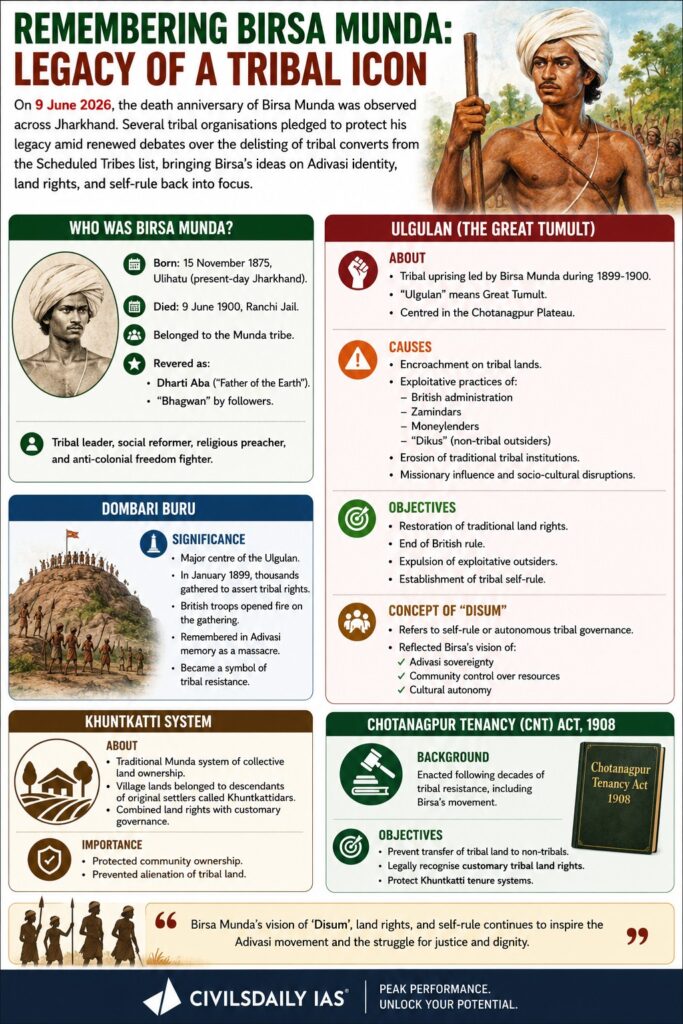
Why in the news?
On 9 June 2026, the death anniversary of Birsa Munda was observed across Jharkhand. Several tribal organisations pledged to protect his legacy amid renewed debates over the delisting of tribal converts from the Scheduled Tribes list, bringing Birsa’s ideas on Adivasi identity, land rights, and self-rule back into focus.
Who was Birsa Munda?
- Born: 15 November 1875, Ulihatu (present-day Jharkhand).
- Died: 9 June 1900, Ranchi Jail.
- Belonged to the Munda tribe.
- Revered as: Dharti Aba (“Father of the Earth”) and “Bhagwan” by followers.
- Tribal leader, social reformer, religious preacher, and anti-colonial freedom fighter.
Ulgulan (The Great Tumult)
- Tribal uprising led by Birsa Munda during 1899-1900.
- “Ulgulan” means Great Tumult.
- Centred in the Chotanagpur Plateau.
Causes
- Encroachment on tribal lands.
- Exploitative practices of:
- British administration,
- Zamindars,
- Moneylenders,
- “Dikus” (non-tribal outsiders).
- Erosion of traditional tribal institutions.
- Missionary influence and socio-cultural disruptions.
Objectives
- Restoration of traditional land rights.
- End of British rule.
- Expulsion of exploitative outsiders.
- Establishment of tribal self-rule.
Concept of “Disum”
- Refers to self-rule or autonomous tribal governance.
- Reflected Birsa’s vision of Adivasi sovereignty, Community control over resources, and Cultural autonomy.
Dombari Buru
- Major centre of the Ulgulan.
- In January 1899, thousands gathered to assert tribal rights.
- British troops opened fire on the gathering.
- Remembered in Adivasi memory as a massacre.
- Became a symbol of tribal resistance.
Khuntkatti System
- Traditional Munda system of collective land ownership.
- Village lands belonged to descendants of original settlers called Khuntkattidars.
- Combined land rights with customary governance.
Chotanagpur Tenancy (CNT) Act, 1908
Background
- Enacted following decades of tribal resistance, including Birsa’s movement.
Objectives
- Prevent transfer of tribal land to non-tribals.
- Legally recognise customary tribal land rights.
- Protect Khuntkatti tenure systems.
[2020] With reference to the history of India, “Ulgulan” or the Great Trumult is the description of which of the following events?
(a) The Revolt of 1857
(b) The Mappila Rebellion of 1921
(c) The Indigo Revolt of 1859-60
(d) Birsa Munda’s Revolt of 1899-1900
