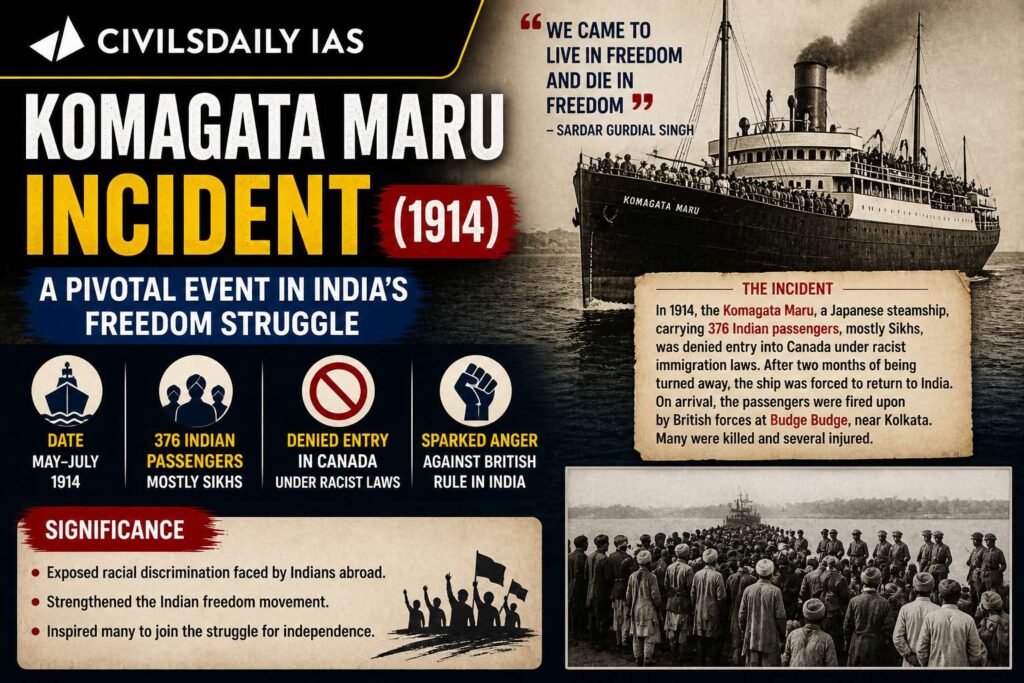
Why in the News
The Komagata Maru incident (1914) has resurfaced in public discourse after references in global media, highlighting racist immigration policies under colonial rule and its role in India’s freedom movement.
About Komagata Maru
- Ship: Komagata Maru (also called Guru Nanak Jahaz)
- Chartered by: Gurdit Singh
- Origin: Hong Kong
- Destination: Vancouver, Canada
- Passengers: 376 Indians
- Majority Sikhs, along with Muslims and Hindus
Timeline of Events
- April 1914: Ship leaves Hong Kong
- May 1914: Arrives at Vancouver
- Only 24 passengers allowed entry
- Remaining passengers denied entry and kept on ship for 2 months
- July 1914: Ship forced to return to India
Reason for Denial of Entry
- Canadian law: Continuous Journey Regulation (1908)
- Required migrants to travel directly without stops from their country
- Aimed to restrict Asian immigration
- Influenced by racist groups like the Asiatic Exclusion League
Events on Return to India
- Ship reached Budge Budge (near Kolkata)
- British authorities tried to send passengers to Punjab
- Passengers resisted
- Police opened fire
- 20 people killed
- Many injured
| [2014] The Ghadr (Ghadar) was a: (a) revolutionary association of Indians with headquarters at San Francisco. (b) nationalist organization operating from Singapore. (c) militant organisation with headquarters at Berlin. (d) Communist movement for India’s freedom with headquarters at Tashkent. |
