Fiscal federalism refers to the financial relations between centre and states, covering the division of taxation powers, expenditure responsibilities, and transfer mechanisms. Article 268 – 293 deal with Fiscal Federalism in India.
Evolving Pattern of Centre-State Financial Relations in Planned Development
1950-1990- Centralised Planning Era
The Planning Commission controlled transfers through discretionary plan grants.
The Finance Commission played a limited role in fiscal transfers.
The Centre shaped State priorities through proliferation of CSS.
1991-2014- Reform & Decentralisation Phase
Economic liberalisation gave States more fiscal autonomy in revenue and expenditure.
Introduction of VAT (2005) boosted State revenues through a buoyant tax base.
CSS were rationalised but tied funds still constrained State flexibility.
2015 onwards- New Federalism Phase
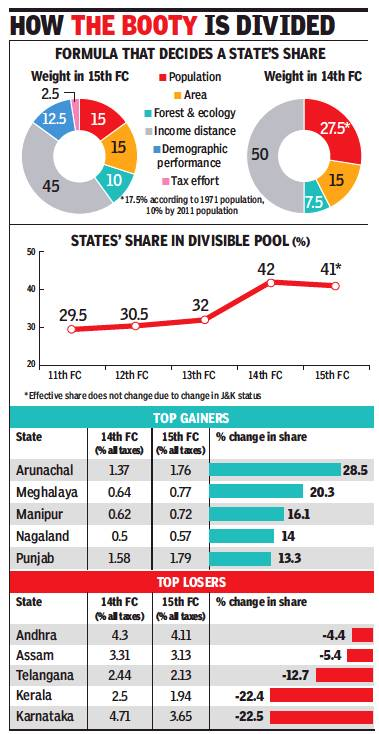
The 14th Finance Commission raised devolution to 42%, enhancing fiscal space for States.
NITI Aayog replaced the Planning Commission and adopted a consultative approach.
GST (2017) introduced pooled sovereignty and created a shared tax regime.
The 15th Finance Commission continued 41% devolution but increased performance-linked grants.
Impact of Recent Reforms on Fiscal Federalism
Positive Impacts
Institutionalised Cooperative Federalism – GST Council as joint decision-making forum.
Economic Efficiency – GST reduced cascading taxes, transport time cut by 33%, tax base expanded from 66 lakh (2017) to 1.5 crore+ (2024), collections near .
Strengthened Development Role – States’ developmental expenditure rose from 8.8% of GDP (2004-05) to 12.5% (2021-22).
Negative Impacts
The Centre retains major taxation powers (income tax, CGST, natural resources), while States restricted to SGST.
Cesses & surcharges grew, shrinking States’ effective share from 35% (2015-20) to ~31% (2020-24).
Delayed GST compensation, especially during COVID, undermined States’ trust.
Borrowing capped at 3% of GSDP, with enhanced limits tied to reform conditions (e.g., power sector).
The 15th FC’s 45% income distance weight penalised better-performing States (TN, Kerala, Karnataka).
Grants-in-aid declined from to , reducing States’ fiscal flexibility.
CSS burden increased as States finance a larger share but have little role in design.
Way Forward
Equity in devolution – Use HDI as a parameter in horizontal tax distribution.
Off-budget borrowings – Scrutinise and report to ensure transparency and accountability.
Horizontal imbalance – Guarantee minimum share for rich States and set a ceiling for poorer States.
Increase Devolution to 50% under 16th FC.
Include Cess/Surcharge in divisible pool
Restructure CSS – Consolidate into fewer umbrella schemes
For India’s fiscal federalism to be effective, it must rest on the principles of autonomy, adequacy, and elasticity.