Mains Ready By December. Smash Mains & Smash PYQ Admissions Open

GS Paper: GS2-17.India and its neighborhood- relations.

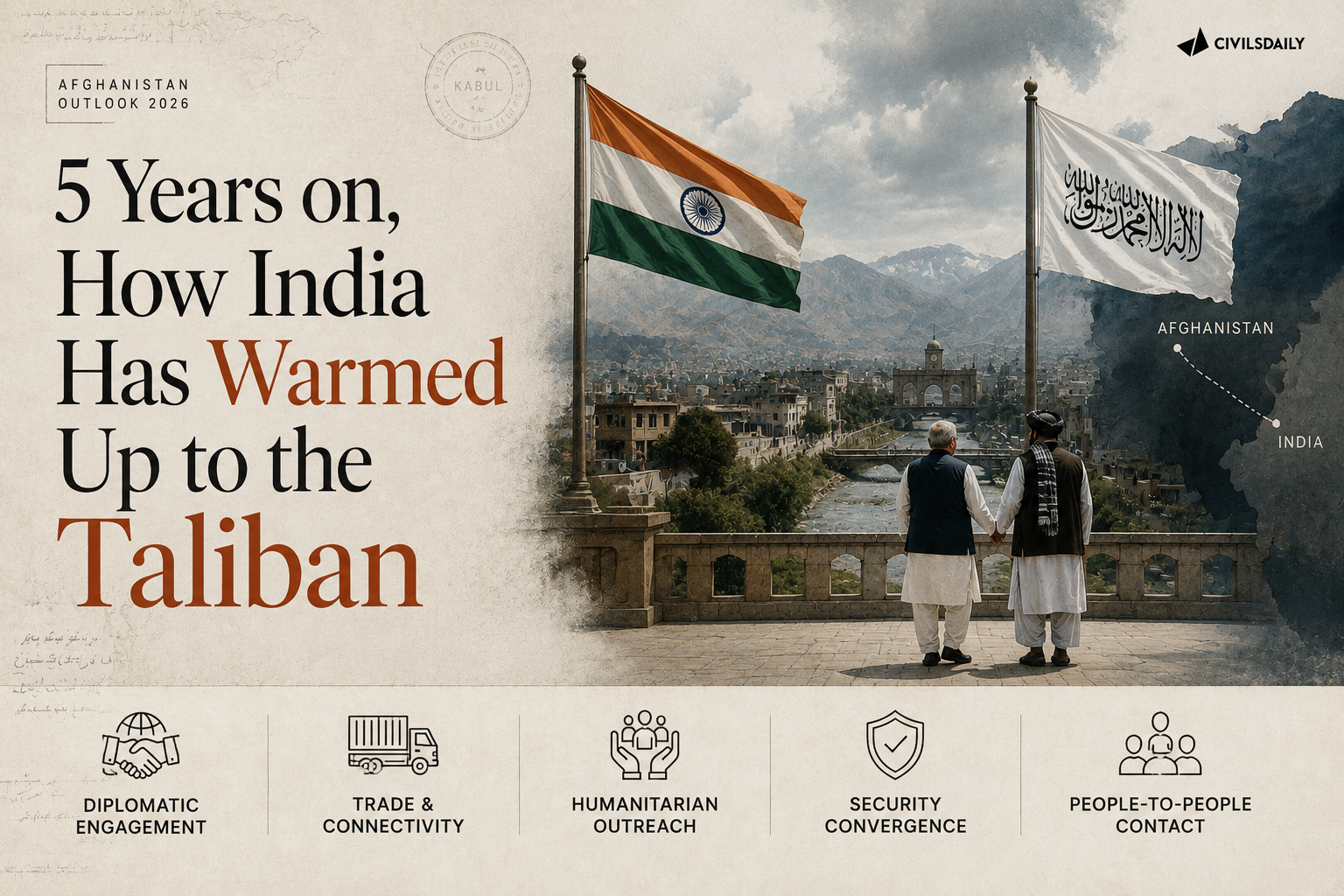
  • At Afghan embassy, Taliban diplomats mark 5th anniversary of victory day

    Why in the News

    The Afghanistan Embassy in New Delhi held a reception on 17 August 2026, marking five years of Taliban rule. Indian officials attended despite India continuing to withhold formal recognition of the Islamic Emirate of Afghanistan.

    The event highlights India’s growing working relationship with the Taliban without formal diplomatic recognition.

    What is a Chargé d’Affaires-led Mission?

    • Chargé d’Affaires: Diplomat heading a mission when no ambassador is accredited.
    • Under the Vienna Convention on Diplomatic Relations, 1961, it ranks below an ambassador.
    • An ambassador presents credentials to the Head of State, while a chargé d’affaires is accredited to the Foreign Ministry.
    • It allows diplomatic engagement without necessarily signalling formal recognition.
    • The Afghan mission in Delhi has operated under this arrangement since November 2025.

    What is the Islamic Emirate of Afghanistan?

    • Formal name used by the Taliban administration since August 2021.
    • India engages with the Taliban as a de facto authority but has not formally recognised it as Afghanistan’s government.

    How Has India-Taliban Engagement Evolved?

    • 2021: India closed its Kabul embassy and evacuated personnel.
    • 2022: India established a technical mission in Kabul.
    • 2025: Afghan Foreign Minister visited India.
    • India subsequently upgraded its Kabul mission to full embassy status.
    • November 2025: Taliban-appointed diplomats took charge of the Afghan Embassy in Delhi under a chargé d’affaires.
    • 2026: Embassy hosted its first public victory anniversary reception in Delhi.

    Why is India Engaging the Taliban?

    • Security: Maintains visibility over terrorist groups and developments affecting India.
    • Connectivity: Chabahar Port provides access to Afghanistan bypassing Pakistan.
    • Development assets: India has invested heavily in projects such as the Salma Dam, Zaranj-Delaram Highway and Afghan Parliament.
    • Regional competition: China, Russia, Iran and Central Asian countries are expanding engagement with Kabul.
    • Trade: Bilateral trade remains around $1 billion.

    “[2013, GS2, 10 marks] The proposed withdrawal of International Security Assistance Force (ISAF) from Afghanistan in 2014 is fraught with major security implications for the countries of the region. Examine in light of the fact that India is faced with a plethora of challenges and needs to safeguard its own strategic interests.”

  • India courts will decide extradition of Hasina, talks on to change course

    Why in the News

    Dhaka has made the extradition of the former Bangladesh Prime Minister a precondition for a planned bilateral visit, and Indian officials state the request must go before Indian courts rather than being settled diplomatically. The route runs through the India Bangladesh Extradition Treaty, 2013 and the Extradition Act, 1962. The tension is between a treaty designed to remove the political offence defence for serious crimes and a request whose political character is contested.

    What is the India Bangladesh Extradition Treaty, 2013?

    1. About: The treaty, signed in 2013, provides for extradition between India and Bangladesh for offences punishable by at least one year of imprisonment.
    2. Dual criminality: The conduct must constitute an offence in both countries for extradition to proceed.
    3. Political offence exception: Article 6 allows refusal where the offence is of a political character, subject to a list of carve outs.
    4. The carve outs: Twelve categories, including murder, terrorism related offences and kidnapping, are expressly excluded from the political offence defence.
    5. 2016 amendment: The evidentiary requirement was relaxed so that a warrant issued by a competent court of the requesting state suffices, without prima facie evidence.

    How does an extradition request actually proceed in India?

    1. Request stage: The request is received through diplomatic channels and processed by the Consular, Passport and Visa Division of the Ministry of External Affairs.
    2. Magisterial inquiry: The central government may direct a magistrate to conduct an inquiry into the request.
    3. Judicial finding: The magistrate reports whether a prima facie case for surrender is made out.
    4. Executive decision: The final surrender decision rests with the central government, which may still refuse.
    5. Judicial review: The order is subject to challenge in the High Court and the Supreme Court, which is what makes the process a judicial one in practice.

    Why is this request legally contested?

    1. Sentence in absentia: The International Crimes Tribunal in Bangladesh awarded a death sentence in November 2025 for crimes against humanity, delivered in absentia.
    2. Fair trial objection: In absentia trials and death sentences are challenged as inconsistent with international fair trial standards.
    3. Political character claim: The defence argues the prosecution arises from a change of government, engaging Article 6 of the treaty.
    4. Carve out counter: The offences charged fall within categories the treaty excludes from the political offence defence.
    5. Comparable precedent: The same fair trial objection was raised against the Syrian court’s in absentia death sentences delivered on 11 August 2026 for the Daraa crackdown.

    What is the diplomatic cost of the dispute?

    1. Visit at risk: The planned bilateral visit on 21 August is in doubt because extradition has been made a precondition.
    2. Regional forum linkage: The Bangladesh leadership was invited to a multilateral summit as chair of the Bay of Bengal Initiative for Multi Sectoral Technical and Economic Cooperation, so the bilateral rift affects a regional grouping.
    3. Trigger event: A press conference held in Delhi by the former Prime Minister on 5 August hardened Dhaka’s position.
    4. Possible resolution: Officials note the question becomes moot if the former Prime Minister returns to Bangladesh voluntarily in December as she has said she will.

    Challenges in India’s extradition practice

    1. Low success rate: India secures a small fraction of the fugitives it seeks. e.g. the prolonged proceedings in the United Kingdom over economic offenders sought by India.
    2. Prison conditions objection: Requested states refuse surrender citing Indian prison standards. e.g. the assurances India had to give on Barrack 12 of Arthur Road Jail in the Vijay Mallya proceedings.
    3. Human rights and death penalty bar: Many states will not extradite where the death penalty may be imposed. e.g. the assurances routinely sought by European states before surrender.
    4. Treaty coverage gaps: India has extradition treaties with a limited set of countries and arrangements with others. e.g. the absence of a treaty with several jurisdictions where fugitives relocate.
    5. Political offence litigation: The political character defence generates prolonged appellate litigation. e.g. the multi year appellate process in cases involving asylum claims.
    6. Reciprocity expectations: A refusal in one direction weakens the case for cooperation in the other. e.g. India’s own pending requests to Bangladesh for insurgent leaders sheltered across the border.

    Conclusion

    Routing the request to the courts converts a bilateral demand into a judicial question that the executive cannot concede quickly, which is itself the diplomatic outcome India has chosen. The treaty’s twelve carve outs make the political offence defence hard to sustain, while the in absentia death sentence supplies an independent ground for refusal. The next milestone is whether the 21 August visit proceeds, and whether a formal extradition request is filed for magisterial inquiry.

    Back2Basics: Extradition Act, 1962

    1. Governs the extradition of fugitive criminals from India to foreign states and the receipt of fugitives into India.
    2. Applies to treaty states under Chapter II, and permits extradition to non treaty states through a notified arrangement.
    3. Requires that the offence be an extradition offence, defined as one punishable with imprisonment of at least one year under the laws of both countries.
    4. Provides for a magisterial inquiry, with the magistrate reporting to the central government on whether a prima facie case exists.
    5. Bars extradition for an offence of a political character, subject to the exclusions in the applicable treaty.
    6. The Ministry of External Affairs is the central authority for processing requests.

    Way Forward

    1. Keep the process judicial: Insist on the statutory magisterial inquiry route, since a diplomatic surrender would set a precedent against India’s own pending requests.
    2. Seek assurances on sentence: Obtain an undertaking against execution before any surrender, consistent with international practice on capital cases.
    3. De link the bilateral agenda: Continue trade, connectivity and water cooperation tracks independently of the extradition question.
    4. Use the regional forum: Sustain engagement through the Bay of Bengal grouping so the bilateral rift does not stall regional cooperation.
    5. Press reciprocal requests: Pursue India’s own outstanding extradition requests to Bangladesh in the same process, establishing symmetry.

    [2013, GS2, 10 marks] The protests in Shahbag Square in Dhaka in Bangladesh reveal a fundamental split in society between the nationalists and Islamic forces. What is its significance for India?”

  • India marks 27 places in Arunachal Pradesh on the official map

    Why in the News

    India officially marked 27 places in Arunachal Pradesh with standard names on Survey of India maps, responding to China’s attempts to rename locations in the State.

    What is the Cartographic Dispute?

    • China: Calls Arunachal Pradesh Zangnan and periodically assigns Chinese names to locations.
    • India: Rejects China’s claims and maintains that Arunachal Pradesh is an integral part of India.

    Strategic Locations

    • Long Ju: Site of a 1959 India China boundary confrontation.
    • Thag La: Strategic ridge associated with the 1962 India China War.

    Why Does Naming Matter?

    • LAC: Reinforces India’s position along the disputed Line of Actual Control.
    • Sovereign record: Official mapping creates a formal cartographic record of India’s territorial claims.
    • Information warfare: Place naming is also a tool of strategic signalling and narrative competition.

    What Remains Unresolved?

    • The India China boundary dispute remains unsettled despite diplomatic and military negotiations.
    • Cartographic measures do not by themselves alter the ground position or resolve the boundary.

    Back2Basics: Survey of India

    • Status: India’s national mapping agency and one of the oldest scientific departments of the Government of India.
    • Ministry: Department of Science and Technology.
    • Role: Prepares official topographic and boundary maps.
  • India-Bangladesh ties should be Hasina-proof

    Why in the News

    The former Bangladesh Prime Minister held her first question taking media interaction from exile in India. She announced a political comeback and said she would return in December. The event risks turning India’s grant of refuge into a diplomatic irritant with Dhaka’s elected government.

    What is the diplomatic dilemma India faces?

    1. Refuge granted: India gave the former Prime Minister refuge after she fled Bangladesh on 5 August 2024 amid protests.
    2. Legitimacy concern: the grant was defended given the unfairness of the legal proceedings against her, including a death sentence by the International Crimes Tribunal.
    3. Platform risk: using the refuge as a political platform complicates ties with the elected government.
    4. Elected counterpart: the Bangladesh Nationalist Party (BNP) led administration under the new Prime Minister took office about six months earlier.

    Why is the timing fraught?

    1. Reset underway: New Delhi is rebuilding ties after strained relations with the earlier Muhammad Yunus led interim government.
    2. Domestic backlash: a mob hurled petrol bombs at a party member’s residence after he joined the exiled leader online.
    3. Media bar: the statements were barred from broadcast in Bangladesh under laws the former government itself once used.
    4. Awami League banned: the leader’s party is barred from contesting, so the comeback call targets the incumbent government.

    What unresolved issues shadow the relationship?

    1. Ganga treaty: the 1996 Ganga Water Treaty is due for renewal this year.
    2. Teesta treaty: the Teesta water sharing treaty is still to be signed.
    3. Migration: New Delhi views illegal immigration from Bangladesh as a major irritant.
    4. Trade curbs: some trade restrictions remain even after Bangladesh removed visa curbs.
    5. China factor: India is wary of Dhaka drifting into China’s orbit, and the new Prime Minister has visited China but not India.

    Why must ties be insulated from any single individual?

    1. Shared border: a 4,000 kilometre border makes cooperation indispensable against trafficking and cross border extremism.
    2. Economic stakes: Indian investment and infrastructure financing support Bangladesh’s growth, with stakes in power and connectivity.
    3. Strategic caution: both governments need to insulate bilateral ties from short term compulsions.

    Conclusion

    India was right to shelter the former Prime Minister, but her political aspirations cannot bruise ties with the elected government. The bilateral relationship, anchored in geography and security, is too important to be held hostage by one individual. New Delhi’s task is to keep the reset with Dhaka insulated from her comeback bid.

    Back2Basics

    The 1996 Ganga Water Treaty is a 30-year bilateral agreement between India and Bangladesh signed on December 12, 1996. It governs the sharing of dry-season (January 1 to May 31) water flows from the Ganges River at the Farakka Barrage.

    Key Provisions and Formula

    1. Lean Season Focus: Applies specifically to lean-season flows from January 1 through May 31.
    2. 50:50 Sharing Rule: If the water flow at Farakka is 70,000 cusecs or less, India and Bangladesh each receive 50% of the water.
    3. Fixed Allocation Windows:
      • Flows of 70,000-75,000 cusecs: Bangladesh receives a fixed 35,000 cusecs, and India receives the rest.
      • Flows above 75,000 cusecs: India receives 75,000 cusecs, and Bangladesh receives the balance.
    4. Emergency Clause: If water flow drops below 50,000 cusecs in any 10-day period, both nations must hold immediate consultations for emergency adjustments.

    Administration and Oversight

    1. Joint Committee: An equal-representation monitoring committee measures daily flows at the Farakka feeder canal and Bangladesh’s Hardinge Bridge.
    2. Review Schedule: Subject to five-year reviews or earlier adjustments if requested.

    PYQ Relevance

    [UPSC 2013] Critically examine the compulsions which prompted India to play a decisive role in the emergence of Bangladesh.

    Linkage: It examines the strategic and political foundations of India–Bangladesh relations. The article highlights how India must balance humanitarian refuge with long-term bilateral and strategic interests.

  • JD(U) tells Centre not to renew 1996 Farakka water treaty without safeguarding Bihar

    Why in the News

    The 1996 Farakka Water Treaty between India and Bangladesh is set to expire on 12 December 2026. The JD(U) has urged the Centre not to renew the treaty unless Bihar’s long term water security and developmental needs are adequately addressed.

    What is the 1996 Farakka Water Treaty?

    • Definition: A bilateral agreement between India and Bangladesh for sharing the Ganga’s dry season flow at the Farakka Barrage.
    • Objective: To allocate Ganga waters during the lean season between the two countries.
    • Duration: Signed in 1996 for 30 years, expiring on 12 December 2026.

    What is the Farakka Barrage?

    • Location: Built across the Ganga River in West Bengal.
    • Purpose: Diverts water into the Hooghly River.
    • Objective: Flushes silt to maintain the navigability of Kolkata Port.

    Why has Bihar opposed the treaty’s renewal?

    • Reduced Water Availability: Bihar argues that diversion at Farakka reduces lean season water availability within the state.
    • Development Concerns: Seeks greater consideration of Bihar’s long term irrigation, drinking water and development needs.
    • Demand for Renegotiation: JD(U) has called for safeguards before any extension of the treaty.
    • Federal Dimension: Highlights the need to balance state interests with India’s international water sharing commitments.

    Why is the treaty sensitive for India and Bangladesh?

    • Shared Rivers: India and Bangladesh share numerous transboundary rivers, making water sharing politically significant.
    • Dry Season Scarcity: Limited lean season flows often lead to competing demands.
    • Related Issue: The Farakka dispute exists alongside the unresolved Teesta Water Sharing Agreement, another key bilateral concern.

    [2013, GS2, 10 marks] The protests in Shahbag Square in Dhaka in Bangladesh reveal a fundamental split in society between the nationalists and Islamic forces. What is its significance for India?

    [2017] With reference to river Teesta, consider the following statements:
    1. The source of river Teesta is the same as that of Brahmaputra but it flows through Sikkim.
    2. River Rangeet originates in Sikkim and it is a tributary of river Teesta.
    3. River Teesta flows into Bay of Bengal on the border of India and Bangladesh.
    Which of the statements given above is/are correct?

    [A] 1 and 3 only

    [B] 2 only

    [C] 2 and 3 only

    [D] 1, 2 and 3

  • India and Sri Lanka advance a slate of bilateral projects

    Why in the News

    A high level visit produced concrete movement across trade, finance, energy, and connectivity between India and Sri Lanka. The development adds to the standing bilateral dossier rather than resolving a single dispute.

    What is the 13th Amendment context?

    1. Devolution law: The 13th Amendment to Sri Lanka’s Constitution created Provincial Councils to devolve power, including to Tamil majority areas.
    2. India’s interest: India has consistently pressed for its full implementation and Provincial Council elections.
    3. Pending status: Implementation has remained incomplete for decades.

    What was agreed on this visit?

    1. Trade and social security: Both sides agreed to advance the free trade agreement update and a social security pact.
    2. Rupee credit: Agreements were exchanged on Indian Rupee denominated Lines of Credit worth $350 million within a $450 million Cyclone Ditwah reconstruction package.
    3. Energy and connectivity: Talks covered grid interconnection, the Sampur solar project, the Trincomalee energy hub, and Kankesanthurai harbour.
    4. Digital identity: A Unique Digital Identity project modelled on India’s system was discussed.

    Why does the relationship matter for India?

    1. Neighbourhood first: Sri Lanka is central to India’s regional policy.
    2. Strategic location: Its position astride Indian Ocean sea lanes shapes maritime security.
    3. China factor: Deeper Indian engagement counters competing external influence.

    Conclusion

    The visit deepens a multi sector partnership without a single headline pact. The next milestone is the finalisation of the free trade agreement update and the social security pact.

    [2022, GS2, 10 marks] India is an age-old friend of Sri Lanka.’ Discuss India’s role in the recent crisis in Sri Lanka the light of the preceding statement.”

  • [6th August 2026] The Hindu OpED: A climate resilience pathway between India and China
    PYQ Relevance
    [UPSC 2024]
    The West is fostering India as an alternative to reduce dependence on China’s supply chain and as a strategic ally to counter China’s political and economic dominance.’ Explain this statement with examples.
    Linkage: The PYQ examines India-China strategic competition and the scope for selective cooperation amid geopolitical rivalry. The article shows how climate resilience and disaster management can provide a limited, low-risk avenue for India–China engagement despite strategic distrust.

    Mentor’s Comment

    El Niño delayed India’s monsoon, followed by intense rainfall that caused severe flooding in Mumbai, Surat, Assam, and Odisha. Similar extreme weather also affected Guangxi, Shaanxi, and Gansu in China, highlighting the increasing frequency of climate-related disasters. Shared exposure to extreme climate events is proposed as a low risk avenue for India China cooperation. The tension is between deep strategic rivalry and a narrow band of mutual interest in disaster resilience.

    How do India and China face similar climate challenges?

    1. Urbanisation: Wetlands, forests and permeable land are replaced by concrete, reducing natural water absorption.
    2. Drainage Deficit: Outdated drainage systems and poor waste management aggravate urban flooding.
    3. Loss of Green Spaces: Shrinking green cover increases runoff and weakens climate resilience.
    4. Coastal Risks: Coastal megacities face extreme rainfall, storm surges and sea-level rise.
    5. Inland Extremes: Inland cities experience recurring heatwaves, droughts and flash floods.
    6. Economic Costs: Climate disasters disrupt supply chains, reduce productivity and cause economic losses.
    7. Health Impacts: Frequent floods and heat events increase disease burden and public health risks.

    Past Engagement: How have India and China cooperated on climate resilience?

    1. Climate Frameworks: Since the early 1990s, summit-level joint statements, MoUs and agreements have promoted practical climate cooperation.
    2. Disaster & Data Cooperation: Collaboration covered floods, earthquakes, droughts, extreme weather, along with hydrological, oceanic and seismic data sharing, joint R&D and governance exchange.
    3. Strategic Economic Dialogues: Six dialogues focused on sustainable urban planning, waste management, sewage treatment, water efficiency and capacity building.
    4. Sister City Agreements: Delhi-Beijing, Mumbai-Shanghai and Chennai-Chongqing were created to implement joint urban resilience projects, but diplomatic tensions limited execution.
    5. Mutual Learning: China offers data-driven planning (transport, housing, drainage), while India contributes early warning systems, Heat Action Plans, cool roofs, nature-based solutions and community-led adaptation.
    6. Future Cooperation: Scope exists for sponge cities, resilient agriculture, hydrological modelling, Himalayan glacier monitoring and revival of shared water agreements (which ceased in 2022).

    What is the proposed cooperation pathway?

    In April 2026, the visit by a Chinese delegation led by China’s Special Envoy for Climate Change to New Delhi suggests that climate cooperation remains a priority.

    1. Shared exposure: Both countries face recurring monsoon floods and urban flooding disasters.
    2. Low risk domain: Disaster mitigation and urban resilience avoid the sensitivities of border and trade disputes.
    3. Existing channels: An April 2026 visit by a Chinese Special Envoy and past sister city agreements offer a base.

    What models could underpin it?

    1. Sponge cities: China’s urban water absorption model is cited as a resilience approach.
    2. Glacier concerns: Shared Himalayan glacier risks link both countries’ water security.
    3. City linkages: Past agreements between major cities offer a template for exchange.

    Why is the pathway limited?

    1. Strategic distrust: Border tensions constrain deeper engagement.
    2. Asymmetry: Cooperation must manage a large power imbalance.
    3. Narrow scope: Resilience cooperation cannot resolve the core rivalry.

    How can India and China bridge the climate finance gap?

    1. Public Funding Dependence: Climate adaptation is financed mainly through public funds in both countries.
    2. Private Capital: Expand blended finance, municipal bonds and credit enhancement to mobilise private investment.
    3. Ecosystem Gaps: Climate finance markets remain nascent, constrained by weak local capacity and regulatory gaps.
    4. Knowledge Exchange: Share evidence-based practices on innovative climate finance models.
    5. Global South Leadership: Develop common standards, metrics and fiscal frameworks for climate resilience financing.
    6. Win-Win Cooperation: Climate finance collaboration offers a low-risk pathway to strengthen India–China engagement and resilience.

    Conclusion

    Climate resilience offers a contained space for engagement without touching the strategic core. The unresolved question is whether either side will invest political capital in so narrow a domain.

  • [29th July 2026] The Hindu OpED: Iran’s Afghan balancing act amid regional upheaval

    PYQ Relevance
    [UPSC 2013]
    The proposed withdrawal of the International Security Assistance Force (ISAF) from Afghanistan in 2014 is fraught with major security implications for the counters of the region. Examine in light of the fact that India is faced with a plethora of challenges and needs to safeguard its own strategic interests.
    Linkage: The PYQ examines the regional security fallout of a foreign military withdrawal from Afghanistan. The article traces how the 2021 US withdrawal reshaped Iran’s Afghan calculus, a parallel instance of a withdrawal reordering regional strategic behaviour.

    Mentor’s Comment

    Delegations from both the Taliban and the rival Northern Alliance attended the funeral of Iran’s Supreme Leader Ayatollah Ali Khamenei in Tehran. This dual presence exposed Iran’s continued refusal to fully commit to the Taliban government despite deep economic and diplomatic engagement with Kabul. The visit occurred while Iran was fighting a war in the west, raising the stakes of managing its eastern flank.

    Why does Iran’s history with the Northern Alliance still shape its Taliban policy today?

    1. Pre-2001 alignment: Iran backed the Northern Alliance against the Taliban through the 1990s, alongside India, Russia, and Tajikistan.
    2. Post-9/11 recalibration: Iran’s view of the Taliban shifted after the 9/11 attacks brought sustained Western military deployment to its borders.
    3. Non-recognition persists: Iran has built the strongest external influence in Kabul since 2021 but still withholds formal recognition of the Taliban government.
    4. Dual channel maintained: Iran hosted Taliban Deputy Prime Minister Mullah Abdul Ghani Baradar and Foreign Minister Amir Khan Muttaqi alongside Northern Alliance leader Ahmed Massoud at the same funeral.

    How did the US withdrawal from Afghanistan reshape Iran’s regional calculus?

    1. Border threat removed: The August 2021 US withdrawal ended a two-decade military presence on Iran’s eastern border.
    2. Competing patronage exposed: Pakistan simultaneously backed the Taliban and the US-led war on terror, producing overlapping and contradictory interests.
    3. Contradiction on record: Osama bin Laden was found in Abbottabad in May 2011, in a house and not a cave, pointing to this dual role.
    4. A quieter front sought: Iran calculated that reducing conflict on its Afghan front would free up resources for other priorities.
    5. Limited patronage offered: Iran could offer the Taliban political legitimacy but only a limited amount of material patronage.

    Why does Iran keep hedging despite the Taliban’s declared wartime support?

    1. Support pledged: A Taliban spokesman close to emir Hibatullah Akhundzada said the group would support Iran if it came under attack. The extent of this support remains undefined.
    2. Access granted: The Taliban gave Iran access to Afghanistan’s civilian airports over the past year.
    3. Durability doubted: Iran treats an insurgency-turned-government as carrying a persistent question mark over its long-term stability.
    4. Internal fissures noted: Ideological and tribal divisions inside the Taliban require constant micromanagement.
    5. Power still consolidating: The Taliban is still solidifying control between Kabul, its political capital, and Kandahar, its ideological one.
    6. Institutional memory at play: Quds Force chief Esmail Qaani’s operational history traces back to the 1990s Taliban-Northern Alliance conflict. This history informs his current caution.

    Why does Iran engage both the Taliban and its opposition at once?

    1. Hedging strategy: Engaging both the recognised Taliban government and the Northern Alliance lets Iran preserve influence regardless of which side gains ground in Afghanistan’s internal balance of power.
    2. Border security concern: Iran shares a long border with Afghanistan, and instability on either side directly affects Iranian security, giving Tehran incentive to maintain channels with all major Afghan actors.
    3. Pakistan factor: Iran’s Afghanistan policy is shaped in part by its complex relationship with Pakistan, which has its own competing interests in Afghan internal politics.
    4. Regional war context: The West Asia war constrains Iran’s bandwidth and resources, making a flexible, multi track Afghan policy more practical than committing exclusively to one Afghan faction.

    What does the Iran-Pakistan wartime “brotherhood” reveal about the limits of regional alliances?

    1. Mediator role assumed: Pakistan positioned itself as a mediator between Tehran and Washington during the war.
    2. Divergent aims surfaced: Pakistan seeks favour with the US and Gulf partners, shown by its troop deployment in Saudi Arabia.
    3. Instrumental use by Iran: Iran uses the relationship as a channel to reach the US through a neighbour it knows, though does not fully trust.
    4. Bilateralism made incidental: The Iran-Pakistan relationship itself is secondary to each country’s separate external objectives.

    Conclusion

    Iran’s simultaneous engagement with the Taliban and the Northern Alliance is a hedging strategy shaped by the West Asia war’s demands on its resources and by its complicated relationship with Pakistan. The approach preserves Iranian influence in Afghanistan without requiring Tehran to bet its regional position on one Afghan faction’s success.

    Back2Basics

      Key Terms

      1. IRGC (Islamic Revolutionary Guard Corps): Iran’s ideological military force, separate from its regular armed forces.
      2. Quds Force: IRGC’s branch handling external operations and foreign militant networks.
      3. Northern Alliance: A coalition of anti-Taliban Afghan factions, historically backed by Iran, India, and Russia.

    1. India’s strategic thinking should shift from border “geography” to a “geometry of interests”

      Why in the News

      India’s strategic thinking should shift from a border centric “geography” view to a broader “geometry of interests” spanning the Gulf, Central Asia, the Indo-Pacific and maritime domains.

      Why is a border centric strategic view seen as inadequate?

      1. Narrow threat framing: A geography centric view concentrates strategic attention on land borders with Pakistan and China, underweighting maritime and extended neighbourhood interests.
      2. Expanding interest map: India’s energy security, diaspora, and trade interests in the Gulf, Central Asia and the Indo-Pacific now carry strategic weight comparable to border security concerns.
      3. Maritime domain gap: A geography first framing has historically under-prioritised India’s maritime domain, despite its growing dependence on sea lanes for energy and trade.

      Conclusion

      The central idea is that India’s strategic doctrine has not kept pace with the expansion of its actual interests beyond its land borders. A “geometry of interests” framing would reallocate strategic attention toward the Gulf, Central Asia, the Indo-Pacific and maritime domains in proportion to their real weight in India’s security and economic interests.