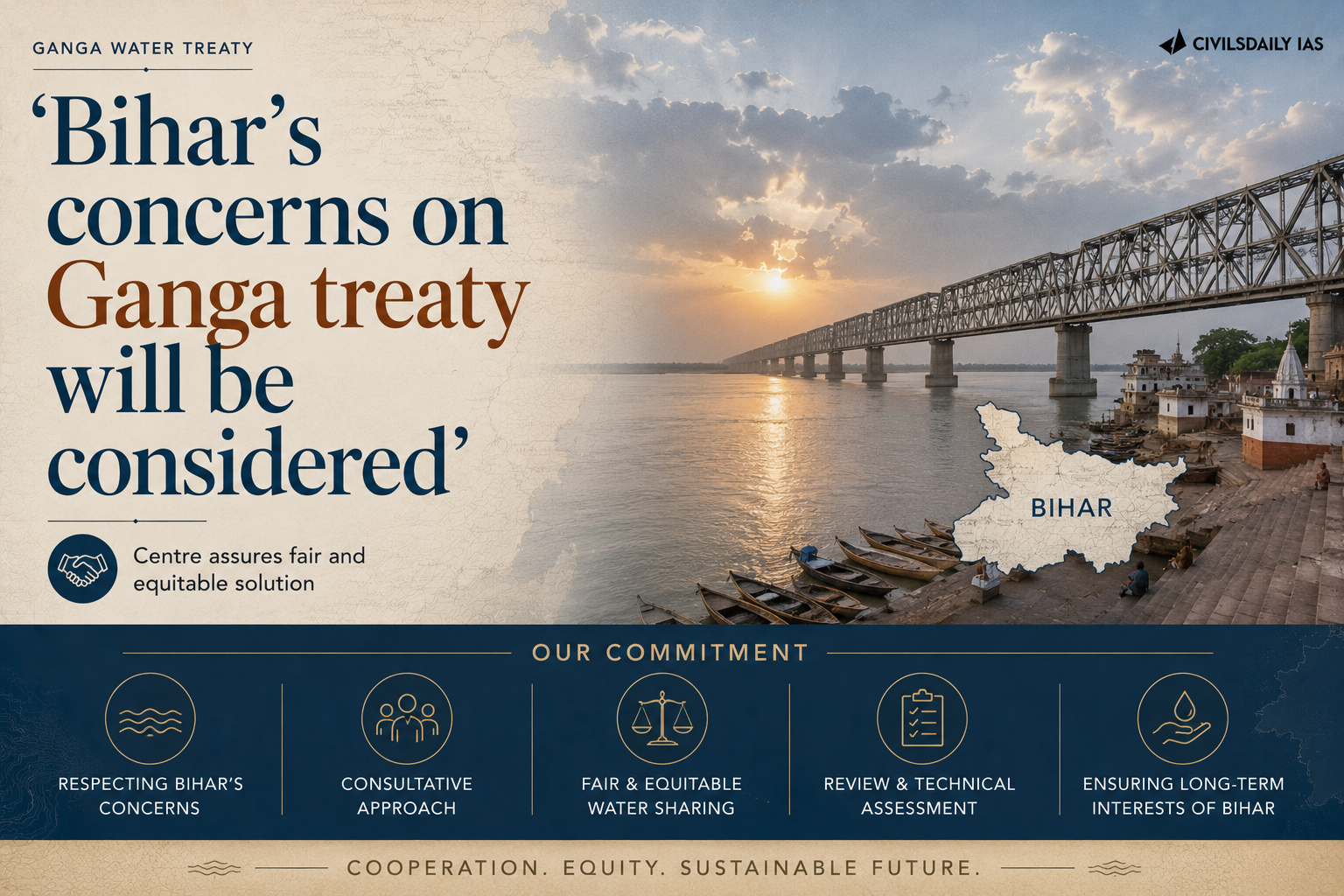
Why in the News
The External Affairs Minister has written that India will decide on the renewal of the Ganga Water Treaty, 1996 with Bangladesh while keeping Bihar’s interests in consideration. The letter answers a Janata Dal (United) Member of Parliament, a former Bihar Water Resources Minister, who had called on the government not to renew the treaty on the ground that it had negatively impacted the State. The treaty expires on 31 December 2026, and its renewal is one of the major items on this year’s diplomatic calendar for the two countries. The tension is that a bilateral instrument negotiated as a foreign policy commitment is now being contested by the riparian State that says it carries the domestic cost of that commitment.
What is the India-Bangladesh Ganga Water Treaty, 1996?
- What it does: It governs the sharing of Ganga waters between India and Bangladesh at the Farakka Barrage in West Bengal during the dry season, from 1 January to 31 May each year, when flows are lowest and competition for water is sharpest.
- How the sharing works: Availability at Farakka is measured in ten day cycles, and the water is divided between the two countries according to a formula fixed to the flow observed in that cycle rather than to a fixed annual quantity.
- Its term and oversight: The treaty was signed for 30 years, and a Joint Committee of officials from both countries observes flows at Farakka and reports on implementation.
What is Bihar’s objection to renewal?
- The State says the costs fall upstream: Maintaining the assured flow at Farakka is held to have contributed to silt accumulation upstream in Bihar’s stretch of the Ganga, raising the riverbed and worsening flooding.
- The demand is framed as an entitlement, not a concession: Bihar is described as asking only for what its own scientific assessment establishes, so that 13 crore people are not left short of water for drinking, irrigation and industrial supply for another 30 years.
- The characterisation of the original bargain: The treaty is described as a remnant of the Gujral Doctrine era, which projected a generous image of India in the neighbourhood without serving Bihar’s interests.
- The demand itself: Reading the data across the treaty’s 30 years, the State’s position is that India should allow the treaty to lapse rather than renew it.
How does the Centre say the decision will be taken?
- The process is inter ministerial, not purely diplomatic: Consultations involving relevant stakeholders have been held under the leadership of the Ministry of Jal Shakti to ensure broad based consultation on the future of the treaty.
- Bihar was represented in them: An authorised representative of the Government of Bihar participated in consultations held on 22 August 2023, 30 October 2023, 15 March 2024 and 31 May 2024.
- No decision has been announced: The stated position is that the government will take the appropriate decision while keeping these factors in focus.
Why does the renewal question arrive at a difficult bilateral moment?
- Political contact between the two governments has thinned: The renewal is in focus partly because top level political meetings between India and Bangladesh have not been taking place.
- A planned visit collapsed: Talks for a New Delhi visit by Bangladesh’s Prime Minister broke down over a virtual press conference given in New Delhi by the deposed former Prime Minister of Bangladesh.
- The clock is fixed while the diplomacy is not: The expiry date is unaffected by the state of political contact, so the negotiating window narrows regardless of whether high level engagement resumes.
Challenges to renewing the Ganga Water Treaty
- The treaty measures flow but does not allocate sediment: A water sharing formula fixed to discharge at a barrage says nothing about the silt that the same regime deposits upstream. Eg. Bihar’s objection turns on riverbed aggradation upstream of Farakka rather than on the volume of water it receives.
The Fix: Add a sediment management protocol to the renewed instrument, with joint measurement of bed levels upstream and downstream of the barrage. - A riparian State bears the cost of a Union treaty with no channel to price it: Foreign affairs is a Union subject while water is a State subject, so the State that absorbs the consequence has no formal standing in the negotiation. Eg. Bihar’s participation here was through inter ministerial consultations, which are advisory and produce no binding record of its position.
The Fix: Institutionalise a standing riparian States consultation under the Ministry of Jal Shakti for every transboundary river negotiation, with its recommendations placed on record before signature. - The lean season formula does not survive a drying trend: A sharing arrangement written around observed historical flows becomes unworkable when the flows themselves decline. Eg. Reduced Himalayan glacier melt contribution and increased upstream withdrawal both cut dry season discharge in the Ganga basin.
The Fix: Build a variable review clause into the renewed treaty, triggering renegotiation when measured dry season flow falls below a defined threshold for consecutive years. - The basin is shared by more than two countries: Bilateral treaties on a river rising in Nepal and China cannot govern the augmentation that would actually solve the shortage. Eg. Proposals to augment lean season Ganga flow depend on storage in Nepal, which is not a party to this treaty.
The Fix: Pursue a basin level arrangement in parallel, beginning with data sharing and joint storage feasibility studies with Nepal. - Non renewal is not a costless option: Allowing the treaty to lapse removes the only agreed mechanism regulating dry season flows and hands the issue to unilateral action. Eg. The pre 1996 period saw recurring disputes over Farakka withdrawals with no settled sharing formula.
The Fix: Treat renegotiation on revised terms, rather than lapse, as the fallback position, so the sharing mechanism survives while the formula changes.
Conclusion
The dispute is not really about whether the treaty is renewed. It is about the absence of a mechanism to price a domestic cost inside a foreign policy decision. A State that carries the physical consequence of a river agreement participates only through consultations that leave no binding record of what it asked for and no obligation to answer it. What to watch is whether the scientific assessment Bihar rests its case on is placed on the record of the negotiation, since a claim that is never formally examined cannot be formally rejected either.
[2026, GS1, 10 marks] “Water resources are both an asset and a source of conflict in South Asia.” Examine this statement giving examples.”
