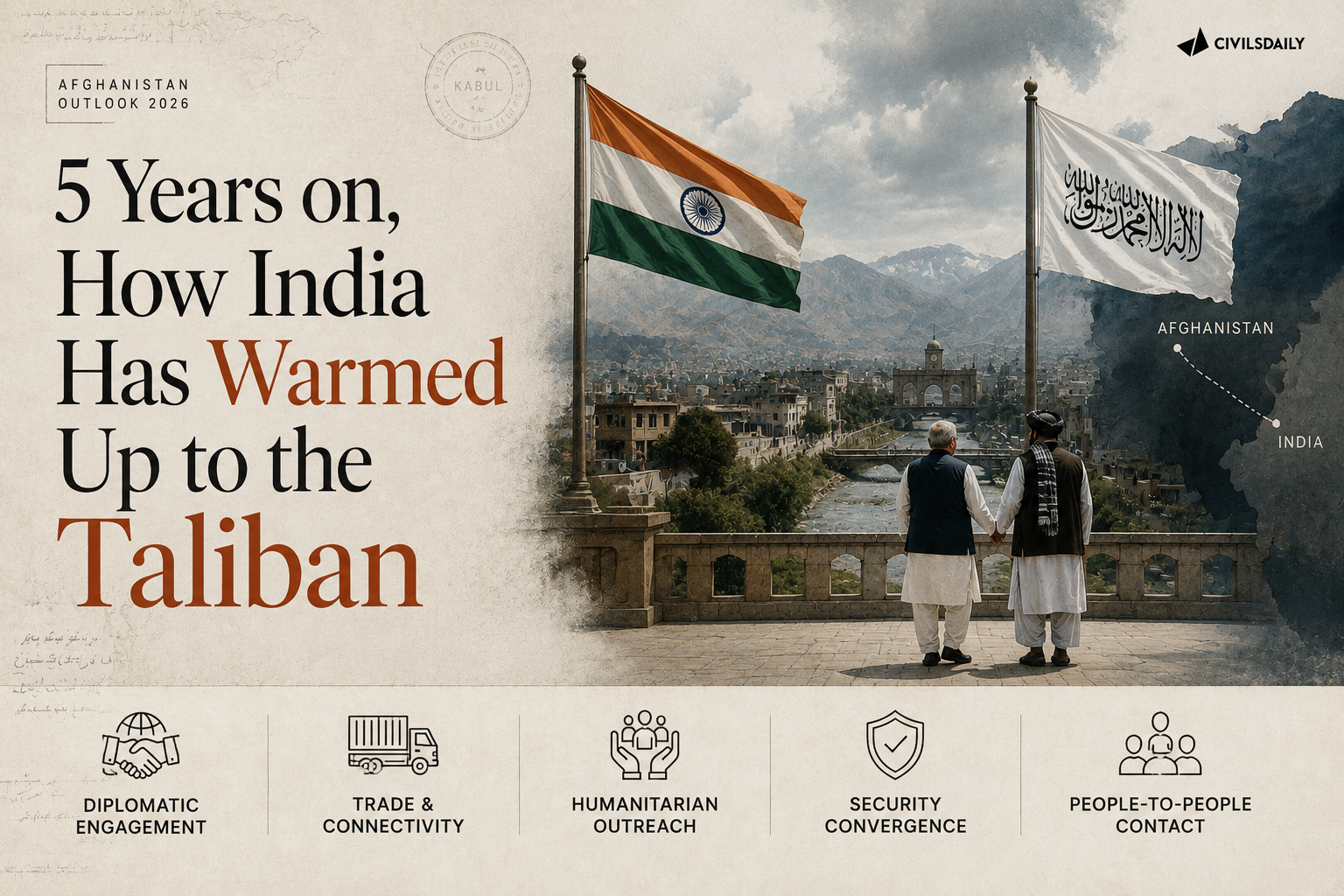
Why in the News
The Afghanistan embassy in New Delhi marked “victory day” on 15 August 2026, five years after the Taliban’s takeover of the country. Indian diplomats and about two dozen foreign diplomats attended the event. The occasion sits against a reversal: on 17 August 2021 India hurriedly evacuated its entire embassy from Kabul after the Ashraf Ghani led government collapsed. That collapse came ahead of the 31 August deadline set by the United States President for the withdrawal of American troops. India now conducts business with the Islamist regime without granting it official diplomatic recognition. Indian officials describe this as “cautious engagement”, and critics describe it as “opportunistic”.
What is engagement without official recognition?
- The status being withheld: Diplomatic recognition is a state’s formal acceptance that a given authority is the lawful government of a country, which allows full ambassadorial exchange and treaty dealings. India has not granted it to the Taliban.
- What India does instead: India deals with the Taliban as the effective administering authority, running missions, delivering aid and negotiating projects, without conceding legal status. Recognition can then be traded later for concessions.
- The visible marker of the gap: The Afghan missions in Delhi, Mumbai and Hyderabad are manned by Taliban appointed diplomats. The main flagpole of the Delhi embassy continues to fly the old Afghan Republic’s tricolour.
How did India move from evacuation to engagement?
- First official contact, 31 August 2021: Hours after the last United States military aircraft flew out of Kabul, ending a 20 year war, India made its first official contact with the Taliban. India’s Ambassador to Qatar met the head of the Taliban political office in Doha at the embassy.
- First acknowledgement, September 2021: India recognised the Taliban as “those in positions of power and authority across Afghanistan”, the first clear description of the group as a state actor.
- First aid consignment, December 2021: India sent its first consignment of medicines to Afghanistan under the new Taliban regime, choosing to distinguish the regime from the Afghan people.
- Technical team, late June 2022: India sent a “technical team” to the embassy in Kabul to coordinate delivery of humanitarian aid.
- Ministerial contact opens, January 2024: The Taliban Foreign Minister met diplomats from regional nations including India in January 2024. The Foreign Secretary held a substantive meeting with him in Dubai in January 2025.
- Contact reaches Cabinet level, May 2025: The External Affairs Minister spoke to the Taliban Foreign Minister by phone on 15 May 2025. The call came days after India and Pakistan agreed to stop military strikes.
- Mission upgrade, April to October 2025: India sent the Joint Secretary in charge of the Pakistan, Afghanistan and Iran division of the Ministry of External Affairs to Kabul in April 2025. The Taliban Foreign Minister then visited India in October 2025, and both sides decided to upgrade their missions to embassy level and appoint charge d’affaires.
Why is India deepening ties with the regime it once shunned?
- Protecting a sunk investment: India invested for years in Afghanistan after the fall of the Taliban in 2001, and the government concluded that it had to upgrade engagement or watch its USD 2 to 3 billion investment go down the drain.
- Leverage, not charity: The investment was meant for the people of Afghanistan and to create leverage and influence inside the country. Withdrawal would have surrendered both.
- Pakistan has become the Taliban’s adversary: The Taliban’s once benefactor and ally has turned into a deadly opponent, with multiple clashes along their contested border. New Delhi reads this as a window of opportunity.
- China is filling the Western vacuum: Beijing has started building bridges with the Taliban and is eyeing Afghanistan’s natural resources.
- Russia is the pacing partner: Russia is the only country to have established diplomatic ties with the Taliban, and Delhi has been working with Moscow on the Taliban to keep track of Chinese influence.
- Presence inside Delhi’s own calendar: The Taliban appointed Charge d’affaires, Mufti Noor Ahmad Noor, has attended the Prime Minister’s Independence Day address, the President’s At Home reception and a diplomatic event at the Norwegian embassy.
What are India’s security concerns in Afghanistan?
- The operating principle: New Delhi has operated on the principle that Afghanistan’s territory should not be used for anti-India activities or for support to terrorist groups.
- The threat assessment is unchanged: An 10 August 2026 report of the United Nations Security Council’s 1267 sanctions committee stated that the terrorist threat emanating from Afghanistan remained largely unchanged.
- The de facto authorities cannot suppress it: The same report found that despite efforts by the de facto authorities to combat Islamic State in Iraq and the Levant-Khorasan (ISIL-K) and contain other groups, they were unable to suppress the terrorist problem. It also said Al-Qaeda’s status and strength in Afghanistan remains unchanged.
- What the report did not say: It carried no mention of anti-India terror groups such as Lashkar-e-Taiba and Jaish-e-Mohammad, a silence New Delhi reads as relief rather than assurance.
- Assurances so far are verbal: Engagement has been “limited”, and the Taliban has indicated it will be “reasonable” in the way it “handles” Indian concerns. The security provided to Indian diplomats in Kabul has given the Indian establishment some confidence.
- The regime’s own pitch: The Charge d’affaires told the victory day gathering that Afghanistan’s geography “should not be a field for negative competition, but rather a bridge for connectivity, cooperation and shared prosperity”, a message read as directed at both India and Pakistan.
What has India given up to secure this engagement?
- The aid record is substantial: Since August 2021 India has delivered 50,000 metric tonnes of wheat and over 445 tonnes of essential life saving medicines, vaccines and disaster relief material.
- The rights record is not: Since taking control the Taliban has eroded the rights of Afghanistan’s 22 million women, barring school access for girls over 12, curbing travel without a male chaperone and bringing a law implying legal approval for child marriage.
- India once led on this at the United Nations: A Security Council resolution on 30 August 2021 on upholding human rights and women’s rights in Afghanistan was adopted under India’s rotating presidency. In December 2022 India expressed concern over the Taliban banning women from universities.
- The red lines have been dropped: Rights for minorities and women are no longer part of either the Taliban’s or India’s publicly stated red lines, and India has not insisted on the old positions.
- What replaced them: India has agreed to move forward on development cooperation for Indian funded projects and on visas for Afghans visiting India for medical treatment, business and education.
Challenges to India’s engagement with the Taliban
- Recognition is a one way concession: Formal recognition is the only remaining bargaining chip, and granting it removes India’s last point of leverage over the regime’s conduct. Eg. The Delhi embassy’s flagpole still carries the Afghan Republic’s tricolour, the single visible marker of what has not yet been conceded. Fix. Tie any move on recognition to specified, verifiable commitments on counter terrorism access and on women’s education, published as conditions rather than expectations.
- Assurances rest on no verification mechanism: India has no independent means of confirming that Afghan territory is not being used against it, and depends on United Nations monitoring reports issued months apart. Eg. The 1267 committee’s own assessment says the de facto authorities were unable to suppress the terrorist problem. Fix. Seek a standing bilateral security channel with agreed reporting on named groups, modelled on India’s existing joint working groups on counter terrorism.
- The rights silence carries a reputational cost: India’s abandonment of the positions it advanced at the Security Council in 2021 weakens its standing as a votary of rules based conduct. Eg. India’s own presidency delivered the 30 August 2021 resolution on women’s rights that it no longer presses. Fix. Separate the humanitarian and development track from the political track, so aid continues while India keeps stating the rights position in multilateral forums.
- Projects have no legal protection: Indian funded assets sit in a country whose government India does not recognise, so no treaty or investment protection framework covers them. Eg. Development cooperation on Indian funded projects has restarted without any bilateral investment instrument in force. Fix. Route new project commitments through United Nations agencies and multilateral funds that carry their own immunities and audit trails.
- The Pakistan window can close: The engagement rests on the Taliban’s current estrangement from Pakistan, which is a function of border clashes rather than of any settled alignment. Eg. Both sides have seen multiple clashes along their contested border. Fix. Build the relationship on connectivity and trade assets India controls, such as Chabahar port access, which survive a swing back in Kabul’s alignment.
Conclusion
India has completed a strategic embrace of the Taliban in everything except name, trading its 2021 human rights positions for security assurances and the protection of a two to three billion dollar investment. The engagement is now institutional, with Taliban appointed diplomats manning three Afghan missions in India and both sides committed to embassy level representation. What remains unresolved is recognition itself, and with it the only leverage India still holds over the regime’s conduct on terrorism and on women’s rights.
[2026] “Match List I with List II and select the answer using the code given below the Lists:
List I (Project Supported by India)List II (Country)
A. Mangdechhu Hydroelectric Project1. Maldivas
B. Restoration of Stor Palace2. Afghanistan
C. District Hospital at Dickoya3. Bhutan
D. Institute of Security and Law Enforcement Studies4. Sri Lanka
Code: A B C D
[A] 1 4 2 3
[B] 3 2 4 1
[C] 3 4 2 1
[D] 1 2 4 3
