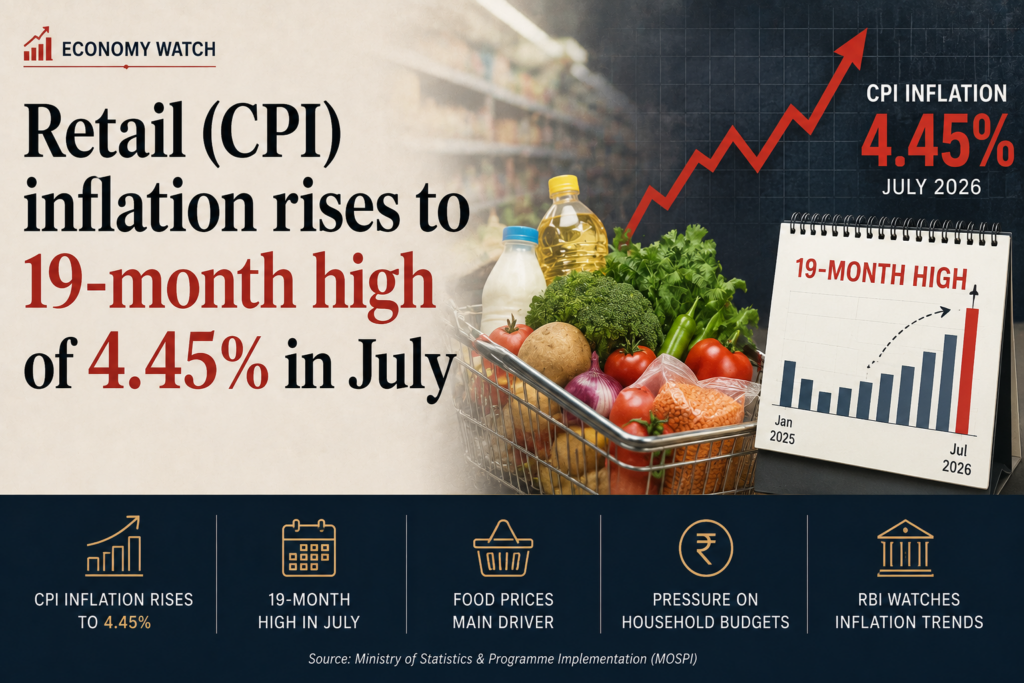
India’s CPI (Consumer Price Index) inflation rose to 4.45% in July, driven mainly by food and fuel prices, while remaining within the RBI’s tolerance band.
What is CPI?
CPI = Consumer Price Index
Measures changes in retail prices of a fixed basket of goods and services.
India’s CPI was rebased to 2024.
Sector-wise data under the new series is available from January 2026.
What Drove Inflation?
Food inflation: 5.52%.
Onion inflation: 22.54%.
Restaurants & accommodation: 7.7%.
Transport: 4.4%.
Personal care: 14.8%.
What Remained Stable?
Core inflation: 3.9%, excluding food and fuel.
Health inflation: 1.3%.
Recreation: 1.6%.
Stable core inflation suggests limited demand-pull pressure, with the current rise largely driven by supply-side factors.
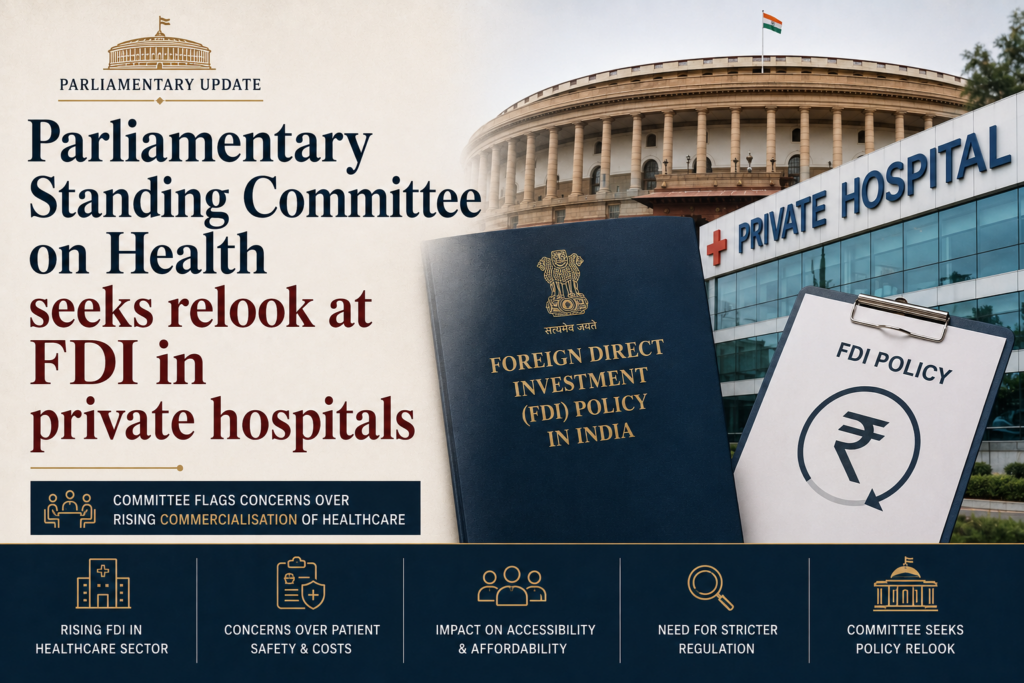
A Parliamentary Standing Committee has recommended a review and rationalisation of Foreign Direct Investment (FDI) limits governing the operation and acquisition of existing private hospitals, warning that aggressive corporatisation and an influx of foreign capital could push up healthcare costs. The recommendation exposes a tension between attracting capital to expand hospital capacity and protecting the affordability of medical care from a shift of healthcare from a public service into a purely capitalistic enterprise.
What is Foreign Direct Investment (FDI) in hospitals?
Definition: FDI is a non-debt-creating capital flow in which a foreign entity takes a lasting stake in an Indian enterprise, here in the ownership, operation or acquisition of hospitals.
Current position: Hospitals in India permit 100% FDI under the automatic route, which the Committee flags for the acquisition and operation of existing facilities.
Who examined the issue and in which report?
Committee: The Department-related Parliamentary Standing Committee on Health and Family Welfare.
Report: Its 176th report on the Affordability and Accessibility of Healthcare Facilities in the Public and Private Sector.
Why does the Committee want FDI limits reviewed?
Consolidation risk: Foreign capital is facilitating the acquisition of cost-effective, mid-sized hospitals by larger corporate entities.
Corporatisation: Such aggressive corporatisation is transforming healthcare from a public service into a purely capitalistic enterprise.
Cost inflation: This has the potential to inflate the cost of medical procedures and trigger price increases across the healthcare ecosystem.
Selective openness: Foreign capital should be encouraged in medical devices, consumables and specialised medicines for rare diseases, while its use in direct operation and acquisition of hospitals needs greater scrutiny.
What is the evidence of a public-private cost gap?
Cost divergence: Citing the 80th round of the National Sample Survey, the panel put the average cost of hospitalisation at Rs 50,508 in private hospitals against Rs 6,631 in government hospitals.
Regulator role: A strong public healthcare system could act as a market regulator by offering an affordable alternative and exerting competitive pressure on private providers.
Price standardisation: It called for mechanisms to standardise and cap the cost of essential treatments, diagnostics and routine procedures in private hospitals.
What structural measures did the Committee recommend?
Public multispeciality hospitals: Autonomous, efficiently managed public multispeciality hospitals in every revenue division to cut dependence on major cities for tertiary care.
Redirected capital: Incentives to steer foreign investment toward local manufacturing of medical technologies and pharmaceuticals.
Tier-2 and tier-3 push: Tax holidays and other incentives to attract private multispeciality hospitals in smaller cities and rural areas, with public-private partnerships for underserved regions.
Cross-subsidisation: Private hospitals receiving government support to use revenue from higher-paying patients to help poorer patients.
Reserved beds: Raising mandatory bed reservation for Below Poverty Line, Economically Weaker Section and AB-PMJAY beneficiaries from 10% to 20%.
Fee scrutiny: Hospital-level ethics committees to examine professional fees.
Why is aggressive corporatisation a two-sided problem?
The capital case: Foreign investment can expand hospital capacity, technology and specialised care that public systems struggle to fund.
The affordability case: Consolidation of mid-sized hospitals by large corporates can raise prices and weaken affordable options.
The unresolved gap: Without a strong public alternative and price caps, foreign capital risks entrenching a high-cost private tier.
Challenges to affordable healthcare in India
Out-of-pocket burden: A large share of health spending is paid directly by households, pushing many into distress.
Public-private divide: A wide cost gap between government and private care.
Regional maldistribution: Concentration of tertiary hospitals in metros and large cities.
Regulatory weakness: Limited standardisation and capping of procedure costs.
Human resource shortage: Deficits of doctors, nurses and specialists in rural areas.
Low public spending: Government health expenditure remains a small share of GDP.
Conclusion
The Committee has urged the government to review and rationalise FDI in the operation and acquisition of existing private hospitals while redirecting foreign capital toward medical manufacturing. The current status is a tabled recommendation; the next milestone is the government’s response on FDI norms, price standardisation and expanded public hospital capacity.
Healthcare Financing in India (Foundational Context)
About: Healthcare in India is delivered through a mix of public facilities, private hospitals and insurance-funded care.
Scale: Private hospitals dominate tertiary care, with hospitalisation costs several times higher than in government facilities.
Structural fact: High out-of-pocket expenditure remains a defining feature of Indian health financing.
Government Initiatives for Healthcare
Ayushman Bharat PM-JAY: Health cover of up to Rs 5 lakh per family per year for eligible beneficiaries.
Ayushman Arogya Mandirs: Primary health and wellness centres for screening and preventive care.
National Health Mission: Support for public health infrastructure and human resources.
Production Linked Incentive for pharma and medical devices: Boosts domestic manufacturing of medicines and equipment.
Challenges in Health Financing
High out-of-pocket spending, pushing households into poverty.
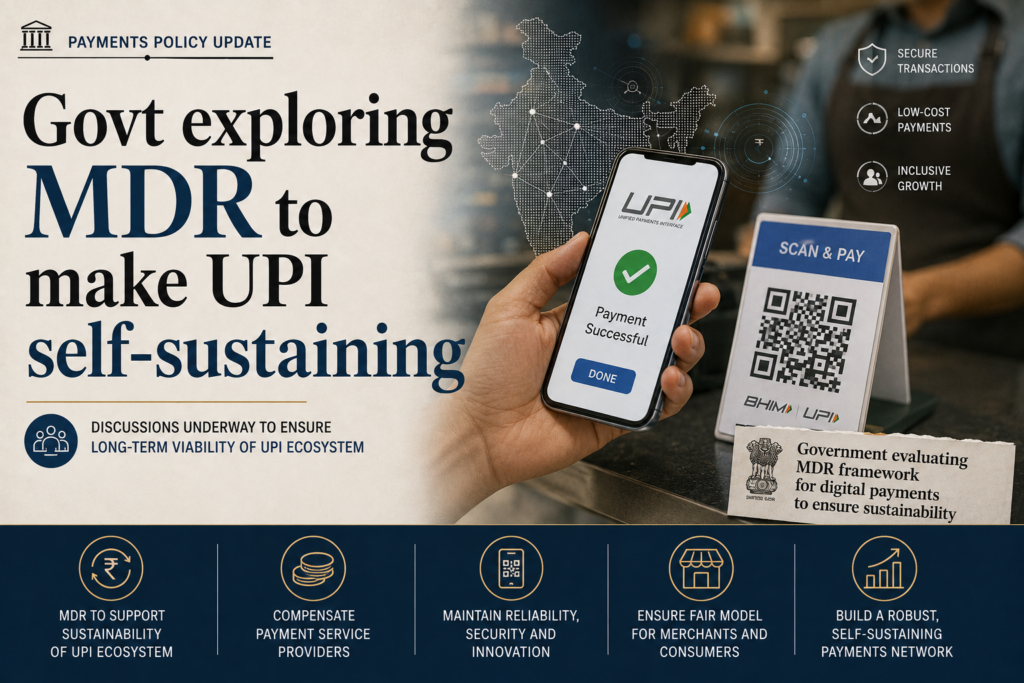
The government told Parliament that the current Unified Payments Interface (UPI) model is financially unsustainable, and that it is examining two routes to make the platform self-supporting without inflating the Budget. The trigger exposes a core tension: the zero-charge design that drove mass adoption now starves the ecosystem of the revenue needed for cybersecurity, fraud prevention and network upkeep.
What is Unified Payments Interface (UPI)?
Definition: UPI is a real-time payment system built by the National Payments Corporation of India (NPCI) and the Indian Banks’ Association that lets money move instantly between two bank accounts through a mobile app. It was launched as a pilot in April 2016 and became fully operational in August 2016.
Scale: More than 55 crore people use UPI and 703 entities, from banks to payment service providers, facilitate its transactions. Of the 28,174 crore digital transactions recorded in 2025-26, 86% ran on UPI.
What is the Merchant Discount Rate (MDR)?
Definition: MDR is the fee that banks, payment processors and gateways levy on a merchant for accepting a digital payment.
Current position:MDR is charged on most debit card and all credit card transactions. UPI and RuPay debit card transactions were exempted in 2020, making them zero-cost for merchants.
What Makes Up MDR?
Interchange fee: Money sent to the customer’s card-issuing bank.
Network fee: Charges paid to card networks like Visa or Mastercard.
Processor fee: Markup kept by the payment gateway or processor for handling the tech
Why is the current UPI model financially unsustainable?
Cost recovery gap: The subsidy scheme reimbursing processors is far short of actual cost. There is a mismatch between the roughly Rs 2,000 crore allocation and the industry’s estimated operational cost of about Rs 20,700 crore a year.
Coverage shortfall: The Standing Committee on Finance found the incentive covers merely 11% of the industry’s actual costs and 14% of potential MDR collections.
Investment risk: The gap threatens critical spending on cybersecurity, fraud prevention and network infrastructure as volumes scale toward a projected 150 billion transactions per month.
What options is the government exploring?
Selective MDR: Restoring MDR on certain high threshold transactions and high turnover merchants, leaving small merchant payments untouched.
Tiered incentives: A tiered incentive structure to phase out government support over the next few years.
Legal enabler: An amendment to the Payment and Settlement Systems Act, 2007 has already removed the bar on charging merchants a fee for receiving UPI payments.
Industry proposal: Payment firms seek an MDR of 0.3% to 0.6% on payments above Rs 2,000 to large merchants, about 4% of person to merchant transactions but 68% of value.
Conclusion
The government has confirmed that UPI cannot indefinitely run on subsidies and is examining selective MDR and a tapering incentive structure to make it self-sustaining. The next milestone is a framework that funds the ecosystem through charges on large merchants while shielding small merchants.
[UPSC 2026] Which one of the following statements about Unified Payments Interface (UPI) and Central Bank Digital Currency (Digital Rupee) is NOT correct?
(a) UPI is a real-time payment system but Digital Rupee is akin to sovereign paper currency
(b) In case of UPI, settlement for end users happens instantly; in case of Digital Rupee, wallet balance gets transferred to another wallet
(c) UPI transactions are recorded by banks and reflected in bank statements; in case of Digital Rupee, no data is captured in bank statements
(d) In both the cases, the liability lies with the users and their respective banks.
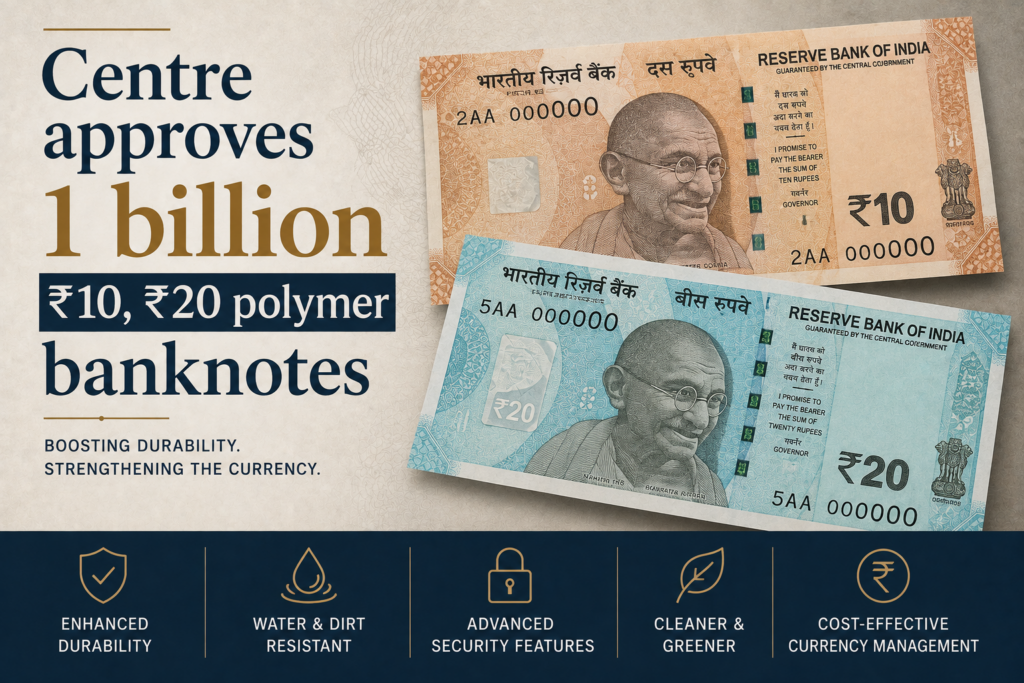
Government approved 1 billion polymer notes each of ₹10 and ₹20 for field trials, following an RBI proposal under Section 25 of the RBI Act, 1934.
What are Polymer Banknotes?
Made from a thin plastic film instead of cotton-paper.
More durable, moisture-resistant and hygienic.
Offer enhanced anti-counterfeiting features.
Have a longer circulation life, reducing replacement needs.
Government Approval
Denominations: ₹10 and ₹20.
Quantity: 1 billion each.
Will circulate alongside paper notes.
Regular issuance will depend on successful field trials.
Procurement is at an initial stage, so cost and timeline are not yet fixed.
Why Polymer Notes?
Longer life → lower replacement costs.
Higher security → difficult to counterfeit.
Better durability → resistant to dirt, water and wear.
Global precedent → used by several countries.
Currency Management: Key Facts
RBI: Sole issuer of banknotes, except ₹1 note.
Government of India: Issues coins and ₹1 note.
Section 22, RBI Act: RBI’s sole right to issue banknotes.
Section 24: Specifies permissible denominations.
Section 25: Design, form and material require Central Government approval on RBI recommendation.
Coinage Act, 2011: Governs coins and ₹1 note.
Back2Basics: RBI
Established under RBI Act, 1934; began operations in 1935.
Nationalised in 1949.
Functions as India’s central bank and monetary authority.
Manages currency, monetary policy, banking and payment systems.
[2025] Which of the following are the sources of income for the Reserve Bank of India? I. Buying and selling Government bonds II. Buying and selling foreign currency III. Pension fund management IV. Lending to private companies V. Printing and distributing currency notes Select the correct answer using the code given below.
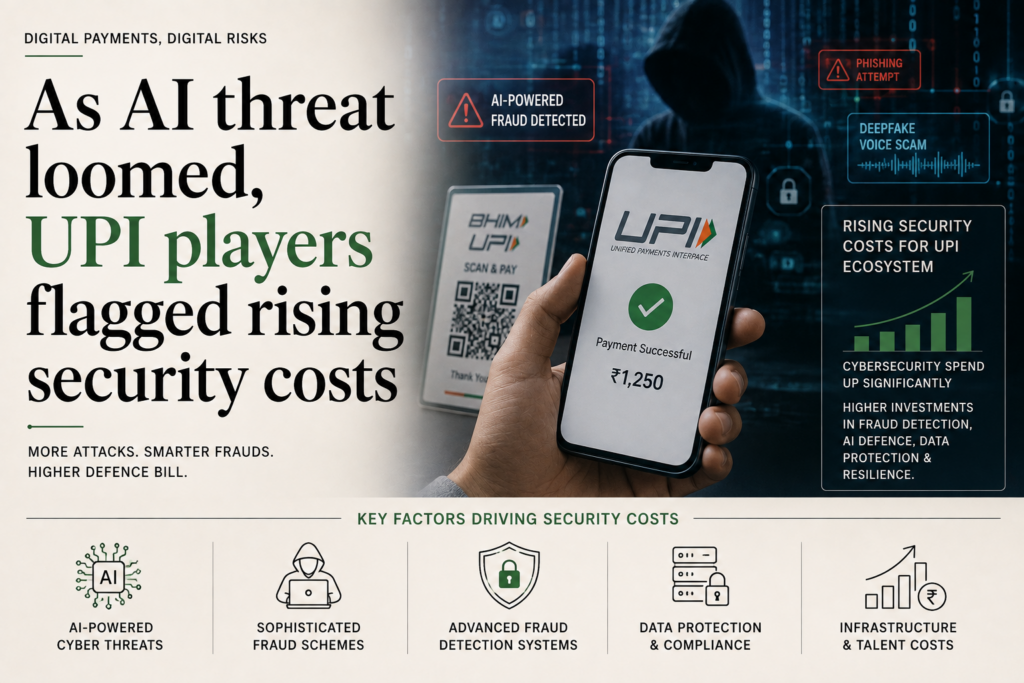
UPI platforms have flagged rising cybersecurity costs, especially from AI-enabled fraud, renewing demands to allow Merchant Discount Rate (MDR) on UPI.
What is MDR?
MDR: Fee paid by merchants to banks/payment providers for processing digital payments.
UPI: MDR is currently zero, so merchants pay no transaction fee.
Costs are borne by banks, payment apps and government reimbursements.
Why are Security Costs Rising?
AI-enabled fraud can make sophisticated cyberattacks cheaper and easier.
Security accounts for 20%+ of UPI platform costs.
Security infrastructure costs around 10 to 20 paise per transaction.
Dependence on imported AI/cloud tools adds dollar and currency risks.
UPI infrastructure is not costless and someone must bear its cost.
Reduces dependence on uncertain government subsidies.
Provides dedicated funding for cybersecurity and system resilience.
Concerns
Fees on small-value transactions could push users back to cash.
Higher costs may disproportionately affect price-sensitive consumers.
Poorly designed MDR could weaken UPI’s role as a public digital infrastructure.
Foreign AI security tools create strategic and currency dependence.
UPI: Back2Basics
UPI: Real-time interbank payment system developed by NPCI.
Enables instant P2P and P2M payments.
NPCI: Umbrella organisation for India’s retail payment systems, established in 2008.
Key systems: UPI, RuPay, IMPS, BBPS and FASTag.
Regulated by RBI under the Payment and Settlement Systems Act, 2007.
“[2026] Which one of the following statements about Unified Payments Interface (UPI) and Central Bank Digital Currency (Digital Rupee) is NOT correct?
(a) UPI is a real-time payment system but Digital Rupee is akin to sovereign paper currency
(b) In case of UPI, settlement for end users happens instantly; in case of Digital Rupee, wallet balance gets transferred to another wallet (no traditional settlement)
(c) UPI transactions are recorded by banks and reflected in bank statements; in case of Digital Rupee, no data is captured in bank statements
(d) In both the cases (UPI and Digital Rupee), the liability lies with the users and their respective banks
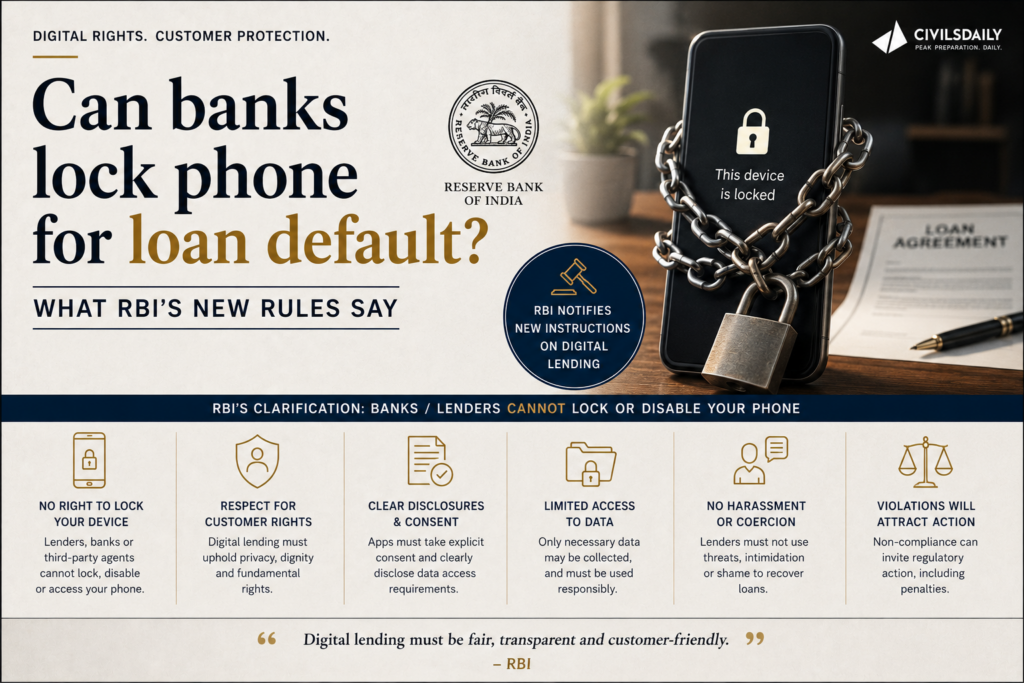
The Reserve Bank of India (RBI) has issued a comprehensive set of rules governing how commercial banks recover unpaid loans, coming into force on January 1, 2027. The framework introduces India’s first detailed regulation of technology-based restrictions on mobile phones financed through bank loans, balancing lenders’ recovery rights against borrower protection.
What is the RBI’s new loan-recovery framework?
Comprehensive recovery rules: The framework governs the conduct of banks and outsourced recovery agents in recovering unpaid loans, and applies to all commercial banks.
Board-governed process: It makes recovery a board-governed process rather than a purely operational function, requiring a documented recovery policy.
Effective date: It comes into force on January 1, 2027.
Can banks now lock a financed phone?
Only for device loans: Technology-based restrictions can be used only where the loan specifically financed that smartphone, tablet or laptop.
Disclosure required: The loan agreement must clearly disclose these restrictions in advance.
30-day threshold: No restriction can be activated until the account is 30 days past due, despite notices to the borrower.
Gradual escalation: Restrictions must be introduced gradually.
60-day limit for full lock: Complete restrictions can be imposed only after 60 days of non-payment, and outgoing calls cannot be blocked before that.
Work not disrupted: Restrictions must not interfere with activities necessary for the borrower’s work or employment.
Visibility: Borrowers must be able to view the status of restrictions on their device at any time.
Fast restoration: Once overdue amounts are paid, functionality must be restored within one hour.
Compensation: Where restoration is delayed by the bank, compensation of Rs 250 per hour is payable until access is restored, subject to a ceiling equal to the loan amount.
Data protection: Banks and third-party technology providers are barred from accessing personal data stored on borrowers’ devices.
How are recovery agents regulated?
Fixed contact hours: Agents can contact borrowers only between 8 am and 7 pm, unless the borrower requests otherwise.
Identification: They must identify themselves through identity cards and authorisation letters and carry copies of notices issued by the bank.
Certification: Only certified individuals can undertake recovery work.
Background checks: Banks must conduct background verification before appointing agents and periodically thereafter.
How are banks held accountable?
Call recording: Banks must record recovery-related calls, keep records for at least six months and inform borrowers that conversations are recorded.
No aggressive incentives: Recovery targets and incentive structures should not encourage aggressive behaviour.
Grievance redressal: Every bank must set up a dedicated grievance redressal mechanism for recovery complaints, detailed in loan documents and communications.
Direct responsibility: Banks are made directly responsible for the conduct of outsourced recovery personnel.
Why were fresh directions issued?
Retail lending boom: India’s retail lending market has expanded rapidly, driven by digital loans, unsecured personal credit and Buy Now Pay Later products.
Device financing: Growth in financing for smartphones and consumer electronics raised the practice of remotely disabling devices.
Rising complaints: Complaints about harassment by recovery agents and aggressive collection practices have grown.
Conclusion
The RBI has converted loan recovery from an operational function into a board-governed, rights-based process, and for the first time regulated the remote disabling of financed devices. The framework takes effect on January 1, 2027, and its impact will depend on how banks build recovery policies, certify agents and enforce the device-restriction safeguards. The next milestone is compliance readiness across all commercial banks before the effective date.
Back2Basics: Reserve Bank of India (RBI)
Type: Central bank and monetary authority of India.
Established: 1935, nationalised in 1949.
Governing Acts: RBI Act, 1934 and Banking Regulation Act, 1949.
Headquarters: Mumbai.
Core functions: Monetary policy, currency issue, banker to the government, banking regulation and supervision, and management of foreign exchange.
What are the RBI’s Functions?
About: The RBI is India’s central bank, established in 1935, responsible for monetary policy, currency issuance and financial system regulation.
Rationale: It exists to maintain price stability, ensure adequate credit flow and safeguard the stability of the banking and payments system.
Regulatory scope: It regulates commercial banks on liquidity of assets, branch expansion, mergers, winding-up and, increasingly, conduct towards customers.
Statutory Framework Governing Bank Regulation
Reserve Bank of India Act, 1934: Establishes the RBI and its monetary and regulatory powers.
Banking Regulation Act, 1949: Empowers the RBI to license, supervise and regulate banks, including branch expansion, mergers and winding-up.
Payment and Settlement Systems Act, 2007: Provides for RBI regulation of payment systems, including digital lending rails.
Consumer Protection Act, 2019: Reinforces borrower rights against unfair practices.
Government and RBI Initiatives for Borrower Protection
Fair Practices Code for Lenders: Sets standards for transparency and conduct in lending.
RBI Integrated Ombudsman Scheme: Provides a single redressal window for customer complaints against banks and lenders.
Digital Lending Guidelines, 2022: Regulate loan disbursal, data use and recovery by digital lenders.
RBI Retail Direct and Financial Literacy programmes: Improve borrower awareness and protection.
Key Facts about RBI Regulation of Banks
Effective date of new recovery rules: January 1, 2027.
Compensation cap: Rs 250 per hour for delayed restoration, ceiling equal to the loan amount.
Recovery contact window: 8 am to 7 pm.
Record retention: At least six months for recovery calls.
Challenges in Loan Recovery and Retail Lending
Agent harassment: Aggressive and coercive collection practices remain widespread.
Digital coercion: Remote disabling of financed devices can cut borrowers off from work and emergencies.
Data misuse: Access to personal data on devices raises privacy risks.
Over-leverage: Rapid unsecured and Buy Now Pay Later lending raises default risk.
Enforcement gaps: Outsourced agents are hard to monitor and hold accountable.
Grievance delays: Weak redressal leaves borrowers without timely remedy.
Way Forward
Enforce certification: Ensure only verified, certified agents undertake recovery.
Audit device restrictions: Independently audit compliance with the 30-day and 60-day safeguards.
Strengthen redressal: Make grievance mechanisms accessible and time-bound.
Protect data: Enforce the bar on accessing personal data with strict penalties.
Promote responsible lending: Tighten underwriting for unsecured and device-linked credit.
PYQ Relevance
[2013] The Reserve Bank of India regulates the commercial banks in matters of
(1) liquidity of assets
(2) branch expansion
(3) merger of banks
(4) winding-up of banks.
Select the correct answer using the codes given below:
Youth unemployment protests and the passage of the Micro, Small and Medium Enterprises Development (Amendment) Bill, 2026, have refocused attention on the Micro, Small and Medium Enterprises (MSME) sector as a job engine. The central argument is that industrial strength comes not from supporting isolated firms but from building clusters, dense ecosystems where suppliers, labour, research institutions and capital reinforce one another.
What is a cluster-based development model?
Definition: A cluster is a geographic concentration of firms in a related activity, together with their suppliers, workers, research institutions and finance, located close enough to reinforce one another.
Core idea: Proximity generates shared benefits that an isolated firm cannot capture on its own.
What is the “Little Giant” programme?
Chinese niche-firm scheme: The Little Giant programme is a Chinese policy that supports technically strong small firms operating in narrow specialised niches.
Support offered: It provides these firms with financing, tax support and research and development assistance.
How significant is the MSME sector in India?
Number of firms: India has 63 million MSMEs.
Employment: They employ more than 320 million people.
Output share: They contribute about 31% of Gross Domestic Product (GDP) and 35% of manufacturing output.
Exports: They account for 49% of exports.
Structural weakness: The sector remains largely informal, fragmented and concentrated in low-value activities.
What does the MSME Development (Amendment) Bill, 2026, address?
Delayed payments: It seeks to tackle the problem of delayed payments to smaller firms.
Dispute resolution: It aims to ease dispute resolution for MSMEs.
Compliance burden: It reduces some compliance burdens on the sector.
Limits: It does not by itself resolve the deeper problems of credit access and the burden of Goods and Services Tax (GST), labour, environmental and tax compliance.
Why do clusters work?
Knowledge spillovers: Technical know-how spreads quickly through worker mobility, informal interaction and shared service providers.
Talent pooling: A cluster creates a real labour market that attracts and retains specialised workers, which an isolated firm struggles to hire.
Lower fixed costs: Firms share infrastructure such as testing labs, effluent-treatment plants, cold storage and logistics hubs.
What do global cluster models demonstrate?
United States, Research Triangle: In North Carolina, universities such as Duke, the University of North Carolina at Chapel Hill and North Carolina State anchored biotechnology and pharmaceutical ecosystems by connecting research with industry.
China, Guangdong: Industrial zones with land, tax incentives and infrastructure created thick supplier networks, letting firms design, fabricate and prototype quickly.
China, Little Giant programme: Dedicated support to technically strong small firms in narrow niches through financing, tax support and research assistance.
Why have India’s existing cluster schemes underperformed?
Infrastructure grants, not ecosystems: India already runs the MSME Cluster Development Programme and PM MITRA textile parks, but many function more like infrastructure grants than true ecosystem builders.
Firm-level lending: Banks still assess firms individually despite a large MSME credit gap, ignoring cluster-level ties.
Disconnected universities: Top Indian universities often remain disconnected from nearby industry, unlike US and Chinese models.
What policies can make clusters engines of jobs?
Specialised hubs: Move from generic industrial estates to sector-specific clusters, such as auto components in Pune and electronics in Sriperumbudur.
An Indian Little Giant scheme: Identify hidden champions in fields like precision castings and defence components, and give them dedicated credit lines, faster patent processing, research support and priority procurement.
Cluster-level financing: Assess shared collateral, buyer-supplier ties and collective performance, expanding the Tiruppur textile model through the Small Industries Development Bank of India (SIDBI) and cluster-focused non-banking financial companies.
University-industry links: Place universities at the centre of the ecosystem as suppliers of talent, lab infrastructure and innovation.
Conclusion:
MSMEs can become engines of jobs, productivity and exports only if policy shifts from isolated firm support to ecosystem building. The Amendment Bill helps with payments, disputes and compliance, but the binding constraints of fragmented finance and weak knowledge networks are addressed only at the cluster level. Strong specialised clusters, cluster-based finance and closer university-industry ties are the missing preconditions.
Back2Basics:
About MSMEs in India
Definition: MSMEs are enterprises classified by investment in plant and machinery or equipment and by annual turnover.
Classification: Micro (investment up to Rs 1 crore, turnover up to Rs 5 crore), Small (up to Rs 10 crore and Rs 50 crore), Medium (up to Rs 50 crore and Rs 250 crore).
Economic role: MSMEs are the second-largest employer after agriculture and a backbone of manufacturing and exports.
Registration: Firms register on the Udyam portal for formal recognition and scheme access.
Statutory Framework Governing MSMEs
Micro, Small and Medium Enterprises Development Act, 2006: Provides the legal definition and framework for MSMEs and for tackling delayed payments.
MSME Development (Amendment) Bill, 2026: Strengthens provisions on delayed payments, dispute resolution and compliance.
Governing Act: Micro, Small and Medium Enterprises Development Act, 2006.
Ministry: Ministry of Micro, Small and Medium Enterprises.
Development bank: SIDBI is the principal financial institution for the sector.
Registration portal: Udyam Registration.
Composite criteria: Classification uses both investment and turnover.
Government Initiatives for MSMEs
MSME Cluster Development Programme: Supports common facilities and infrastructure for firm clusters.
PM MITRA Parks: Integrated textile parks to build scale and supplier networks.
Credit Guarantee Fund Trust for Micro and Small Enterprises (CGTMSE): Provides collateral-free credit guarantees.
PM Vishwakarma: Supports traditional artisans and craftspeople.
Prime Minister’s Employment Generation Programme (PMEGP): Credit-linked subsidy for micro-enterprise creation.
Key Facts about the MSME Sector
Firm count: 63 million MSMEs.
Employment: More than 320 million people.
GDP share: About 31%.
Export share: 49%.
Manufacturing output share: 35%.
Challenges in the MSME Sector
Credit gap: Limited access to affordable formal credit, worsened by firm-level rather than cluster-level assessment.
Compliance burden: GST, labour, environmental and tax compliance weigh heavily on small firms.
Informality: Most MSMEs remain outside the formal system, limiting scale and finance.
Low value addition: Concentration in low-value activities caps productivity and wages.
Delayed payments: Late payments from buyers strain working capital.
Weak technology and skills: Limited access to research, testing and specialised labour.
Way Forward
Build specialised clusters: Concentrate resources in sector-specific hubs rather than generic estates.
Cluster-based lending: Reform credit appraisal to use collective performance and supplier ties.
Identify hidden champions: Support niche high-performers with dedicated finance and procurement.
Integrate universities: Anchor clusters with research institutions for talent and innovation.
Ease compliance: Simplify and consolidate regulatory requirements for small firms.
PYQ Relevance
[UPSC 2023] Faster economic growth requires increased share of the manufacturing sector in GDP, particularly of MSMEs. Comment on the present policies of the Government in this regard.
Linkage: Examines how MSMEs can drive manufacturing-led economic growth. The article highlights the shift from firm-level support to cluster-based MSME development. It shows how finance, infrastructure, skills and industry-university linkages can raise MSME productivity and jobs
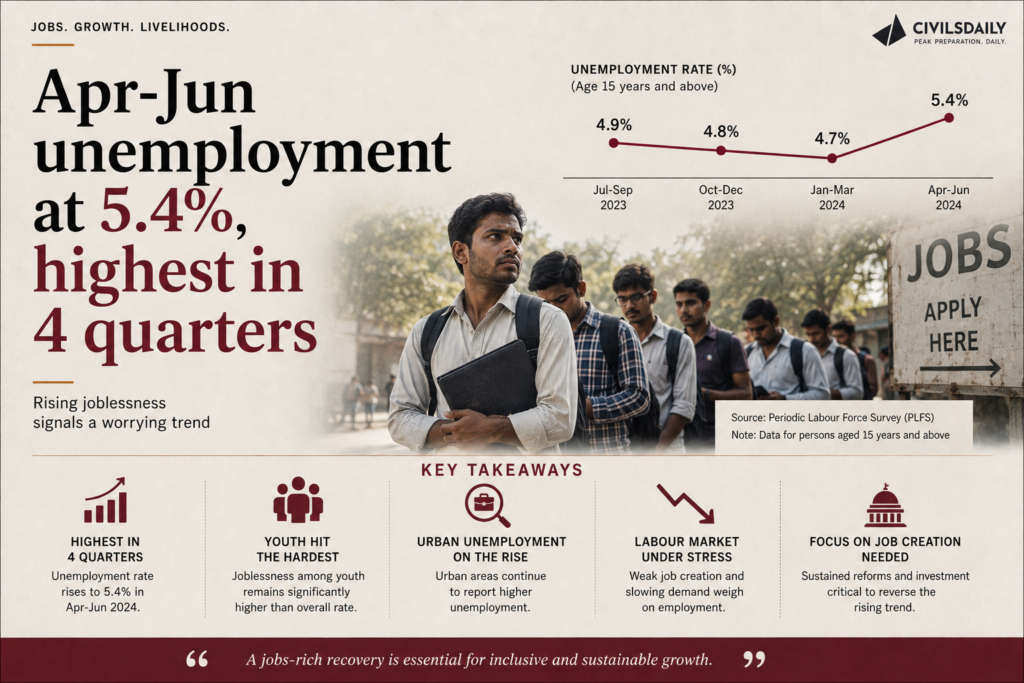
The unemployment rate for persons aged 15 years and above rose to 5.4% in April-June 2026, a four-quarter high, according to the Periodic Labour Force Survey (PLFS). Youth and urban women experienced the sharpest increase.
What is PLFS?
PLFS: Periodic Labour Force Survey.
Conducted by the National Statistical Office (NSO) under the Ministry of Statistics and Programme Implementation (MoSPI).
Launched in 2017.
Replaced the earlier quinquennial Employment-Unemployment Surveys.
Provides regular employment and unemployment estimates.
What did April-June 2026 PLFS Show?
Overall: 5.4% from 5.0% in the previous quarter.
Rural: 4.8% from 4.3%.
Urban: 6.7% from 6.6%.
Female: 5.7% from 5.3%.
Male: 5.3% from 4.8%.
Employed population: About 566 million, including 402 million males and 164 million females.
Where is Joblessness Concentrated?
Youth (15-29 years): 15.9%, the highest in the current PLFS series.
Female youth: 19.6%, a series high.
Urban females: 8.7% compared with 6.1% for urban males.
Rural females: 4.7%, close to rural males at 4.8%.
Key takeaway: The headline unemployment rate masks much higher youth and urban female unemployment, pointing to problems of job quality, skills and labour-market absorption.
About Unemployment
Unemployment refers to people in the labour force who are willing and able to work but do not have work.
Key Labour Indicators
Labour Force Participation Rate (LFPR): Labour force as a percentage of the working-age population.
Worker Population Ratio (WPR): Employed persons as a percentage of the population.
Unemployment Rate (UR): Unemployed persons as a percentage of the labour force.
Types of Unemployment
Structural: Skill or location mismatch with available jobs.
Frictional: Temporary unemployment while changing jobs.
Cyclical: Caused by economic downturns.
Disguised: More workers employed than required, common in agriculture.
Seasonal: Employment varies with seasons, especially agriculture.
Back2Basics: PLFS
Full form: Periodic Labour Force Survey.
Conducted by: National Statistical Office (NSO).
Ministry: Ministry of Statistics and Programme Implementation (MoSPI).
Launched: 2017.
Coverage: Rural and urban India.
Key measures:Usual Status and Current Weekly Status (CWS).
Youth: Persons aged 15-29 years.
Government Initiatives
MGNREGA: Mahatma Gandhi National Rural Employment Guarantee Act, providing up to 100 days of rural wage employment.
“[2023, GS3, 15 marks] Most of the unemployment in India is structural in nature. Examine the methodology adopted to compute unemployment in the country and suggest improvements.”
[2018] With reference to Pradhan Mantri Kaushal Vikas Yojana, consider the following statements :
1. It is the flagship scheme of the Ministry of Labour and Employment. 2. It, among other things, will also impart training in soft skills, entrepreneurship, financial and digital literacy. 3. It aims to align the competencies of the unregulated workforce of the country to the National Skill Qualification Framework. Which of the statements given above is/are correct?
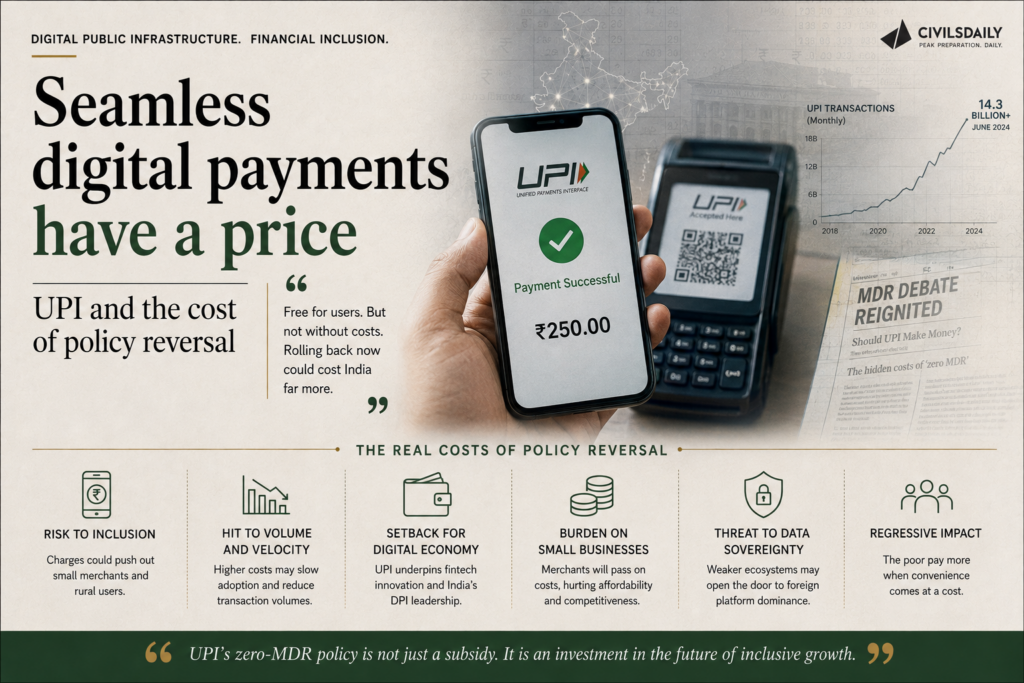
Parliament has passed the Taxation and Other Laws (Amendment) Bill, 2026, allowing a legal framework for possible charges on Unified Payments Interface (UPI) and RuPay debit card transactions. The debate centres on whether digital payments should remain free to promote inclusion or adopt a sustainable funding model.
What is UPI?
UPI: Unified Payments Interface.
Enables instant bank-to-bank payments through mobile applications.
Operated by the National Payments Corporation of India (NPCI).
Processed 23.6 billion transactions in July.
What is Merchant Discount Rate (MDR)?
MDR: Merchant Discount Rate.
A fee charged for processing digital payments, generally paid by merchants.
Credit-card MDR: around 1-3%.
Debit-card MDR: up to 0.9%.
UPI has followed a zero-MDR regime since 2020.
What Does the 2026 Bill Do?
Amends Section 10A of the Payment and Settlement Systems Act, 2007.
Creates legal space for the government to notify charges on specified electronic payment modes.
A proposed MDR of 0.25-0.5% has been discussed for UPI transactions above ₹2,000.
This could cover about 5% of transactions by volume but around 65% by value.
The government has stated that consumers and small merchants will not bear MDR and the final framework is yet to be decided.
Fraud prevention: Cybersecurity and fraud-control systems require funding.
Government support: ₹8,730 crore was provided through incentives during 2021-22 to 2024-25.
Funding gap: This covered only a limited share of industry costs.
Market concentration:PhonePe and Google Pay together account for around 80% of UPI transactions.
What is a Two-Sided Market?
A platform connecting two groups whose participation reinforces each other.
UPI: Consumers ↔ Payment platforms ↔ Merchants
More users attract more merchants, while more merchants attract more users. Therefore, imposing a charge on one side may reduce the network effect.
Why Could MDR Affect UPI?
Arguments for charges
Provides sustainable revenue for infrastructure.
Supports innovation and fraud prevention.
May attract more competitors into the UPI ecosystem.
Arguments against charges
Could discourage merchants and consumers from using digital payments.
Intermediaries may absorb the cost rather than pass it on.
Could weaken India’s financial inclusion and formalisation gains.
May encourage a shift back towards cash.
About India’s Digital Payments Ecosystem
RBI: Reserve Bank of India, the regulator.
NPCI: National Payments Corporation of India, operator of major retail payment rails.
Banks and fintechs: Participate as payment service providers.
UPI: Real-time account-to-account payment system.
RuPay: India’s domestic card payment network.
Statutory Framework
Payment and Settlement Systems Act, 2007: Regulates payment systems under RBI supervision.
Section 10A: Provides the framework for charges on specified electronic payment modes.
RBI Act, 1934: Establishes the Reserve Bank of India.
Information Technology Act, 2000: Provides legal recognition to electronic records and authentication.
Back2Basics: NPCI
Full form: National Payments Corporation of India.
Established: 2008.
Nature: Not-for-profit company.
Promoted by: Banks under the guidance of RBI and Indian Banks’ Association (IBA).
Key systems: UPI, RuPay, Immediate Payment Service (IMPS), FASTag and Bharat Bill Payment System (BBPS).
Government Initiatives
UPI Incentive Scheme: Supports the cost of low-value UPI transactions.
Digital India Programme: Expands digital infrastructure and inclusion.
BHIM: Bharat Interface for Money, NPCI’s UPI application.
RuPay: Domestic card network.
JAM: Jan Dhan-Aadhaar-Mobile trinity supporting digital transfers and financial inclusion.
“[2026] Which one of the following statements about Unified Payments Interface (UPI) and Central Bank Digital Currency (Digital Rupee) is NOT correct?
(a) UPI is a real-time payment system but Digital Rupee is akin to sovereign paper currency
(b) In case of UPI, settlement for end users happens instantly; in case of Digital Rupee, wallet balance gets transferred to another wallet (no traditional settlement)
(c) UPI transactions are recorded by banks and reflected in bank statements; in case of Digital Rupee, no data is captured in bank statements
(d) In both the cases (UPI and Digital Rupee), the liability lies with the users and their respective banks
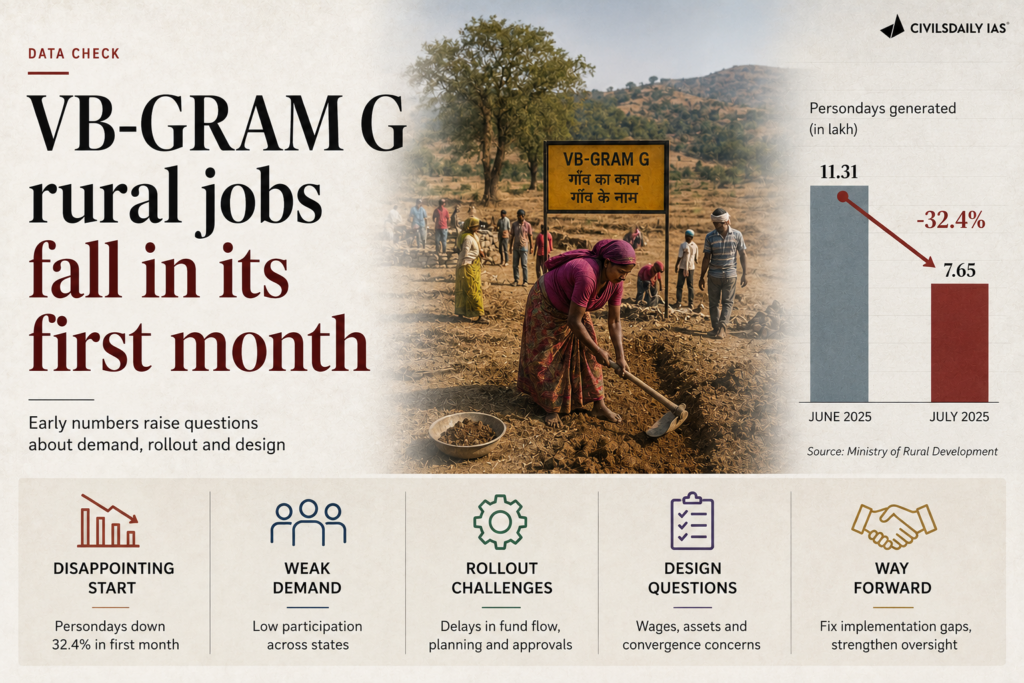
After replacing MGNREGS on 1 July 2026, the Viksit Bharat Guarantee for Rozgar and Ajeevika Mission (Gramin) [VB-GRAM G] recorded nearly a 50% year-on-year decline in rural employment generated during its first month.
What is VB-GRAM G?
New framework: Replaced MGNREGS from 1 July 2026.
Employment guarantee: Increased from 100 to 125 days per rural household.
Digital monitoring: Retains face-authentication-based attendance.
Why did employment fall?
Transition friction: Migration of registrations, job cards and payment systems disrupted work allocation.
Sowing season: Provision for pausing employment demand during peak agricultural operations reduced July person-days.
Comparability issue: Comparing July 2026 with July 2025 may exaggerate the decline because the institutional framework has changed.
Implementation lag: Initial administrative bottlenecks may have temporarily reduced employment generation.
MGNREGS: Back to Basics
Ministry: Ministry of Rural Development.
Legal basis:MGNREGA, 2005.
Guarantee: At least 100 days of wage employment per rural household.